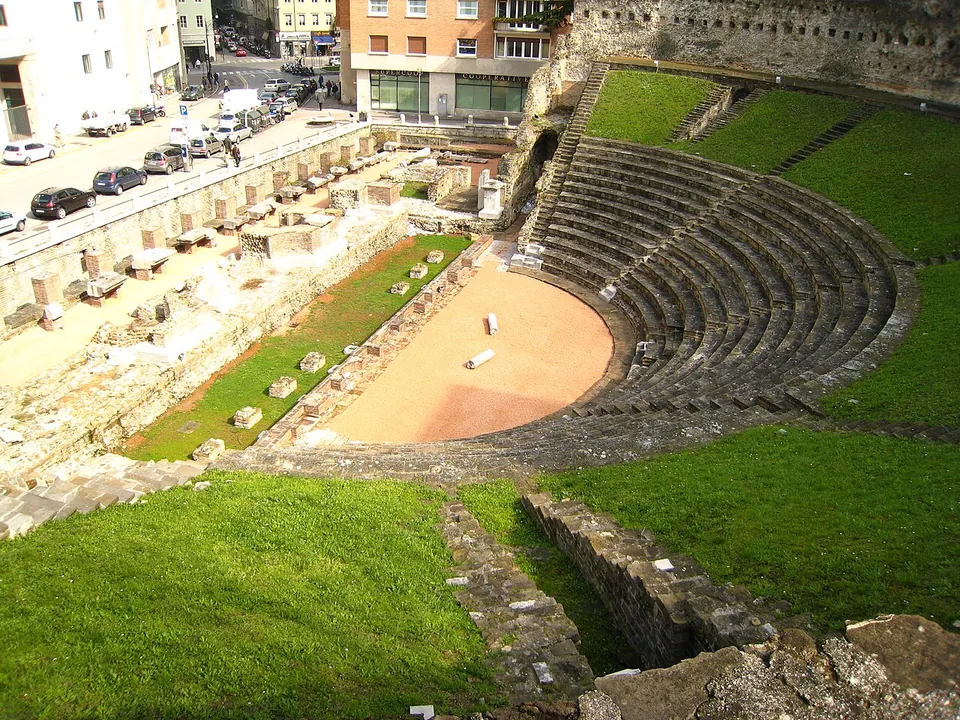
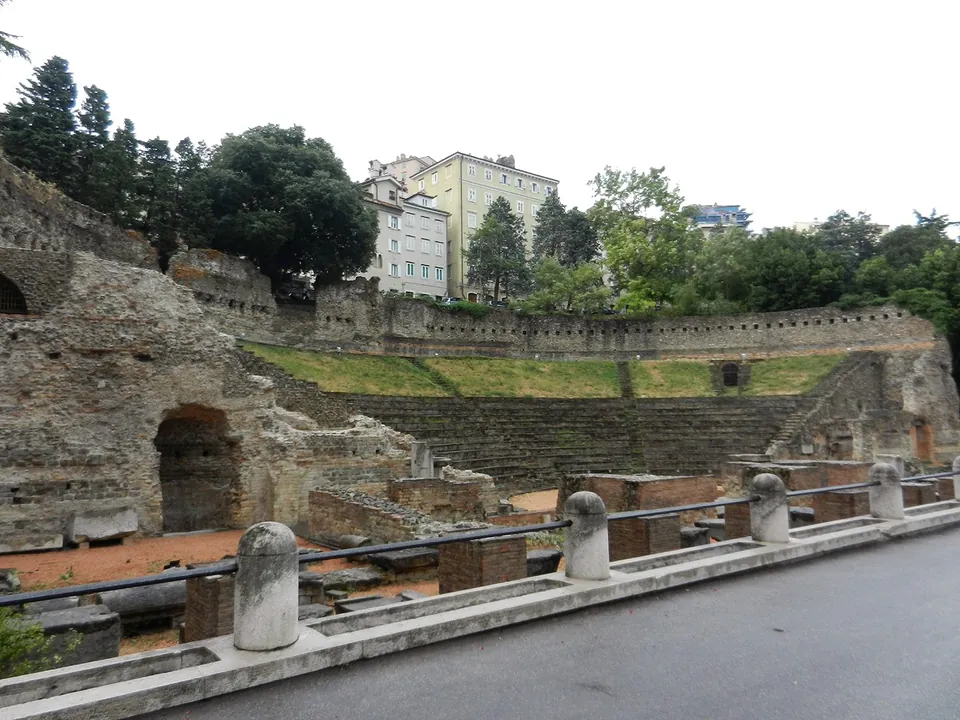
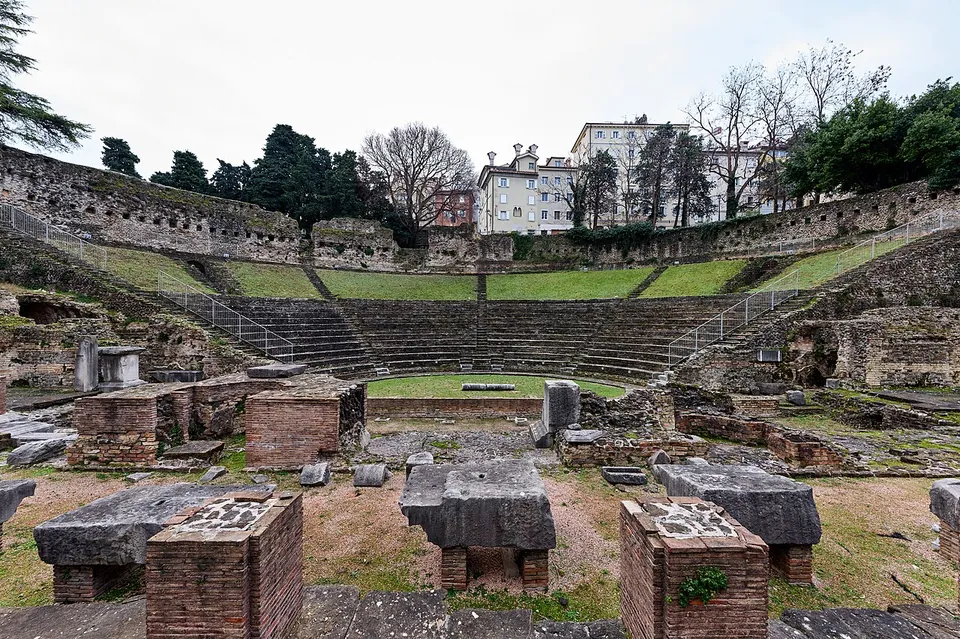


This is the theatre of Roman Tergeste, set into the foot of San Giusto hill in the middle of today’s Trieste. Its seating, the tall wall that closed it at the top and the lower parts of the stage all lie open below street level, and at present the street is where you see them from.
What is there today
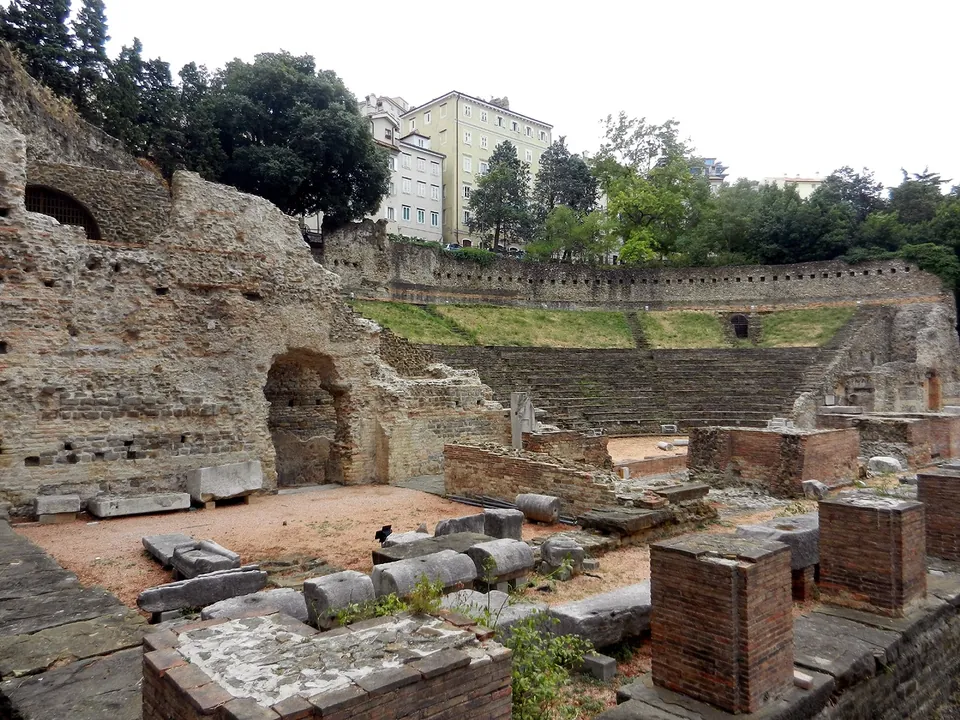
The seating (cavea) rests on the slope of the hill above a semicircular orchestra, with part of the stage building in front of it; the theatre was restored and partly rebuilt after it was excavated (the Soprintendenza). Twelve rows of seats survive in the lower tier of the cavea; the eight or nine rows above them have left no trace and may have been of wood. The wall that encloses the seating at the back still stands 15 m high, with brackets on its outer face for the masts of an awning (velum) and a large niche at its centre (fr.wikipedia).
Of the stage little stands. Only fragments are left of the back wall of the stage and the portico behind it (de.wikipedia); what remains is mainly the lower part of the stage, which had a wooden floor, and a few of its structures (Comune di Trieste). Casts of two twin inscriptions naming a man who contributed to the theatre’s restoration are kept on site (the Soprintendenza); the statues found here are in the Lapidario Tergestino at the Castle of San Giusto (it.wikipedia; Comune di Trieste).
It is a modest building: the cavea is 64.4 m across and the orchestra 20.3 m (fr.wikipedia). Published capacity estimates range from about 2,250 to 6,000 spectators. The archaeologists’ figures cited by fr.wikipedia lie between 2,250 and 3,500, and the city’s own itinerary gives 3,500; the 6,000 comes from tourist guides (fr.wikipedia).
Is it worth the trip?
If you are in Trieste, yes. It is central, free and laid out so plainly that the shape of a Roman theatre reads at a glance from the pavement. It is not a reason to travel to Trieste on its own, and for now it is a monument you look into rather than walk round: the interior is closed for excavation and refurbishment works, and the Soprintendenza gives no reopening date. Pair it with the Arco di Riccardo and the forum on San Giusto hill, each a few hundred metres away (OpenStreetMap), on the Tergeste – Trieste page.
Getting there
The theatre lies on via del Teatro Romano at the foot of San Giusto hill, on the edge of the old town (it.wikipedia). Buses 5, 9, 10, 11, 17, 18, 24, 25 and 30 serve it (Comune di Trieste); the nearest stops OpenStreetMap maps are on Corso Italia, about 120 m away. The Park San Giusto car park is about 150 m away (OpenStreetMap).
There is nothing to pay: the remains are seen from the street outside. Guided visits and school activities inside have been suspended until further notice for the works (the Soprintendenza, read 20 October 2026); enquiries go to the Soprintendenza on +39 040 4527511.
Visiting details
- Opening hours
- Visible from outside; the operator lists no opening hours. The interior of the archaeological area is closed for excavation and refurbishment works, and guided visits and school activities inside are suspended until further notice.
- Tickets
- Nothing to pay to see it from the street; the Soprintendenza publishes no ticket for the theatre.
- Parking
- The Park San Giusto car park is about 150 m away (OpenStreetMap relation/5572051); the surface car park 56 m from the theatre is private.
Before you go
- The theatre can only be seen from outside, over its perimeter, while works continue. The Soprintendenza takes enquiries on +39 040 4527511.
Hours and prices checked 20 October 2026 on the operator's own site. Confirm before travelling.
History
When it was built the theatre stood at the northern edge of the town, against the first slopes of the hill and almost on the shore of the gulf: only the coast road from Aquileia lay between it and the sea. Land reclaimed over the centuries has since put the sea several hundred metres away, and via del Teatro Romano, which runs past the front of the stage, roughly follows the line of that ancient road (fr.wikipedia).
Published dates for its building differ. The Soprintendenza puts its first phase in the age of Augustus, and fr.wikipedia, comparing its architecture with the well-dated theatres of Mérida and Verona, in the last third of the 1st century BC; the city’s itinerary dates the original building to the middle of the 1st century AD. Early in the 2nd century Quintus Petronius Modestus, a procurator under Trajan, contributed to its restoration (the Soprintendenza). Three or four inscriptions found in the cavea name him, and they record work on the theatre without saying what it was (fr.wikipedia). Some accounts make him the theatre’s founder (de.wikipedia); fr.wikipedia calls that idea anachronistic and long abandoned. Most of the statues found here seem to date from his time: figures of Athena, Aphrodite, Apollo, Hygieia, Asclepius and Dionysus decorated the stage, and a head of the emperor Titus was recut from one of Nero (fr.wikipedia).
At the end of antiquity the theatre was abandoned, used as a quarry and stripped of its most valuable stone, and houses were built against and on top of its walls (fr.wikipedia). The architect Pietro Nobile identified it in 1814, guided by the old name of the spot, “Rena vecia”, the old arena (Comune di Trieste). It was uncovered between July 1937 and September 1938, when part of the old town was demolished under Mussolini’s policy of showcasing the national heritage, the Roman above all (fr.wikipedia); medieval parts of the town were destroyed in the process (de.wikipedia). In 1964 a performance of Sophocles’ Electra returned it to its first use, and it has hosted summer performances since (fr.wikipedia).
More photographs

Nearby
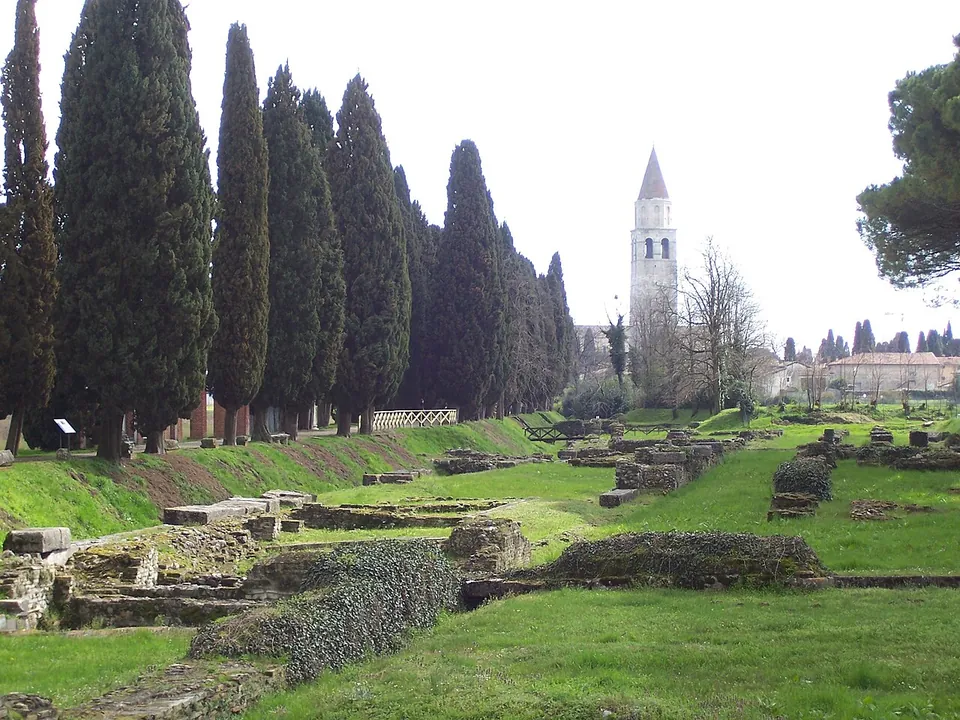
Photo: Zavijavah · CC BY-SA 3.0 · Commons
34 km · city · Friuli-Venezia Giulia
Aquileia
What you see of Roman Aquileia are the areas that have been excavated and left open: a forum with re-erected columns, the quays of a river port, quarters of houses reduced to their walls and floors, and large mosaic floors, several of them under modern covers.
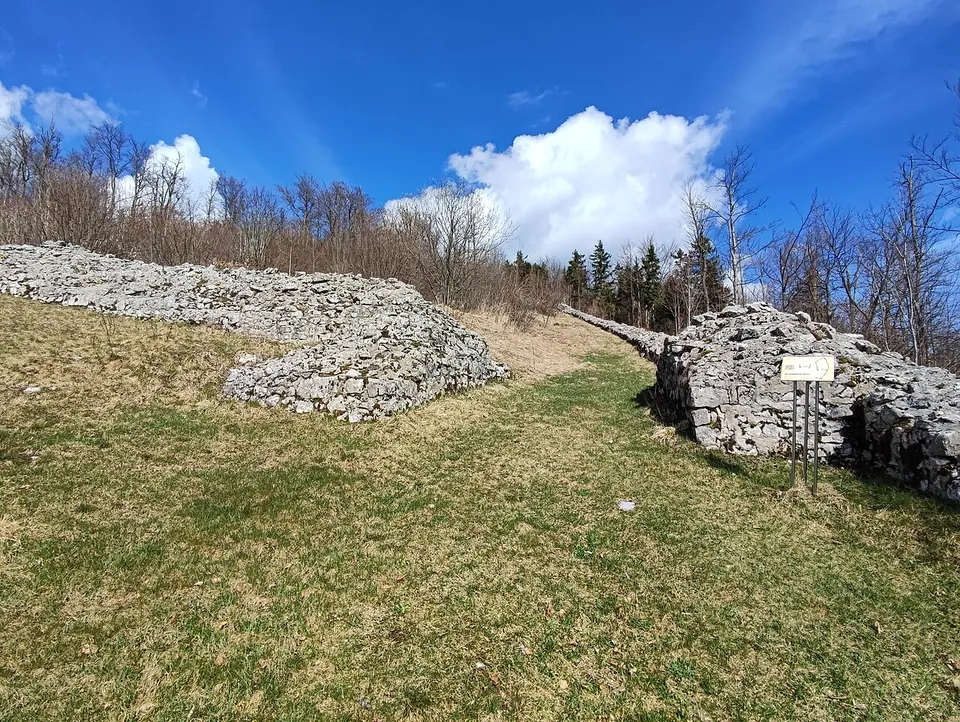
Photo: Ajznponar · CC0 · Commons
36 km · fort · Ajdovščina
Ad Pirum
The fort follows the ground in an irregular oval, 250 m long and up to 75 m wide.
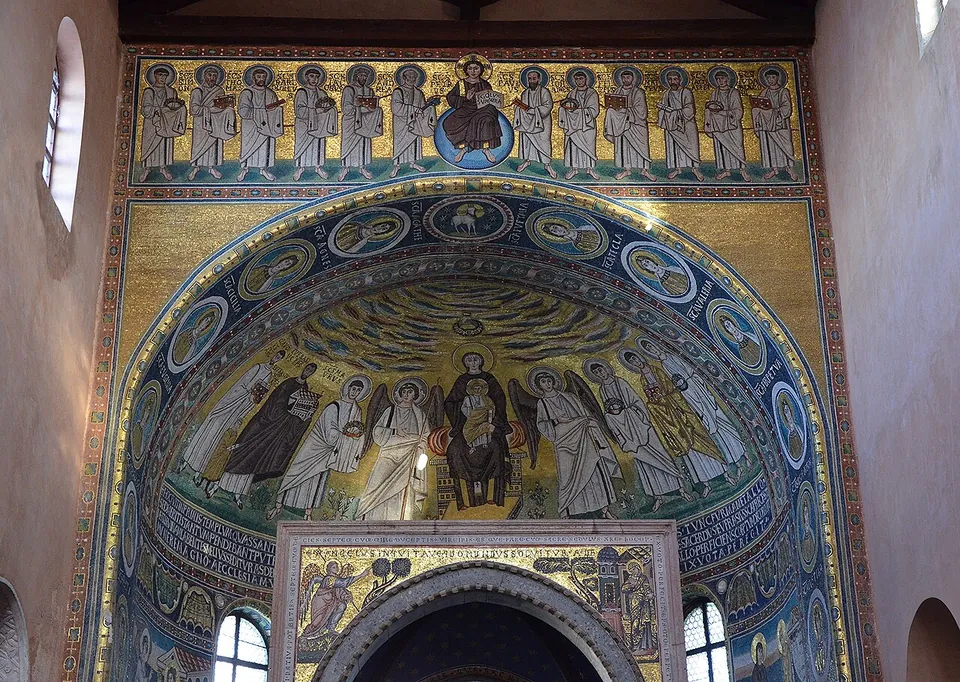
Photo: Carole Raddato · CC BY-SA 2.0 · Commons
49 km · church · Istria County
Euphrasian Basilica
The whole episcopal complex survives: the basilica itself, an atrium surrounded by porticoes with a collection of carved stones, an octagonal baptistery, the bishop's palace and a later bell tower (en.wikipedia).


Straight-line distances.
Sources
Every fact on this page comes from the records below, each used under the licence noted.
| Source | Licence |
|---|---|
| Pleiades 683009535 | CC BY |
| Wikidata Q752696 | CC0 |
| OpenStreetMap way/74495081 | ODbL |
| Wikipedia (it) — Teatro romano di Trieste | CC BY-SA 4.0 |
| Wikipedia (fr) — Théâtre romain de Trieste | CC BY-SA 4.0 |
| Wikipedia (de) — Teatro Romano di Trieste | CC BY-SA 4.0 |
| Soprintendenza Archeologia, Belle Arti e Paesaggio del Friuli Venezia Giulia — archaeological areas (the operator) | licence not recorded |
| Ministero della Cultura — Teatro Romano di Trieste | licence not recorded |
| Ministero della Cultura — "Il Teatro romano di Trieste. Percorsi di ricerca, restauro e valorizzazione" (Soprintendenza presentation, 30 October 2025) | licence not recorded |
| Comune di Trieste — Archaeological itinerary | licence not recorded |