What is there today
Four of these remains are stops of their own: the theatre, the forum basilica on San Giusto hill, the
Arco di Riccardo and the Antiquarium of via di Donota, the last of them closed at present.
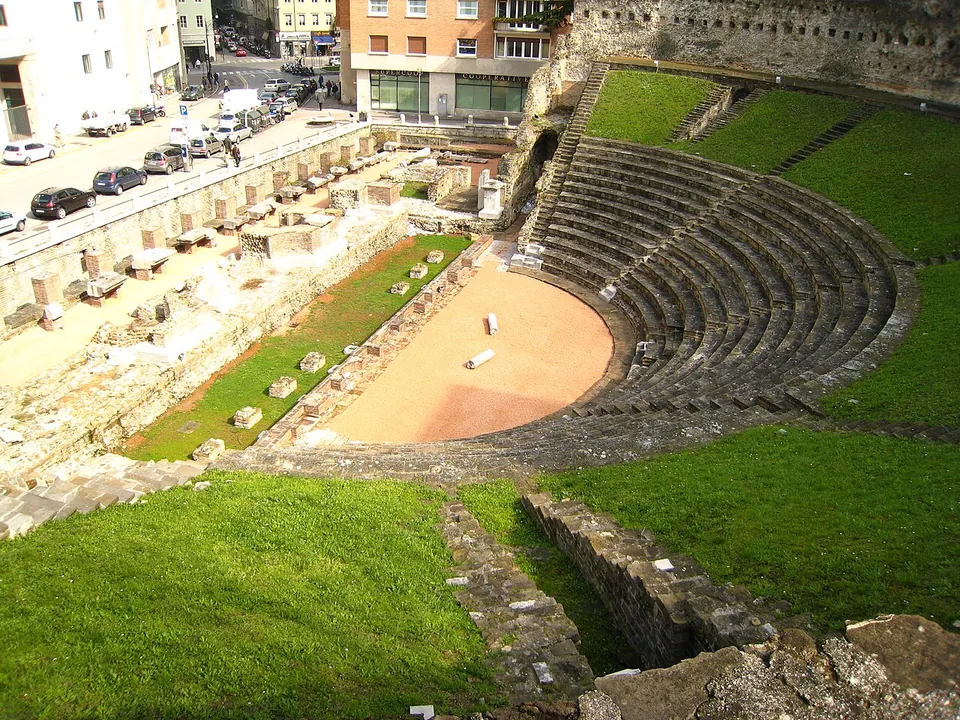
The theatre is the centrepiece. It sits at the foot of the hill on via del Teatro Romano,
built into the slope so that its lower rows of seats rest on the hillside; the outer wall of
the seating still stands to about 15 m (fr.wikipedia). Of the stage wall only fragments
survive (de.wikipedia). The theatre was restored and partly rebuilt after excavation, and
casts of two inscriptions naming a benefactor of its restoration are kept on site (the
Soprintendenza). Published estimates of its capacity range from about 2,250 to 6,000; the
city’s own itinerary gives 3,500.
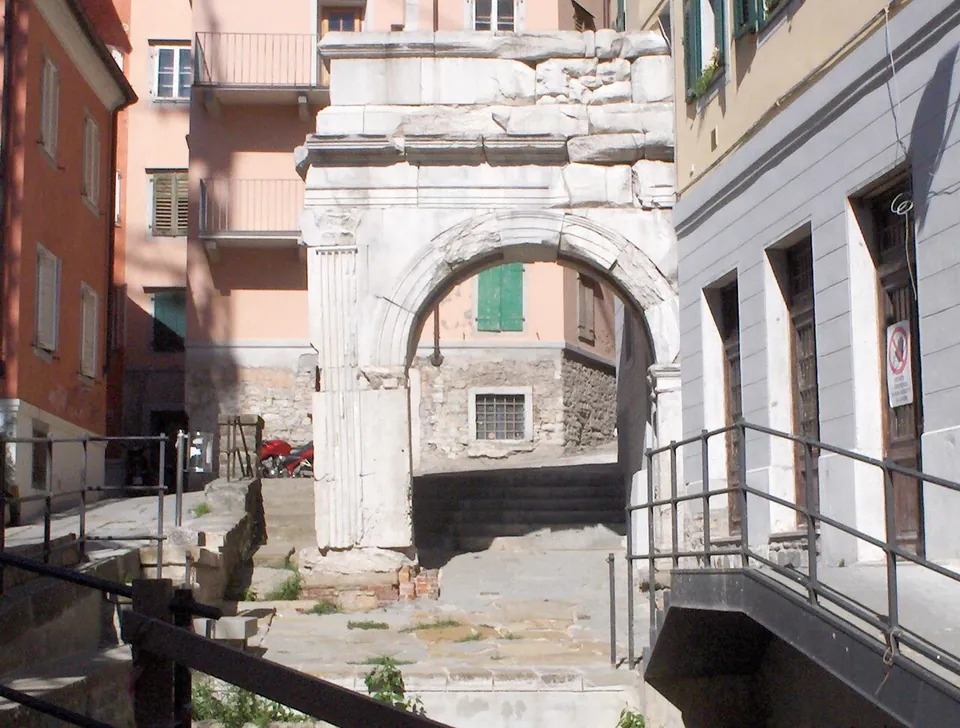
The Arco di Riccardo stands in piazza Barbacan: a single arch 7.2 m high, one
of its two decorated pilasters still visible, the other built into a neighbouring house
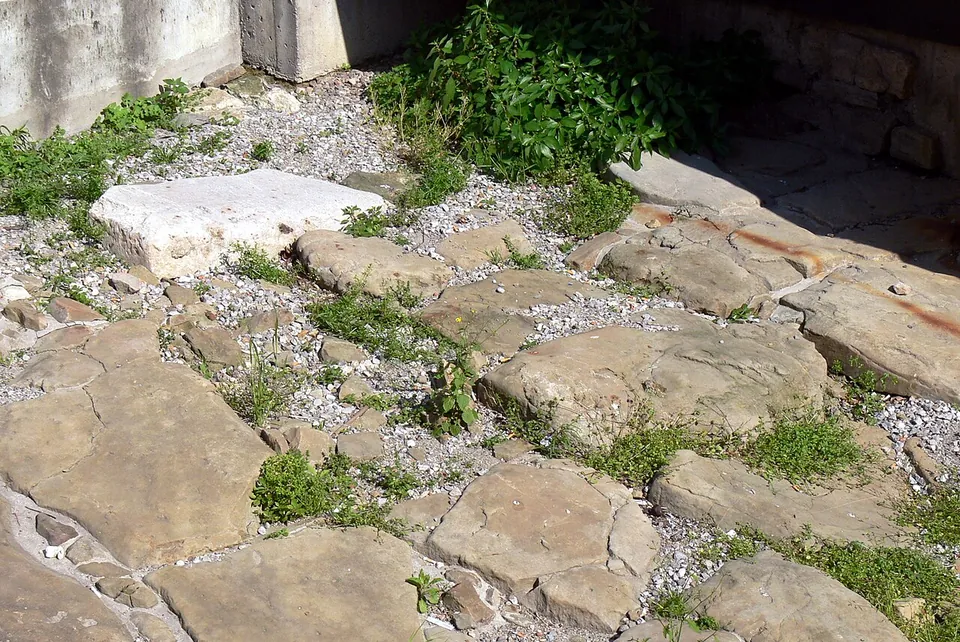
(it.wikipedia; en.wikipedia), with a stretch of Roman road paving beside it.
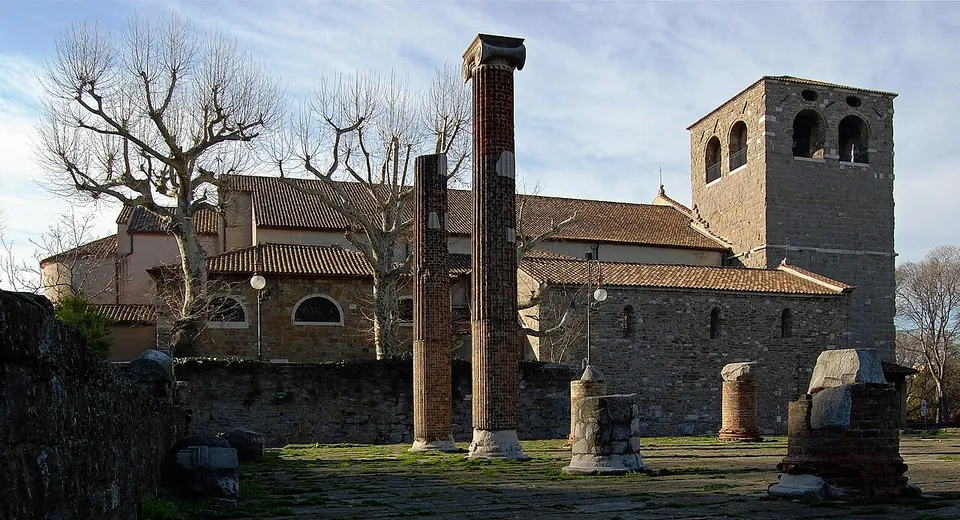
On the summit of the hill, in the square in front of the cathedral, columns and foundations
mark the civil basilica of the forum, a three-aisled hall 88 by 23.5 m excavated in 1929–1934. Part of the monumental
gateway (propylaeum) to a sacred precinct is built into the cathedral’s bell tower; the buried part in front of it, with its
stairway, can be seen from a tunnel leading down to the Orto Lapidario (Comune di Trieste).
Smaller remains are dotted around the old town: a late Roman tower at the bottom of the
steps to Santa Maria Maggiore, the base of a pillared gateway on via dei Capitelli, and a
5th-century oil press made from a reused funerary block, in the building at via dei
Capitelli 8 (Comune di Trieste). The Antiquarium of via del
Seminario shows a section of the Augustan town wall 2.4 m thick. The Antiquarium of via di
Donota, behind the theatre, is an excavated Roman house later used as a cemetery, with a
small room of its finds in a tower of the medieval wall; the Soprintendenza lists it as closed to the public. The statues found in the theatre, with inscriptions and monuments from the
forum and the cemeteries, are in the Lapidario Tergestino in a bastion of the castle (Comune
di Trieste).
Is it worth the trip?
If you are in Trieste, yes: the theatre, the arch and the forum are free, in the open and
close together, and the walk between them takes you through the old town. On their own they
are not a reason to travel far. At the moment you see the theatre from the street rather
than from inside, the via Donota antiquarium is closed, and the early Christian basilica has
been closed to visits since June 2025, so what Roman Tergeste offers today is a walk past its monuments,
not a visit into them.
Getting there
Trieste has direct trains to Venice, Milan, Rome and other Italian cities (en.wikipedia).
In town, buses 5, 9, 10, 11, 17, 18, 24, 25 and 30 stop near the theatre, and bus 24 serves
San Giusto hill and the arch (Comune di Trieste). The Park San Giusto car park is about 150 m from
the theatre (OpenStreetMap).
The Roman sites are free. The theatre, the arch and the forum remains can be seen at any time;
the Antiquarium of via del Seminario opens on Saturdays from 10.00 to 12.00; the Antiquarium
of via di Donota is closed to the public; and visits to the early Christian basilica on via
Madonna del Mare have been suspended since 16 June 2025 while it is excavated (the
Soprintendenza, read 18 October 2026). Visits inside the theatre are suspended during
excavation and refurbishment works; the Soprintendenza takes enquiries on +39 040 4527511.
History
Tergeste became part of the Roman Republic in 177 BC, during the Second Istrian War
(en.wikipedia). It was at first a village dependent on Aquileia and became a colony under
Julius Caesar, who recorded its name as Tergeste (Pleiades; en.wikipedia). Geophysical
survey suggests fortifications of the late 3rd to early 2nd century BC in the area of the
later town, which may represent Rome’s first efforts to control the Istrian landscape
(Pleiades). Octavian, the
future Augustus, gave the colony its wall in 33–32 BC (the Soprintendenza); under the
Augustan reorganisation of Italy it belonged to the tenth region, later Venetia et Histria
(Pleiades). It prospered on the road from Aquileia to Istria and as a port (en.wikipedia).
The theatre goes back to the Augustan age; early in the 2nd century Quintus Petronius
Modestus, procurator and priest of the cult of Trajan, contributed to its restoration (the
Soprintendenza). The present form of the Arco di Riccardo dates from about AD 50–75; some
sources take it for a gate in the town wall, others for an entrance to a sanctuary of the
Magna Mater, and its name may come from “Arco del Cardo”, after the main street, rather than
from Richard the Lionheart (it.wikipedia). Under Antoninus Pius the town’s territory was
enlarged, and the neighbouring Carni and Catali were granted Roman citizenship at the request of a
Tergeste citizen, Fabius Severus (en.wikipedia).
By late antiquity Tergeste was a bishopric (Pleiades). A new defensive wall went up at the
end of the 4th or start of the 5th century; its surviving tower reuses blocks cut for funerary
monuments (Comune di Trieste), and burials filled the via Donota cemetery into the 6th century (it.wikipedia). The
theatre was abandoned, stripped of its stone and covered by houses; the architect Pietro
Nobile identified it in 1814, and it was uncovered in 1937–1938 when part of the old town
was demolished (fr.wikipedia). Since 1964 it has again been used for summer performances
(fr.wikipedia).
Nearby
Photo: Zavijavah · CC BY-SA 3.0 · Commons
34 km · city · Friuli-Venezia Giulia
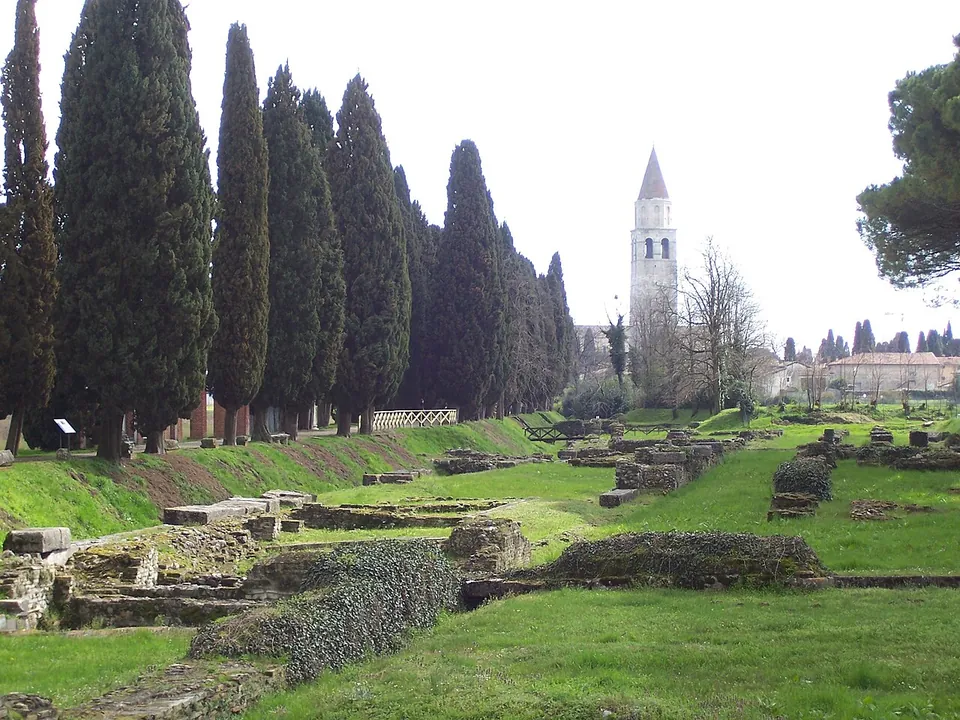
What you see of Roman Aquileia are the areas that have been excavated and left open: a forum with re-erected columns, the quays of a river port, quarters of houses reduced to their walls and floors, and large mosaic floors, several of them under modern covers.
36 km · fort · Ajdovščina
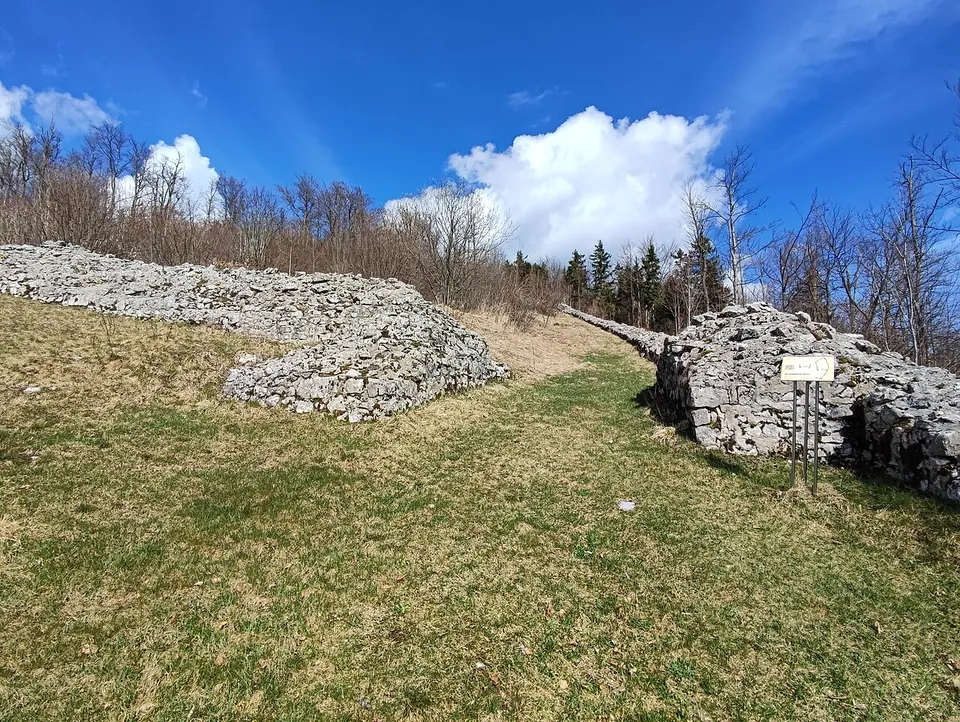
The fort follows the ground in an irregular oval, 250 m long and up to 75 m wide.
49 km · church · Istria County
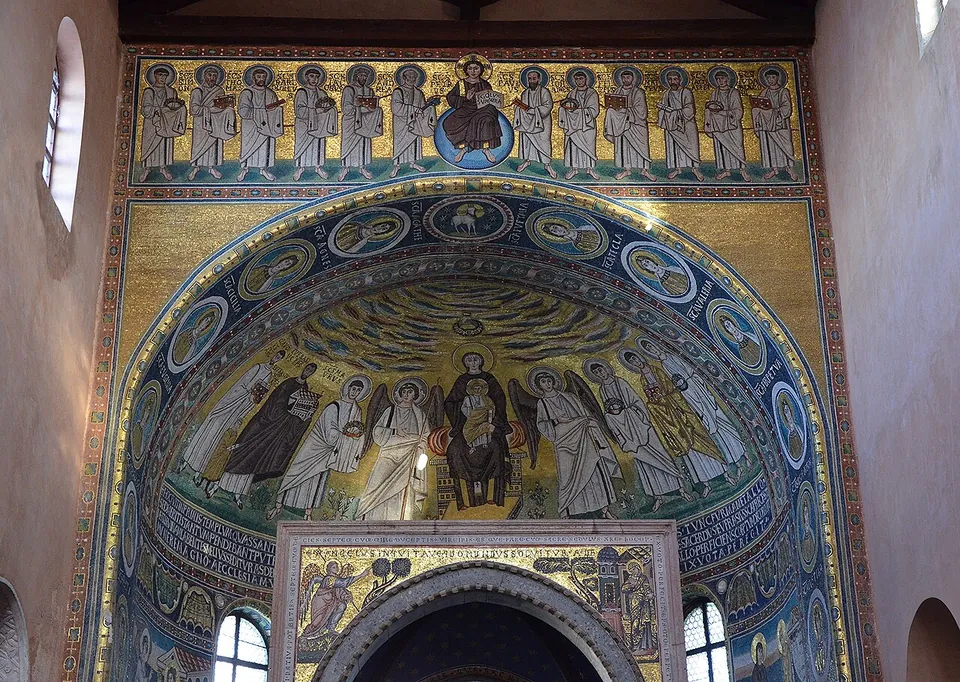
The whole episcopal complex survives: the basilica itself, an atrium surrounded by porticoes with a collection of carved stones, an octagonal baptistery, the bishop's palace and a later bell tower (en.wikipedia).
Straight-line distances.
Sources
Every fact on this page comes from the records below, each used under the licence noted.