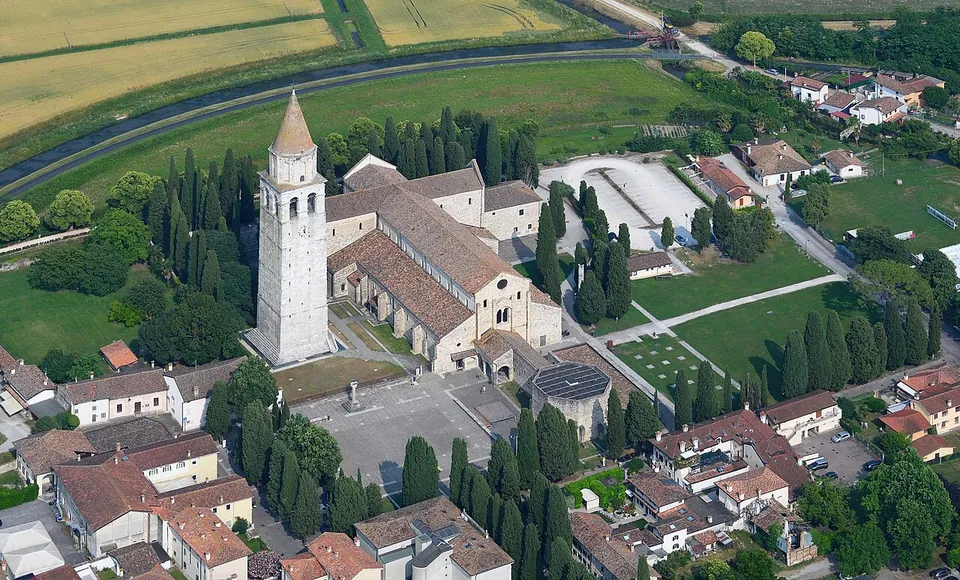


Aquileia was one of the major cities of the Roman Empire, founded as a colony in 181 BC near the head of the Adriatic. The modern town of the same name stands on part of it, and its archaeological area and Patriarchal Basilica are a UNESCO World Heritage Site (en.wikipedia).
What is there today
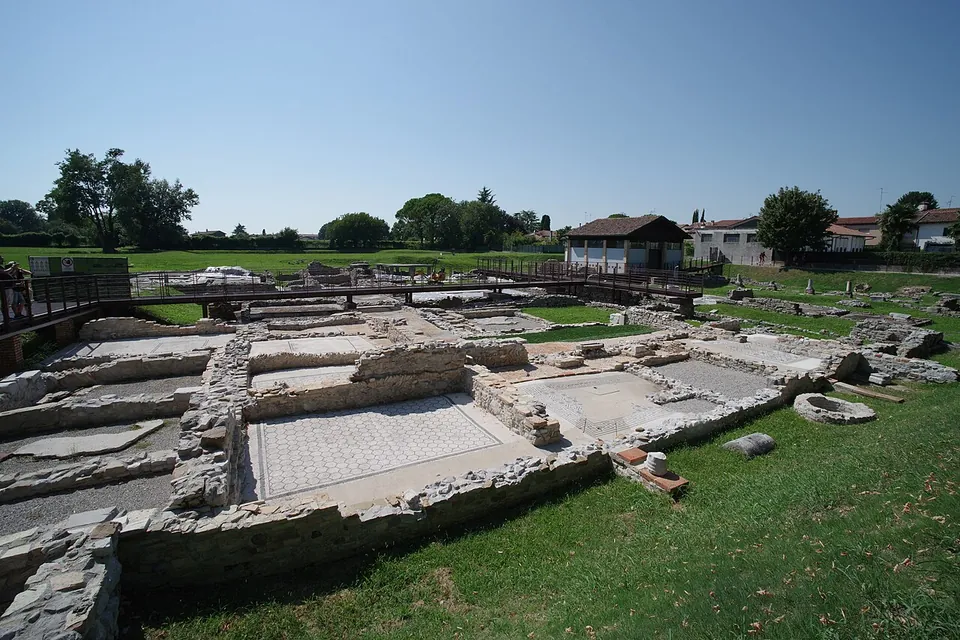
What you see of Roman Aquileia are the areas that have been excavated and left open: a forum with re-erected columns, the quays of a river port, quarters of houses reduced to their walls and floors, and large mosaic floors, several of them under modern covers. The open areas all lie within about 600 m of the Basilica square (OpenStreetMap).
The forum
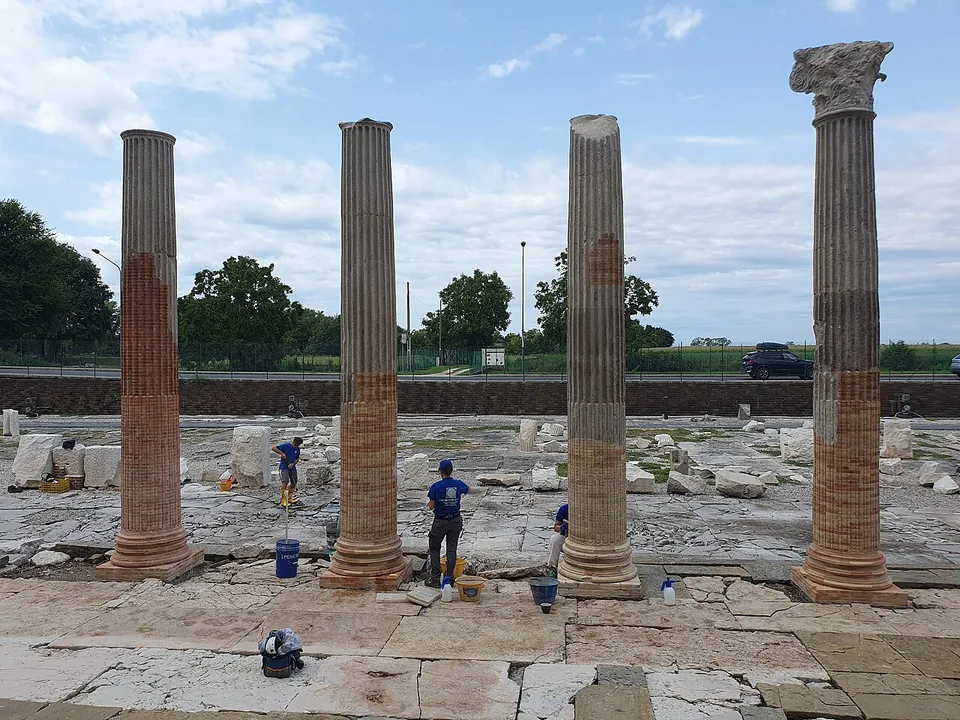
The operator places the forum’s first phase in the 2nd century BC and dates the square you see, paved in Aurisina limestone with porticoes on at least three sides, to the first half of the 1st century AD. A row of columns from the eastern portico was put back up in the 1930s and patched with brick, and their capitals are dated to about 170–180 AD. Published figures for the square range from 115 to 141 m long and 55 to 57 m wide (it.wikipedia, the operator). To the south ran a civil basilica, only partly recognisable today, and a paved street, the decumanus of Aratria Galla, named after the woman who paid for its paving (the operator). Archaeologists were still at work in the forum in 2025.
The river port and the Via Sacra
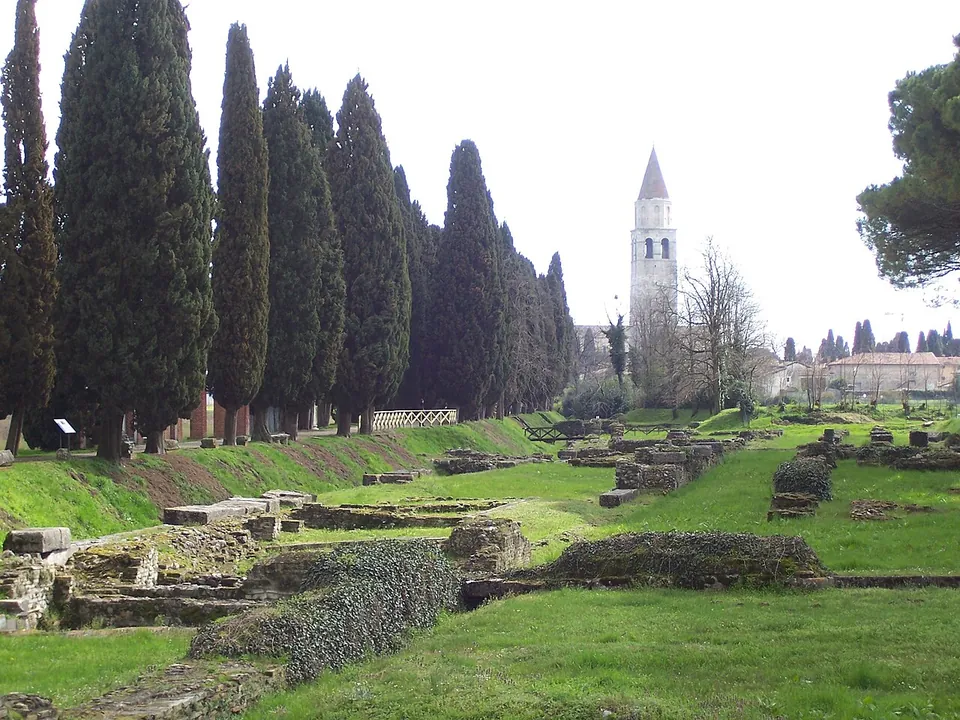
A cypress-lined path, the Via Sacra, laid out in the 1930s with the spoil from the excavation, runs from the Basilica past the remains of the river port (the operator). The quays, loading ramps and mooring blocks run for more than 300 m along what was a river bed almost 50 m wide, and behind them stand the walls of an equally long, narrow building, probably a warehouse. The operator dates a complete rebuilding over an older harbour to the start of the 1st century AD; the Wikipedia articles date the first port to the late 2nd century BC and its rebuilding in stone to the later 1st century AD. In the 4th century a town wall almost 3 m thick was built over the quays. The operator calls it one of the best-preserved port structures of the Roman world.
The Domus of Titus Macer
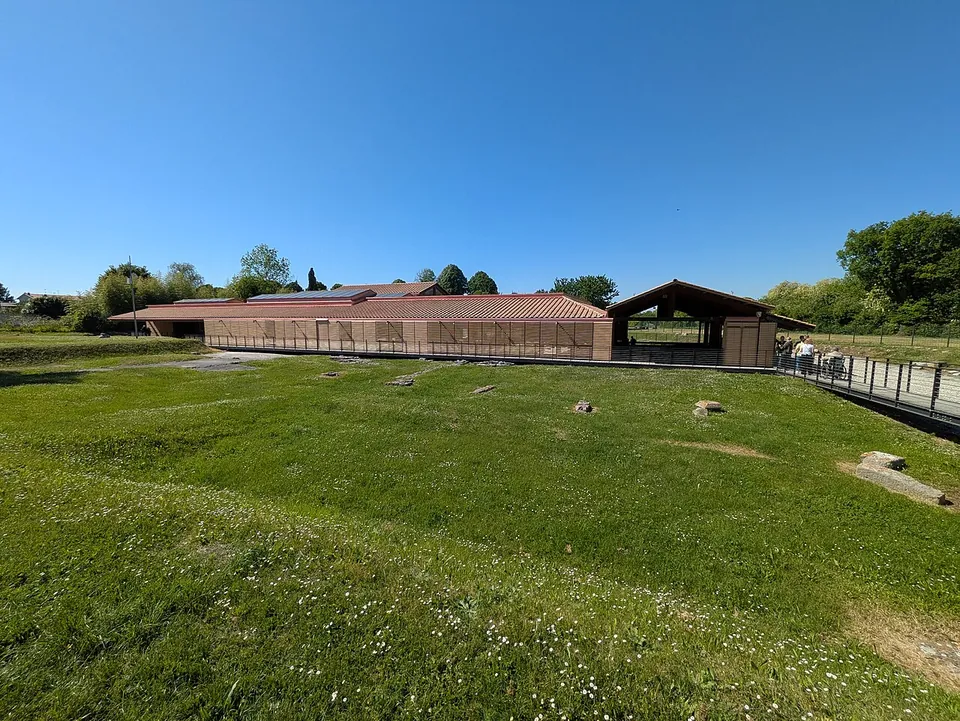
If you see only one house, make it this one. The excavated house covers about 1,700 m², some 77 m by 25 m between two paved streets, and a modern roof built over its full plan shows the house at its real size, room by room: an atrium with four columns and a water basin, a reception room with a mosaic floor, a garden, a dining room and, in the eastern part, four shops, one of them a bakery whose oven remains are still on view (the operator). The name rests on a stone weight inscribed T.MACR found in the excavation. The University of Padua excavated it between 2009 and 2015 (the operator). Published dates for it differ: the operator says it was built in the 1st century BC and lived in until the 6th century AD, while Pleiades dates it to the mid-1st century AD, when at least two older houses were merged into one.
The Domus e Palazzo Episcopale
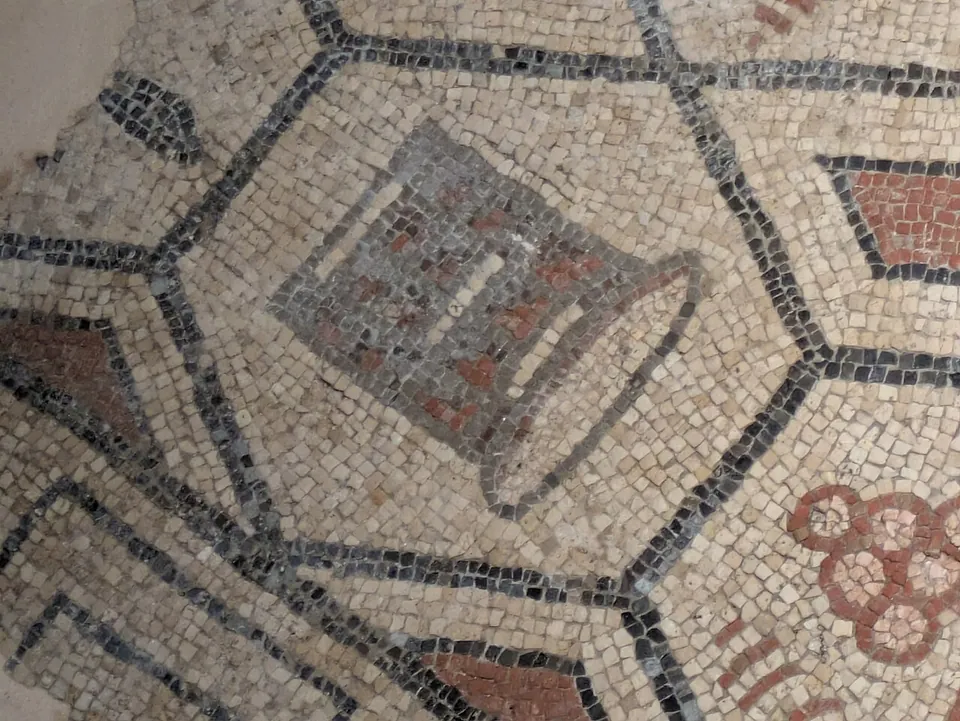
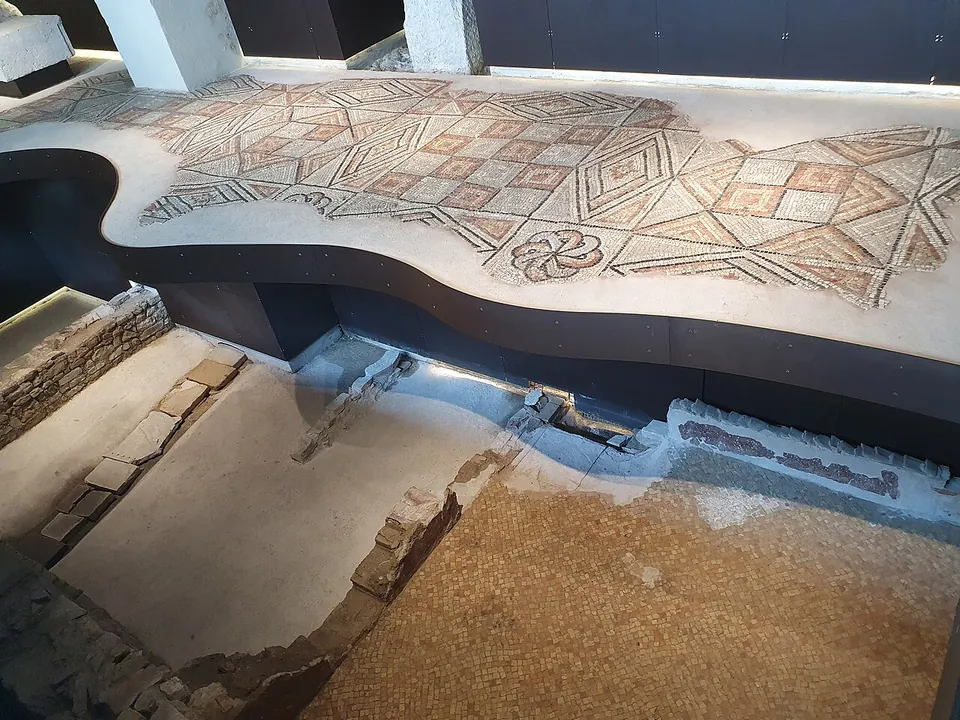
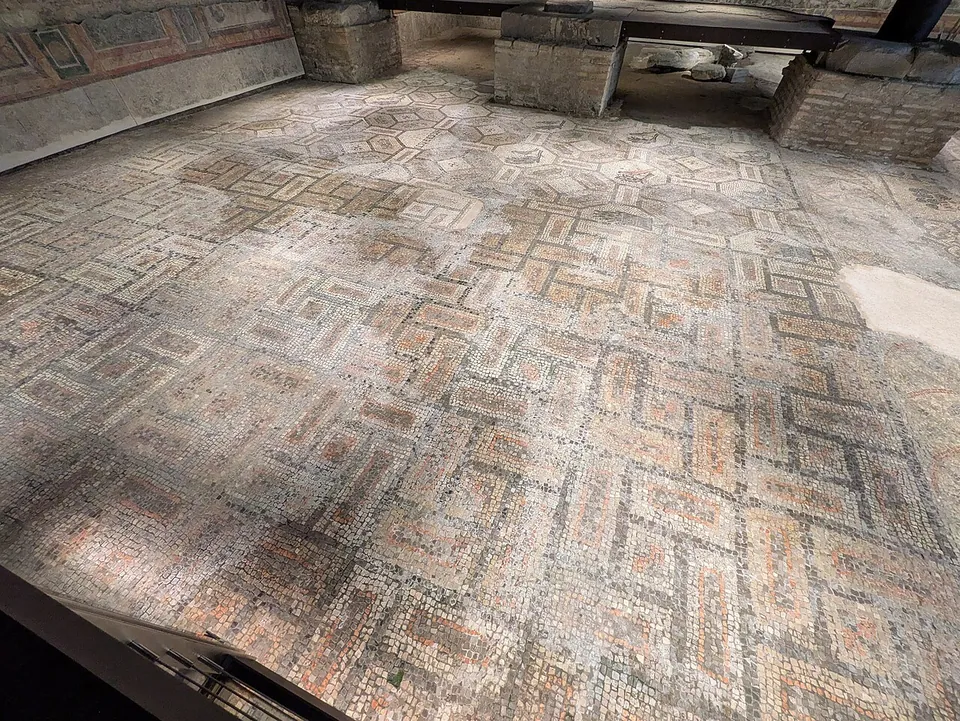
On the north side of the Basilica square, a route under a modern cover takes you down to 4 m below today’s ground through three periods stacked on top of each other (the operator): first the mosaic floors of the 5th-century bishop’s palace, then, at the deepest level, part of a 1st-century house with frescoed walls still standing more than a metre high, and last a 4th-century apsed hall of about 100 m² whose mosaic floor is full of fish, octopus, shells, birds, grapes and baskets of fruit. The operator gives the apsed hall the same craftsmen and date as the mosaics of the Basilica’s first halls.
The Basilica’s 4th-century mosaics
The Basilica itself is a later church, but it stands on the halls that Bishop Theodore founded in 313 with the support of Constantine, probably the first public complex built for Christian worship. Their remains can be seen in the nave of the present building and under the bell tower (it.wikipedia). The ticket takes in the Basilica’s 4th-century mosaics and the Cripta degli Scavi, the mosaic-floored north Theodorian hall, together with the baptistery and the Südhalle (the operator).
The Fondo CAL houses and the Eastern Domus
West of the main road, the open-air Fondo CAL area holds houses rebuilt and merged over four centuries, from the 1st to the 4th–5th (the operator). In the Eastern Domus a large apsed hall, under a modern roof, has a 4th-century mosaic of the Good Shepherd among fish, dolphins, peacocks and ducks. It was long taken for an early Christian oratory and is now read as the reception room of a rich man’s house. A western house, laid out around a peristyle, has black-and-white geometric mosaics that date its main phase to the age of Augustus (the operator).
Other open areas
In the southern part of the town, the Fondo Pasqualis shows three 5th-century market squares, with gaming boards scratched into the kerbs of one, and two lines of a late Roman town wall (the operator). The Sepolcreto, a small necropolis, is another free open-air area (the operator).
What you cannot visit
- The amphitheatre was excavated in trenches by the University of Verona in 2015 and 2016, which found that it stood entirely on self-supporting walls, like the Arena of Verona (univrmagazine). It is not among the areas the operator lists as open, and its mapped position is only approximate.
- The Grandi Terme, a vast late-antique public bath building, has been excavated by the University of Udine in campaigns since 2002 (DIUM, Università di Udine). It is not on the operator’s regular opening list, though it was opened to visitors on the European Archaeology Days in June 2026 (Ministero della Cultura).
- The House of the Wounded Animals (Domus delle bestie ferite), an elite townhouse with elaborate mosaic floors from the age of Augustus and from late antiquity (Pleiades), lies about 1 km north-west of the Basilica and is not on the operator’s list.
- The circus, built from 293, lies near today’s cemetery, and nothing of it is visible beyond a stretch of late-antique wall (PromoTurismoFVG).
The National Archaeological Museum, entered from Via Roma, holds the finds from the city (en.wikipedia), among them the mosaics taken from the Domus of Titus Macer’s block, such as the Rape of Europa and the “unswept floor” (the operator).
Is it worth the trip?
Yes, and it is worth a whole day. Do not expect standing buildings: the city shows mostly as plans at ground level, a line of re-erected columns and a stretch of quays. The mosaics are the real reward. In the Basilica, under the bishop’s palace and in the Domus of Titus Macer you walk over or beside large floors of the 1st to 5th centuries, and the roof over the Domus of Titus Macer, which the operator calls unique in Europe, lets you read a Roman town house at its full size. The open-air areas cost nothing. One €12 ticket covers the Basilica complex and both covered houses, and the museum is another €10.
If you have only an hour, take the Basilica, the Domus e Palazzo Episcopale next to it and the walk down the Via Sacra past the port to the forum.
Getting there
Aquileia is about 15 km south of the Palmanova motorway exit on the SR 352 towards Grado (the museum), and the Basilica’s bell tower is the landmark to drive towards (the operator). There is a pay car park about 70 m from the Basilica square (OpenStreetMap). Without a car, take the train to Cervignano–Aquileia–Grado station, about 10 km away, then a SAF or APT bus to the “Aquileia Centro” stop, five minutes’ walk from the Basilica. The nearest airport is Trieste, at Ronchi dei Legionari. The town is linked to the Alpe Adria cycle route from Austria to Grado (the operator, the museum).
The open-air areas (forum, Fondo CAL, Sepolcreto, decumanus) are free and open 09.00–19.00 from April to September and 09.00–18.00 in March and from 1 to 24 October. From 25 October to February they close at 16.00 on weekdays and 17.00 at weekends. The river port and Fondo Pasqualis keep the same hours but close at 16.00 every day in winter. The Basilica complex and the Domus e Palazzo Episcopale open at 10.00 and close at 19.00 in summer, 18.00 in March and October, and 16.00 on weekdays (17.00 on Saturdays) from November to February. On Sundays and holidays the Basilica itself opens only at 12.00, and it closes for services. The Domus of Titus Macer opens daily at 10.00 on the same seasonal pattern, with last tickets half an hour before closing.
The combined ticket for the Basilica complex, the Domus e Palazzo Episcopale and the Domus of Titus Macer is €12 (€9 in groups of 15 or more, free for under-18s), sold online and at the Basilica shop in Piazza Capitolo. The National Archaeological Museum opens Tuesday to Sunday, 10.00–19.00 (last entry 18.00), and costs €10, €2 for 18–25-year-olds, free for under-18s and for everyone on the first Sunday of each month. A 48-hour FVGcard Aquileia&Grado (€20 for one adult and one child under 18) covers both (Fondazione Aquileia, the Basilica and the museum, read 23 October 2026; check before travelling).
Visiting details
- Opening hours
- Open-air areas (forum, Fondo CAL houses, Sepolcreto, decumanus): 09.00–19.00 from 1 April to 30 September, 09.00–18.00 in March and from 1 to 24 October, and from 25 October to the end of February 09.00–16.00 on weekdays and 09.00–17.00 at weekends and on holidays; the river port and the Fondo Pasqualis markets keep the same hours but close at 16.00 every day in winter. Domus of Titus Macer: daily 10.00–19.00 from April to September, 10.00–18.00 in March and October, and 10.00–16.00 on weekdays (10.00–17.00 at weekends) from November to February; last tickets 30 minutes before closing; closed 25 December. Basilica, crypts, baptistery, Südhalle and Domus e Palazzo Episcopale: 10.00–19.00 from April to September, 10.00–18.00 in March and October, 10.00–16.00 on weekdays and 10.00–17.00 on Saturdays from November to February; on Sundays and holidays the Basilica itself opens only from 12.00, and it closes during services. The Basilica complex is closed on 25 December. National Archaeological Museum: Tuesday to Sunday 10.00–19.00, last entry 18.00, closed Mondays.
- Tickets
- The open-air areas are free. One €12 ticket covers the Basilica complex (with its 4th-century mosaics and the Cripta degli Scavi), the Südhalle, the Domus e Palazzo Episcopale and the Domus of Titus Macer; €9 each for groups of 15 or more, free for under-18s and residents of Aquileia. The National Archaeological Museum is a separate €10 ticket (€2 for 18–25-year-olds, free under 18), free for everyone on the first Sunday of the month. The FVGcard Aquileia&Grado (€20, 48 hours, one adult and one child under 18) covers both.
- Parking
- A pay car park is mapped about 70 m from the Basilica square (OpenStreetMap way/43934208); the museum names the car park on Via Curiel, past the museum on the road to Grado, as the nearest to it.
Before you go
- Winter hours start on 25 October, when the open-air areas and the Domus of Titus Macer close at 16.00 on weekdays.
- The Basilica is closed to visitors on Sunday and holiday mornings until 12.00 and during weddings, funerals and other services, including ones that cannot be scheduled in advance (the Basilica's own page).
- The amphitheatre, the Grandi Terme and the House of the Wounded Animals are not among the areas the operator lists as open.
Hours and prices checked 23 October 2026 on the operator's own site. Confirm before travelling.
History
Rome founded Aquileia in 181 BC as a military colony to hold the eastern edge of Italy against the Carni and the Histri (en.wikipedia). An inscription names Titus Annius Luscus, who brought a second group of colonists in 169 BC and was charged with writing the colony’s laws and building a temple (the operator). Roads made it a hub. The Via Postumia (148 BC) ran from here towards Genoa, the Via Annia (131 BC) came in from Adria and Padua, and around 14 BC the Via Gemina was begun towards Emona, today’s Ljubljana, along the Amber Road (it.wikipedia). Ships from all over the Mediterranean came up the river to its port (the operator), and an ancient description quoted in the Wikipedia articles calls it the market of the Illyrian peoples along the Danube. The city’s population is estimated at close to 100,000 in the 2nd century AD (en.wikipedia).
In 238 the city held out against the siege of the emperor Maximinus Thrax, who was killed there by his own soldiers (the operator). Under the Tetrarchy it became one of the capitals of the empire, given grand public and private buildings for the emperor Maximian, with a circus begun in 293 next to an imperial residence and a mint working from 294/296 to 425 (it.wikipedia). In 313 Bishop Theodore founded the first Christian halls under today’s Basilica, and in time the Patriarch of Aquileia was the most important person in the Western Church after the bishop of Rome (en.wikipedia).
Attila’s Huns sacked the city in 452. It never recovered and shrank to half its size (it.wikipedia), though trade went on: a gold coin of Leo I (457–474) was found in the southern markets (the operator), and someone buried a hoard of 560 coins in the atrium of the Domus of Titus Macer around 460 and never came back for it (the operator). In the 8th century the patriarchs moved to Cividale, and the town revived around the year 1000 (en.wikipedia).
More photographs





Nearby
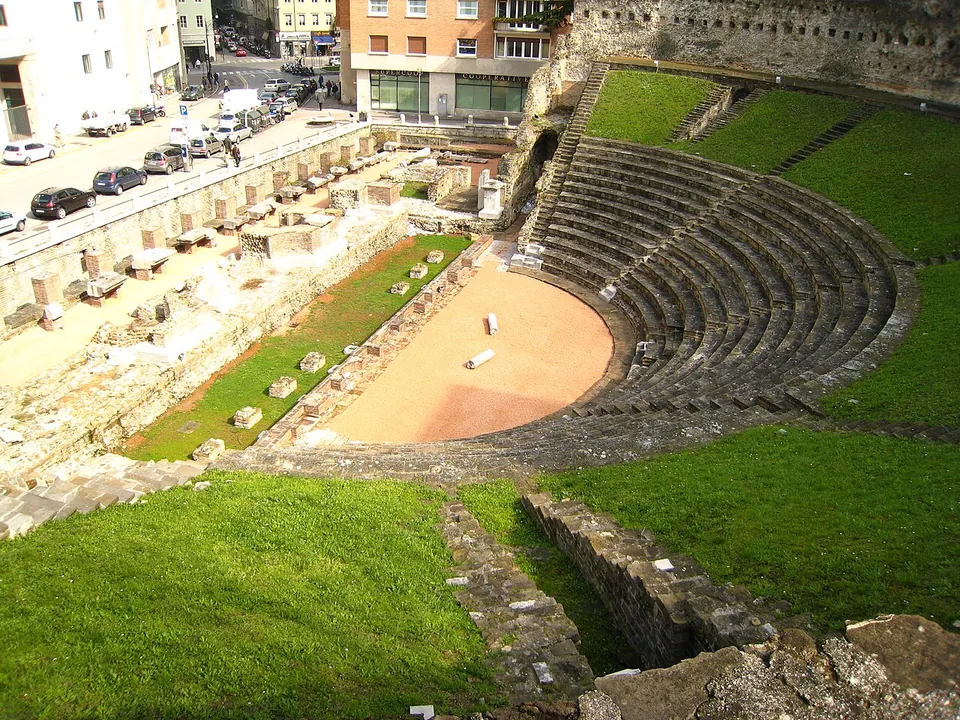
Photo: Tiesse · Public domain · Commons
34 km · theatre · Friuli-Venezia Giulia
Roman Theatre of Trieste
The seating (cavea) rests on the slope of the hill above a semicircular orchestra, with part of the stage building in front of it; the theatre was restored and partly rebuilt after it was excavated (the Soprintendenza).
Photo: Tiesse · Public domain · Commons
34 km · city · Friuli-Venezia Giulia
Tergeste – Trieste
Four of these remains are stops of their own: the theatre, the forum basilica on San Giusto hill, the Arco di Riccardo and the Antiquarium of via di Donota, the last of them closed at present.

Straight-line distances.
Sources
Every fact on this page comes from the records below, each used under the licence noted.