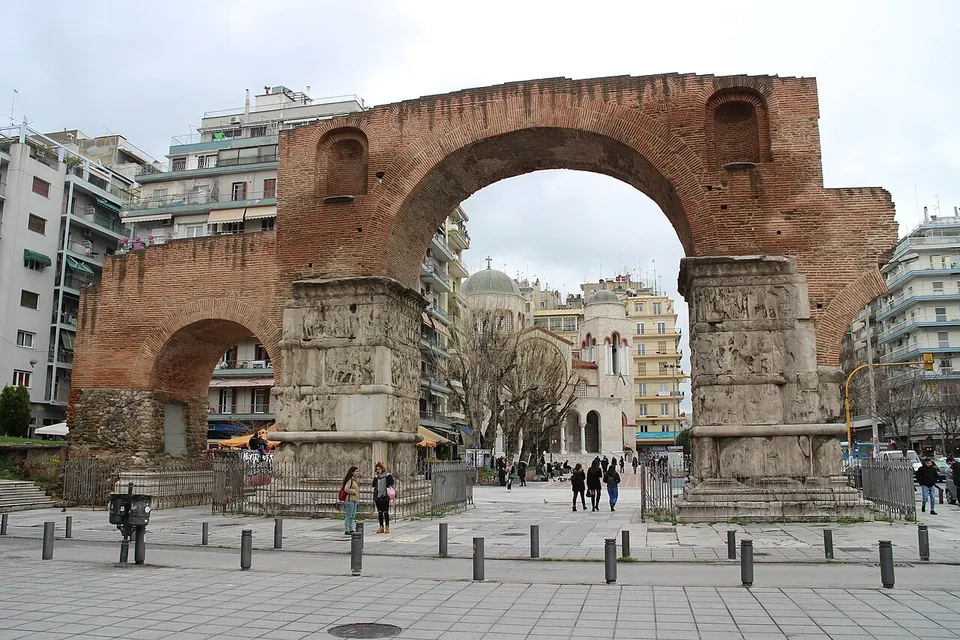
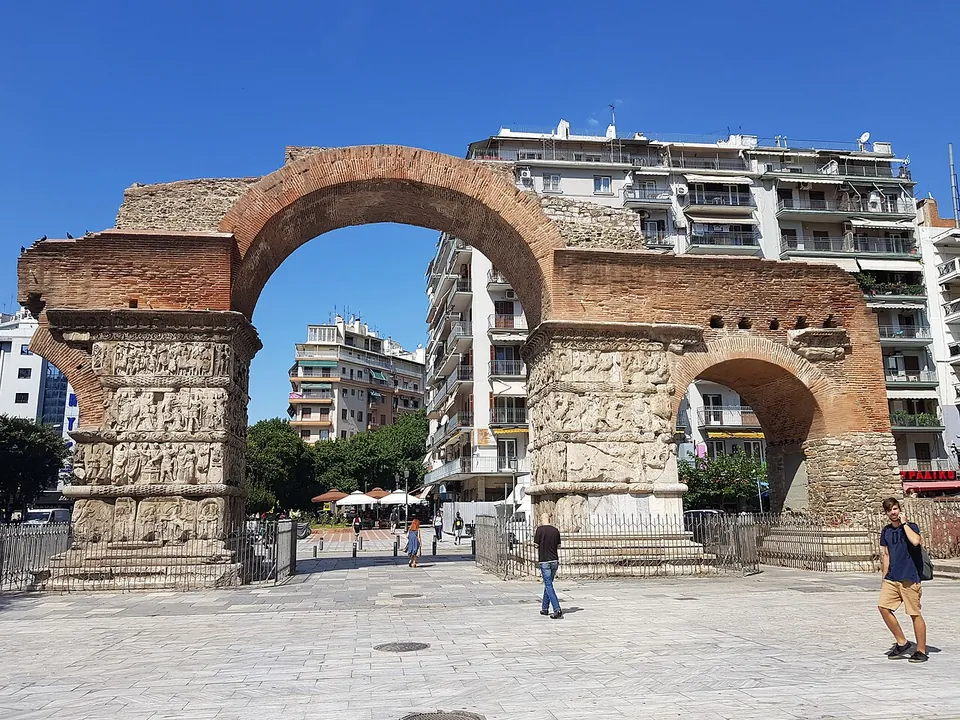


The Arch of Galerius is what is left of the triumphal arch the emperor Galerius built across the Via Egnatia in Thessalonica, to celebrate his victory over the Persian king Narseh and the capture of Ctesiphon (Pleiades; en.wikipedia). Locals call it Kamara, and it stands in the open street, the city’s most popular meeting point (en.wikipedia; the Region of Central Macedonia).
What is there today
The arch was a gateway on eight pillars carrying three arches: a masonry core faced first with brick and then with carved marble panels. Three of the eight pillars survive, on the north-west side, with parts of the arches above them; the core has been consolidated with modern brick to protect it (en.wikipedia). The central opening is 9.7 m wide and 12.5 m high, the side opening 4.8 m wide and 6.5 m high (en.wikipedia; el.wikipedia).
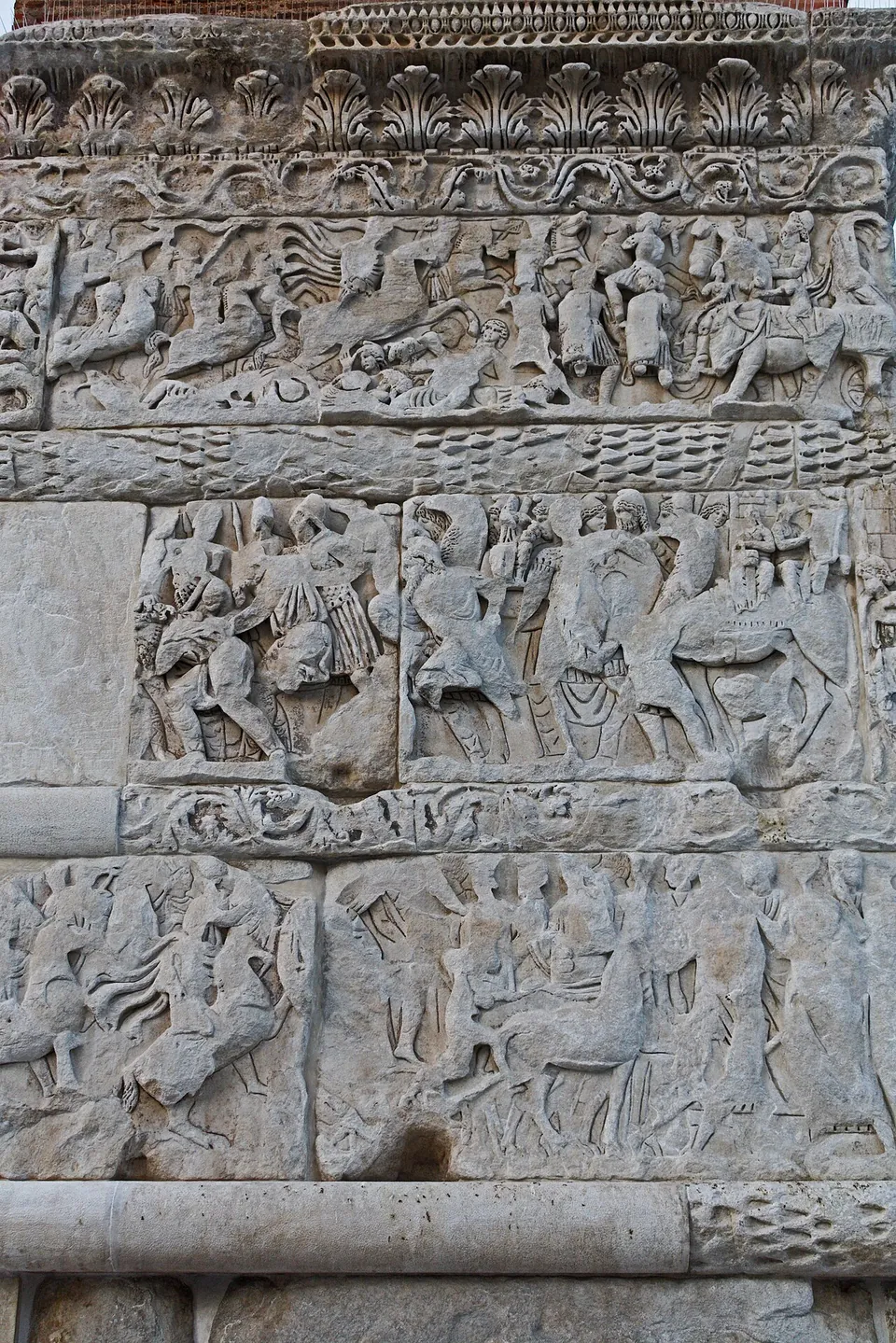
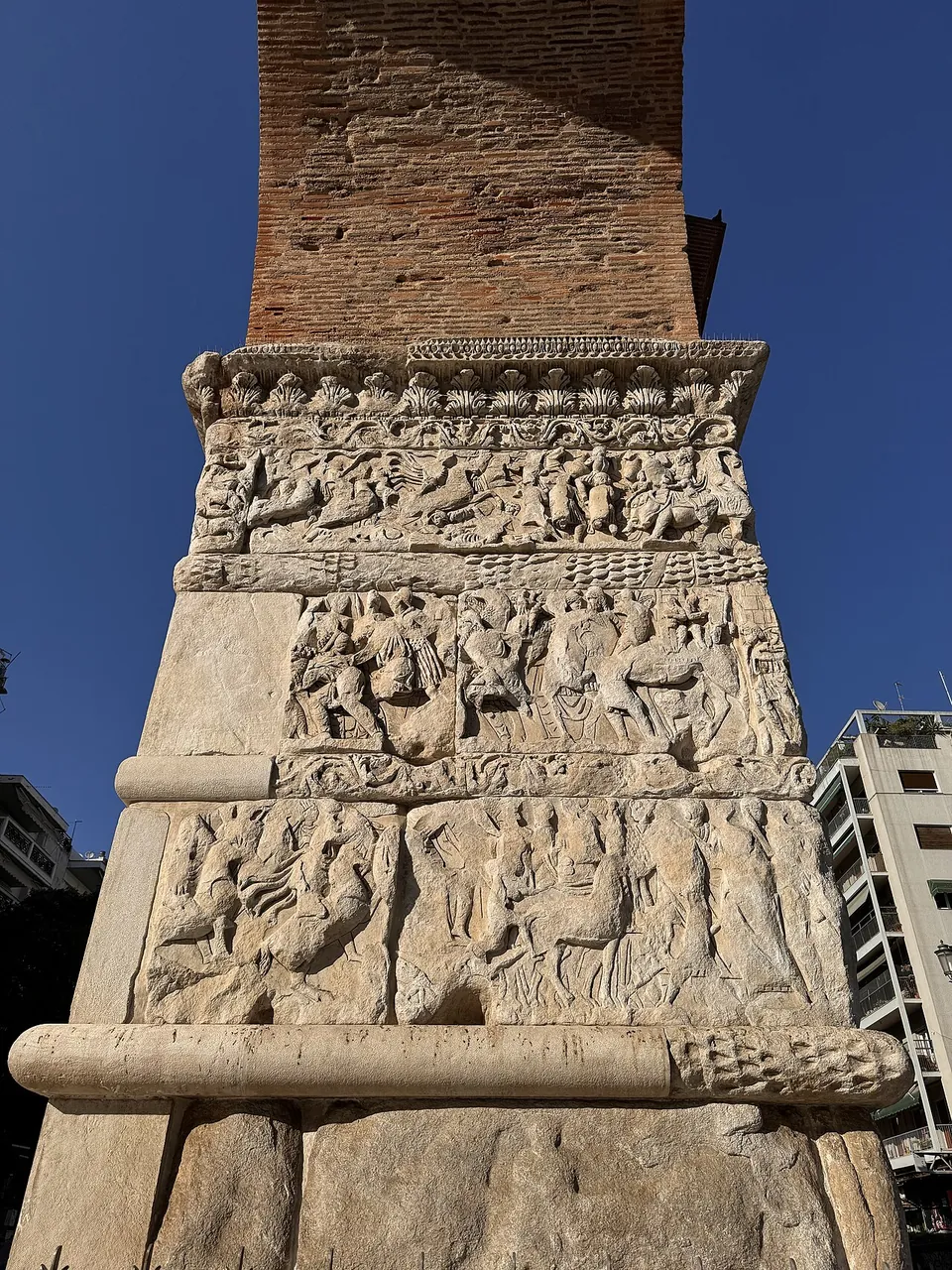
The reliefs are the thing to look at. The two pillars that flanked the central passage keep their marble slabs, carved in four stacked bands, divided by mouldings of laurel leaves and garlands (en.wikipedia; el.wikipedia). They tell the story of Galerius’s war against the Persians as propaganda more than as chronicle (en.wikipedia; de.wikipedia). In one scene Galerius, on a rearing horse, charges the Persian king with a lance while an eagle brings him a victory wreath - though the two never met in battle. Another shows the imperial family at a sacrifice of thanksgiving, with Galerius’s wife Valeria, the daughter of the emperor Diocletian, at his side, and a third the four rulers of the Tetrarchy together, Galerius alone in armour (en.wikipedia). A label naming the river Tigris survives on one panel (en.wikipedia).
Is it worth the trip?
Yes, and it takes only a few minutes: it stands in the open street, on Egnatia (en.wikipedia; the Region of Central Macedonia). The reliefs are a source in their own right for Galerius’s Persian campaign, and de.wikipedia calls the arch a masterpiece of Roman triumphal imagery. Look at it together with the Rotunda, 125 m up the pedestrian street, and Galerius’s palace, 235 m the other way: the three were built as one complex (en.wikipedia).
Getting there
The arch stands where Dimitriou Gounari Street meets Egnatia Street (en.wikipedia), in the city centre. City buses stop at “Kamara”, about 100 m away (OpenStreetMap). The Rotunda is 125 m to the north-east and Galerius’s palace in Navarinou Square 235 m to the south-west (en.wikipedia); the Roman Forum is about 800 m to the north-west.
Visiting details
- Tickets
- Free
- Parking
- The city bus stops named Kamara, after the arch, are about 100 m away (OSM node/5405440704, node/344396043).
History
Galerius was made Caesar, the junior emperor of the East, by Diocletian, whose daughter Valeria he married in 293. After a defeat by the Persians in 297, the Roman army invaded Armenia the next year and beat the Persian king Narseh, and Galerius was allowed to build a triumphal arch in Thessalonica (de.wikipedia). Pleiades and en.wikipedia date its building to 298–299 and its dedication to 303; de.wikipedia has it finished before 305, because the reliefs still show Diocletian as senior emperor, and el.wikipedia puts it in 305.
It stood at the crossing of the city’s main axes. The central arch spanned the Via Egnatia, the Roman road from Dyrrachium to Byzantium, which ran through the city as its main east-west street, and a road linking the Rotunda, 125 m to the north-east, with the palace, 235 m to the south-west, passed through the arch along its length (en.wikipedia). The two arches met under a dome, and the road beneath was a processional way lined with colonnades (el.wikipedia).
In time the arch’s purpose was forgotten, since it shows the triumph but never names Galerius. Under Ottoman rule it was put down to Constantine the Great, Philip II or Alexander the Great, and called the Arch of Philip or of Constantine, until the scholar Karl Frederik Kinch showed in a monograph of 1890 that it was Galerius’s (en.wikipedia). In 1864, when the Frenchman Emmanuel Miller came to take the colonnade known as Las Incantadas to France, rumours that he meant to take the arch too stirred a public outcry; the arch was not touched (en.wikipedia).
More photographs

Sources
Every fact on this page comes from the records below, each used under the licence noted.
| Source | Licence |
|---|---|
| Pleiades 361097849 | CC BY |
| Wikidata Q1258082 | CC0 |
| OpenStreetMap way/135678907 | ODbL |
| Wikipedia (en) — Arch of Galerius and Rotunda | CC BY-SA 4.0 |
| Wikipedia (el) — Αψίδα του Γαλερίου | CC BY-SA 4.0 |
| Wikipedia (de) — Galeriusbogen | CC BY-SA 4.0 |
| Region of Central Macedonia (official tourism site) — Arch of Galerius | licence not recorded |