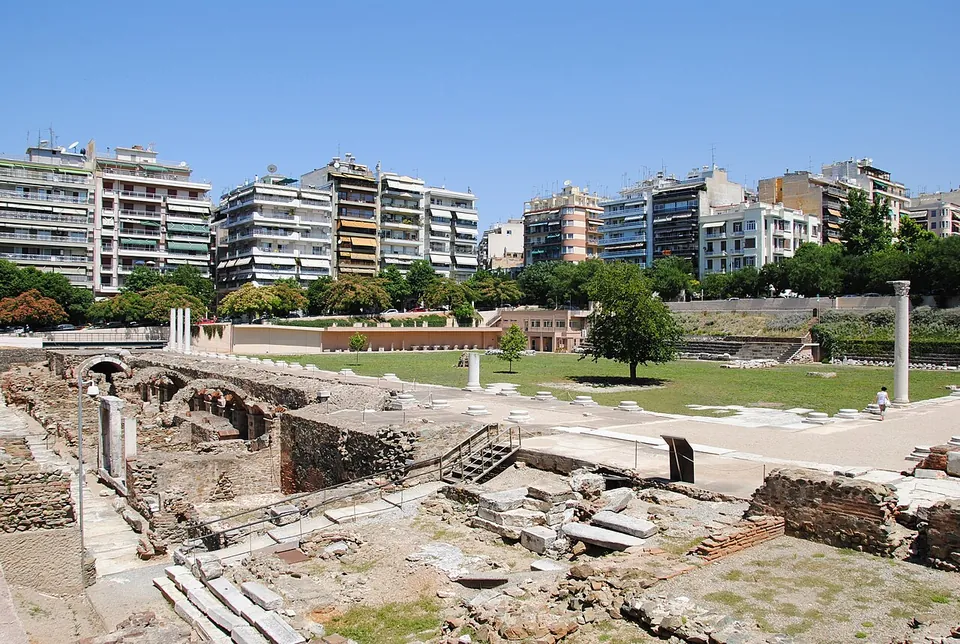
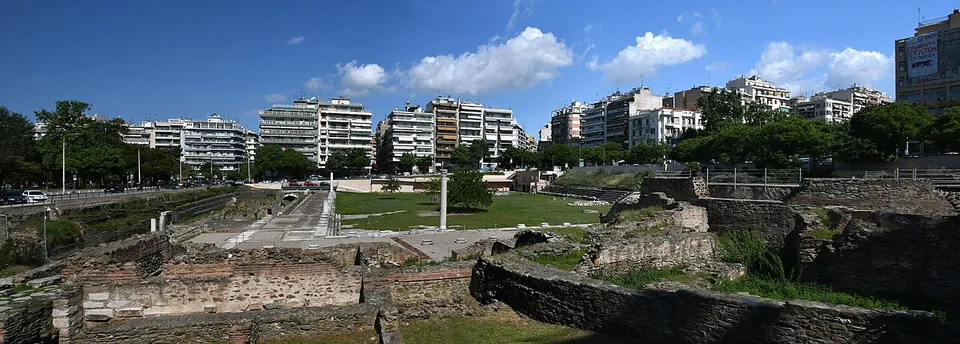


The Roman Forum was the civic centre of Roman Thessalonica: a large square with colonnades, shops, an underground gallery and a small theatre, at the top of today’s Aristotelous Square. It was found by chance in 1966, when the ground was dug for a new courthouse, and kept as an open site with a museum (the operator; en.wikipedia).
What is there today
The forum as it stands is of the 2nd and 3rd centuries AD: the operator gives two building phases, in the mid-2nd and the mid-3rd century. It was laid out as a central square with colonnaded wings holding storerooms and shops, a covered underground gallery (the cryptoporticus), a mint, a bath complex and an odeon (the operator).
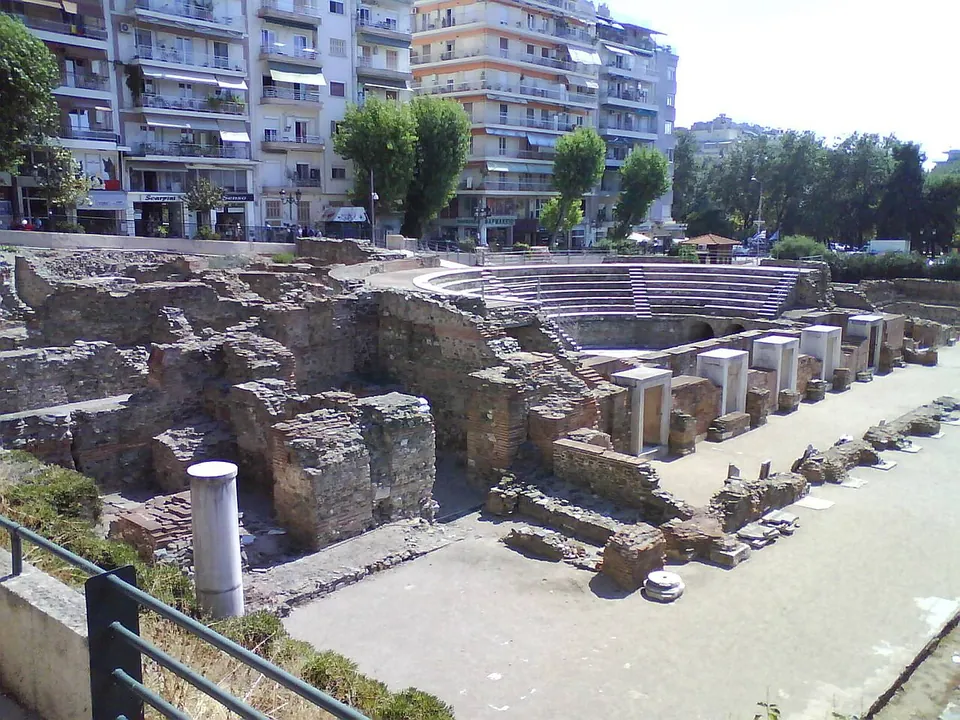
What has been uncovered is a large rectangular square, with traces of its marble paving in the north-west part; on the east side the odeon, with built tiers and a stage, which Greek Wikipedia calls an odeon and council chamber and English Wikipedia says was also used for gladiatorial games; and along the south side the ground floor of a multi-storey colonnade, the cryptoporticus (el.wikipedia). The odeon still hosts cultural events (the operator; el.wikipedia). The tall column in the square is the only monolithic marble column found whole, capital and all, which the ephor of antiquities Fotis Petsas had re-erected (el.wikipedia).
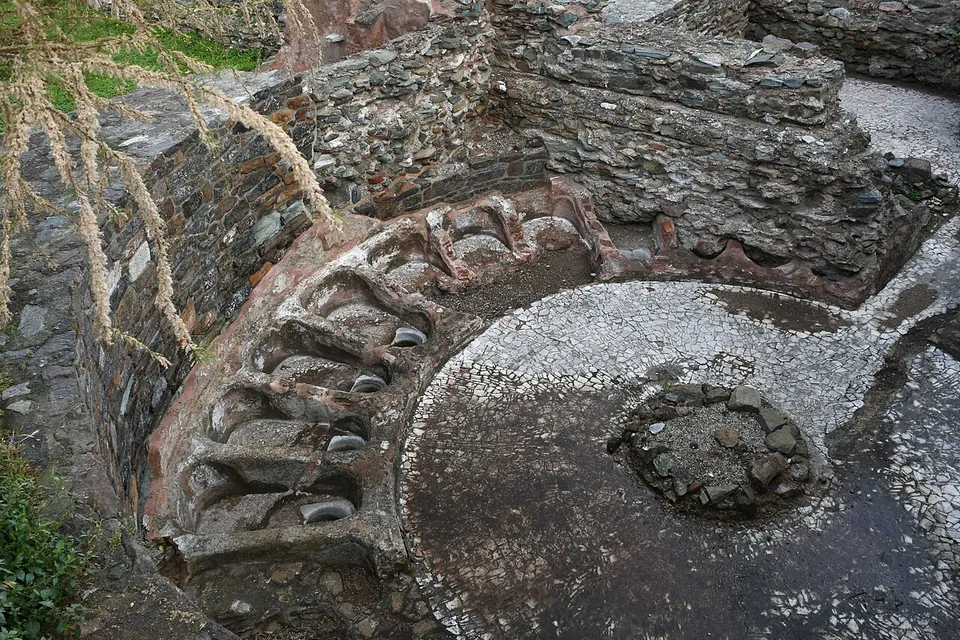
In the south-east corner are the remains of a bath house, with a round sweating room ringed by twenty-five basins, a cold and a hot pool and a furnace; Greek Wikipedia dates it to the first half of the 2nd century BC, before the forum (el.wikipedia), while English Wikipedia counts it among the forum’s Roman baths. The finds include mosaic floors, a stretch of paved street, drains, silver coins and sculpture (el.wikipedia).
The museum lies underground in the western part of the site, as a continuation of the cryptoporticus, and you enter it from the gallery. It shows finds from the excavation, from the 3rd century BC to modern times: statues, vases, inscriptions and coins (the operator; el.wikipedia).
The forum’s most famous sculpture is not here. The Stoa of the Idols, known as Las Incantadas (“the enchanted ones”), was part of the forum complex and stood at about the level of today’s Egnatia Street, where it formed the entrance to the forum; its reliefs of eight mythological figures were taken to the Louvre in 1864, and they are still there (el.wikipedia; the operator).
Is it worth the trip?
Yes, if you are in Thessaloniki. It is in the city centre, an 8-minute walk from Aristotelous Square, and the €10 ticket includes the museum (the operator). Expect low walls, a grassed square with a tall column, the odeon’s seating and the vaulted gallery, ringed by apartment blocks: the city simply stopped building here. It is closed on Tuesdays.
Getting there
The entrance is at the corner of Filippou and Agnostou Stratiotou streets, 8 minutes on foot from Aristotelous Square (the operator). Bus stops on Filippou Street are about 70 m away, and paid car parks about 150 m (OpenStreetMap). The Arch of Galerius and the Rotunda are about 800 m to the south-east, and Galerius’s palace about 900 m south-east.
It opens daily except Tuesday. From 1 April to 31 August it is open 08.00–20.00, closing earlier through September and October (18.00 by the second half of October), and from 1 November to 31 March 08.30–15.30. Last entry is 20 minutes before closing; it is shut on 1 January, 25 March, 1 May, Easter Sunday and 25–26 December. A ticket is €10, reduced €5, and covers the site and its museum; entry is free on 6 March, 18 April, 18 May, the last weekend of September, 28 October, and on the first and third Sunday of each month from November to March (hh.gr, read 9 October 2026 — check before travelling). There are toilets and a lift (the operator).
Visiting details
- Opening hours
- Daily except Tuesday, 08.00–20.00 from 1 April to 31 August, then closing earlier through the autumn (19.30 in early September, 18.00 by late October); 08.30–15.30 from 1 November to 31 March. Last entry 20 minutes before closing. Closed 1 January, 25 March, 1 May, Easter Sunday and 25–26 December.
- Tickets
- €10, including the museum; reduced €5. Free on 6 March, 18 April, 18 May, the last weekend of September and 28 October, and on the first and third Sunday of each month from November to March.
- Parking
- Paid car parks are mapped about 150 m from the site (OSM way/110164567, way/110164565, fee=yes), and bus stops on Filippou Street about 70 m away (node/5481157727).
Hours and prices checked 9 October 2026 on the operator's own site. Confirm before travelling.
History
In Roman Thessalonica the two main streets were the Via Regia, today’s Egnatia Street, running east to west, and a road at right angles to it that probably crossed the city from the sea to the acropolis; the forum stood where they met. It was built on the model of the centre of Rome, at a time when forums of the same kind were laid out all over the empire, and for about three centuries it was the city’s administrative centre. The Roman forum had two squares: the one excavated, and another that was an open square without colonnades in Byzantine times and still lies unexplored under the upper part of Aristotelous Square (el.wikipedia).
In the early Christian period the forum changed but kept some of its role as a meeting place: the cryptoporticus became a large water cistern, and part of it a healing shrine, where an early Christian wall painting of great importance was found (el.wikipedia). The forum and the odeon were probably in use until at least the 6th century (en.wikipedia).
The site stayed buried until 1966, when the ground was dug for the city’s new courthouse. The finds put an end to the plans, and the ephor Fotis Petsas, by re-erecting the column, made sure nothing would be built on the site (el.wikipedia; the operator). The courthouse went elsewhere, but the name Courthouse Square survives in popular use (en.wikipedia).
More photographs

Sources
Every fact on this page comes from the records below, each used under the licence noted.
| Source | Licence |
|---|---|
| Pleiades 688857980 | CC BY |
| Wikidata Q16932289 | CC0 |
| OpenStreetMap way/14788669 | ODbL |
| Hellenic Heritage (H.O.C.R.E.D., for the Ministry of Culture) — Roman Forum of Thessaloniki, hours and tickets | licence not recorded |
| Wikipedia (en) — Roman Forum (Thessaloniki) | CC BY-SA 4.0 |
| Wikipedia (el) — Ρωμαϊκή Αγορά της Θεσσαλονίκης | CC BY-SA 4.0 |