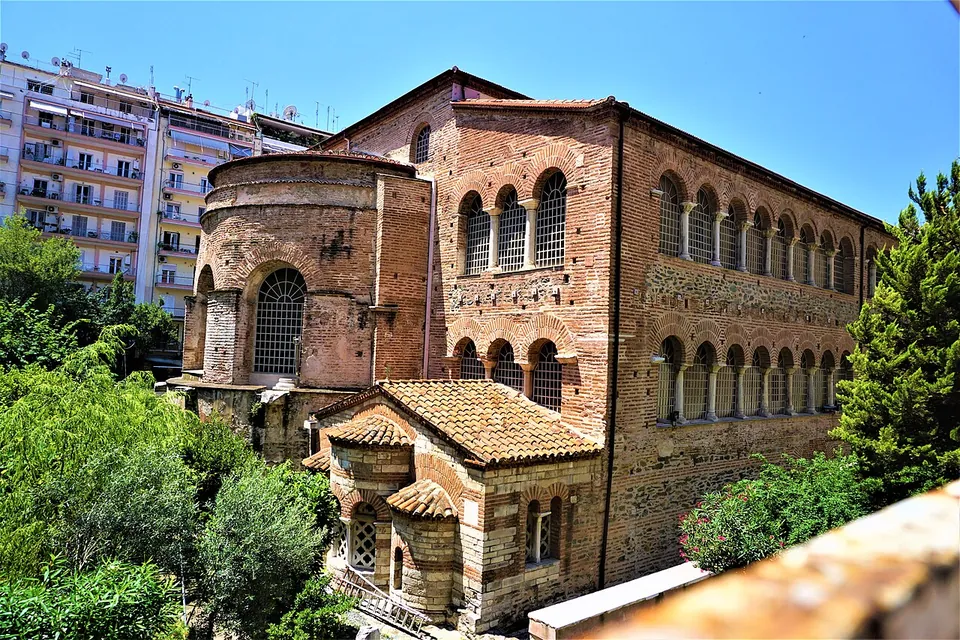
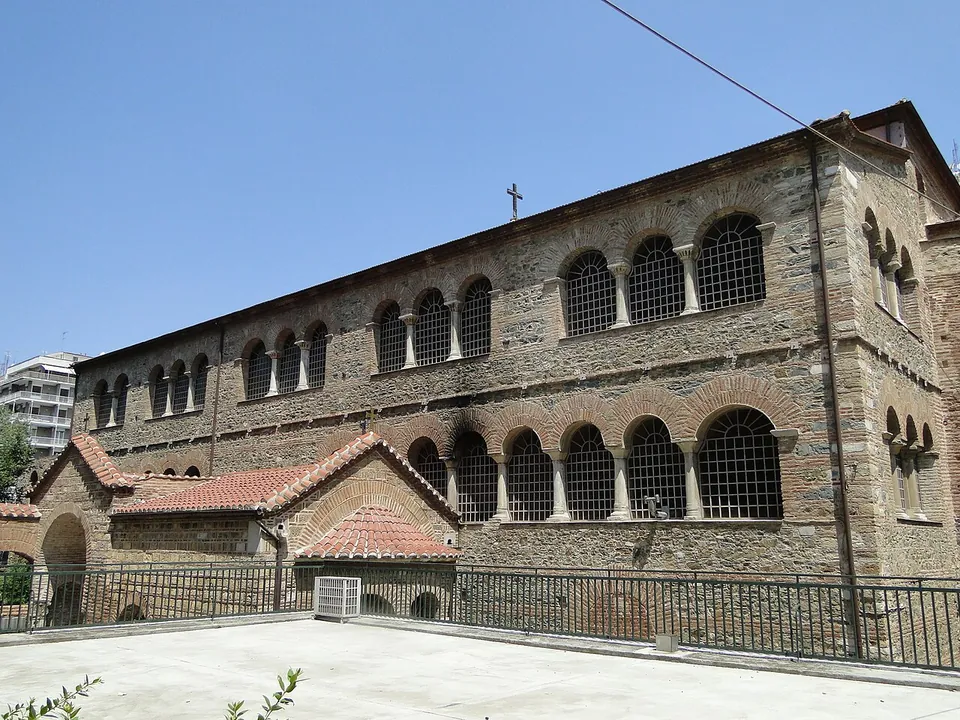


The Church of the Acheiropoietos is a great basilica of about AD 450–470 in the centre of Thessaloniki, perhaps the oldest of the city’s surviving churches, and still in use. Its capitals, the columns of its entrance and its nave floor are those of the 5th century, and it is part of the UNESCO World Heritage site of Thessaloniki’s early Christian and Byzantine monuments (en.wikipedia).
What is there today
The church is a three-aisled basilica 28 m wide and 36.5 m long, with a wooden roof, a semicircular apse at the east and a narthex flanked by towers at the west. Columns divide the aisles, and galleries run above the side aisles. You enter through a triple arched opening from the narthex into the nave; on the south side a monumental doorway probably opened onto the Byzantine city’s main street, and a small building beside it has been identified as the baptistery (en.wikipedia).
Of the original decoration there survive fine 5th-century Ionic capitals from a workshop of Constantinople, columns of green Thessalian marble in the triple entrance, the nave’s original pavement of marble from Proconnesus and fragments of 5th-century decorative mosaics. On the south side are damaged frescoes of the early 13th century showing the Forty Martyrs of Sebaste. Beneath the north aisle, three layers of floor mosaics from an earlier Roman bath have been uncovered. The present roof is lower than the original, which raised the nave to let in light (en.wikipedia).
Is it worth the trip?
Yes, and it is easy: a 5th-century basilica still standing with its marble and mosaics, a short walk from the Roman forum, the Rotunda and Hagia Sophia (en.wikipedia; OpenStreetMap). It is a working church, and the parish publishes no visiting hours.
Getting there
The church stands on Agias Sofias Street opposite Makedonomachon Square, in the city centre (en.wikipedia). Buses stop at “Agias Sofias” about 100 m away, and there are paid underground car parks nearby (OpenStreetMap).
Visiting details
- Tickets
- Free
- Parking
- On Agias Sofias Street opposite Makedonomachon Square, in the city centre (en.wikipedia); bus stops "Agias Sofias" about 100 m away (OSM node/493570095), and paid underground car parks within about 190 m (node/3738891893). It is a working church; no visiting hours are published by the parish or the Ministry of Culture.
History
Known in Byzantine times as the Panagia Theotokos, the church is dedicated to the Virgin Mary; its present name, first recorded in 1320, probably comes from an icon “not made by hands” (acheiropoietos) kept there. It was altered in the 7th century and again in the 14th–15th. After the Ottoman conquest of 1430 it was the first church in the city to be turned into a mosque, by Sultan Murad II himself, and an inscription of his survives on the eighth column from the east of the north colonnade (en.wikipedia).
Sources
Every fact on this page comes from the records below, each used under the licence noted.
| Source | Licence |
|---|---|
| Pleiades 55417173 | CC BY |
| Wikidata Q1584774 | CC0 |
| OpenStreetMap way/32624145 | ODbL |
| Wikipedia (en) — Church of the Acheiropoietos | CC BY-SA 4.0 |
| Ministry of Culture and Sports (Odysseus) — Church of Acheiropoiitos, information | licence not recorded |
| Wikipedia (en) — Macedonia (Roman province) | CC BY-SA 4.0 |