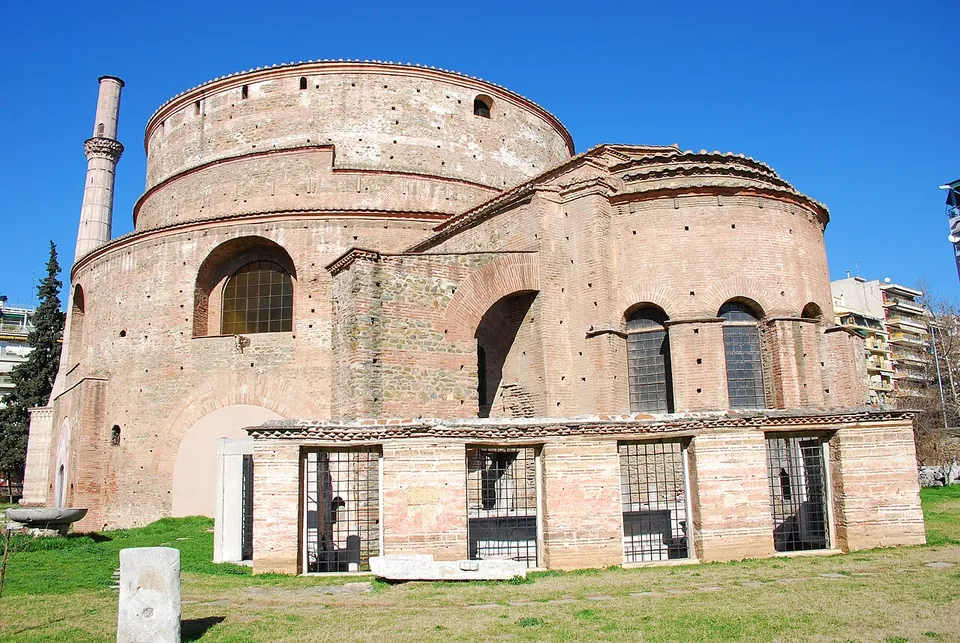
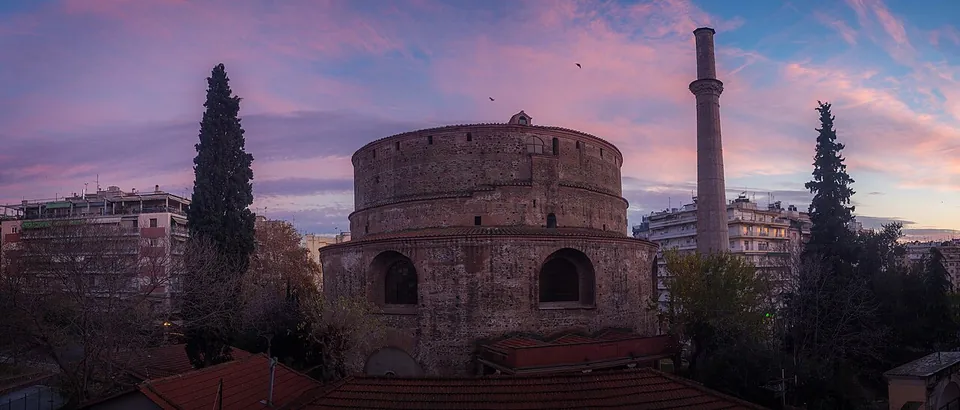


The Rotunda is a great round brick building of the early 4th century, put up by the emperor Galerius next to his palace in Thessalonica. What it was built for is not known - a temple or his own mausoleum are the usual guesses - but it has stood ever since: as a church with some of the earliest Christian mosaics of the East, then as a mosque, and today as a monument you can walk into (el.wikipedia; the operator; de.wikipedia).
What is there today
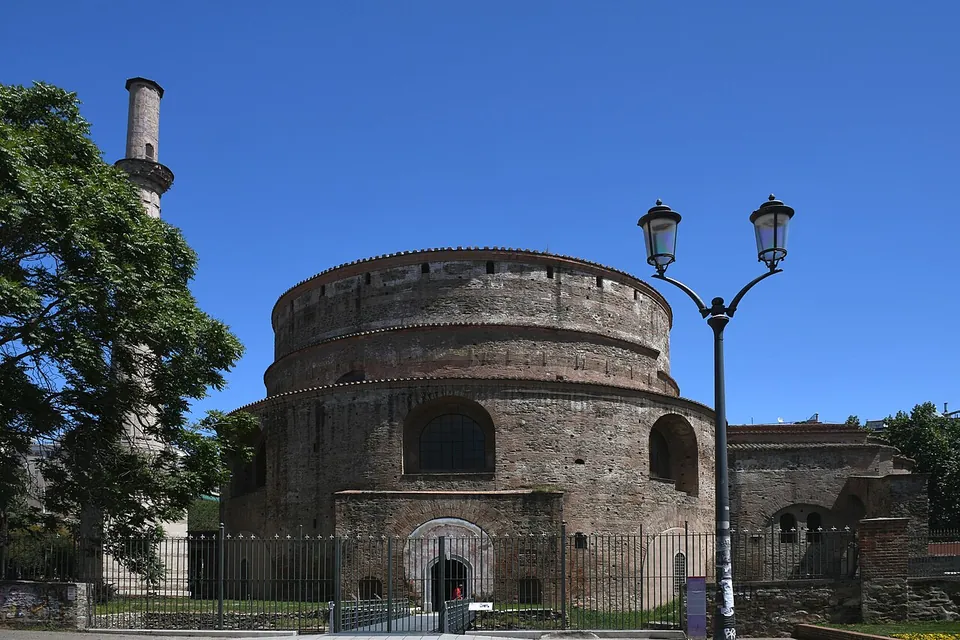
The building stands complete to its dome. It is about 24.5 m across inside, with walls 6.30 m thick and a flat brick dome rising to 28–30 m by the published figures (en.wikipedia; de.wikipedia; el.wikipedia; the operator). Eight vaulted recesses are cut into the thickness of the wall, with large arched windows above them and a row of smaller ones higher up; the dome once had an opening at the top to let in daylight (el.wikipedia). When it was built it was the largest brick dome in the world (de.wikipedia).
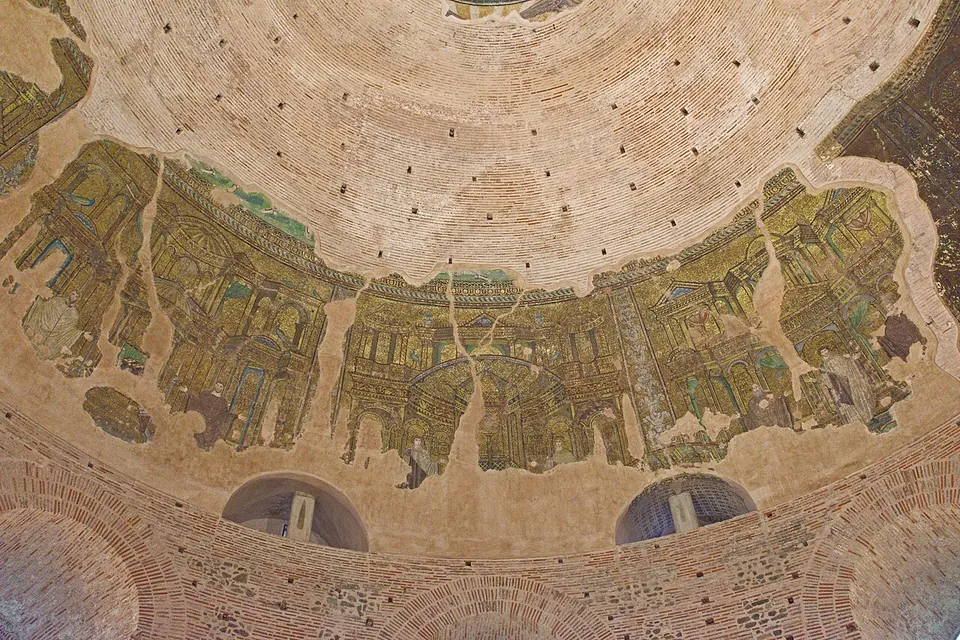
The mosaics are the reason to go inside. The dome and the vaults of the recesses were once covered in them, and many are lost (en.wikipedia). What survives best is a band in the dome of saints - two or three to each of eight panels, praying, in front of fantastic two-storey buildings on a gold ground - with inscriptions giving their names (el.wikipedia). Above it, a charcoal sketch on the plaster shows where a figure of Christ once stood at the top of the dome, and fragments of the four angels who held up his medallion have survived (the operator; el.wikipedia). The vaults are decorated with fruit, birds, flowers and geometric patterns in bright colours (el.wikipedia; en.wikipedia). They are counted among the oldest wall mosaics of the Christian East (de.wikipedia) and as masterpieces of the early Byzantine period (the operator).
Outside, the minaret from its time as a mosque still stands, the only one left in Thessaloniki (de.wikipedia), and ancient remains are displayed on the south side (en.wikipedia).
Is it worth the trip?
Yes. It is an emperor’s building still standing to its dome, and the most important surviving church of the early Christian period in the Greek-speaking part of the Roman Empire (en.wikipedia); its mosaics are masterpieces of the early Byzantine period (the operator). It is on UNESCO’s World Heritage List with the Arch of Galerius (en.wikipedia), which stands 125 m away, so the two make one visit. A ticket is €10; it is closed on Tuesdays (the operator).
Getting there
The Rotunda is on Agiou Georgiou Square, an 18-minute walk from Aristotelous Square; the nearest metro station is Sintrivani, on line 1 (the operator). Buses stop at Panepistimio, about 170 m away (OpenStreetMap). The Arch of Galerius is 125 m to the south-west down a pedestrian street, and Galerius’s palace 235 m beyond the arch (en.wikipedia); the Roman Forum is about 800 m to the north-west.
It opens daily except Tuesday: 08.00–20.00 from 1 April to 30 September, 08.00–19.00 in the first half of October and 08.00–18.00 in the second, and 08.30–15.30 from 1 November to 31 March. Last entry is 20 minutes before closing; it is shut on 1 January, 25 March, 1 May, Easter Sunday and 25–26 December. A ticket is €10, reduced €5, and entry is free on 6 March, 18 April, 18 May, the last weekend of September, 28 October, and on the first and third Sunday of each month from November to March (hh.gr, read 9 October 2026 — check before travelling). The Greek Orthodox Church uses the building for festivities on some days of the year (en.wikipedia).
Visiting details
- Opening hours
- Daily except Tuesday, 08.00–20.00 from 1 April to 30 September; 08.00–19.00 from 1 to 15 October and 08.00–18.00 from 16 to 31 October; 08.30–15.30 from 1 November to 31 March. Last entry 20 minutes before closing. Closed 1 January, 25 March, 1 May, Easter Sunday and 25–26 December.
- Tickets
- €10; reduced €5. Free on 6 March, 18 April, 18 May, the last weekend of September and 28 October, and on the first and third Sunday of each month from November to March.
- Parking
- No car park is mapped close by; bus stops (Panepistimio) are about 170 m away (OSM node/5471054325), and the operator gives Sintrivani on metro line 1.
Hours and prices checked 9 October 2026 on the operator's own site. Confirm before travelling.
History
Galerius had the Rotunda built around 304–306 (el.wikipedia; en.wikipedia; de.wikipedia) as part of his palace quarter: a processional road ran north-east to it from his triumphal arch, and its first entrance was on the south-west, where that road arrived (el.wikipedia). He died in 311 and was buried at Felix Romuliana, in today’s Serbia (see its page), so the Rotunda stood empty for decades (en.wikipedia).
At the end of the 4th century, under Theodosius I, it was turned into a church: the east recess was opened up into a sanctuary, a new entrance was made on the west, and a lower outer wall built 8 m out created an aisle all round (el.wikipedia); de.wikipedia leaves open whether this happened under Constantine or Theodosius. The church has been identified with the Church of the Archangels (the Asomatoi) named in Byzantine sources (en.wikipedia; el.wikipedia).
In 1590 it became a mosque and gained its minaret (en.wikipedia; de.wikipedia; el.wikipedia gives 1591). After Thessaloniki became Greek in 1912 it was consecrated as the Church of Agios Georgios, probably named after a small chapel nearby (el.wikipedia; the operator; de.wikipedia). It was damaged by the earthquake of 1978 and then restored (en.wikipedia), and reopened as a museum in 1999 (de.wikipedia).
More photographs

Sources
Every fact on this page comes from the records below, each used under the licence noted.
| Source | Licence |
|---|---|
| Pleiades 264924632 | CC BY |
| Wikidata Q1584841 | CC0 |
| OpenStreetMap way/59559434 | ODbL |
| Hellenic Heritage (H.O.C.R.E.D., for the Ministry of Culture) — Rotunda, hours and tickets | licence not recorded |
| Wikipedia (en) — Arch of Galerius and Rotunda | CC BY-SA 4.0 |
| Wikipedia (de) — Rotunde (Thessaloniki) | CC BY-SA 4.0 |
| Wikipedia (el) — Ροτόντα (Θεσσαλονίκη) | CC BY-SA 4.0 |