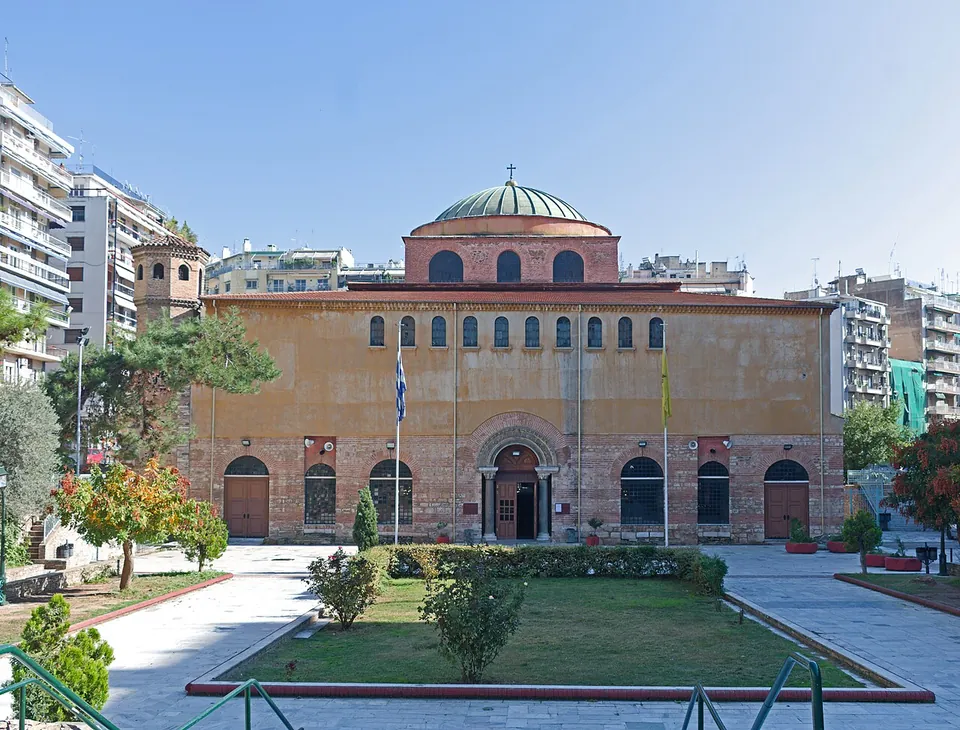
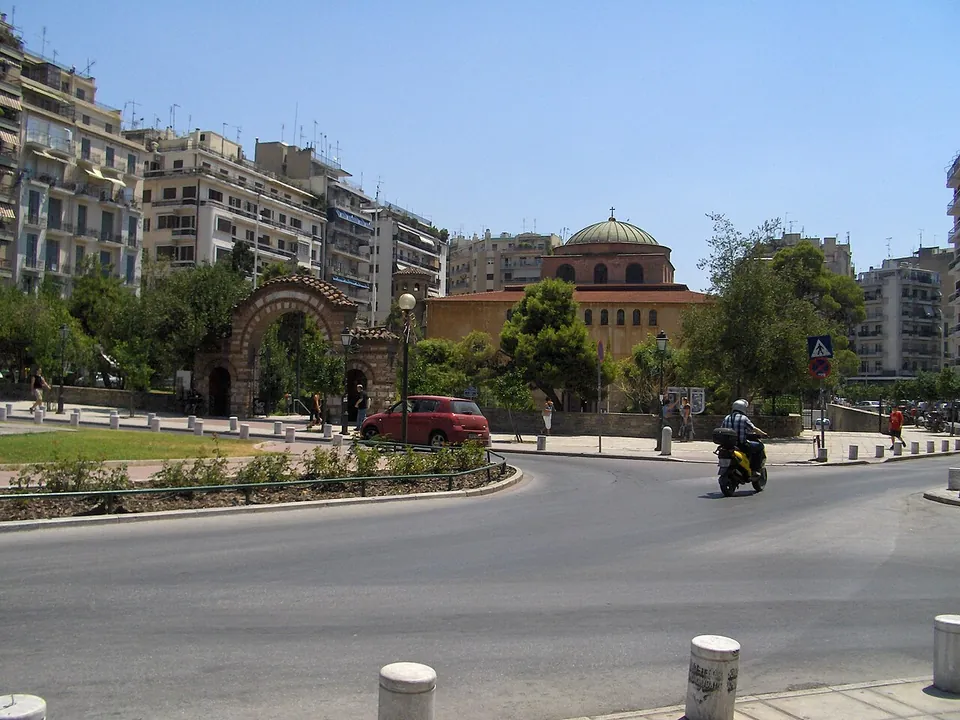


Hagia Sophia, the church of the Holy Wisdom, is one of the oldest churches still standing in Thessaloniki. A church stood here from Roman times; the present domed building was raised in the 7th century, after the earlier church collapsed in 620, and it is still the city’s cathedral (en.wikipedia; el.wikipedia). It belongs to the very end of the period this atlas covers, and much of what you see inside is later Byzantine work.
What is there today
The church is a domed basilica: the columns of the nave are pushed out to the sides so that the central space forms a cross, a step between the domed basilica and the cross-in-square church of later Byzantine architecture (en.wikipedia). Its plan is almost square, and the dome is 10 m across (de.wikipedia).
The mosaics are of the 8th and 9th centuries (de.wikipedia). In the apse, a plain gold ground with a single great cross, of the time when religious images were banned, was replaced with the Virgin (Theotokos) in 787–797; the dome shows the Ascension, with the Twelve Apostles, the Virgin and two angels around it (en.wikipedia).
Is it worth the trip?
Yes, if you are in the centre of Thessaloniki: it stands on its own square a short walk from the Acheiropoietos and the Roman forum, and it is a working cathedral, with nothing to pay as far as any source records (en.wikipedia; OpenStreetMap). Come for the dome and its mosaics rather than for Rome: the building is of the 7th century and its decoration later still.
Getting there
The church stands on Agias Sofias Square in the city centre (de.wikipedia). Buses stop at “Agias Sofias” about 40 m away, and a paid underground car park is mapped about 180 m away (OpenStreetMap). No visiting hours are published.
Visiting details
- Tickets
- Free
- Parking
- On Agias Sofias Square in the city centre (de.wikipedia); buses stop at "Agias Sofias" about 40 m away (OSM node/5471079921), and a paid underground car park is mapped about 180 m away (node/3738891893). It is the cathedral of the Metropolis of Thessaloniki and a working church; no visiting hours are published.
History
Pleiades records a church to Saint Sophia here from the 3rd century AD; de.wikipedia dates the earlier church to 315. The present building, modelled on the Hagia Sophia in Constantinople, followed the collapse of 620. It was the cathedral of the Crusaders’ Thessaloniki from 1205 to 1224, became a mosque after the Ottoman conquest of 1430, and was a church again from 1912. A fire in 1890 damaged it, and the historian Charles Diehl restored it in 1907–1909; much of the interior decoration was plastered over after the Great Fire of 1917, and the dome was restored only in 1980 (en.wikipedia).
Sources
Every fact on this page comes from the records below, each used under the licence noted.
| Source | Licence |
|---|---|
| Pleiades 332324146 | CC BY |
| Wikidata Q1568660 | CC0 |
| OpenStreetMap way/27715355 | ODbL |
| Wikipedia (en) — Hagia Sophia, Thessaloniki | CC BY-SA 4.0 |
| Wikipedia (de) — Hagia Sophia (Thessaloniki) | CC BY-SA 4.0 |
| Wikipedia (el) — Αγία Σοφία (Θεσσαλονίκη) | CC BY-SA 4.0 |
| Wikipedia (en) — Macedonia (Roman province) | CC BY-SA 4.0 |