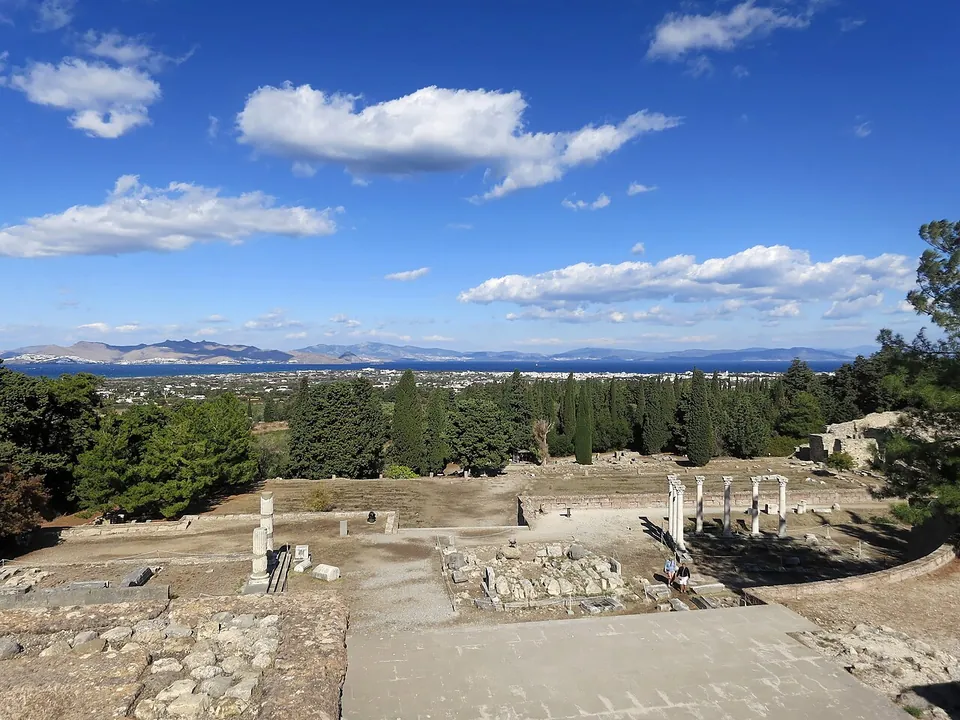


The Asklepieion of Kos is the sanctuary of Asklepios, the god of healing, on a hillside above the sea outside Kos town: the place where scientific medicine grew, thanks to Hippocrates and the school he founded (the operator). It was built in Greek times, and Rome added baths, fountains and a temple to it.
What is there today
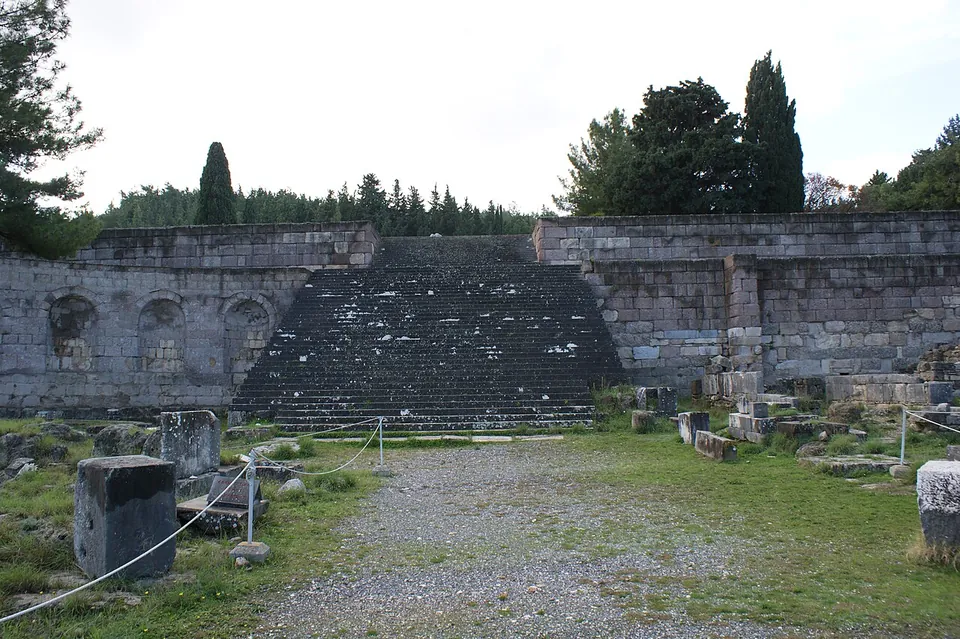
The sanctuary is laid out on three terraces joined by staircases (the Ministry’s leaflet; the operator). Under Rome, fountains with thermal water, cisterns, latrines and baths were added (the operator).
The lowest terrace was enclosed on three sides by a colonnade, of which only the foundations can be seen now. To the east lie Roman baths of the 3rd century AD, with remains of wall paintings and floor mosaics. In the Roman period recesses were made in the retaining wall of the second terrace; in one of them a spring and a cistern survive. Beside the staircase stands a recess in the shape of a small temple with a statue base, probably of Nero, dedicated by Gaius Stertinius Xenophon of Kos, the personal doctor of the emperors Tiberius, Claudius and Nero (the Ministry’s leaflet).
The second terrace holds the oldest structure of the sanctuary, a great altar of the mid-4th century BC, the earliest temple of Asklepios, in the Ionic order, of the 3rd century BC, and a building taken for the priests’ house or the place where the sick slept awaiting the god. East of the altar stands a small Roman temple in the Corinthian order, of the 2nd century AD (the Ministry’s leaflet).
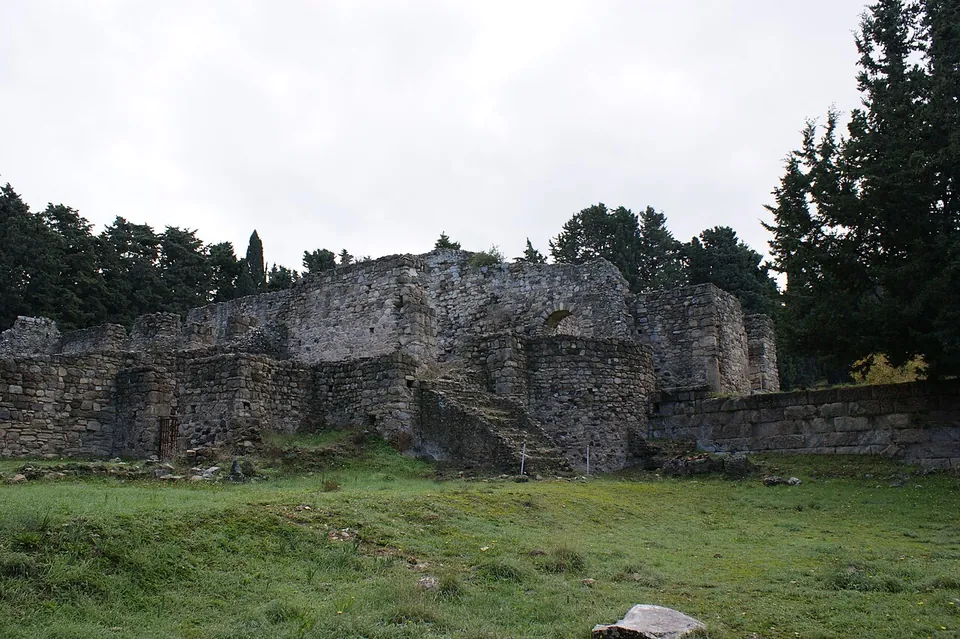
The top terrace is taken up by the large Doric temple of Asklepios, of the 2nd century BC. An early Christian church was later built in its porch; only a capital of it survives. The Knights of St John quarried much of the temple’s upper parts for their medieval castle (the Ministry’s leaflet).
Is it worth the trip?
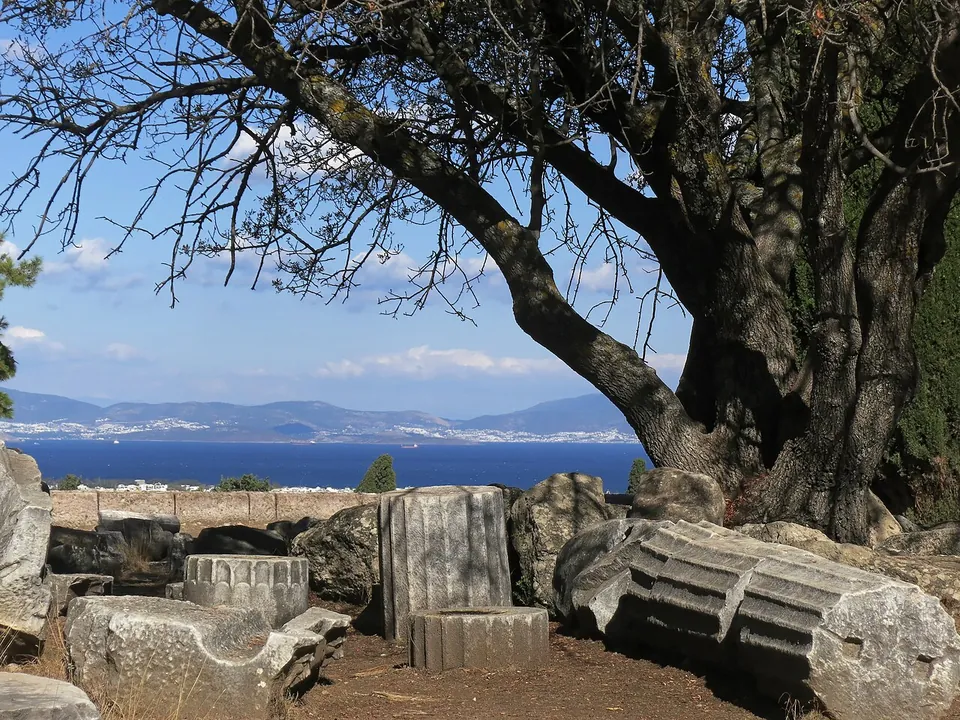
Yes. It is the most famous monument on Kos, and the view from its terraces over the sea to the coast of Asia Minor is part of the visit (the Ministry’s leaflet). The sanctuary is Greek in plan and in its great temples; the Roman layer is the baths, the fountains and recesses below the second terrace, and the small Corinthian temple. What you see owes a good deal to the Italian archaeologists who restored the site and gave it its present form (the Ministry’s leaflet). A ticket is €15.
Getting there
The Asklepieion lies south-west of Kos town, 3.5 to 4 km out (de.wikipedia; the Ministry’s leaflet gives 3.5 km), a 13-minute drive (the operator). A free car park is mapped about 220 m from the site, and a bus stop about 190 m away (OpenStreetMap).
It opens daily from 08.00. From 1 April to 31 August it closes at 20.00; through September and October closing comes earlier in steps, to 18.00 in the second half of October; from 1 November to 31 March it opens 08.30–15.30. Last entry is 20 minutes before closing, and the site is shut on 1 January, 25 March, 1 May, Easter Sunday and 25–26 December. A ticket is €15, reduced €8, and entry is free on 6 March, 18 April, 18 May, the last weekend of September, 28 October, and on the first and third Sunday of each month from November to March (hh.gr, read 9 October 2026 — check before travelling). There is a café on site (the operator).
Visiting details
- Opening hours
- Daily 08.00–20.00 from 1 April to 31 August, then closing earlier through the autumn (19.30 in early September, 18.00 by late October); 08.30–15.30 from 1 November to 31 March. Last entry 20 minutes before closing. Closed 1 January, 25 March, 1 May, Easter Sunday and 25–26 December.
- Tickets
- €15; reduced €8. Free on 6 March, 18 April, 18 May, the last weekend of September and 28 October, and on the first and third Sunday of each month from November to March. Tickets online at tickets.hh.gr.
- Parking
- A free car park is mapped about 220 m from the point (OSM way/9782792, fee=no), and a bus stop about 190 m away (node/3702082845).
Hours and prices checked 9 October 2026 on the operator's own site. Confirm before travelling.
History
The sanctuary was built between the 4th and the 2nd century BC and remained in use until the 4th century AD. In the early 2nd century BC it came under the protection of King Eumenes II of Pergamon and took on the monumental form it still has, with the great staircase and the Doric temple on the top terrace. From 242 BC, when Kos won official recognition of the sanctuary’s asylia, its protection from warfare; the Great Asklepieia festival, with musical and athletic contests, was founded then and drew competitors from cities across the Greek world (the operator).
The site was found at the beginning of the 20th century by the German archaeologist Rudolf Herzog, on the suggestion of a local antiquarian, Iakovos Zaraftis (de.wikipedia; Zarraphtis in the Ministry’s leaflet); de.wikipedia dates the discovery to 1901 and the excavation to 1901–1904. Italian archaeologists dug further in the 1930s and restored the monuments (the operator).
More photographs

Sources
Every fact on this page comes from the records below, each used under the licence noted.
| Source | Licence |
|---|---|
| Pleiades 599528 | CC BY |
| Wikidata Q2655433 | CC0 |
| Vici.org 23155 | CC BY-SA (text), CC0 (metadata) |
| OpenStreetMap way/178767835 | ODbL |
| Ministry of Culture and Sports — The Asklepieion on Kos (site leaflet, text by Ersi Brouskari) | licence not recorded |
| Hellenic Heritage (H.O.C.R.E.D., for the Ministry of Culture) — Asclepieion, Kos, hours and tickets | licence not recorded |
| Wikipedia (de) — Asklepieion von Kos | CC BY-SA 4.0 |
| Wikipedia (el) — Ασκληπιείο Κω | CC BY-SA 4.0 |
| Wikipedia (en) — Temple of Asclepius, Kos | CC BY-SA 4.0 |