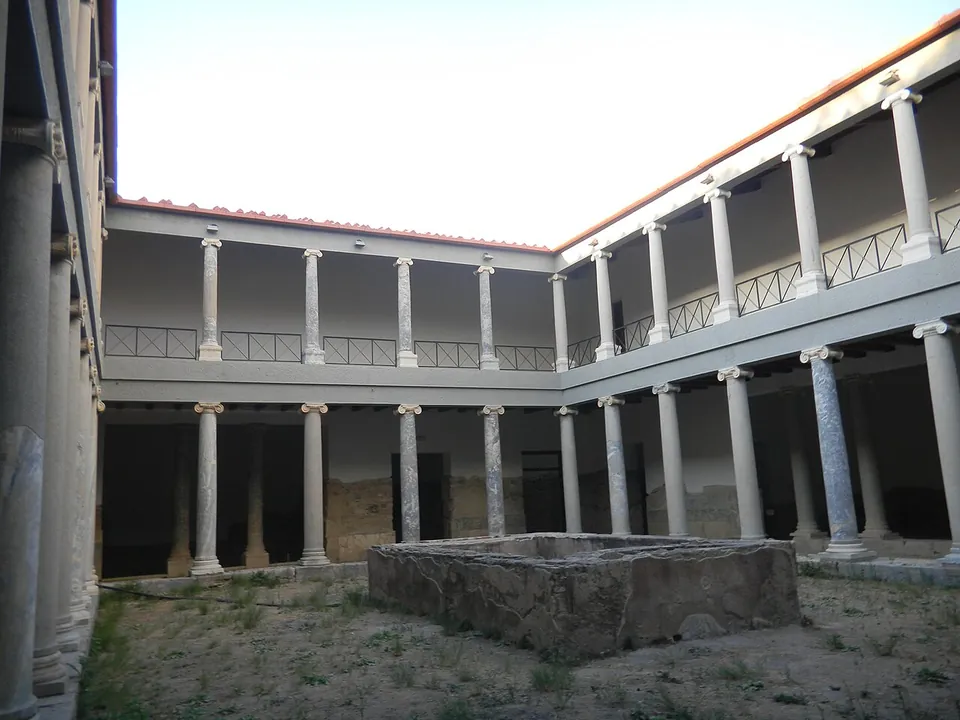
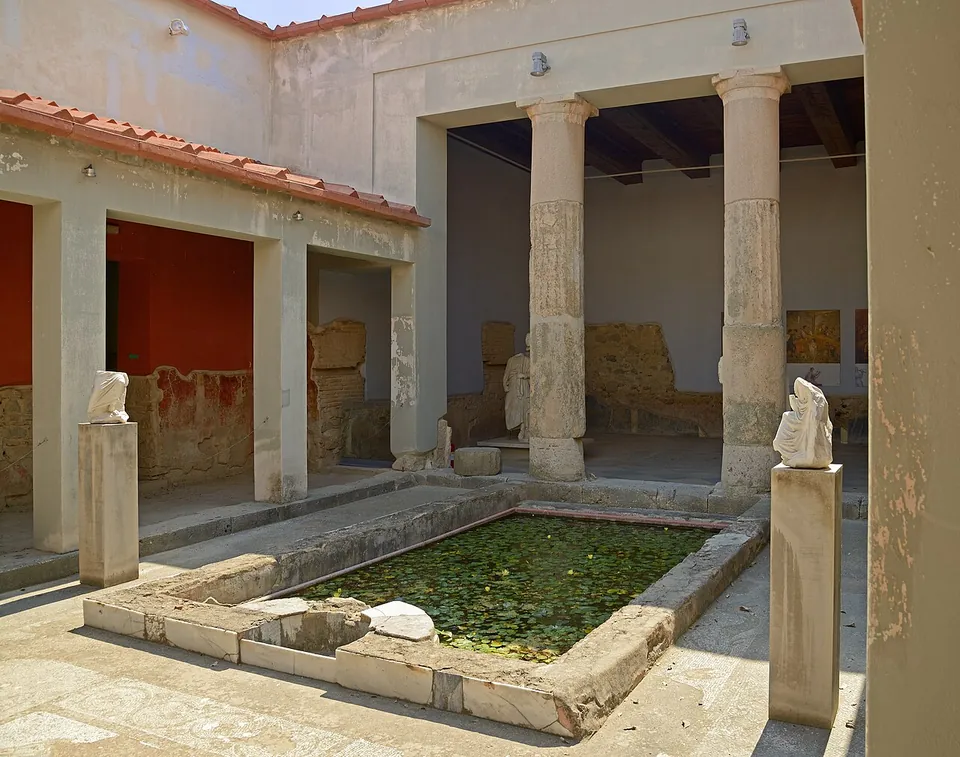


The Casa Romana is a rich Roman town house of the 2nd–3rd century AD in the town of Kos, of the type known from Pompeii, rebuilt by 1940 so that its courtyards and rooms can be walked through (the operator; de.wikipedia). Its 36 rooms are arranged around three courtyards with pools, and their floors keep mosaics of a panther bringing down a deer, a Nereid riding a hippopotamus, dolphins and wild animals (the operator; el.wikipedia).
What is there today
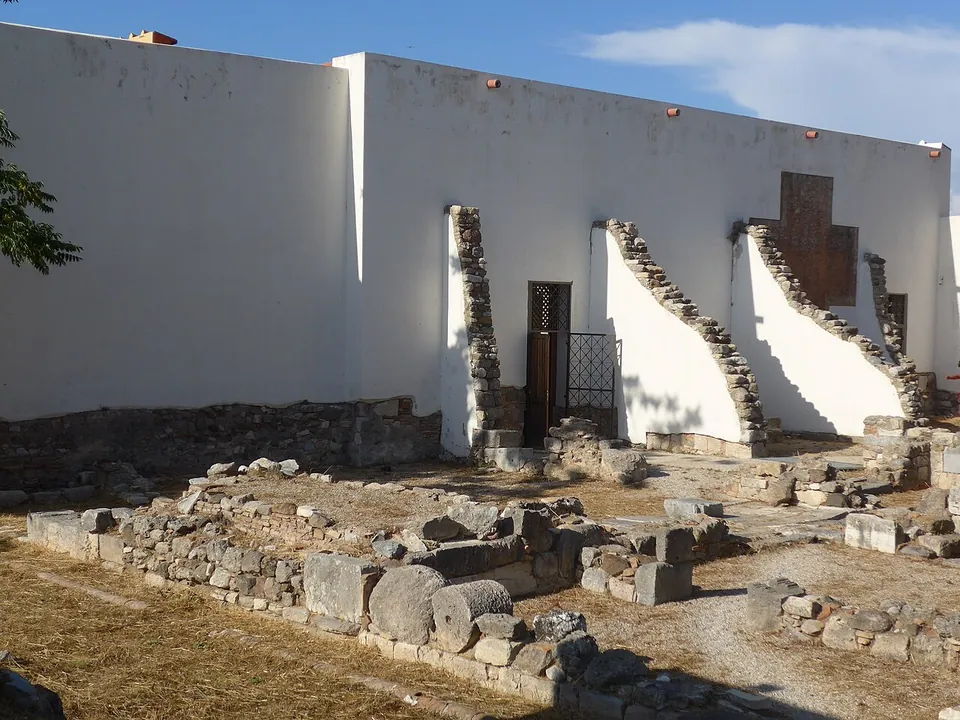
The rebuilt house covers about 1,800 m² within an excavated area of some 6,000 m² (de.wikipedia). The main entrance is on the east side, where a base carries the inscription “ΑΠΕΛΕΞΙΚΑΚΟΣ”, “he who wards off evil”; the first courtyard has a small basin and, on its floor, a well-preserved mosaic of a panther tearing at a deer. Almost every room has mosaics: in the main reception room and others there are geometric floors, tigers and panthers, and traces of marble wall facing; the service rooms lie on the north-west side, by the stairs to the upper floor (el.wikipedia). The rooms also show finds from the house: pottery and glass, coins, wall paintings and marble sculpture (the operator).
The house was built over a Hellenistic one, as statues of Nymphs and of Athena found here suggest (the operator; el.wikipedia).
Is it worth the trip?
Yes. It is a Roman house rebuilt so that you can walk through it, with its courtyards, pools and floor mosaics, a 10-minute walk from the port of Kos; a ticket is €10 (the operator; de.wikipedia). The odeon lies close by, and the western excavation site across the road (de.wikipedia).
Getting there
The house is on Grigoriou E’ Avenue, about 500 m south of the harbour, 10 minutes on foot or 5 by car from the port (the operator; de.wikipedia). A free car park is mapped about 90 m away, and the KTEL bus stops about 170 m away (OpenStreetMap).
It opens daily except Tuesdays: 08.00–20.00 from 1 April to 31 August, closing earlier through September and October (18.00 by the second half of October), and 08.30–15.30 from 1 November to 31 March. Last entry is 20 minutes before closing; it is shut on 1 January, 25 March, 1 May, Easter Sunday and 25–26 December. A ticket is €10, reduced €5, and entry is free on 6 March, 18 April, 18 May, the last weekend of September, 28 October, and on the first and third Sunday of each month from November to March (hh.gr, read 10 October 2026 — check before travelling). There are toilets and parking (the operator).
Visiting details
- Opening hours
- Daily except Tuesdays, 08.00–20.00 from 1 April to 31 August, then closing earlier through the autumn (19.30 in early September, 18.00 by late October); from 1 November to 31 March 08.30–15.30, closed on Tuesdays. Last entry 20 minutes before closing. Closed 1 January, 25 March, 1 May, Easter Sunday and 25–26 December.
- Tickets
- €10; reduced €5. Free on 6 March, 18 April, 18 May, the last weekend of September and 28 October, and on the first and third Sunday of each month from November to March.
- Parking
- On Grigoriou E' Avenue, 10 minutes on foot or 5 by car from the port of Kos (the operator), which lists parking; a free car park is mapped about 90 m away (OSM way/433841171), and the KTEL bus stops about 170 m away (node/8996360518).
Hours and prices checked 10 October 2026 on the operator's own site. Confirm before travelling.
History
The house was found in 1933, after the earthquake that destroyed much of Kos, when the island was under Italian rule; the Italian archaeologist Luciano Laurenzi excavated it, and the Italian administration rebuilt it by 1940. It was restored again in 1976 (the operator; de.wikipedia; el.wikipedia).
Sources
Every fact on this page comes from the records below, each used under the licence noted.
| Source | Licence |
|---|---|
| Wikidata Q16327980 | CC0 |
| OpenStreetMap way/82790135 | ODbL |
| Hellenic Heritage (H.O.C.R.E.D., for the Ministry of Culture) — Roman Villa (Casa Romana), Kos, hours and tickets | licence not recorded |
| Wikipedia (de) — Casa Romana | CC BY-SA 4.0 |
| Wikipedia (el) — Ρωμαϊκή οικία Κω | CC BY-SA 4.0 |