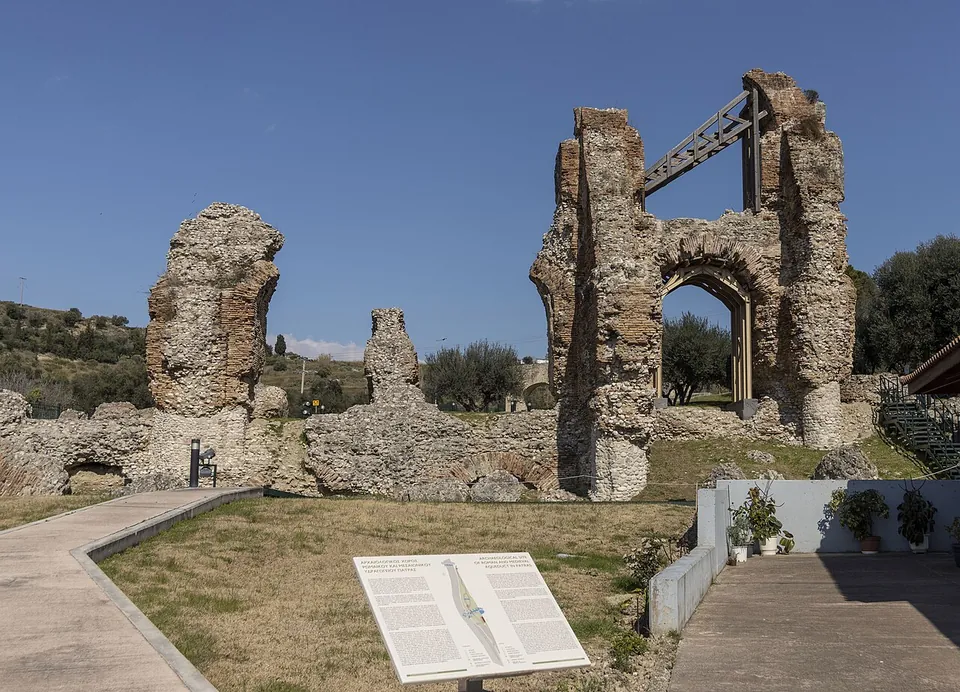
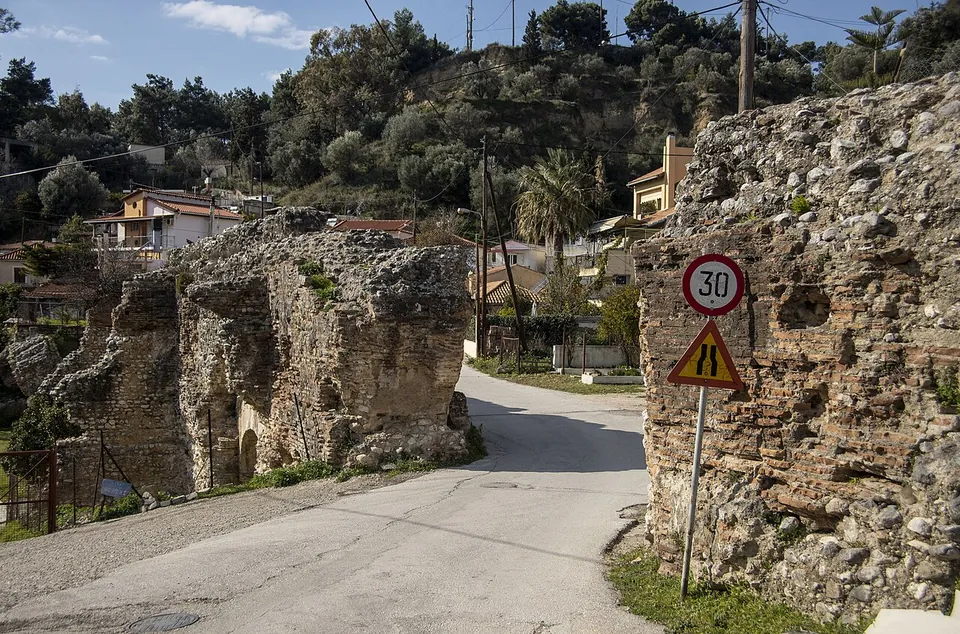


The Roman aqueduct of Patras brought water to the Roman city from the springs of Romanos on Mount Panachaiko, probably from the reign of Hadrian. Its tall piers of stone and brick still stand in two places: in a small archaeological park at Aroi and astride a street in Asyrmatos (en.wikipedia; el.wikipedia).
What is there today
The park at Aroi, the “Roman and Medieval Aqueducts of Patras”, opened in September 2018 beside the city’s short ring road, whose building it had held up for more than ten years. It shows the Roman piers together with a stretch of a later aqueduct of the Ottoman period, of the 15th–16th century, which was found a few hundred metres away in 2006 and moved here in pieces in 2009 (en.wikipedia; el.wikipedia).
In Asyrmatos, well-preserved sections of the Roman aqueduct cross the yards of houses and the neighbourhood’s street (el.wikipedia). Other parts of both aqueducts still lie on private land (en.wikipedia).
Most of the channel ran underground, and it crossed valleys and gorges on arches (en.wikipedia); el.wikipedia describes two tiers of arches of cut stone faced with brick, with the water channel on top. Published figures for its length range from 6.5 to 7.5 km, from the springs to the ancient acropolis, where the castle stands today (en.wikipedia; el.wikipedia).
Is it worth the trip?
Worth a short stop if you are already in Patras for the odeon and the museum: the piers are imposing, and the park has paths and an information board (the photograph). No bus stop is mapped near the park, so a car or a taxi helps (OpenStreetMap).
Getting there
The park lies beside the short ring road at Aroi, with a car park mapped about 50 m away (OpenStreetMap). It is fenced, and no operator publishes its hours; the arches in Asyrmatos can be seen from the street.
Visiting details
- Tickets
- Free
- Parking
- The park lies beside Patras' short ring road at Aroi, with a car park mapped about 50 m away (OSM way/512059282); no bus stop is mapped nearby. The park is fenced (OSM way/295361210) and no operator publishes its hours; the arches in Asyrmatos stand over a public street.
History
The Romans made Patras a colony after Actium, and the aqueduct was one of the public works that served its large population (en.wikipedia). At the springs they built a large cistern in the form of a dam, part of which is built into the base of today’s water tank, and an inscription shows that the Nymphs were worshipped there; the city still draws water from the same springs (en.wikipedia; el.wikipedia). A Christian tradition instead credits it to Artemios, sent by the emperor Constantius to take the relics of Saint Andrew to Constantinople, which happened in 353 or 357: the people of Patras gave up the relics in exchange for the water (el.wikipedia). Travellers saw the aqueduct still carrying water in the 17th century (en.wikipedia); el.wikipedia records repairs as late as 1838 and use until 1874, when pipes took over.
Nearby
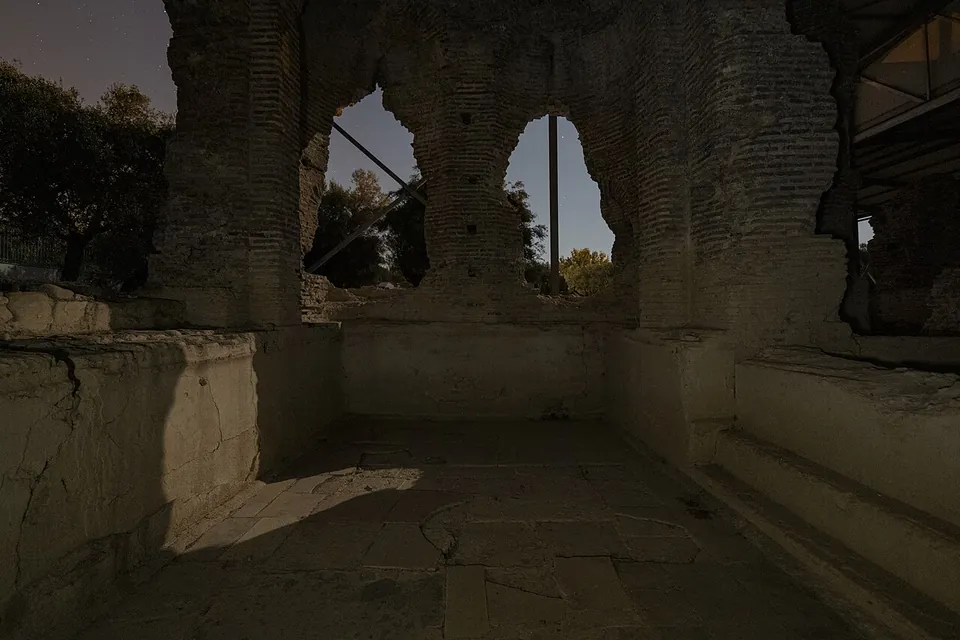
Photo: ΥΠΠΟΑ/ΕΦΑΑΙΤ/(George Ntekas) · CC BY-SA 4.0 · Commons
30 km · bath · Aetolia-Acarnania
Roman Baths of Agios Thomas
The bath house is built of rows of fine brick and stands to a height of 7 m (the operator).

Straight-line distances.
Sources
Every fact on this page comes from the records below, each used under the licence noted.
| Source | Licence |
|---|---|
| Wikidata Q12884201 | CC0 |
| OpenStreetMap way/295361210 | ODbL |
| Wikipedia (en) — Roman and Medieval Aqueducts of Patras | CC BY-SA 4.0 |
| Wikipedia (el) — Ρωμαϊκό υδραγωγείο Πάτρας | CC BY-SA 4.0 |
| Wikipedia (en) — Achaia (Roman province) | CC BY-SA 4.0 |