Skip to content
Menu
Hidden gemHub · 3 stops1st c. BC – 3rd c. ADUnknown

Patrae – Patras

Colonia Augusta Achaica Patrensis, Aroe, Πάτρα

city · Achaia, Greece

What it is
Patrae, today Patras, was refounded by Augustus after Actium as a Roman colony of army veterans, and it became one of the most populous towns in Greece; the city reached the height of its power under Rome (en.wikipedia).
What you’ll see
The Archaeological Museum, a few metres from the bridge (el.wikipedia), shows finds from prehistory to the 4th century AD, among them gladiators' gravestones and part of the largest collection of Roman mosaic floors in Greece, 250 m² in all; a ticket is €10 (hh.gr).
Worth the trip?
Yes, if you are passing through Patras, whose port links Greece with Italy: the odeon is the city's most significant ancient monument, and the museum's mosaics are worth the trip across town (en.wikipedia; hh.gr).
Getting there & cost
The odeon is in the Upper Town, between Germanou and Sotiriadou streets (the Ministry).UnknownHours, tickets and parking
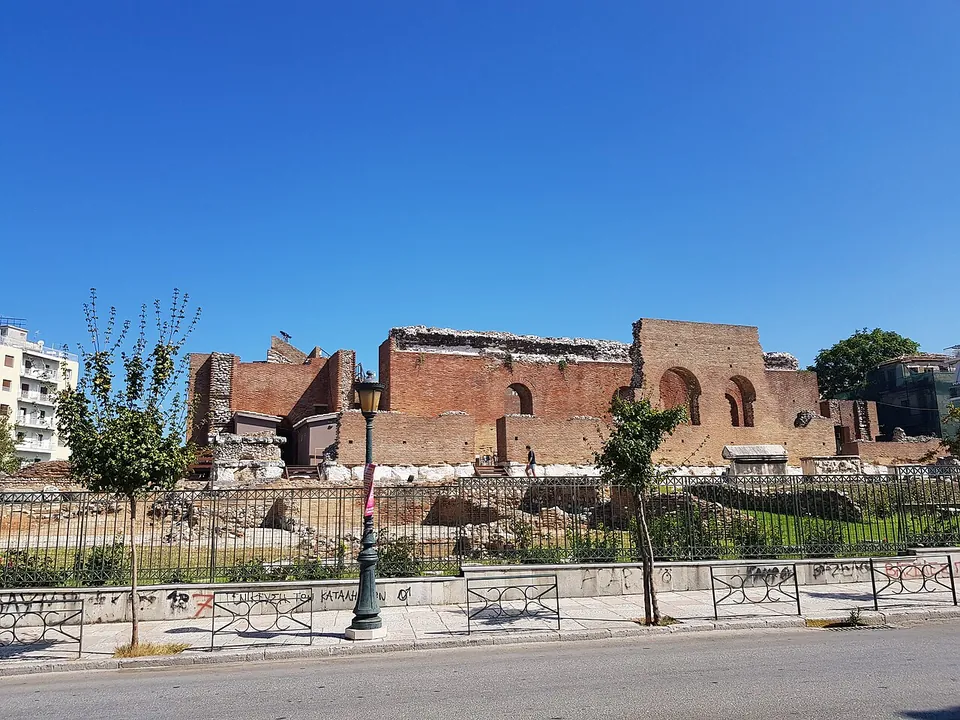
The high brick walls of a ruined stage building with arched openings, seen from a city street through railings, with apartment blocks on either side.
The Roman odeon in the Upper Town, in 2019, before its restoration. · Photo: Armineaghayan · CC BY-SA 4.0 · Wikimedia Commons
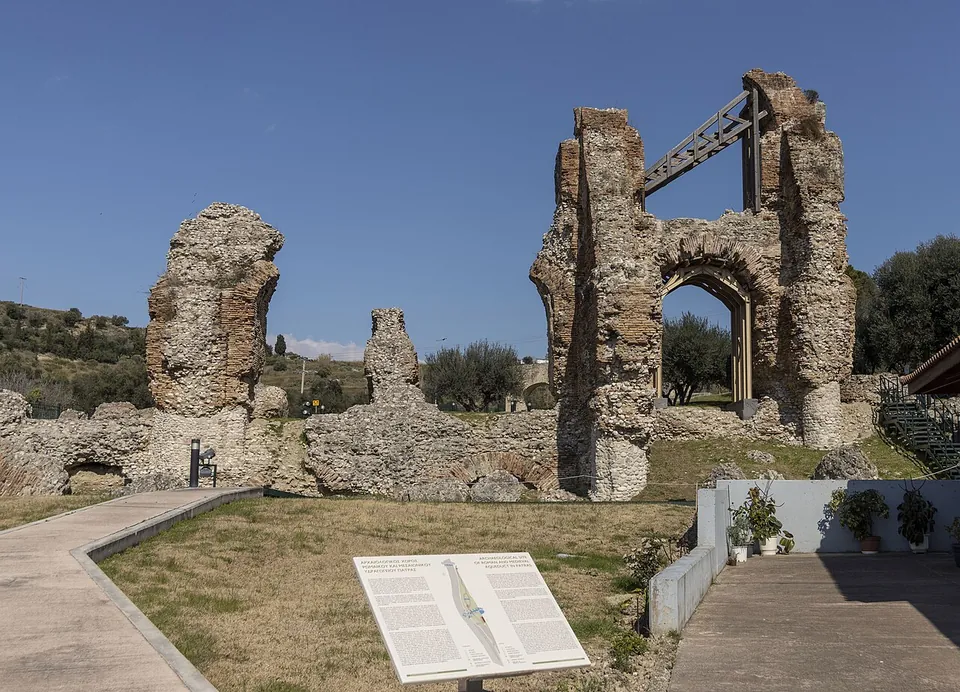
Tall ruined piers of rubble and brick, one still carrying an arch held by a modern steel brace, standing on a lawn with paved paths and an information board in front.
The piers of the Roman aqueduct in the park at Aroi. · Photo: iaberis · CC BY-SA 4.0 · Wikimedia Commons
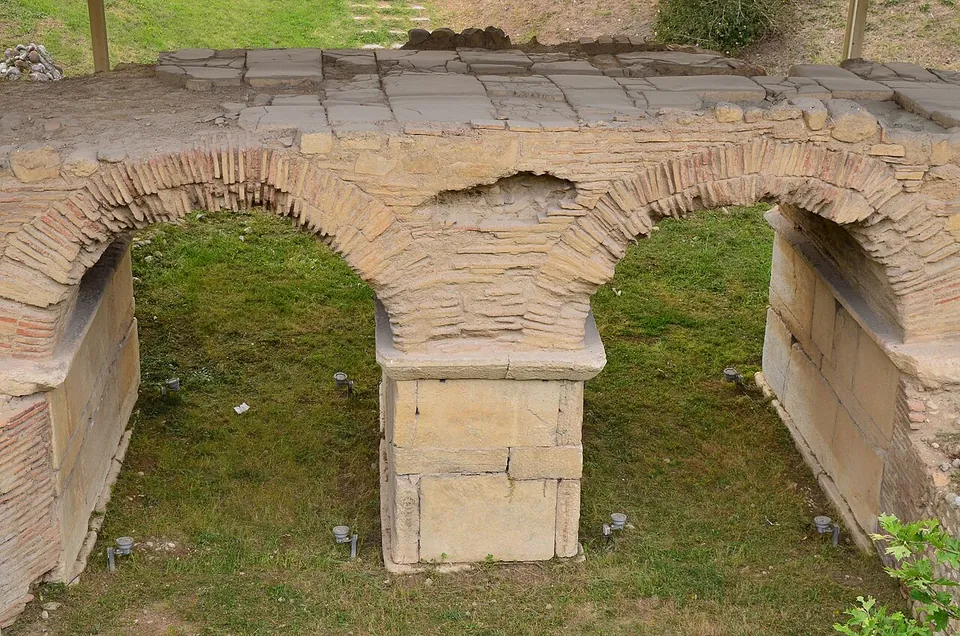
A low bridge of two brick arches on a squared stone pier, its deck of worn stone slabs, sunk in a grassy hollow with small lights in the ground.
The Roman bridge on the road to Aigion. · Photo: Carole Raddato from FRANKFURT, Germany · CC BY-SA 2.0 · Wikimedia Commons

The stops

3 places to see, the best preserved and best known first.

See all 3 stops on the mapWhere each one is, so you can plan your own way round.Open the map →
  1. A low bridge of two brick arches on a squared stone pier, its deck of worn stone slabs, sunk in a grassy hollow with small lights in the ground.

    Photo: Carole Raddato from FRANKFURT, Germany · CC BY-SA 2.0 · Commons

    bridge · Achaia

    Roman Bridge of Patras

    The bridge was found in the early 1980s, when the foundations of a house were being dug, and now lies in a sunken plot under a shelter at the eastern entrance to the city (the Ministry; the photograph).

    Free
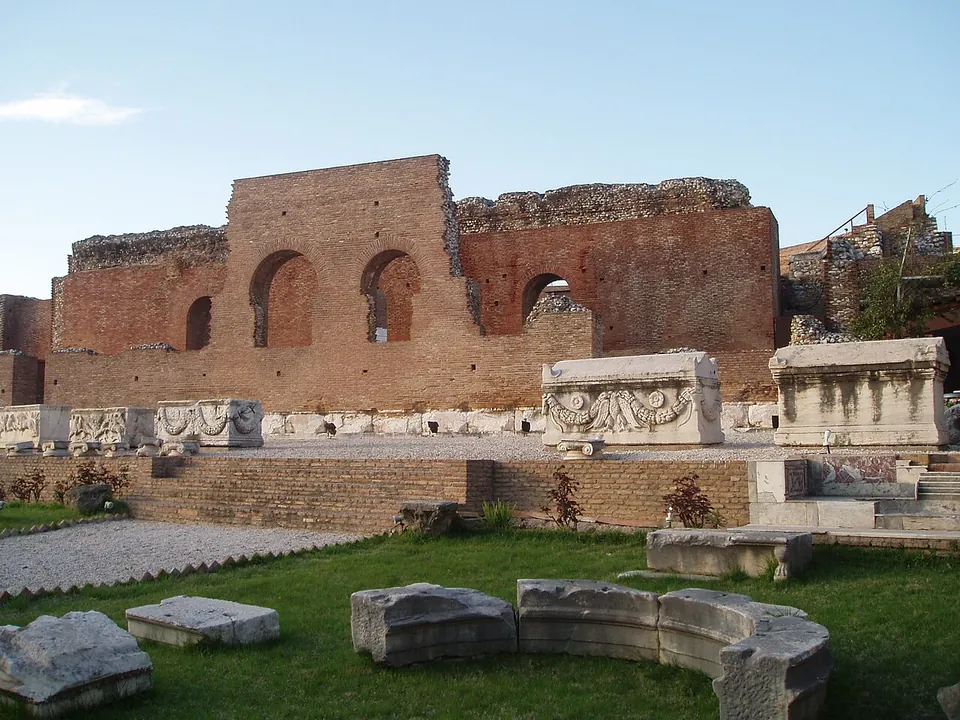
  2. A tall brick wall with three arched openings rising behind a stage edged with carved marble blocks, and fragments of a curved marble parapet lying on the grass in front.

    Photo: Conudrum · CC BY-SA 2.5 · Commons

    theatre · Achaia

    Roman Odeon of Patras

    The tall outer wall of the stage, the odeon's south front, has five doorways onto the stage and two into the side rooms behind it; two built stairways climb to the stage at either side.

    Unknown
  3. Tall ruined piers of rubble and brick, one still carrying an arch held by a modern steel brace, standing on a lawn with paved paths and an information board in front.

    Photo: iaberis · CC BY-SA 4.0 · Commons

    aqueduct · Achaia

    Roman Aqueduct of Patras

    The park at Aroi, the "Roman and Medieval Aqueducts of Patras", opened in September 2018 beside the city's short ring road, whose building it had held up for more than ten years.

    Free

Patrae, today Patras, was refounded by Augustus after Actium as a Roman colony of army veterans, and it became one of the most populous towns in Greece; the city reached the height of its power under Rome (en.wikipedia). Its Roman monuments now stand among the streets of a modern city of some 170,000 people: an odeon whose stage has been rebuilt, an aqueduct and a bridge on the road to Aigion (en.wikipedia; the Ministry).

What is there today

  • The Roman Odeon, in the Upper Town west of the castle, was built in the first half of the 2nd century AD. Restored in 2022–2025, it is the only building of its kind in Greece whose stage has been fully reconstructed, and it seats about 2,500 people for the Patras Festival (the Ministry; Proto Thema). Remains of the Roman stadium lie beside it (el.wikipedia).
  • The Roman aqueduct, probably of Hadrian’s reign, brought water from the springs of Romanos on Mount Panachaiko. Its piers stand in a small park at Aroi, opened in 2018, and across a street in Asyrmatos (en.wikipedia; el.wikipedia).
  • The Roman bridge, of the 2nd–3rd century AD, carried the road to Aigion over the river Kallinaos; the Ministry calls it the best preserved two-arched bridge in Greece. It is free (the Ministry).

The Archaeological Museum, a few metres from the bridge (el.wikipedia), shows finds from prehistory to the 4th century AD, among them gladiators’ gravestones and part of the largest collection of Roman mosaic floors in Greece, 250 m² in all; a ticket is €10 (hh.gr).

Is it worth the trip?

Yes, if you are passing through Patras, whose port links Greece with Italy: the odeon is the city’s most significant ancient monument, and the museum’s mosaics are worth the trip across town (en.wikipedia; hh.gr). The three stops are spread over about 3 km, so the aqueduct and the bridge are easier by car or taxi (OpenStreetMap). No operator publishes hours for the odeon or the aqueduct park.

Getting there

The odeon is in the Upper Town, between Germanou and Sotiriadou streets (the Ministry). The aqueduct park lies beside the short ring road at Aroi, and the bridge at the junction of the New National Road Patras–Athens and Aretha Street, at the eastern entrance to the city (en.wikipedia; the Ministry). The museum is 15 minutes by car or 40 minutes on foot from the centre (hh.gr).

Visiting details

Tickets
Unknown

History

Rome broke the Achaean League in 146 BC, and many people left Patras. After Actium, Augustus settled veterans of the 10th and 12th legions here and gave the rights of colonists to the people of nearby Rhypae and Dyme; Colonia Augusta Achaica Patrensis grew cosmopolitan, struck its own coins from Augustus to Gordian III, paved its streets, and exported its clay oil lamps far across the known world (en.wikipedia). According to Christian tradition, the apostle Andrew was martyred here, and the city became an early centre of Christianity (en.wikipedia). The odeon burned towards the end of the 3rd century, possibly in the raid of the Heruli (the Ministry; Proto Thema), and an earthquake laid the city in ruins in 551 (en.wikipedia).
Nearby

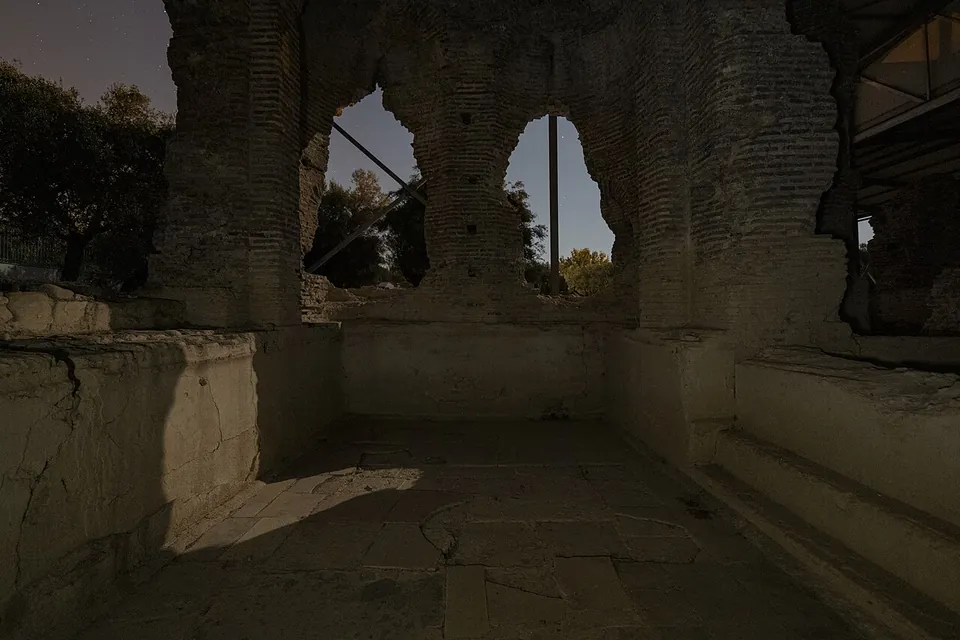
  • Tall ruined walls of brick with two arched window openings, above a sunken basin with a paved floor and a step along one side, lit at night under a protective roof.

    Photo: ΥΠΠΟΑ/ΕΦΑΑΙΤ/(George Ntekas) · CC BY-SA 4.0 · Commons

    29 km · bath · Aetolia-Acarnania

    Roman Baths of Agios Thomas

    The bath house is built of rows of fine brick and stands to a height of 7 m (the operator).

Straight-line distances.