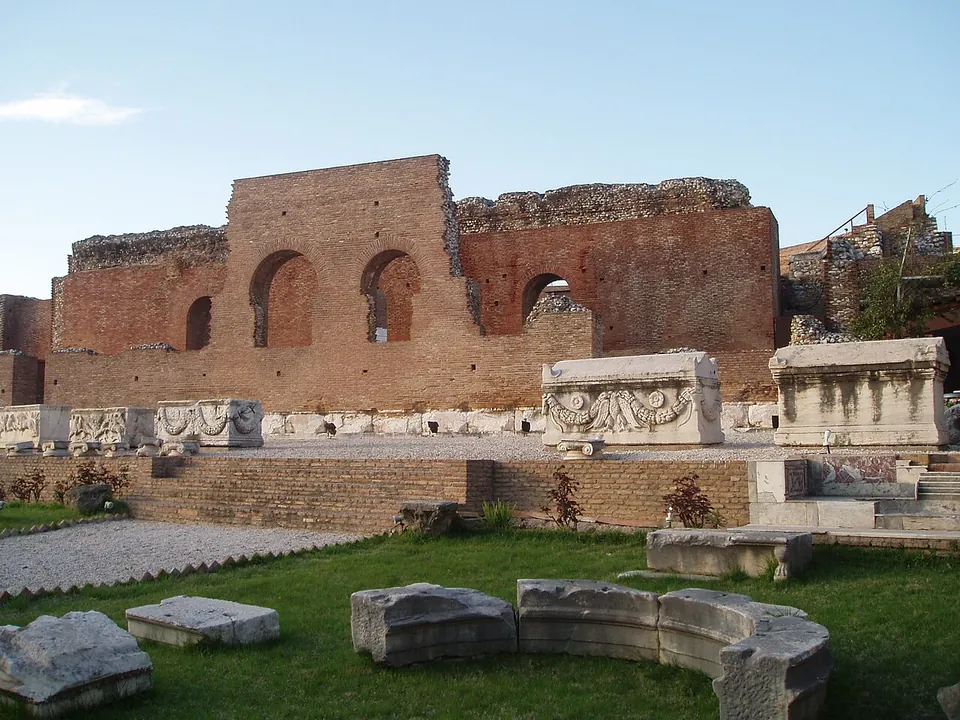
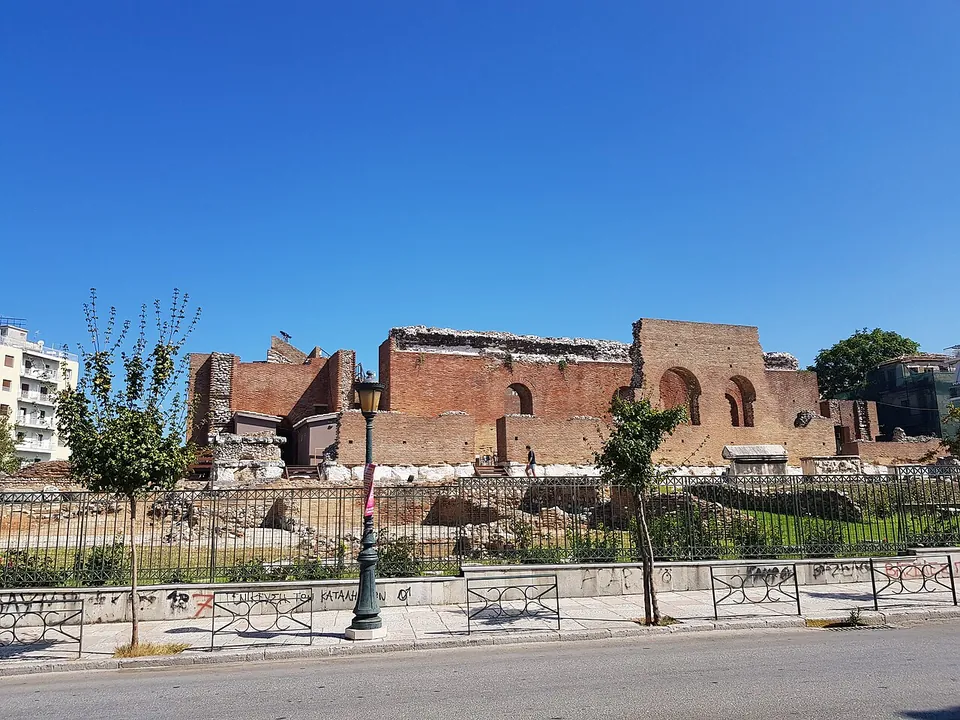
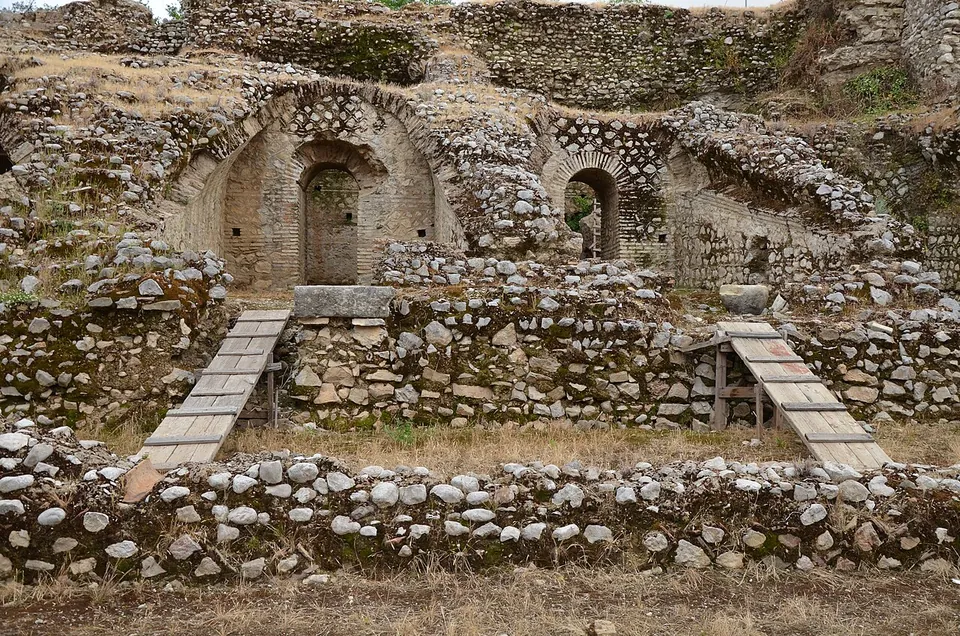


The Roman Odeon of Patras is a theatre of the 2nd century AD in the Upper Town of Patras, built shortly before the Odeon of Herodes Atticus in Athens (the Ministry). Restored between 2022 and 2025, it is the only building of its kind in Greece whose stage has been fully reconstructed, and it seats about 2,500 people for the performances of the Patras Festival (the Ministry; Proto Thema).
What is there today
The tall outer wall of the stage, the odeon’s south front, has five doorways onto the stage and two into the side rooms behind it; two built stairways climb to the stage at either side. The orchestra is paved and parted from the seats by a semicircular parapet, and the seating has four rows below the gangway and seven above it (the Ministry). The floor of the stage was decorated with mosaics (Proto Thema).
The restoration finished in November 2025 corrected the faults of the work of 1960–61 and rebuilt the stage and the rooms behind it, with lighting, a wooden stage floor, a ramp and a lift for visitors with reduced mobility, and bilingual signs, also in braille. Excavation around the building found mosaic floors and traces of burials in the stage building in the early Byzantine period (Proto Thema).
The Roman stadium lies next to the odeon, and its ruins can be seen from Ifaistou Street. It was built in the last quarter of the 1st century AD for the hundredth year of the Roman colony, celebrated in AD 86, and is attributed to a gift of the emperor Domitian. It had two rounded ends and probably measured 200 × 90 m (alfavita.gr). Much of it lies under apartment blocks. Its east side, built against a natural slope, has been uncovered, and the restored part was opened in September 2023 (el.wikipedia; Skai). The games held there, the Kaisareia, drew athletes from all over Greece, and a mosaic from a Roman house, now in the Archaeological Museum, shows the stadium with contests in music, theatre and sport (el.wikipedia).
Is it worth the trip?
Yes, if you are in Patras: it is the city’s most significant ancient monument, and the only Roman stage in Greece that has been fully reconstructed (en.wikipedia; Proto Thema). The Roman stadium is next door, and the Archaeological Museum has the city’s Roman mosaics (el.wikipedia; hh.gr). No operator publishes opening hours or a fee for the odeon, so check locally before you go.
Getting there
The odeon stands in the Upper Town, west of the ancient acropolis and the medieval castle, between Germanou and Sotiriadou streets by Agiou Georgiou square (the Ministry). Car parks are mapped about 160 m away, and town bus stops at Psila Alonia about 260 m away (OpenStreetMap).
Visiting details
- Tickets
- Unknown
- Parking
- In the Upper Town, between Germanou and Sotiriadou streets by Agiou Georgiou square (the Ministry); car parks are mapped about 160 m away (OSM way/497936585, way/483131326), and town bus stops at Psila Alonia about 260 m away (node/3634474601). The Ministry publishes no opening hours or fee.
History
The traveller Pausanias records that the odeon of Patras was older than Herodes’ in Athens and finely decorated, though less so (el.wikipedia). It went out of use towards the end of the 3rd century after a destructive fire, possibly connected with the raid of the Heruli (the Ministry; Proto Thema), and was buried under earth until 1889, when it was found as the hill of Stranis was dug away to fill the new harbour (the Ministry’s guide; el.wikipedia). After the Second World War it was repaired and re-clad in marble, in 1959–63 at the architect Ioannis Vasileiou’s own expense (the Ministry’s guide; el.wikipedia).
Nearby
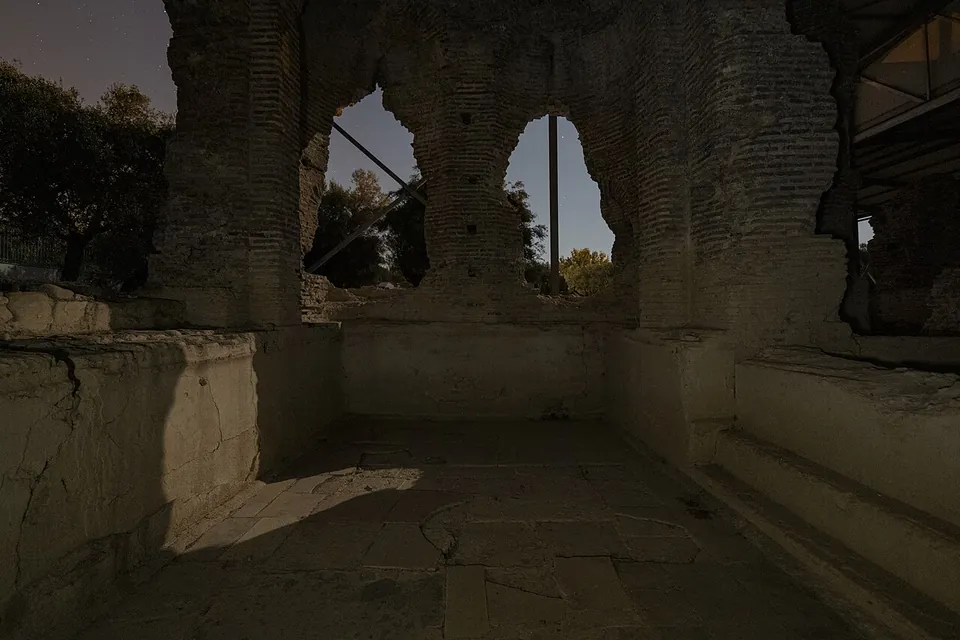
Photo: ΥΠΠΟΑ/ΕΦΑΑΙΤ/(George Ntekas) · CC BY-SA 4.0 · Commons
29 km · bath · Aetolia-Acarnania
Roman Baths of Agios Thomas
The bath house is built of rows of fine brick and stands to a height of 7 m (the operator).

Straight-line distances.
Sources
Every fact on this page comes from the records below, each used under the licence noted.
| Source | Licence |
|---|---|
| Wikidata Q16327108 | CC0 |
| OpenStreetMap way/482489960 | ODbL |
| Hellenic Ministry of Culture (All of Greece One Culture) — Roman Odeon of Patras | licence not recorded |
| Ministry of Culture and Sports (Odysseus) — Odeion of Patras | licence not recorded |
| Proto Thema (English) — "Roman Odeon of Patras - Restored and reopening its doors", 17 November 2025 | licence not recorded |
| Wikipedia (el) — Αρχαίο Ωδείο Πάτρας | CC BY-SA 4.0 |
| Wikipedia (en) — Achaia (Roman province) | CC BY-SA 4.0 |
| Wikipedia (el) — Ρωμαϊκό στάδιο Πάτρας | CC BY-SA 4.0 |
| alfavita.gr — "Roman stadium of Patras", 8 October 2023 | licence not recorded |
| Skai — the restored part of the Roman stadium of Patras inaugurated, 26 September 2023 | licence not recorded |