

What is there today
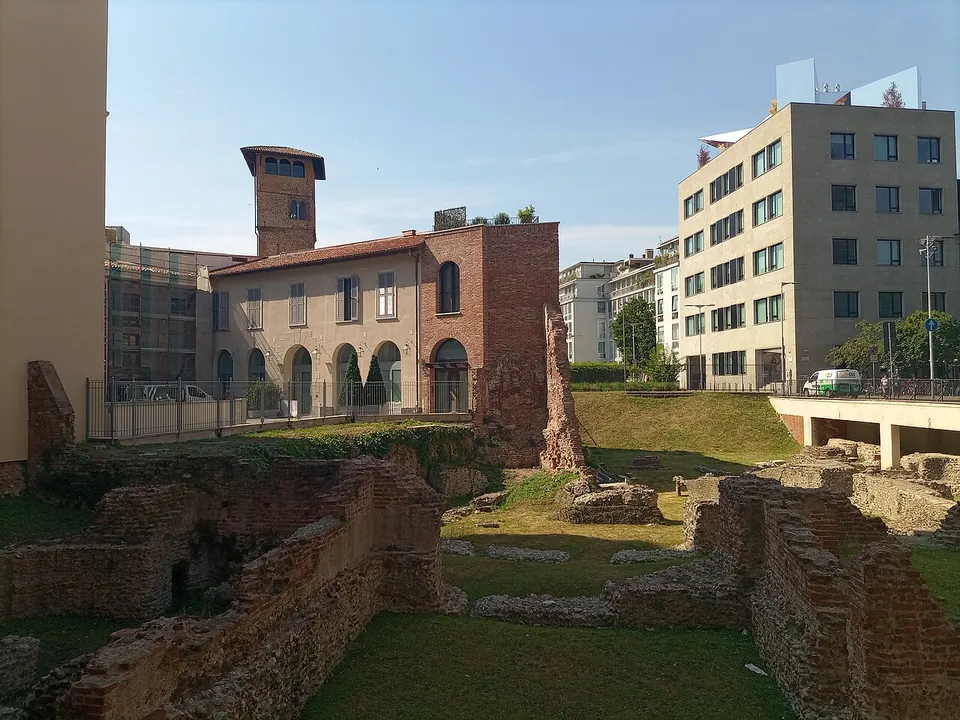
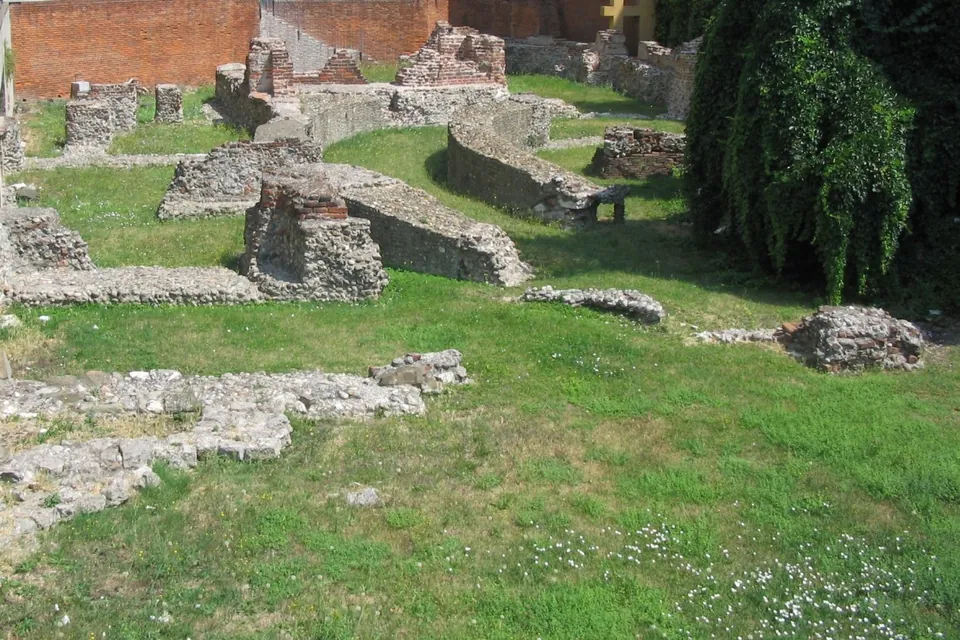
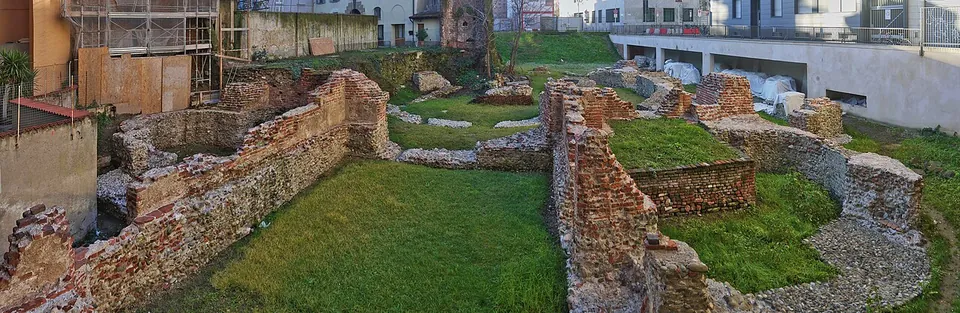
In via Brisa the foundations of the palace’s reception wing lie open to the sky in a green area laid out for display, easy to see (it.wikipedia). They cover about 0.2 hectares and are built of river cobbles set in mortar, with some of the brick walls above them still in place; they are low, and in the apse of the main hall they rise at most 64 cm above the foundations (Piras 2012). The plan is the thing to read. A large hall ending in an apse, flanked by two smaller apsed rooms, opens onto a round central hall 20.70 m across, probably once ringed by columns (it.wikipedia; Piras 2012). The building was heated, and a few of the small pillars that carried one room’s raised floor survive (Piras 2012). A history board stands at the site (OpenStreetMap).
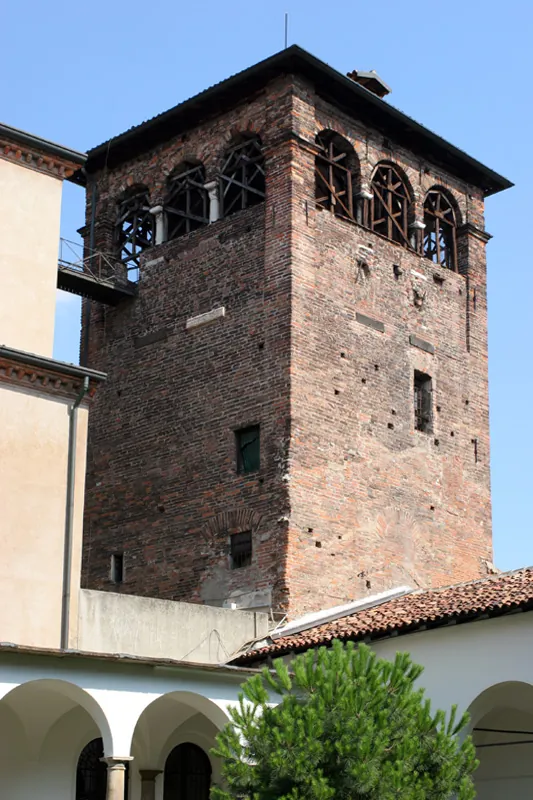
The circus that Maximian built beside the palace is the other half of the visit. It was about 470 m long, and one of the two towers of its starting gates survives almost whole, though altered over the centuries, because it became the bell tower of San Maurizio al Monastero Maggiore as early as the 8th century; you see it from via Luini and from the garden of the Civico Museo Archeologico on Corso Magenta (it.wikipedia). The same garden holds a tower and a stretch of the Roman city wall, described on the Mediolanum – Milan page, and near the wall is an apse that stood by the circus’s western curve, where the judges or the emperor sat to watch the races (it.wikipedia). Lengths of the circus’s outer wall also survive in the courtyards of via Vigna 1 and via Circo 9 and 11, the via Circo stretch standing about 12 m high, but these are shown only on request at the porter’s lodges (it.wikipedia).
About 200 m away, in the basement of Palazzo Turati at via San Vittore al Teatro 14, lies the Augustan theatre: foundations, capitals, part of a column from the stage wall and the original oak foundation piles, seen from a transparent walkway with a sound and scent installation (it.wikipedia; the Chamber of Commerce).
Is it worth the trip?
As part of a walk through Roman Milan, yes; on its own, no. The via Brisa site is a plan at ground level rather than standing rooms, and a few minutes take it in. What makes this corner worth an hour or two is that Maximian’s palace, the tower of his circus and a tower of his city wall all lie within about 160 m of each other (OpenStreetMap), and the museum on Corso Magenta (€5) puts the circus tower and the wall tower in front of you. The theatre, with its walkway and displays, adds the most, but only when the Chamber of Commerce is taking bookings.
Getting there
The site is in the old centre: the Via Meravigli tram and bus stop is about 90 m away and Cairoli metro station about 350 m (OpenStreetMap). The Duomo is about 600 m east.
No operator publishes opening hours or a charge for the via Brisa remains; OpenStreetMap maps gates beside them, one at via Brisa 16. The Civico Museo Archeologico, Corso Magenta 15, opens Tuesday to Sunday from 10.00 to 17.30 and is closed on Mondays. A ticket is €5, or €2.50 for visitors 65 and over, university students and 18- to 25-year-olds; under-18s go free, everyone goes free on the first Sunday of the month, and visitors up to 25 go free on the second Tuesday. A free visitor still needs a ticket (museoarcheologicomilano.it and the Musei Civici ticket shop, read October 2026 - check before travelling).
The theatre is shown on a free guided tour, by appointment only (the Chamber of Commerce). The Chamber’s booking page announced in 2024 that tours were suspended from 15 April 2024, until further notice, for building work at Palazzo Turati, so check before you plan on it.
Visiting details
- Opening hours
- The palace remains in via Brisa lie in an open-air green area; no operator publishes opening hours for it. The Civico Museo Archeologico, Corso Magenta 15, from whose garden the circus tower can be seen, opens Tuesday to Sunday 10.00–17.30 and is closed on Mondays.
- Tickets
- No charge is published for the via Brisa remains. Civico Museo Archeologico €5, reduced €2.50 (65 and over, university students, 18–25-year-olds); free under 18 and for everyone on the first Sunday of the month, and free for visitors up to 25 on the second Tuesday. Free visitors still need a ticket. The theatre under Palazzo Turati is shown on a free guided tour, by appointment only.
Before you go
- The Chamber of Commerce's booking page for the Roman theatre announced in 2024 that tours were suspended from 15 April 2024, until further notice, for building work at Palazzo Turati. Check before going.
- The circus walls in the courtyards of via Vigna 1 and via Circo 9 and 11 are shown only on request at the buildings' porter's lodges.
Hours and prices checked 13 October 2026 on the operator's own site. Confirm before travelling.
History
In 286 Maximian, Diocletian’s colleague in the West, made Mediolanum his residence and capital, and the city was renamed Aurelia Augusta Mediolanum (it.wikipedia). A large part of its western side became the palace quarter, a town within the town of about 8 hectares, holding the halls of state and offices, small private baths, guard posts, private places of worship and living quarters, with a covered passage leading straight into the circus next door (it.wikipedia). The two emperors probably met in the palace in the winter of 288-289, and it was refitted in the 4th century with a stronger heating system, new decoration and some rooms enlarged (it.wikipedia). The via Brisa building was a luxurious part of the residence, organised as suites of rooms for receiving guests of rank (Piras 2012); fragments of Greek marble, serpentine and porphyry wall facing and of painted plaster were found there (it.wikipedia).
The poet Ausonius called it the “Palatinae arces”, the palace citadel, a nod to the emperors’ palaces on the Palatine in Rome. It was in the palace’s council hall that Symmachus’s senatorial delegation pleaded before Valentinian II for the old religions to be tolerated (it.wikipedia). The court left for Ravenna in 402, but the palace stayed a seat of power: after his siege of 452, Attila had a fresco of a Roman victory over the Scythians replaced with one of his own victory over the Romans (it.wikipedia).
The Lombards used some of its rooms while other parts were already being abandoned; in 604 their king Adaloald was crowned in the circus, not in the palace. The palace was abandoned by the first half of the 10th century and demolished before that century was out; its memory survives in the name of the church of San Giorgio al Palazzo on via Torino (it.wikipedia). The circus probably fell when Frederick Barbarossa razed Milan in 1162 (it.wikipedia). The via Brisa remains were excavated between 1951 and 1962, and so little survives partly because of the cellars of buildings destroyed in bombing and partly because the first digging was done hastily with heavy machinery (it.wikipedia; Piras 2012).
More photographs

Sources
Every fact on this page comes from the records below, each used under the licence noted.