


Photo: G.dallorto · Attribution · Commons
Mediolanium, Aurelia Augusta Mediolanum, Milano
city · Lombardy, Italy
2 places to see, the best preserved and best known first.
Photo: G.dallorto · Attribution · Commons
Photo: Lorenzo Fratti · CC BY-SA 3.0 · Commons
palace · Lombardy
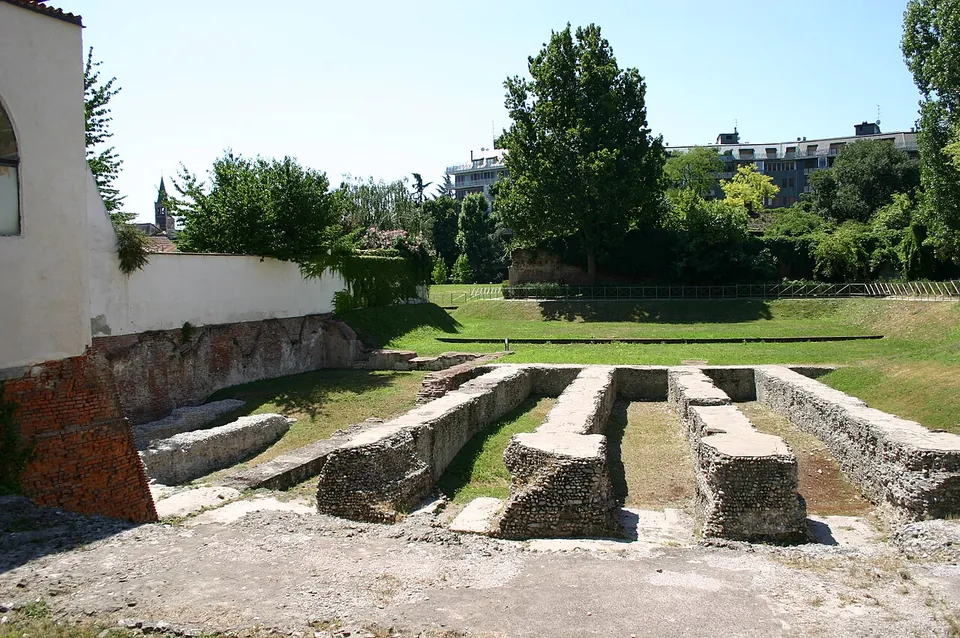
In via Brisa the foundations of the palace's reception wing lie open to the sky in a green area laid out for display, easy to see (it.wikipedia).
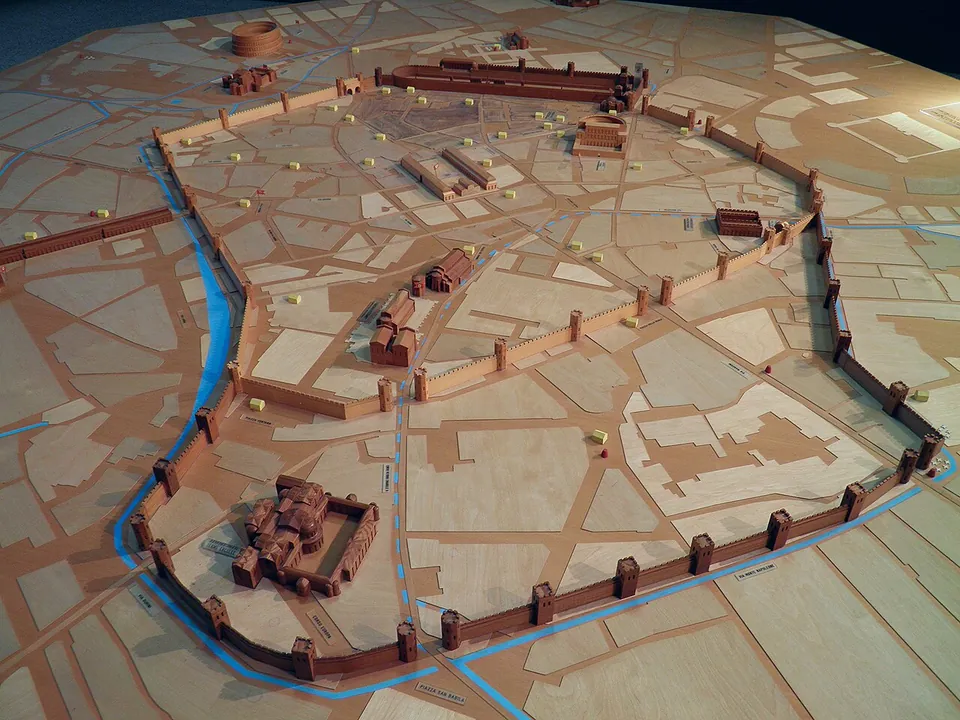
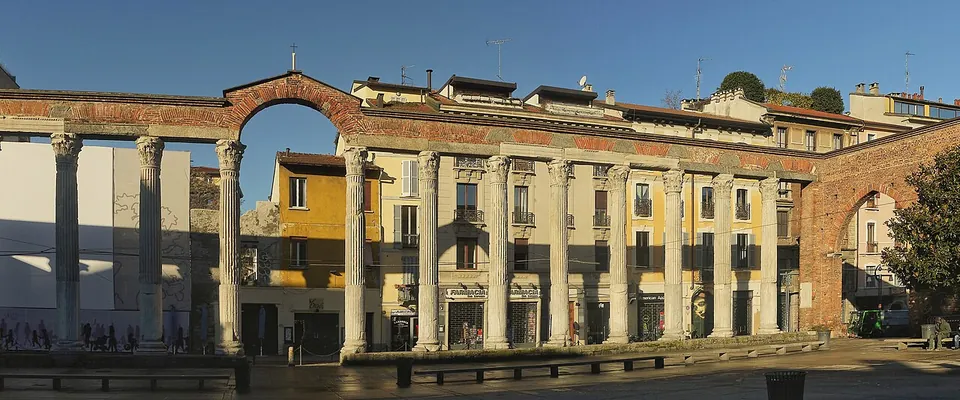
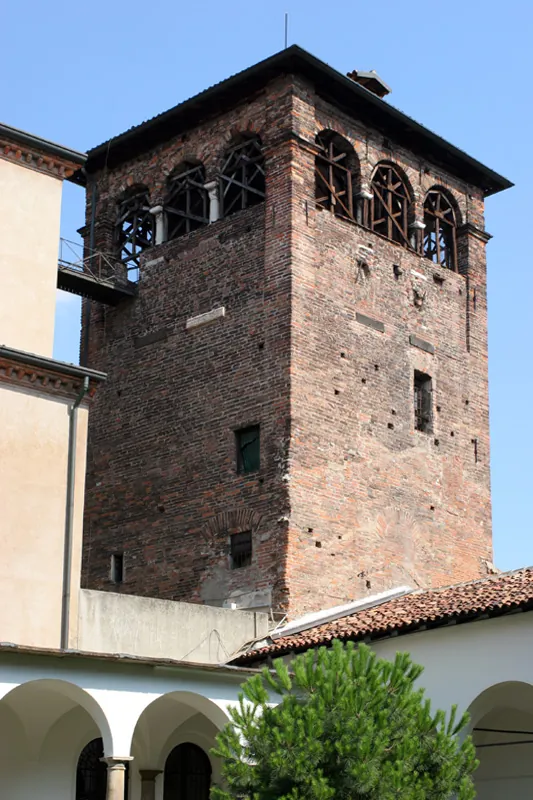
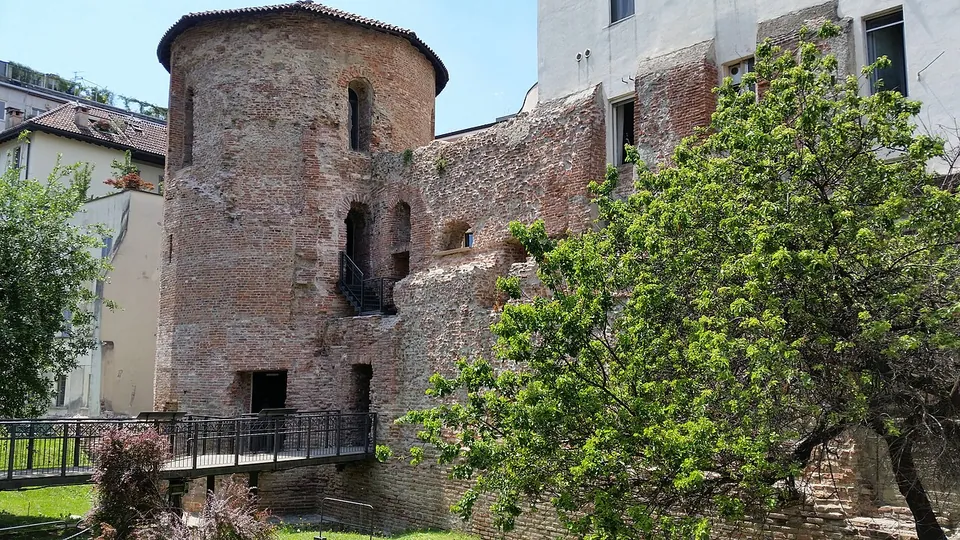
Nothing here stands whole, and the remains are fragments in a dense modern city rather than one archaeological park. The most striking are the Colonne di San Lorenzo, sixteen Roman columns on an open square in front of the basilica of San Lorenzo (en.wikipedia); they and the basilica are described with the amphitheatre next to them, on its own page. The Civico Museo Archeologico on Corso Magenta is the other anchor: one of the two towers of the circus starting gates survives almost intact, though altered over the centuries, because it became the bell tower of San Maurizio; it can be seen from the museum’s garden, which also holds a 24-sided tower and a stretch of Maximian’s city wall (it.wikipedia). The wooden model of the imperial city pictured on this page was photographed inside the museum.
The rest is ground level. The foundations of Maximian’s palace lie open in a green area in via Brisa; a wall of the Baths of Hercules stands in a flowerbed in largo Corsia dei Servi, moved there in the 1960s from its original level 3.5 m below the street (it.wikipedia); and slabs of the forum’s paving floor the crypt of San Sepolcro, on the Pinacoteca Ambrosiana’s ticketed route, while a stretch still in place under the Biblioteca Ambrosiana next door has no published visiting arrangement (the operator; see “The forum” below). Other remains, from the theatre under the Chamber of Commerce to the circus walls in the courtyards of via Circo and via Vigna, are shown only on request or by booking (it.wikipedia).
Not on its own: no single monument here stands whole, and much of what survives is underground or behind private doors. But if you are in Milan anyway, half a day on foot rewards it. The remains described here lie within about a kilometre of the Duomo metro station (OpenStreetMap), the Colonne cost nothing, and the archaeological museum, with the circus tower and the wall in its garden, is the best single stop for €5. The crypt of San Sepolcro, where you walk on the forum’s paving, comes only with the €20 Pinacoteca Ambrosiana ticket: a good half-hour if you are seeing the paintings anyway, not worth that price for the Roman floor alone. Expect to read the Roman city from fragments and plans rather than to walk through it.
One caveat for the amphitheatre: its park and the Antiquarium Alda Levi beside it were closed when the museum’s site was last read, in October 2026 (the operator).
The point on the map is in the old centre, beside the Duomo stop of metro lines M1 and M3 (OpenStreetMap); everything else is reached on foot from there. The forum remains are about 200 m away, the palace and the Baths of Hercules about 600 m, and the amphitheatre about a kilometre.
The Civico Museo Archeologico, Corso Magenta 15, opens Tuesday to Sunday from 10.00 to 17.30 and is closed on Mondays. A ticket is €5, or €2.50 for visitors 65 and over, university students and 18- to 25-year-olds; under-18s go free, everyone goes free on the first Sunday of the month, and visitors up to 25 go free on the second Tuesday. A free visitor still needs a ticket, and first-Sunday tickets cannot be booked online (museoarcheologicomilano.it and the Musei Civici ticket shop, read October 2026 - check before travelling).
The crypt of San Sepolcro is entered from Piazza San Sepolcro, at the corner of via dell’Ambrosiana, and opens from 10.00 to 18.00 every day except Wednesday, with the ticket office closing at 17.15. Since 1 October 2026 it can no longer be visited on its own ticket: entry is with the combined Pinacoteca and Crypt ticket, €20, or €15 over 65, €13 under 18 and for university students, €5 for children aged 6 to 14, and free up to 5 and for visitors with disabilities and a companion, with €1.50 added per ticket when booked. The crypt has steep stairs and an uneven floor and is not accessible to visitors with reduced mobility (Veneranda Biblioteca Ambrosiana, read 23 October 2026 - check before travelling).
Before you go
Hours and prices checked 13 October 2026 on the operator's own site. Confirm before travelling.
Mediolanum was walled twice. The first circuit, perhaps from 49 BC when the town became a municipium, was roughly square, about 700 m a side; after 291 Maximian enlarged it to the east and west (unless it had already been strengthened in the 260s), taking in the Baths of Hercules and the circus, until it enclosed more than 100 hectares within a perimeter of about 4.5 km (it.wikipedia). Its foundations were on average 3.5 to 4 m thick, of cobbles and broken brick in very hard mortar. Narses repaired it between 556 and 568 and Archbishop Ansperto in the later 9th century; according to Landulf Senior it still had about a hundred towers in 1037, and it was finally destroyed by Frederick Barbarossa after the siege of 1162 (it.wikipedia).
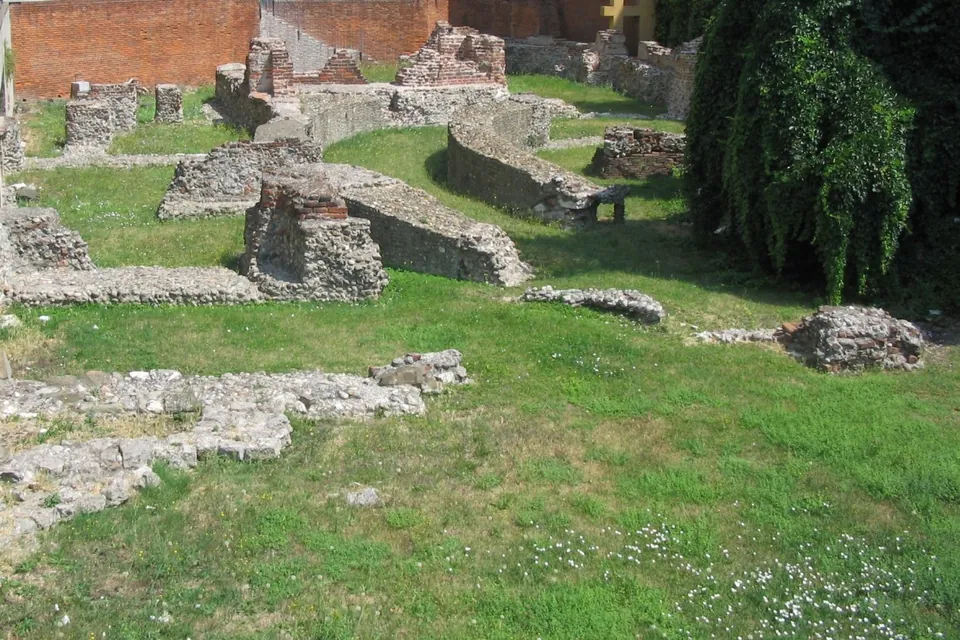
What survives is scattered. The easiest stretch to see is in the garden of the Civico Museo Archeologico on Corso Magenta: a polygonal tower with 24 sides and part of the western stretch of Maximian’s wall. On the north side of the Carrobbio, partly enclosed by buildings, stands part of one of the two towers of the Porta Ticinese, the “Torraccia” or “Torre dei Malsani”: 6 m high on an octagonal base, from the first circuit, and visible in the courtyard of one of the buildings there. In the basements of via San Vito 18 and 26 runs a long stretch of the Republican wall, brick on a stone base; at no. 18 a graffito in Lepontic, a Celtic language, gives the town’s name as “Mesiolano”. A tower stands in a garden between via Medici 3 and via Torchio 4, with a short stretch of Maximian’s wall at via Medici 11; more of it survives in cellars along via Montenapoleone, and a length of its foundations was found and restored in the basement of the Grand Hotel et de Milan in 1991 (it.wikipedia). Apart from the museum garden, all of these lie in the courtyards, gardens and basements of private buildings or a hotel.
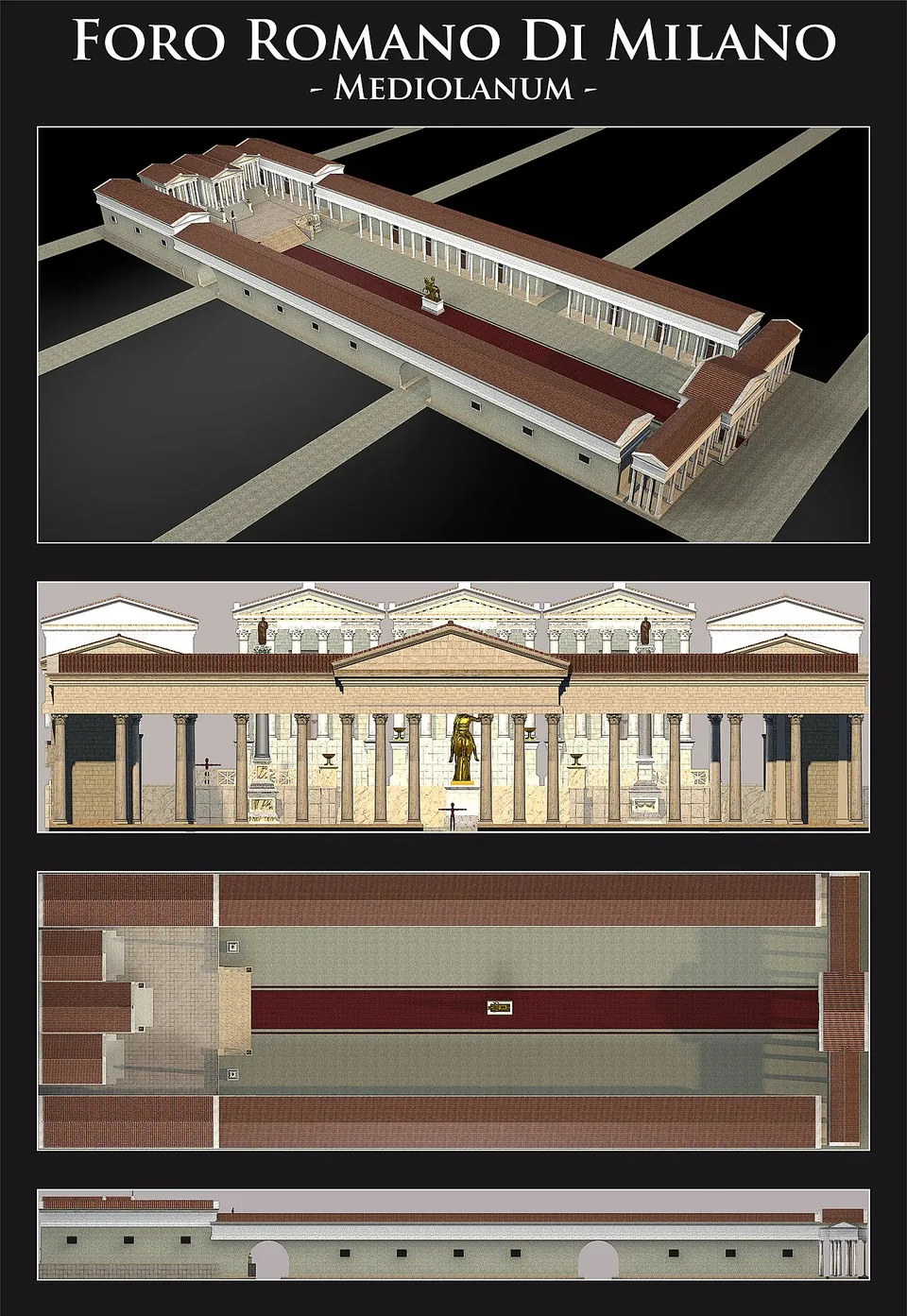
The forum, the main square of Mediolanum, was built under Augustus in the first half of the 1st century, the second large building the Romans raised in the town after the theatre (it.wikipedia). It measured about 55 m across and 160 to 166 m long, with colonnaded porticoes along its long sides and shops opening off them (it.wikipedia; the Biblioteca Ambrosiana). It lay at the crossing of the city’s two main streets and now runs under via dell’Ambrosiana, Piazza San Sepolcro, via Cardinale Federico, Piazza Pio XI and part of via Moneta, named after the Roman mint nearby. A market stood on its east side, and a Capitolium, the temple of Jupiter, Juno and Minerva, is thought to have closed its north end, though excavation has not confirmed it (it.wikipedia). The square was given a more monumental entrance at the turn of the 2nd and 3rd centuries; once Mediolanum became the western capital in 286, many of its public buildings moved to the palace quarter and around the archbishop’s palace, and after the city lost that status the square was reduced and stripped of its finest fittings (it.wikipedia).
Nothing of its buildings stands; what survives is the paving. Excavations in 1990–1992 under the cellars of the Biblioteca Ambrosiana uncovered part of it in its original position, slabs of Verona stone of varying sizes, with a channel that drained rainwater from the porticoes (the operator) and some of the steps up to the shops (it.wikipedia). The library’s page says part of this excavation can be visited, but gives no hours, ticket or booking route, only a contact address; the last opening found was on 16 June 2023, when the Soprintendenza showed the remains on guided visits by booking for the European Archaeology Days (Ministero della cultura).
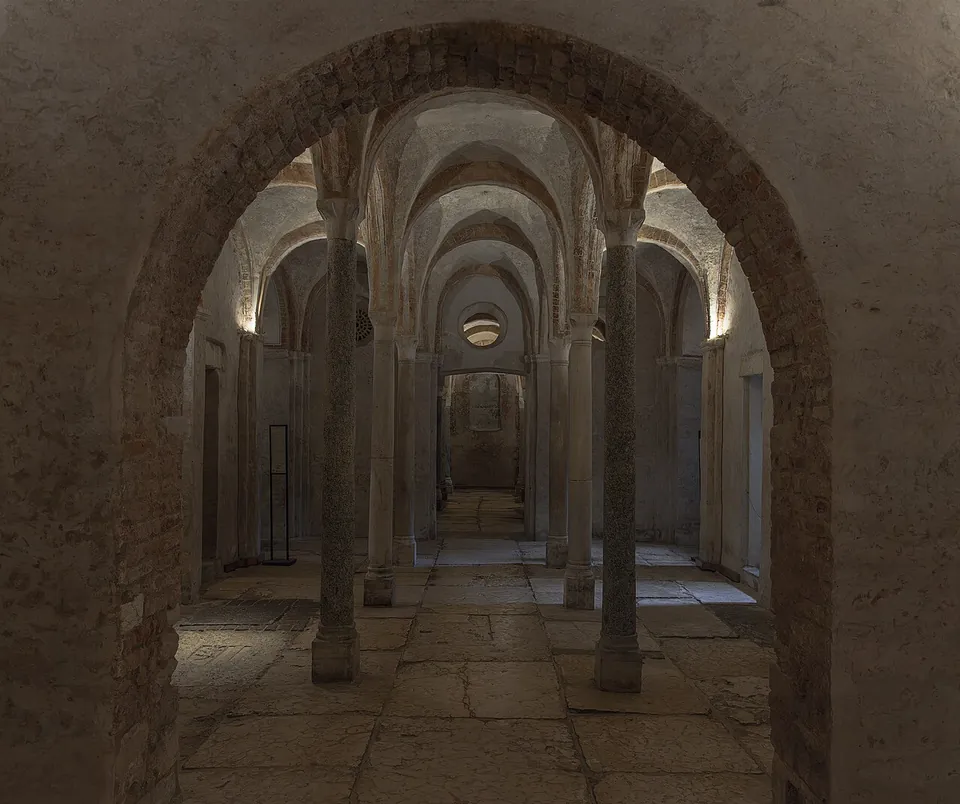
The place to see the forum on an ordinary day is the crypt of San Sepolcro next door, whose floor is laid with large slabs taken from the forum’s paving (it.wikipedia; the operator). On one you can trace the rut left by a cart, and another has a fossil ammonite in it. The crypt itself is medieval: the church was built around 1030 by Rozzone, a mint master, on the site of the forum, and the crypt was reopened to the public in 2016 after fifty years (the operator).
A Celtic settlement of the Insubres stood here from around 590 BC; the Romans captured it in 222 BC, and the Latin name Mediolanum is usually read as “(settlement) in the midst of the plain” (en.wikipedia). It became a Roman colony in 89 BC and a municipium in 49 BC, and stood at the junction of roads running towards Gaul, the Splügen pass, Brescia, Piacenza and Pavia (it.wikipedia). The first city wall dates from around 49 BC; the theatre was built in the Augustan period, and the forum in the first half of the 1st century AD (it.wikipedia). From 260, under Gallienus, the city struck coins at a mint beside the forum, near the modern via Moneta (it.wikipedia).
In 286 Maximian made Mediolanum the residence and de facto capital of the Western Empire. He enlarged the walls to a circuit of about 4.5 km and built the Baths of Hercules, named after his own epithet Herculius, a palace quarter, and a circus whose published length is 450 to 470 m (en.wikipedia; it.wikipedia). Constantine and Licinius met here in 313, the meeting from which the Edict of Milan takes its name, and in the time of Bishop Ambrose (from 374) and Theodosius I the city became the most influential centre of the Western church (it.wikipedia).
The court left for Ravenna in 402, after Alaric’s Goths had besieged the city. Attila besieged it in 452, and in 538, during the Gothic War, it was laid waste; the Lombards, who captured it in 569, made Pavia their capital instead (en.wikipedia).
Every fact on this page comes from the records below, each used under the licence noted.


