

The Milan amphitheatre was the arena of Roman Mediolanum, built just outside the city wall near the Roman Porta Ticinese. It was demolished in late antiquity and quarried for the foundations of San Lorenzo nearby, so what is left is a few foundation walls in a park. The park is closed at present.
What is there today
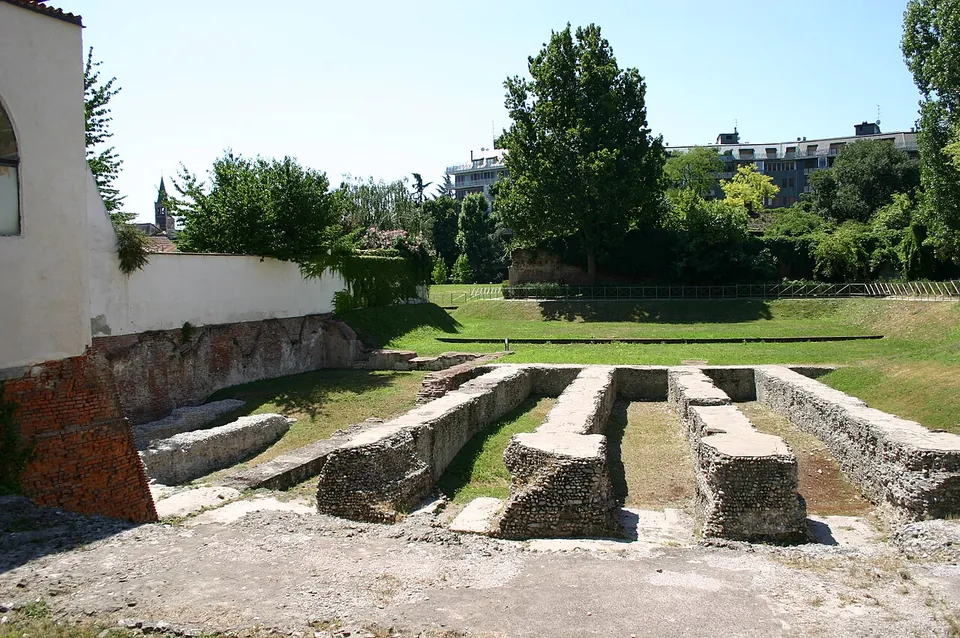
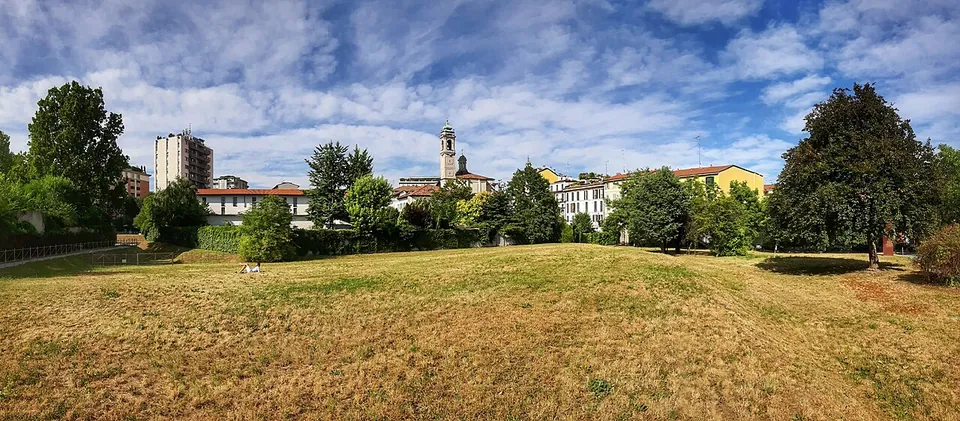
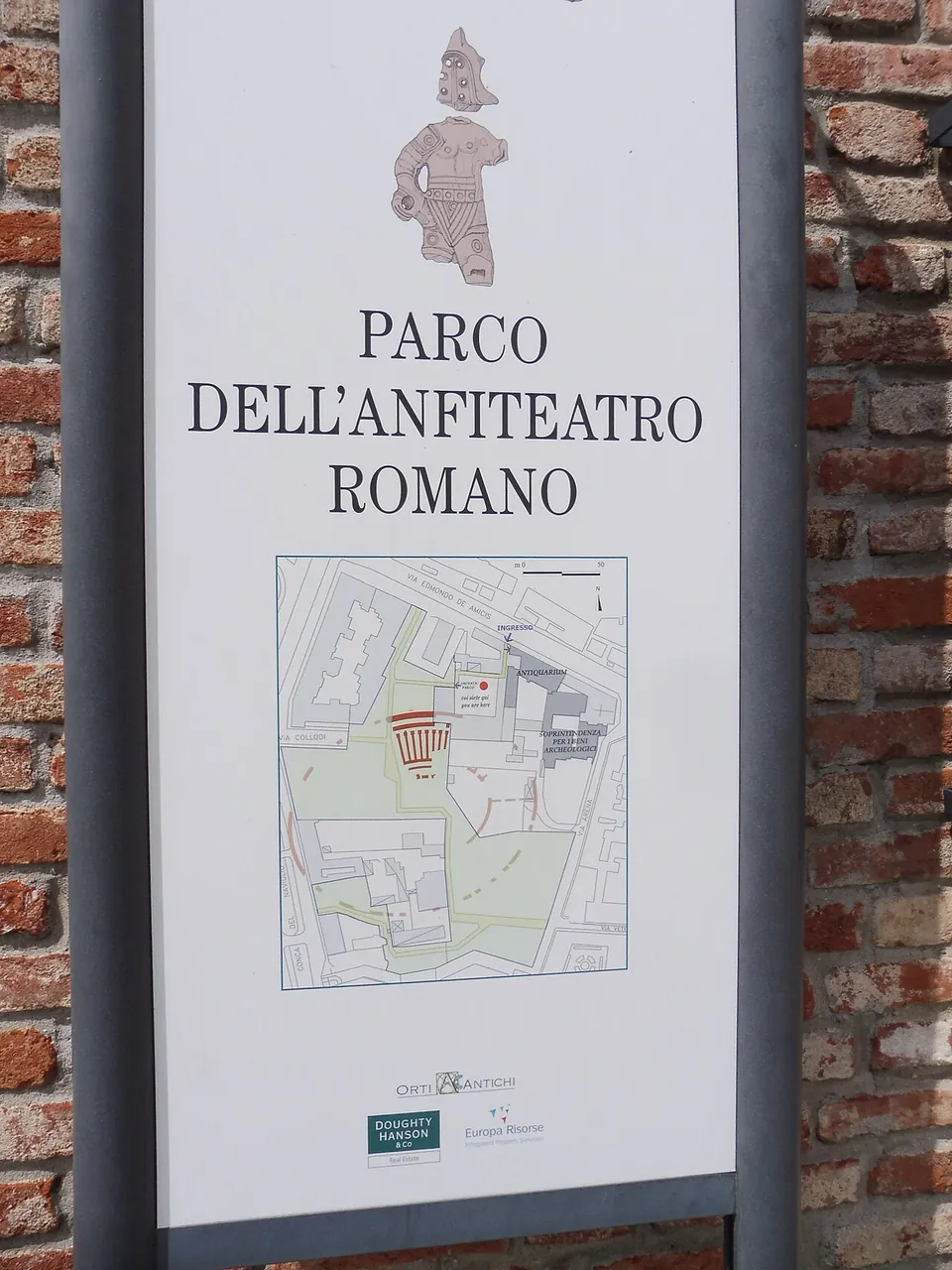
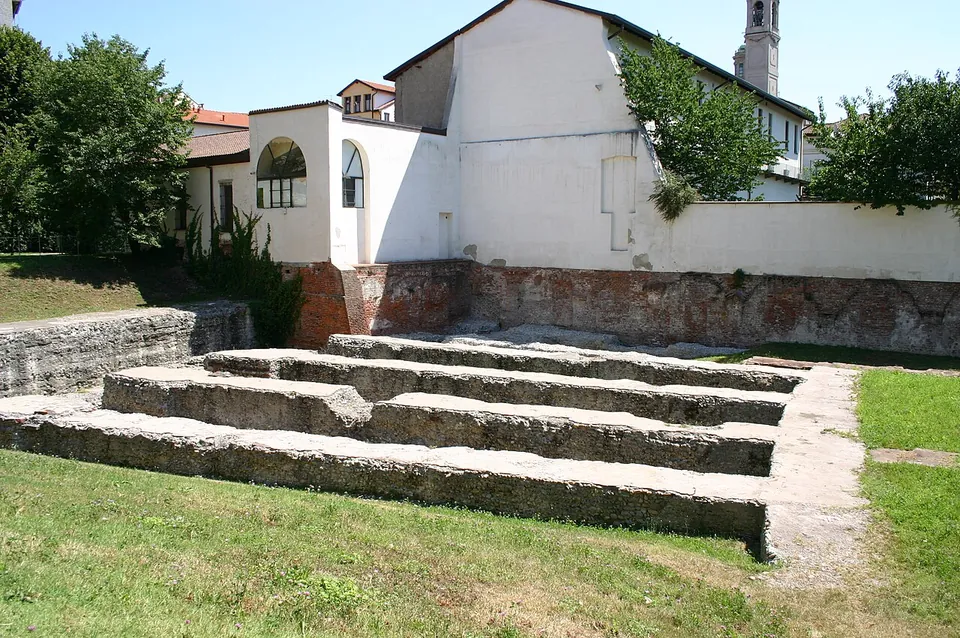
Very little of the building itself. The archaeological park off via De Amicis shows the concrete (opus caementicium) of a radial wall and of the inner elliptical wall, which once held up the seating, and a line on the lawn marks the edge of the arena. The visitable area covers about 150 square metres; the eastern and western sections lie under the modern streets and the foundations of the surrounding buildings, and cannot be visited (it.wikipedia). The name of via Arena, one of the streets around the site, recalls the building. Next to the park, in a former convent of Dominican nuns, the Antiquarium Alda Levi tells the amphitheatre’s story and presents the results of recent excavations in the district (it.wikipedia; the operator).
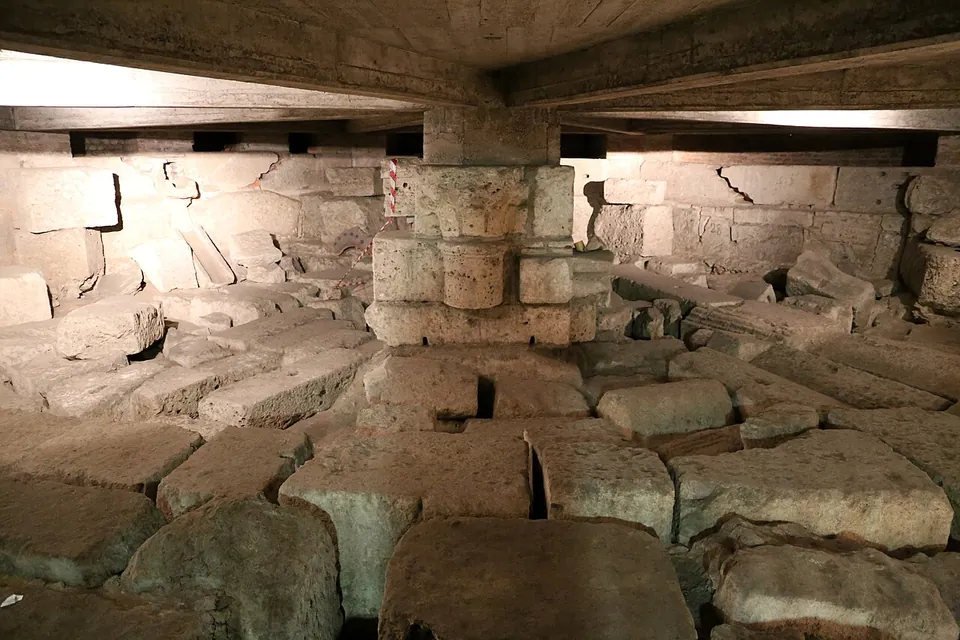
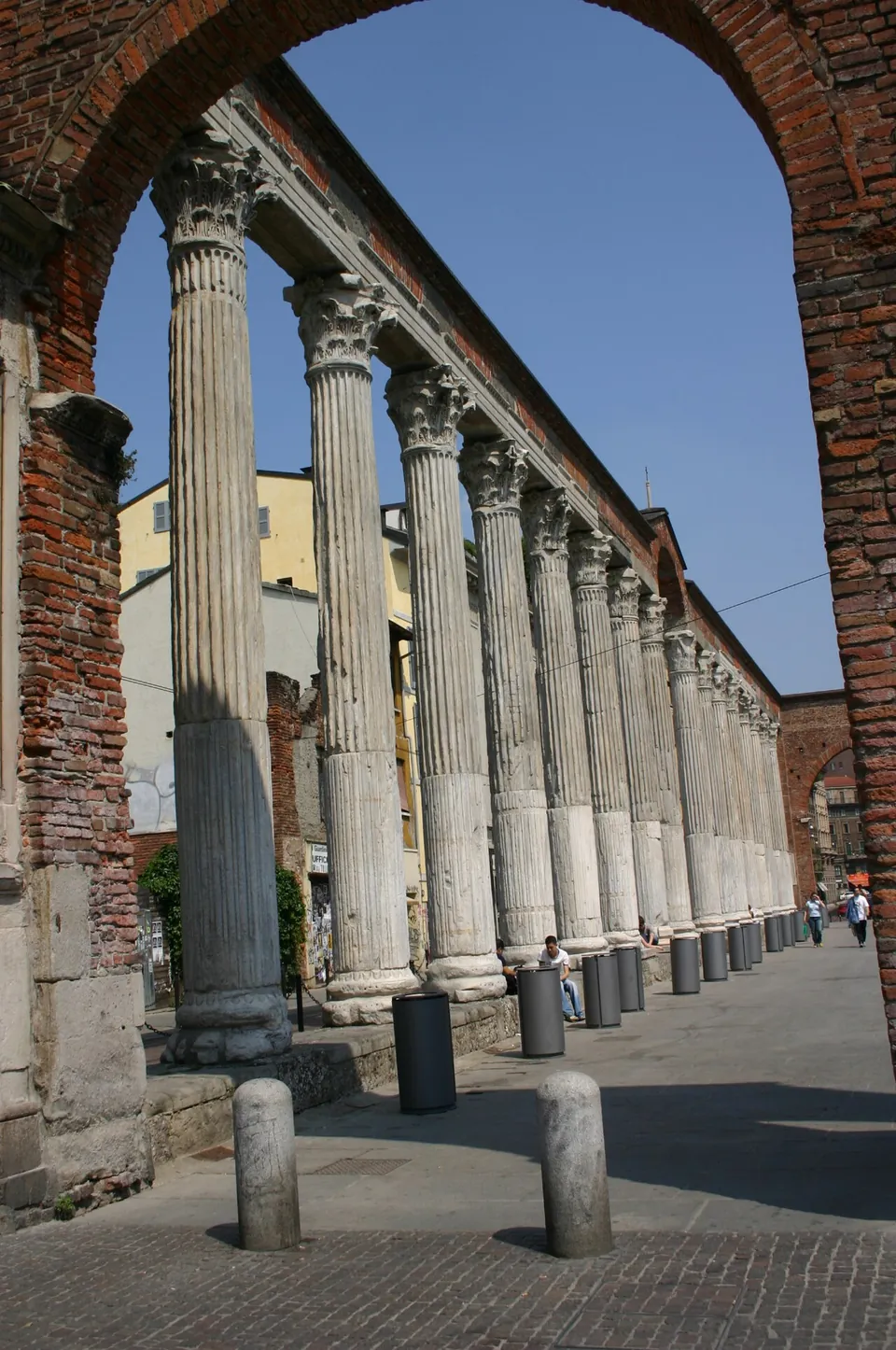
More of the amphitheatre ended up 200 to 300 m away, at San Lorenzo. The stone blocks in the basilica’s foundations seem to come from the wall at the top of the seating, and part of them can still be seen; a Corinthian capital now used as a pier base inside the church probably came from the amphitheatre too (it.wikipedia). Under the chapel of Sant’Aquilino you can visit the foundation platform, built partly of material from the demolished amphitheatre, entering from behind the altar (the parish). In front of the basilica the Colonne di San Lorenzo, sixteen Corinthian columns about 7.5 m high, stand on an open square (it.wikipedia; en.wikipedia).
Is it worth the trip?
Not for the amphitheatre alone, and not at the moment. The Antiquarium and the park were closed when last checked, on 17 October 2026 (the operator), and even when the park is open what it shows is low foundations, not seating or arches. A redevelopment, PAN – Parco Amphitheatrum Naturae, is meant to enlarge the excavated area with new digs and to trace the lines of the arena’s foundations with planted trees and hedges. Published completion dates differ (2025 in it.wikipedia, 2026 in fr.wikipedia), so check before you go.
The corner of the city is worth the walk all the same, for San Lorenzo. The Colonne stand in a public square, and the basilica keeps almost all of its late Roman ground plan. Together they are counted among the major late-imperial Roman monuments of Milan (it.wikipedia). Both fit easily into a walk round the other remains of the Roman city (see the Mediolanum page).
Getting there
The remains lie between via De Amicis, via Conca del Naviglio and via Arena, and the entrance to the Antiquarium is at via E. De Amicis 17 (it.wikipedia; the operator). An entrance to De Amicis station, on metro line M4, is about 175 m away, and there are public transport stops in piazza Resistenza Partigiana about 110 m away (OpenStreetMap; the Soprintendenza names the station on M4). The Colonne are about 200 m away and the basilica about 300 m; from the Duomo the amphitheatre is about a kilometre.
The site is closed for now. The last opening hours the operator published, in 2024, were Tuesday to Saturday 10.00 to 15.00 (last entry 14.30), and the park was already shut then for the PAN excavations. Touring Club Italiano volunteers kept the Antiquarium open, and the operator warned that it could close at short notice; groups had to book, even with their own guide. No admission charge is published. The basilica of San Lorenzo opens Monday to Friday 08.00 to 12.30 and 15.00 to 18.30, and at weekends 09.00 to 13.00 and 15.00 to 19.00. The parish’s site gives no price for the chapel of Sant’Aquilino (museoarcheologicomilano.it and sanlorenzomaggiore.com, read in October 2026 from archived copies dated 2024 to 2026; check before travelling).
Visiting details
- Opening hours
- The Antiquarium Alda Levi and the amphitheatre park were closed on 17 October 2026, with no reopening date published. When the Antiquarium was last listed as open (November 2024) it kept Tuesday to Saturday 10.00–15.00, last entry 14.30, closed on Sundays, Mondays and public holidays; the park was already shut for the excavations of the PAN project. The Colonne di San Lorenzo stand in an open square. The basilica of San Lorenzo opens Monday to Friday 08.00–12.30 and 15.00–18.30, Saturday and Sunday 09.00–13.00 and 15.00–19.00.
- Tickets
- The operator publishes no admission charge for the Antiquarium or the park. The Colonne stand in a public square. The parish publishes no price for the chapel of Sant'Aquilino.
Before you go
- The Antiquarium Alda Levi and the park of the amphitheatre were closed when the Civico Museo Archeologico's site was last read (archived copy of 17 October 2026).
- The Antiquarium was kept open by Touring Club Italiano volunteers and could close at short notice on some days; groups, even with their own guide, had to book (the operator, 2024).
Hours and prices checked 17 October 2026 on the operator's own site. Confirm before travelling.
The Colonne di San Lorenzo
The sixteen columns are of marble from Musso, with Corinthian capitals carrying an entablature (it.wikipedia). They were taken from older Roman buildings of the 2nd or 3rd century. Published accounts differ on which: it.wikipedia suggests a temple near the modern piazza Santa Maria Beltrade, en.wikipedia a temple or a public bath. They were moved here to front the new basilica (it.wikipedia; en.wikipedia). The capitals come from two different buildings and are not the same size, so the lower ones were raised with brick. The row took its present form in the 11th to 12th century, which is when the brick parts of the entablature and the central arch were added (it.wikipedia). In the 16th century there were plans to demolish the colonnade to widen the route for Philip II of Spain’s ceremonial entry into Milan, but Ferrante Gonzaga turned them down (en.wikipedia). The houses between the columns and the church were cleared in 1934–35 (it.wikipedia; en.wikipedia). The bronze statue of Constantine on the square is a modern copy, set up in 1937, of a late-antique original in Rome (it.wikipedia).
The Basilica of San Lorenzo
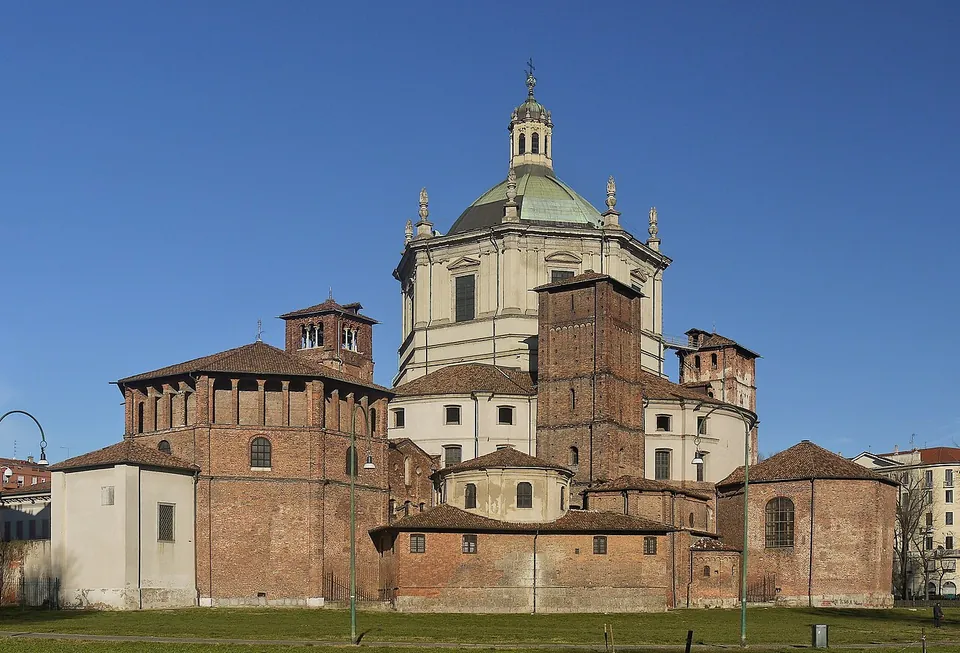
San Lorenzo is one of Milan’s oldest churches. Its plan, a square central space with an apse on each of its four sides, dates from the late empire and has survived almost unchanged, although the building was rebuilt several times (it.wikipedia). The date and founder are uncertain. it.wikipedia gives 390 to 410, from excavations that found blocks from the amphitheatre in the foundations. en.wikipedia sets a theory that it was the “Basilica Portiana” built for the Arian bishop Auxentius (355–372) against excavations of 2002–2004 that point to 390–402, under Theodosius I or Stilicho. What is certain, en.wikipedia says, is that when it was built it was the largest centrally planned building in the West. Fires in 1071 and 1075, the collapse of the dome in 1103 and a further fire in 1124 led to a Romanesque rebuilding, which kept the original interior plan. After the dome fell again in 1573, Martino Bassi rebuilt it with an octagonal drum in the Lombard tradition (it.wikipedia).
The chapel of Sant’Aquilino is the largest chapel of the complex. It is octagonal and was originally a building of its own; the parish dates it to 390–430, and it may first have been an imperial mausoleum (en.wikipedia; the parish). Visitors pass through a richly carved Roman marble doorway reused from an earlier, unknown monument. Fragments of the late-antique mosaics survive: in the atrium, figures of apostles and patriarchs, and by the altar a Christ among the Apostles and the remains of a chariot scene (it.wikipedia; the parish).
History
As usual for an amphitheatre, Mediolanum’s was built outside the city walls, here close to the Roman Porta Ticinese, where the roads to the south-west ran. The whole area was levelled first, and gravel and sand dug from it were used for the lime and the concrete of the foundations (it.wikipedia). Published dates for the building differ. it.wikipedia has it perhaps begun early in the 1st century AD and finished by the end of that century, then enlarged; en.wikipedia and the Pleiades gazetteer’s description, in almost the same words, put it in the 2nd and 3rd centuries. Published sizes differ in the same way: 129.5 by 109.3 m with an arena of 71 by 41 m (en.wikipedia), or 155 by 125 m with an arena of 75 by 41 m (it.wikipedia). On the larger figure it was the third-largest amphitheatre of Roman Italy, after the Colosseum and Capua, and a little bigger than the Arena of Verona; it.wikipedia puts its capacity at 20,000 to 35,000 spectators.
The arena still appears in a text of 396 by Paulinus of Milan. It was then abandoned, as the Church turned against the games and, en.wikipedia adds, as wild animals for the shows stopped arriving in the crisis of the empire (it.wikipedia; en.wikipedia). It became a quarry for building stone when San Lorenzo was built, and its material also went to strengthen the city walls (it.wikipedia). It was finally pulled down during an attack on the city, because a building outside the walls could serve the attackers as a stronghold (en.wikipedia). The date is uncertain, anywhere from 401 to 539: en.wikipedia offers 402, 452 or the Gothic War of the 6th century; it.wikipedia’s article on the amphitheatre favours the siege of 539, its article on San Lorenzo says 401.
The archaeologist Alda Levi led the first excavations on the site in 1936 (the operator). She worked in Milan from 1925 until 1939, when she was dismissed under the racial laws of 1938, and the Antiquarium is named after her. Finds from the excavations of the 1950s and 1960s are kept there (it.wikipedia).
More photographs




Sources
Every fact on this page comes from the records below, each used under the licence noted.