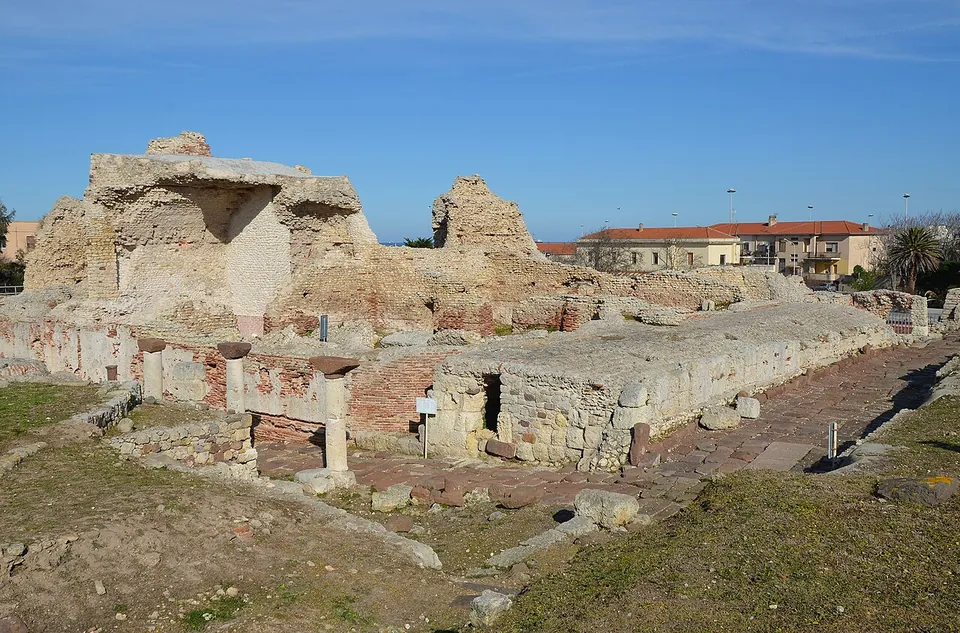
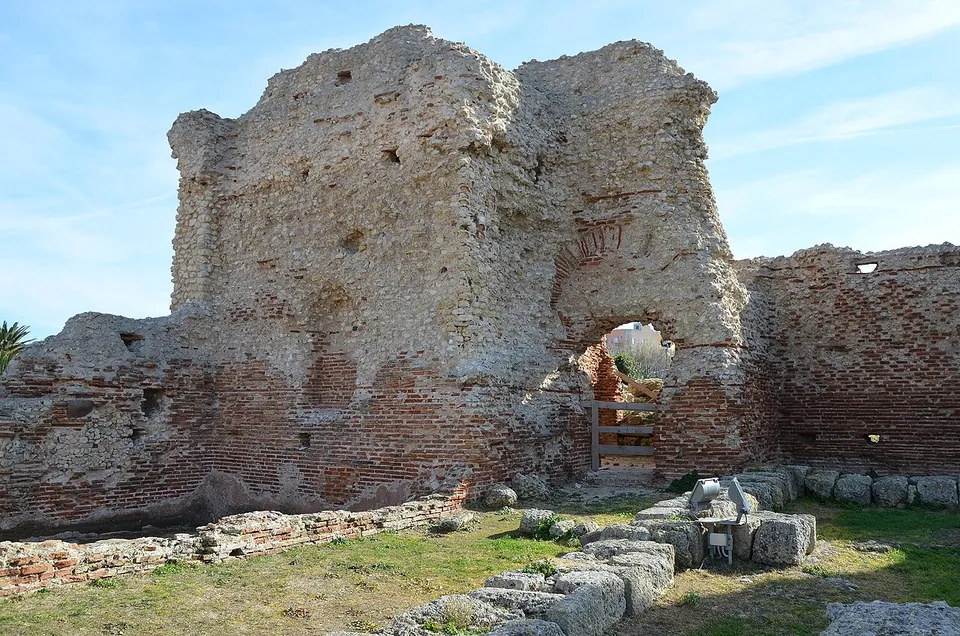


The Antiquarium Turritano is the state archaeology museum of Porto Torres, set in the archaeological park of Turris Libisonis, the Roman colony under the modern town, where the outer walls of a great public bath building are still standing. Both have been closed since 2 May 2026.
What is there today
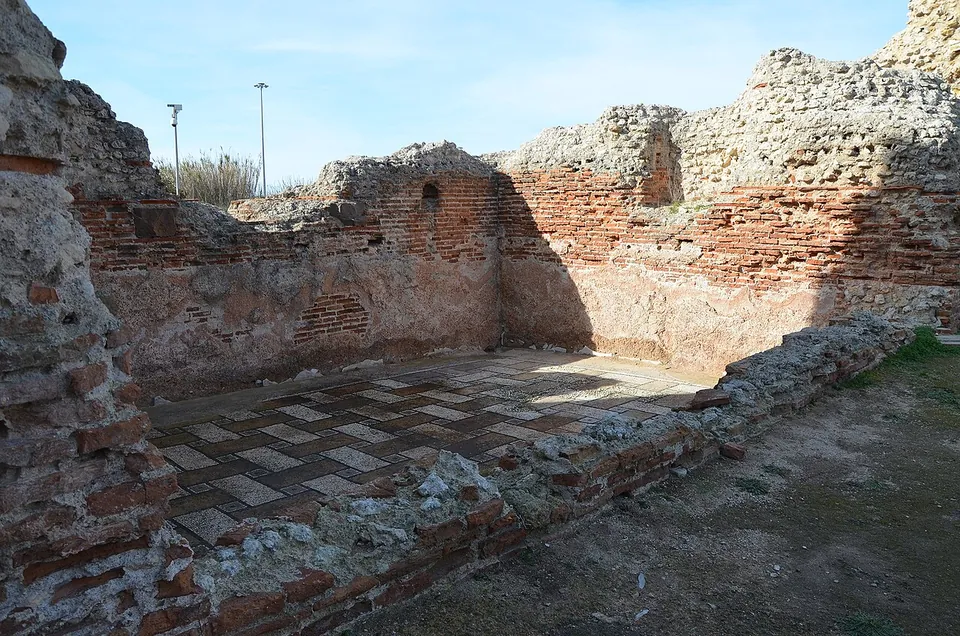
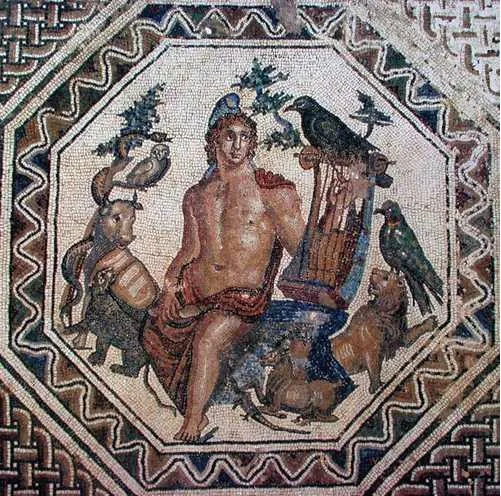
The park holds three Roman bath buildings, a house with figured mosaics, a colonnaded courtyard and a stretch of the city wall (the operator). The biggest ruin is the bath complex in the middle of the park, which the museum calls the Central Baths and which is also known as the Palazzo di Re Barbaro (it.wikipedia): its outer walls survive, in tall masses of rubble and red brick pierced by arched doorways, with mosaic floors still in some of the rooms. Under its entrance porch, excavation has uncovered the Domus of Orpheus, a house of about AD 250 with mosaics of Orpheus and of the Three Graces (the operator).
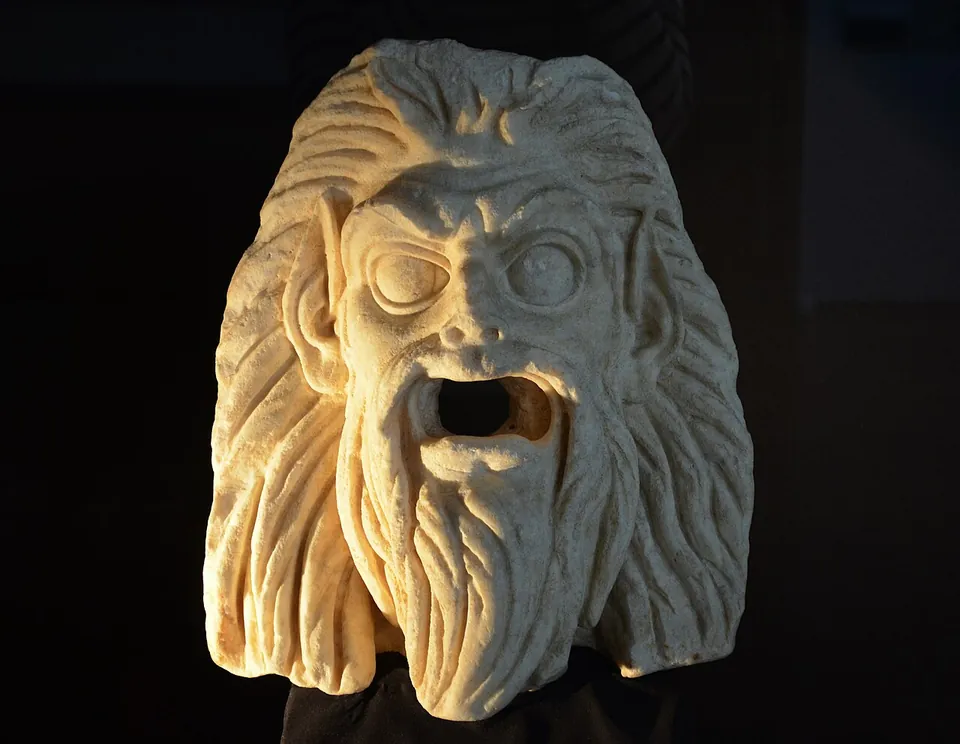
The museum next door holds what the excavations of the colony have produced: pottery, tools, cinerary urns, honorary statues, altars, inscriptions, mosaics and painted wall plaster (the operator). It has been closed for a new display since 15 December 2025.
Is it worth the trip?
Not at the moment. The museum and the archaeological area have been closed since 2 May 2026 for a new display and accessibility works, and on 21 October 2026 the operator had still not announced a reopening date.
When it reopens, the park shows the Roman town at wall height rather than as foundations. it.wikipedia calls the main bath building the largest in Sardinia after the one at Fordongianus, and the Domus of Orpheus mosaics are fine work. The ruins lie within about 250 m of the museum, and before the closure the park could only be visited with museum staff at four set times a day, so a visit has to be planned around them. The Roman bridge, the town’s other stop, is about 500 m away. If you are in north-west Sardinia it is worth a stop; it is not a reason to travel to the island.
Getting there
The museum is at Via Ponte Romano 99 in Porto Torres, on Sardinia’s north-west coast. Porto Torres Marittima railway station is right beside it, buses stop on the covered promenade of Via Mare about 300 m away, and there is a free public car park (the operator).
Before the closure the archaeological area was open Tuesday to Saturday, 09.00 to 16.00 (last entry 15.00), and could be seen only with museum staff, on rounds at 09.00, 10.30, 12.00 and 15.00. It was closed on Mondays and public holidays. A ticket for the area was €5, reduced €2. Entry is free for EU citizens under 18, as at every state museum and site, and for school groups with their teachers; groups are advised to book ahead by phone or e-mail (antiquariumportotorres.cultura.gov.it, read 21 October 2026). Room sheets come in several languages, and free audio guides play from QR codes (the operator). Check the museum’s site for the reopening date and any new tariff before you go.
Visiting details
- Opening hours
- Temporarily closed since 2 May 2026, museum and archaeological area alike, for a new display and accessibility works; the operator will announce the reopening date. Before the closure the area was open Tuesday to Saturday, 09.00–16.00 (last entry 15.00), closed on Mondays and public holidays, and could be visited only with museum staff, at 09.00, 10.30, 12.00 and 15.00.
- Tickets
- Archaeological area €5, reduced €2 (the tariff last published, before the closure). Free for EU citizens under 18, as at all state museums and sites, and for school groups with their teachers.
- Parking
- Free public car park at the museum (the operator); OSM maps surface car parks 40–115 m from the museum.
Before you go
- The museum and the archaeological area have been closed since 2 May 2026, with no reopening date announced (the operator, read 21 October 2026). Check the museum's site before travelling.
Hours and prices checked 21 October 2026 on the operator's own site. Confirm before travelling.
The park, building by building
The Central Baths. it.wikipedia names this public bath complex the Palazzo di Re Barbaro, after a governor of Sardinia and Corsica. Published dates differ: it.wikipedia gives a first building around the 1st century AD and a rebuilding around the 3rd, and counts the Central Baths among the works of the Severan period, when the colony was at its height; the museum dates them, like the Pallottino and Maetzke baths, to around AD 300. In the cold room, the east basin keeps its geometric mosaic floor.
The Domus of Orpheus. The house was found in recent excavations beneath the porch that led into the Central Baths, and is dated by its mosaics to the middle of the 3rd century, about AD 250. Its full plan is not known. One room has a polychrome mosaic of the Three Graces, and facing it a three-lobed basin, which archaeologists read as a fountain, lined with a mosaic of 18 kinds of fish and molluscs. A second set of at least three rooms has mosaics on North African models, the centre one showing Orpheus playing the lyre among animals, in a pointed Phrygian cap. A very similar mosaic from Cagliari, now in Turin, may have served as its model. After only about 50 years the house was demolished and buried to build the new porch of the baths (the operator).
The Pallottino Baths and peristyle. A small public bath building whose hot, warm and cold rooms survive, and three steps lead down into a square basin whose mosaic is still well preserved. In the warm room the remains of collapsed walls and vaults are still in place, and the floor, put back together only recently, undulates over the hollow heating floor beneath it. Its mosaics date it to the late 3rd or early 4th century. Next to it are the remains of a courtyard ringed by columns, its portico paved first in marble and around AD 300 in a mosaic that is no longer visible; some scholars place the town’s forum here (the operator).
The Maetzke Baths. At the eastern edge of the park, partly destroyed when the railway was built, three rooms survive of a bath building of around AD 300, the apsed one taken to be the hot room. Some authors think it was private. It was built over a 1st-century AD quarter, of which parts of two streets, blocks of ordinary housing and richly decorated houses with marble facings and their own baths have been found (the operator).
The city wall. On the west side of the hill above the Riu Mannu, a stretch of the town wall runs north–south along the river: 2.5 m thick, of large limestone blocks laid dry, probably reused, since some carry traces of plaster on one or more faces (the operator).
The museum
The building went up in the early 1970s and opened in 1984; since 2014 the Ministry of Culture has run it (it.wikipedia). Its collection comes almost entirely from the excavations of the Roman colony, most of it from campaigns in the park and rescue digs in the town since the 1970s; most of what was found before the museum opened went to the national archaeological museum in Cagliari and, above all, the Museo Sanna in Sassari (the operator). Before the current rearrangement the ground floor showed finds from the town’s burial grounds, statuary and objects recovered from the sea, and the upper floor material from the Central Baths, a marble collection and the town’s own collection, gathered by Emilio Paglietti between the 19th and 20th centuries and not all of it from Porto Torres. An extension on the ground floor opens onto part of a Roman bath building, with the small pillars that held up its heated floor (it.wikipedia). The new display has not yet been shown.
History
Turris Libisonis was founded between 46 and 41 BC, by Julius Caesar or by Octavian, and reached its peak under the Severans (it.wikipedia). The city wall in the park was founded in the late 2nd or early 3rd century (the operator). From the late 3rd century parts of the town were abandoned, and the Vandal invasion of the 5th century hastened the decline (it.wikipedia); the wall was knocked down and robbed for stone between the 6th and 7th centuries (the operator).
The Pallottino baths were dug in the 1930s by Doro Levi, head of the antiquities service in Sardinia until 1938, when he was removed from his post as a Jew under the Fascist racial laws; they are named after his successor, Massimo Pallottino (the operator). it.wikipedia instead credits Pallottino with their excavation, in 1941–42. Guglielmo Maetzke excavated the baths named after him in the 1960s (the operator), and a new campaign on the Pallottino baths was funded in 2009 (it.wikipedia).
More photographs


Sources
Every fact on this page comes from the records below, each used under the licence noted.