


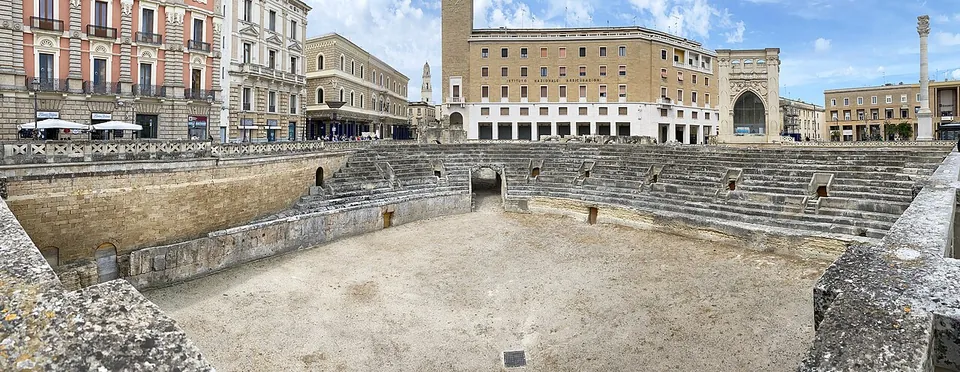
Photo: Bernard Gagnon · CC0 · Commons
amphitheatre · Apulia
Roman amphitheatre of Lecce
The building was an oval about 102 by 82 m (the Ministry of Culture), with an arena of 53 by 34 m (it.wikipedia).
Ticketed
Lupia, Loupiai
city · Apulia, Italy
2 places to see, the best preserved and best known first.
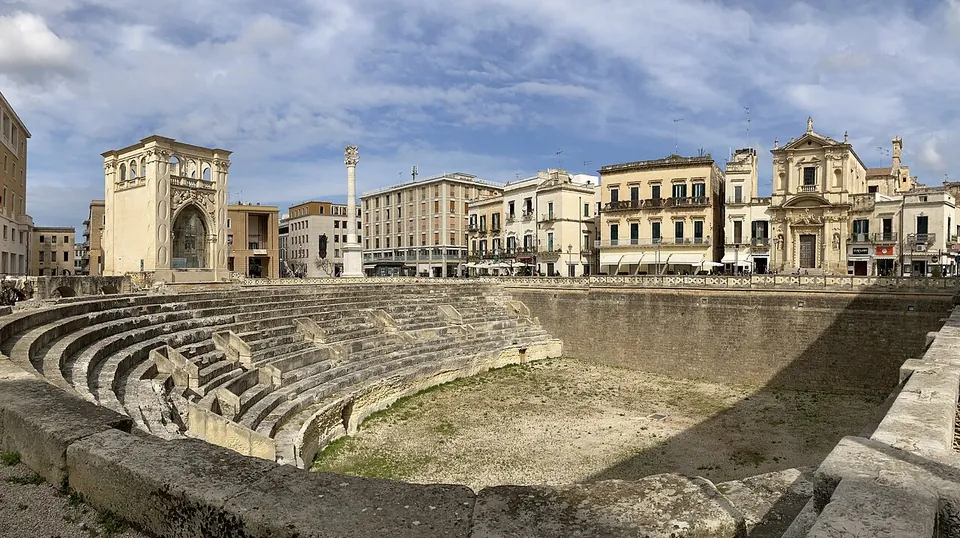
Photo: Bernard Gagnon · CC0 · Commons
amphitheatre · Apulia
The building was an oval about 102 by 82 m (the Ministry of Culture), with an arena of 53 by 34 m (it.wikipedia).
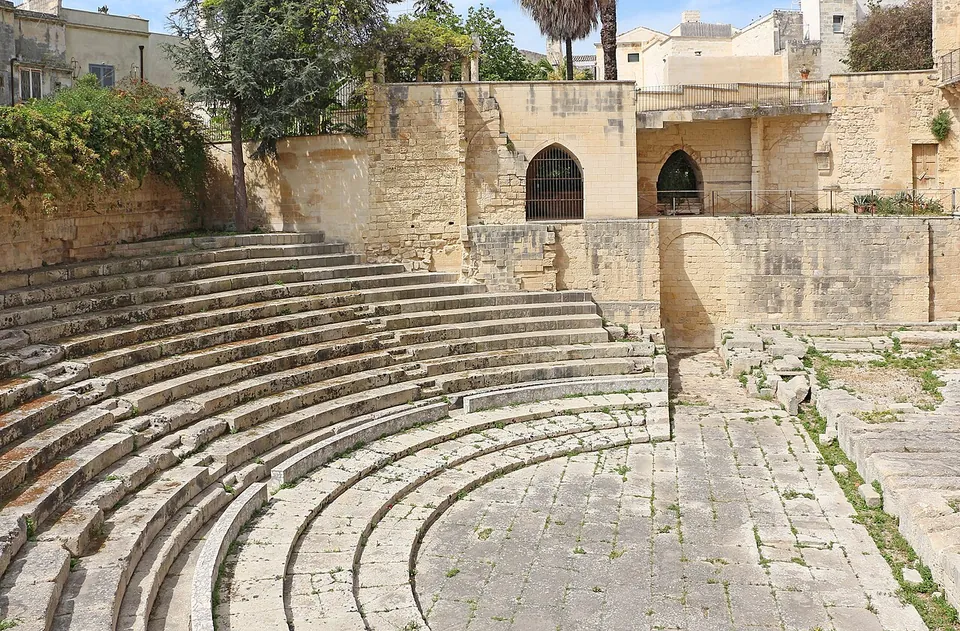
Photo: Bernard Gagnon · CC0 · Commons
theatre · Apulia
The theatre was found by chance in 1929, in the gardens of two palaces, Palazzo D'Arpe and Palazzo Romano (it.wikipedia), and it still sits in a pocket between the old town's houses.
Lupiae was the Roman town under today’s Lecce, in the heel of Italy, and two of the buildings it put up for shows lie open in the historic centre: a third of an amphitheatre, sunk below Piazza Sant’Oronzo, and a small theatre a few minutes’ walk away. They make an hour or two in a city famous for its Baroque, not a reason to travel to Lecce on their own. One €5 ticket covers both, but on 17 October 2026 the ticket office reported the theatre closed for refitting.
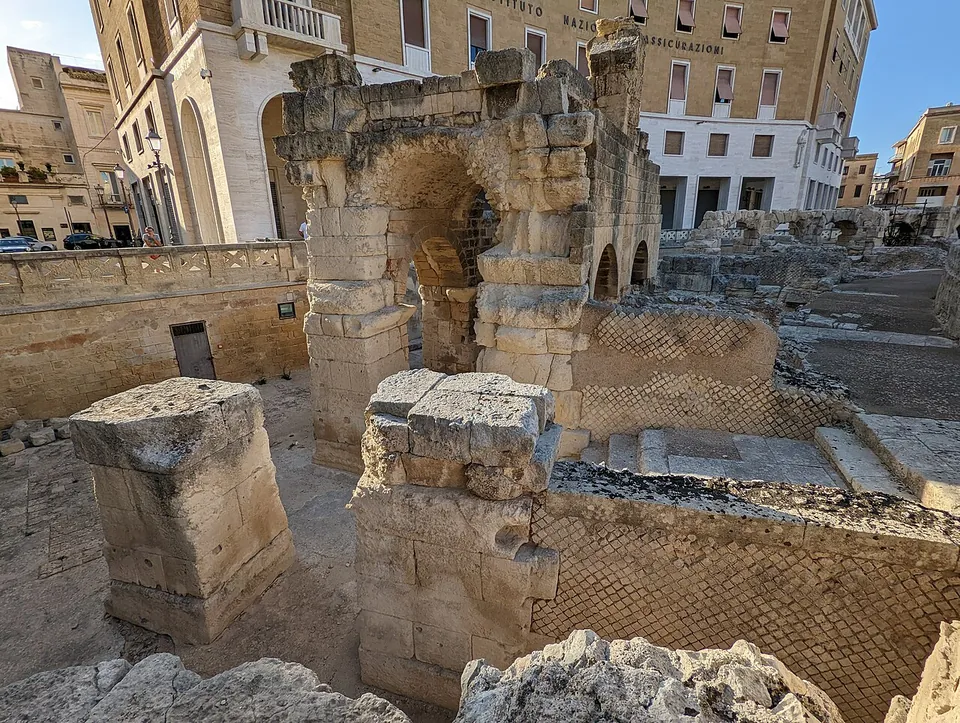
The amphitheatre. It lies in Piazza Sant’Oronzo, below street level. It came to light in the radical replanning of the town centre early in the 20th century (the Ministry of Culture), when the Banca d’Italia building was going up (it.wikipedia). Digging began in 1900 under the archaeologist Cosimo De Giorgi and went on, with breaks, until 1940; about a third of the building is uncovered, and the rest lies under the square and the buildings facing it (the Ministry), among them the church of Santa Maria della Grazia (it.wikipedia; OpenStreetMap). It was an oval about 102 by 82 m. The arena, the corridor beneath the lower seating and the passages joining them are cut straight into the local Lecce stone; the load-bearing parts above them are of squared blocks, joined by concrete faced in opus reticulatum, a net-like pattern of small square stones. Of the 68 arches of the outer wall, 24 piers can be seen today (the Ministry). A relief in white Greek marble of hunts and fights between animals that ran along the parapet of the arena can be seen inside (Aditus, the official ticket office), and the lower corridor keeps many pieces of the building’s sculpted decoration (the Ministry). After restoration it reopened on 25 October 2025, with areas that had been closed, such as the middle corridor, open to visitors (Quotidiano.net).
Its date and its capacity are both uncertain. The Ministry thinks it probably Augustan, with work under Hadrian; other published dates run into the early 2nd century (Pleiades; it.wikipedia). Published estimates of its capacity run from 12,000–14,000 spectators (the Ministry) to about 25,000 (it.wikipedia).
The column in the same square, topped by a statue of Saint Orontius cast in 1739, is itself ancient: it is one of the two columns that marked the end of the Via Appia in Brindisi, given to Lecce by that city (de.wikipedia; en.wikipedia).
The theatre. About 270 m south-west of the amphitheatre, between Via del Teatro Romano and Via Arte della Cartapesta (OpenStreetMap; it.wikipedia), the theatre was found by chance in 1929 in the gardens of two palaces, Palazzo D’Arpe and Palazzo Romano (it.wikipedia). Its seating, cut into the rock and faced with squared blocks, is 40 m across and divided into six wedges of twelve rows each, many of them restored; in front of the orchestra, paved with slabs of white limestone, three broad semicircular steps held movable seats for notables, and behind it is the stage, 30 m wide and raised 0.7 m above the orchestra (it.wikipedia). Everything higher - the upper seating, the portico round the top and the stage front - is gone (fr.wikipedia). It held about 5,000 spectators (Aditus; it.wikipedia). It was restored and brought back into use in 1999, when a museum overlooking the seating, the Museo del Teatro Romano, opened beside it (it.wikipedia); the theatre’s marble statues are kept there and in the provincial archaeological museum, the Museo Sigismondo Castromediano (fr.wikipedia; it.wikipedia).
If you are in Lecce, yes: the amphitheatre is in the middle of the town’s central square, so it is hard to miss and cheap to enter, and it is a real Roman arena, with the arena floor, the lower seating and part of the outer wall still in place (it.wikipedia), not a foundation plan. But keep it in proportion. Only a third of it has been uncovered, the theatre is small and was closed for refitting in October 2026, and together they fill a morning at most. Come for Lecce and its Baroque centre, and give the Roman town an hour of it.
Lecce’s other ancient neighbour, Rudiae, birthplace of the poet Ennius, lies 3 km south-west within the city limits, with an archaeological park and an amphitheatre of its own (en.wikipedia; it.wikipedia).
Lecce railway station, the end of the Adriatic line from Ancona (en.wikipedia), is about 1 km from the amphitheatre (OpenStreetMap). The nearest commercial airport is Brindisi’s, linked from Lecce’s Airport City Terminal (it.wikipedia). Drivers will find the underground Park Liberty car park about 490 m from the amphitheatre, and small surface car parks closer to the square (OpenStreetMap).
The amphitheatre and the theatre share one ticket, from the official ticket office (Aditus, read 17 October 2026):
No operator page publishes the hours or prices of the Museo del Teatro Romano.
Before you go
Hours and prices checked 17 October 2026 on the operator's own site. Confirm before travelling.
The first town here was Messapian. By the late 4th century BC it was a walled town, its walls 3 km long and 5 m thick round about 50 hectares, and stretches of them have been found in the modern city (it.wikipedia). Rome conquered the region in the 3rd century BC; the town took the Latin name Lupiae, and after the Social War ended in 89 BC it became a municipium, later a colony (it.wikipedia; Pleiades).
A short stay by Octavian, the future Augustus, and the loyalty of the local Messapian aristocracy probably lie behind what followed: in the last years of the 1st century BC an amphitheatre, a theatre and a temple, perhaps of Apollo, were built close together, turning the Messapian town into a Roman one (it.wikipedia). The walls, the gates and the cemeteries of the older town stayed in use. Under the Empire, and above all in the 2nd century, it became the most important town of the Salento alongside Brindisi; Trajan’s road from Brindisi to Otranto, the Via Traiana Calabra, ran through it, and Hadrian gave it a port in the bay of San Cataldo (it.wikipedia). Mosaic floors of a rich 5th-century house have been found along the line of Vico dei Sotterranei in the old town (it.wikipedia).
After Rome the town declined. The Ostrogothic king Totila sacked it in 542 and 549, and it then stayed under the Eastern Roman Empire for five centuries (it.wikipedia). The amphitheatre, its purpose gone, was quarried for building stone in the early Middle Ages and later built into the foundations of other buildings (Aditus); calyx capitals taken from it can be seen in Otranto Cathedral (Aditus).
Every fact on this page comes from the records below, each used under the licence noted.
| Source | Licence |
|---|---|
| Pleiades 442642 | CC BY |
| Pleiades — Roman amphitheater at Lupia(e) | licence not recorded |
| Pleiades — Roman theater at Lupia(e) | licence not recorded |
| Wikipedia (it) — Storia di Lecce | CC BY-SA 4.0 |
| Wikipedia (it) — Lecce | CC BY-SA 4.0 |
| Wikipedia (it) — Anfiteatro romano di Lecce | CC BY-SA 4.0 |
| Wikipedia (it) — Teatro romano di Lecce | CC BY-SA 4.0 |
| Wikipedia (fr) — Amphithéâtre de Lecce | CC BY-SA 4.0 |
| Wikipedia (fr) — Théâtre romain de Lecce | CC BY-SA 4.0 |
| Wikipedia (en) — Lecce | CC BY-SA 4.0 |
| Wikipedia (de) — Lecce | CC BY-SA 4.0 |
| Ministero della Cultura — Teatro e Anfiteatro romano di Lecce (hours, tariff, description) | licence not recorded |
| Aditus Culture — Anfiteatro e Teatro romano di Lecce (official ticket office, hours and prices) | licence not recorded |
| Quotidiano.net — Lecce riapre il suo Anfiteatro Romano (28 October 2025) | licence not recorded |
