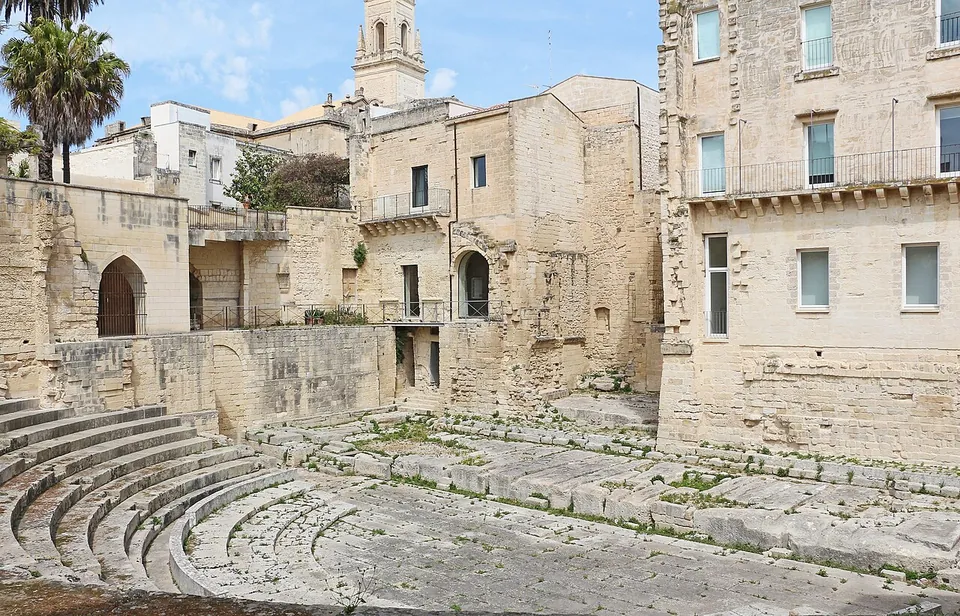


The Roman Theatre of Lecce is the theatre of Roman Lupiae, a half-circle of stone seating and a paved orchestra hidden among the palaces of Lecce’s old town. It is closed for refitting at the moment, but you can still see into it from the street.
What is there today
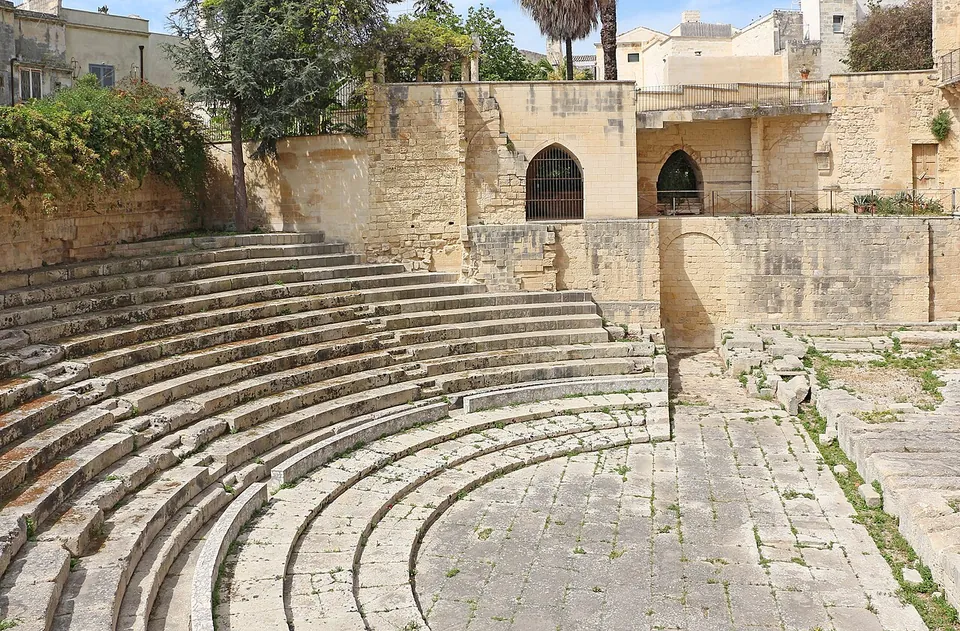
The theatre was found by chance in 1929, in the gardens of two palaces, Palazzo D’Arpe and Palazzo Romano (it.wikipedia), and it still sits in a pocket between the old town’s houses. What was excavated is the lower half: the seating, cut into a bank of rock and faced with squared blocks, 40 m across on the outside and 19 m on the inside. Five radial stairways divide it into six wedges of twelve rows each, many of them restored. In front of the orchestra, which is paved with rectangular slabs of white limestone, three broad semicircular steps took movable seats, when needed, for the town’s notables, with a low parapet behind them; beyond the orchestra are the channel for the curtain and the stage, 30 m wide and raised 0.7 m above the orchestra floor (it.wikipedia).
Everything higher is gone: the upper seating, the portico that ran round the top and the decorated stage front (fr.wikipedia). The finds, among them the marble statues that adorned the theatre, are kept in the Museo del Teatro Romano next door, which overlooks the seating, and in the provincial archaeological museum, the Museo Sigismondo Castromediano (it.wikipedia; fr.wikipedia).
Is it worth the trip?
On its own, no. It is a small theatre, built for about 5,000 people (Aditus, the official ticket office), and only its lower part survives, so a few minutes take it in. Its charm is the setting, a Roman auditorium enclosed by the pale stone walls of later Lecce.
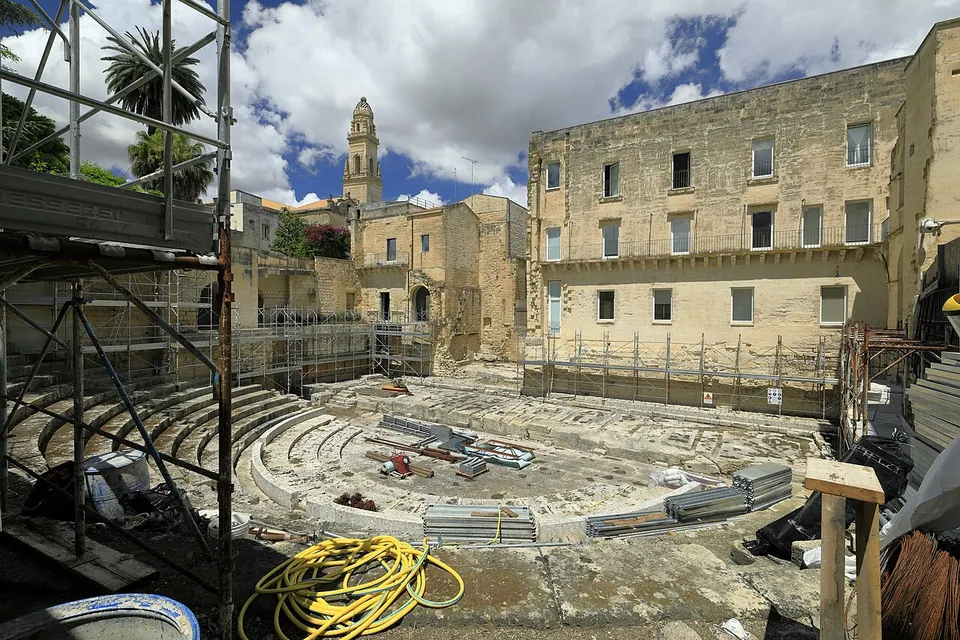
As part of a day in Lecce it is worth the short walk from the amphitheatre in Piazza Sant’Oronzo, which is the bigger sight and shares its ticket. At present that ticket gets you only the amphitheatre: on 20 October 2026 the ticket office reported the theatre closed for refitting, with no reopening date. A photograph taken from Via del Teatro Romano in May 2026 shows scaffolding and building materials in the orchestra, and also shows that the street gives a view into it.
Getting there and what it costs
The theatre lies in the old town between Via del Teatro Romano and Via Arte della Cartapesta, a little over 200 m from the amphitheatre (OpenStreetMap). Lecce railway station is about 750 m away in a straight line, and the nearest mapped bus stops, Castello and Porta San Biagio, about 300 m. Drivers will find street-side parking about 95 m away and a small surface car park about 165 m away; the underground Park Liberty car park is about 600 m away (OpenStreetMap). Toilets, free of charge, are mapped about 35 m away (OpenStreetMap).
One ticket covers the theatre and the amphitheatre (Aditus, read 20 October 2026):
- Admission: €5; €2 for EU citizens aged 18–25; free under 18 (under 12 only with an adult) and in the other categories of Italy’s state museums. Free on the first Sunday of every month, and on 4 November 2026.
- Hours: Tuesday to Sunday, closed on Mondays. October to March 09.00–15.30, last tickets 15.00; April to June 10.00–13.00 and 17.00–21.00, last tickets 12.30 and 20.30; July to September 15.00–21.00, last tickets 20.30. The Ministry of Culture’s page gives 10.00–17.00 for the winter, so check before an afternoon visit between October and March.
- Online tickets are for a set entry time, and the ticket office requires visitors to arrive at it.
No operator page publishes the hours or prices of the Museo del Teatro Romano.
Visiting details
- Opening hours
- Shared ticket with the amphitheatre: Tuesday–Sunday, closed on Mondays. October–March 09.00–15.30 (ticket office until 15.00); April–June 10.00–13.00 and 17.00–21.00 (tickets until 12.30 and 20.30); July–September 15.00–21.00 (tickets until 20.30). Online tickets are for a chosen entry time. The theatre itself is closed for refitting at present (see the warning).
- Tickets
- €5; €2 for EU citizens aged 18–25 (and others on reciprocity); free under 18 (under 12 only with an adult) and in the other categories of Italy's state museums. Free on the first Sunday of every month and on 4 November 2026. One ticket covers the theatre and the amphitheatre in Piazza Sant'Oronzo.
- Parking
- Street-side parking about 95 m away and a small surface car park about 165 m away (OpenStreetMap node/3966787445 and way/412933232); the underground Park Liberty car park (way/647023282, 466 spaces, fee) is about 600 m away.
Before you go
- On 20 October 2026 the official ticket office reported the theatre temporarily closed for refitting ("momentaneamente chiuso per lavori di riallestimento"), with no reopening date. It can still be seen from the street.
- The Ministry of Culture's page gives different winter hours, 10.00–17.00, against the ticket office's 09.00–15.30.
Hours and prices checked 20 October 2026 on the operator's own site. Confirm before travelling.
History
The theatre’s date is uncertain; it is generally assigned to the reign of Augustus (Pleiades; it.wikipedia). In the last years of the 1st century BC Lupiae was given an amphitheatre, a theatre and a temple, perhaps of Apollo, built close together, a programme meant to turn the Messapian town into a Roman one. A short stay by Octavian, the future Augustus, and the loyalty of the local Messapian aristocracy probably lie behind it (it.wikipedia, Storia di Lecce). it.wikipedia’s article on the theatre says Augustus probably ordered both the theatre and the amphitheatre to repay the town, where he had found refuge before he became emperor. The ticket office says the theatre was renewed under Hadrian (Aditus). Some fragments of the terracotta decoration of the parapet are thought to be Augustan, while the marble statues are thought to date from the Antonine age (it.wikipedia); the excavations recovered eleven fragments of marble sculpture from the stage front (Aditus).
Nothing in the sources records when the theatre went out of use. It was forgotten for centuries, like the amphitheatre (it.wikipedia, Lecce), until the 1929 discovery. It was restored and brought back into use in 1999, when the Museo del Teatro beside it was inaugurated on the occasion of a production called Miti in Scena (it.wikipedia, Lecce), and it has since been used for performances (it.wikipedia).
Sources
Every fact on this page comes from the records below, each used under the licence noted.
| Source | Licence |
|---|---|
| Pleiades 694724623 | CC BY |
| Wikidata Q3982369 | CC0 |
| Vici.org 17475 | CC BY-SA (text), CC0 (metadata) |
| OpenStreetMap way/231466071 | ODbL |
| Wikipedia (it) — Teatro romano di Lecce | CC BY-SA 4.0 |
| Wikipedia (fr) — Théâtre romain de Lecce | CC BY-SA 4.0 |
| Wikipedia (it) — Lecce | CC BY-SA 4.0 |
| Wikipedia (it) — Storia di Lecce | CC BY-SA 4.0 |
| Aditus Culture — Anfiteatro e Teatro romano di Lecce (official ticket office, hours, prices and notices) | licence not recorded |
| Ministero della Cultura — Teatro e Anfiteatro romano di Lecce | licence not recorded |