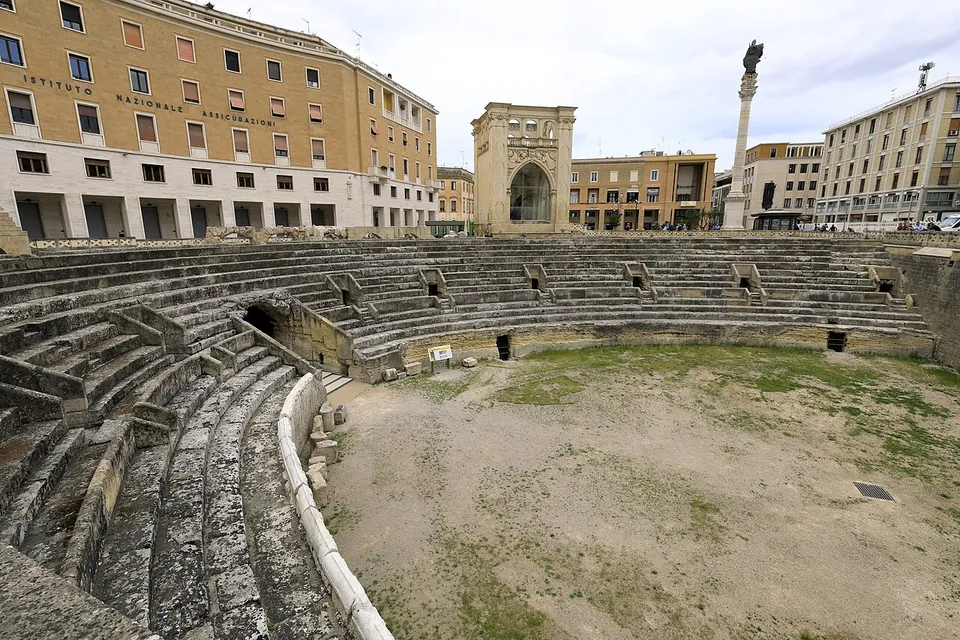
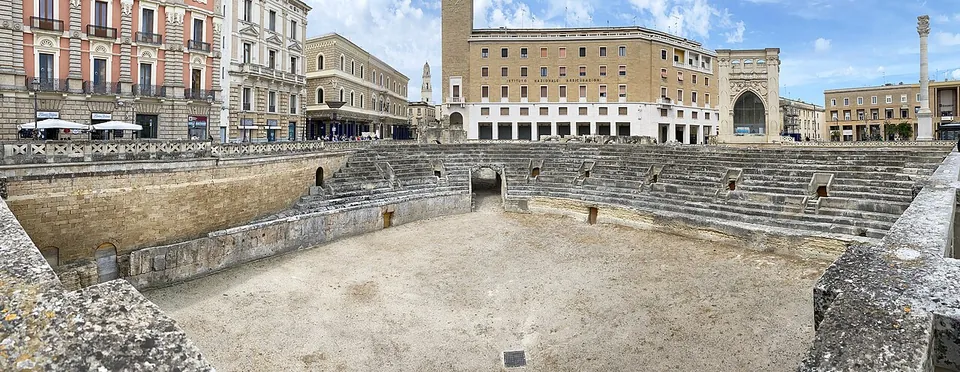


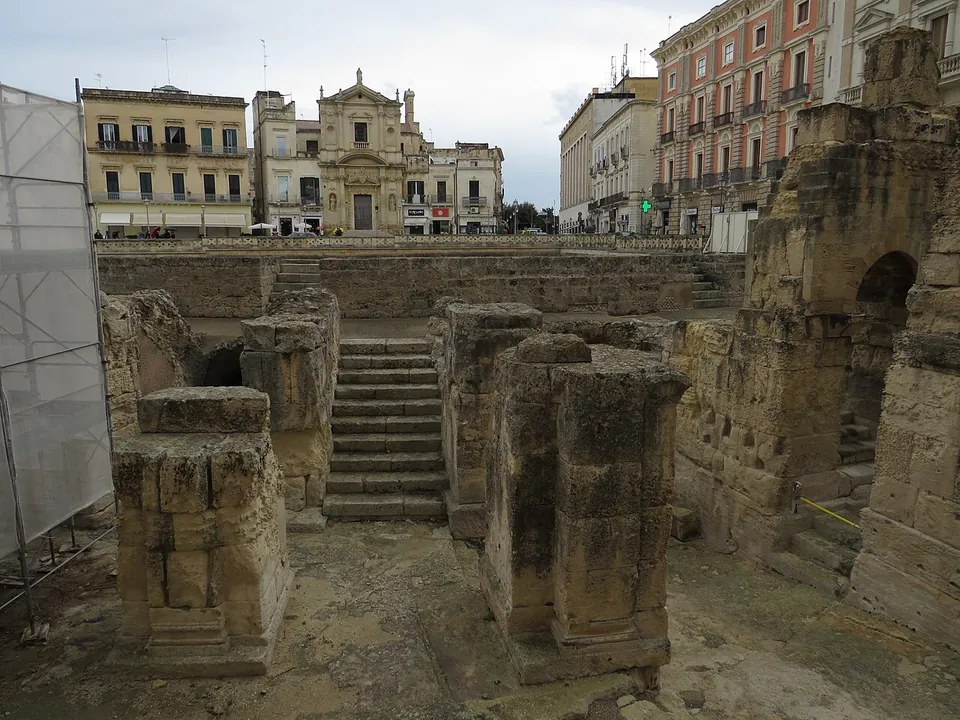
The Roman amphitheatre of Lecce is the arena where the Roman town of Lupiae watched gladiators and wild-beast hunts, and about a third of it lies open in a pit in Piazza Sant’Oronzo, in the heart of Lecce’s old town. What you see is the arena, the lower rows of seating, the corridors round them and 24 stone piers of the outer arcade; the rest lies under the square and the buildings facing it. If you are in Lecce it is worth the €5 and an hour of your time; on its own it is not a reason to travel to Lecce.
What is there today
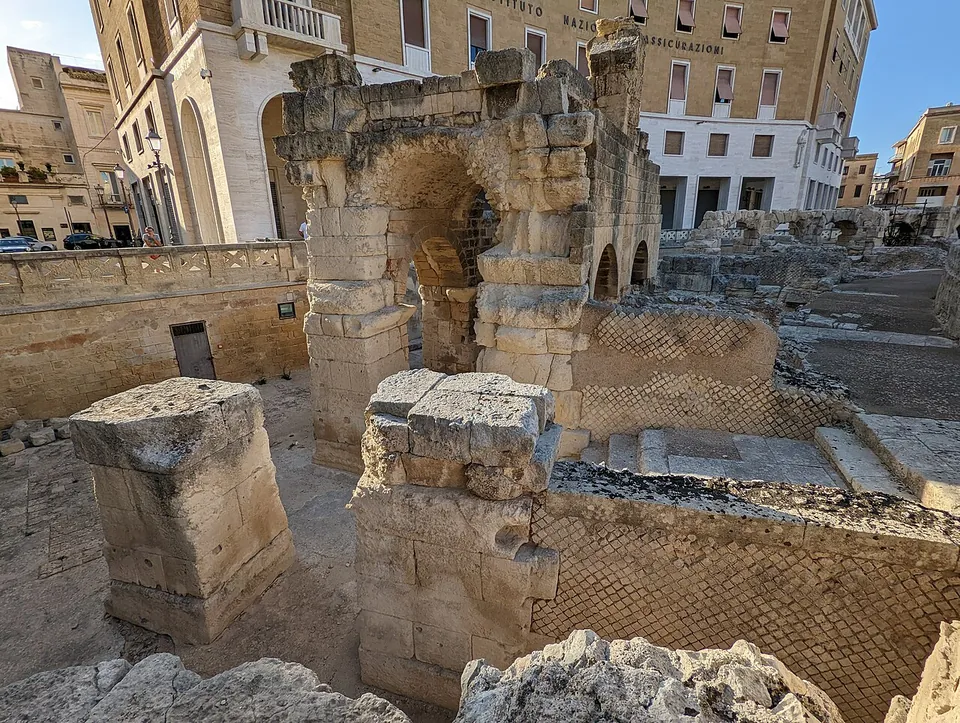
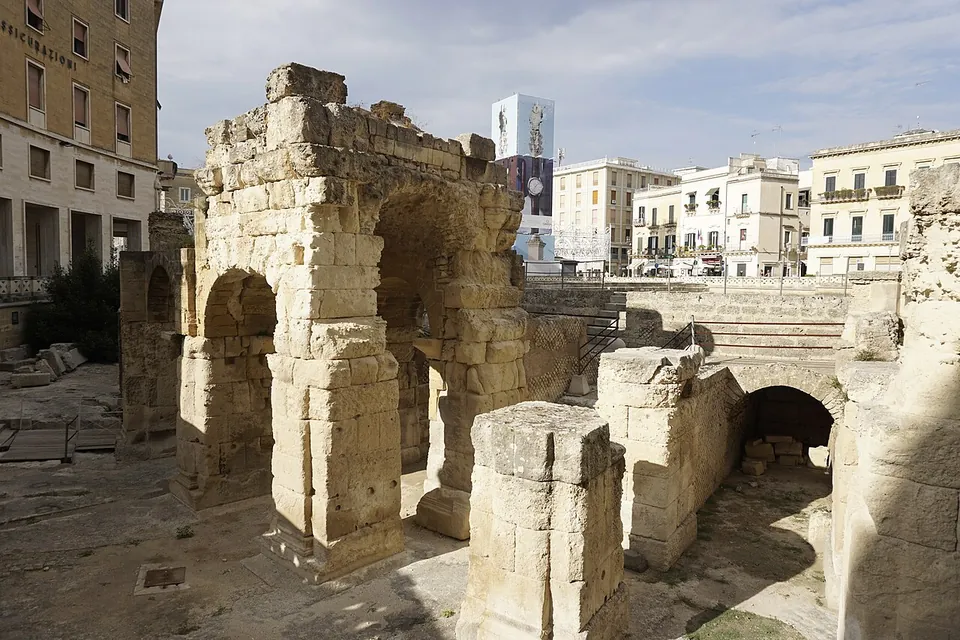
The building was an oval about 102 by 82 m (the Ministry of Culture), with an arena of 53 by 34 m (it.wikipedia). Its builders made the most of the local Lecce stone: the arena, the corridor under the lower seating and the passages joining them are cut straight into the rock, while the frame that carried the upper parts is of squared blocks, linked by concrete faced in opus reticulatum, a net-like pattern of small square stones (the Ministry). Of the 68 arches of the outer wall, 24 piers can be seen today (the Ministry).
The Ministry describes how it worked. The seating was divided into four sectors behind four entrances on the main axes; spectators came in at the level of the middle seating and took stairs up to the upper tiers and a portico round the top, or down to the lower corridor, which led to the front rows and, through six service passages, to the arena. The podium wall round the arena was faced with marble, and a relief of hunts and fights between animals, carved in white Greek marble, ran along the parapet above it; that relief can be seen inside, and the lower corridor keeps many other pieces of the building’s sculpted decoration (Aditus, the official ticket office; the Ministry).
The amphitheatre reopened on 25 October 2025 after restoration work begun in spring 2023, which consolidated walls and arches, laid out the visitor routes and added steel railings. Areas that had been closed, such as the middle corridor, are now open to visitors, and the central lawn has been prepared for cultural events of up to 400 people (Quotidiano.net). Plays are staged in the arena (it.wikipedia).
The column that stands beside it (Quotidiano.net), topped by a statue of Saint Orontius cast in Venice in 1739, is itself ancient: it is one of the two columns that marked the end of the Via Appia at Brindisi, given to Lecce by that city (de.wikipedia).
Is it worth the trip?
If you are in Lecce, yes. Together with the theatre it is the clearest sign of what Roman Lupiae was (it.wikipedia), it sits in the heart of the old town, and it is a real arena with its seating and corridors, not a foundation plan. Keep it in proportion, though: only a third of it has been uncovered, so it reads as a slice of an amphitheatre rather than a whole one, and an hour is plenty. The Roman Theatre a few minutes’ walk away shares the ticket, but was closed for refitting in October 2026. The Lupiae – Lecce page covers the Roman town and both stops.
Getting there and what it costs
The amphitheatre is in Piazza Sant’Oronzo, in the historic centre. Lecce railway station is about 950 m away in a straight line (OpenStreetMap). Drivers will find the underground Park Liberty car park about 460 m away, and two surface car parks within 100 m of the amphitheatre (OpenStreetMap).
One ticket covers the amphitheatre and the Roman Theatre, from the official ticket office (Aditus, read 17 October 2026):
- Admission: €5; €2 for EU citizens aged 18–25 (and others on reciprocity); free under 18 (under 12 only with an adult) and in the other categories of Italy’s state museums. Free on the first Sunday of every month, and on 4 November 2026.
- Hours: Tuesday to Sunday, closed on Mondays. October to March 09.00–15.30, last tickets 15.00; April to June 10.00–13.00 and 17.00–21.00, last tickets 12.30 and 20.30; July to September 15.00–21.00, last tickets 20.30. The Ministry of Culture’s page gives 10.00–17.00 for the winter, so check before an afternoon visit between October and March.
- Online tickets are for a set entry time, and visitors must arrive at it.
- The ticket office offers an audio guide and guided tours, and lists access for disabled visitors among its services; OpenStreetMap tags the site as not wheelchair-accessible, so ask ahead.
Visiting details
- Opening hours
- Tuesday–Sunday, closed on Mondays. October–March 09.00–15.30 (ticket office until 15.00); April–June 10.00–13.00 and 17.00–21.00 (tickets until 12.30 and 20.30); July–September 15.00–21.00 (tickets until 20.30). Online tickets are for a chosen entry time.
- Tickets
- €5; €2 for EU citizens aged 18–25 (and others on reciprocity); free under 18 (under 12 only with an adult) and in the other categories of Italy's state museums. Free on the first Sunday of every month and on 4 November 2026. The ticket also covers the Roman Theatre. A six-month Puglia Musei Card for all the regional museums directorate's sites (Taranto's MArTA excepted) is €20, reduced €14.
- Parking
- Park Liberty, an underground car park (OpenStreetMap way/647023282, 466 spaces, fee), about 460 m away; two small surface car parks lie within 100 m of the amphitheatre.
Before you go
- The Ministry of Culture's page for the site gives different winter hours, 10.00–17.00, against the ticket office's 09.00–15.30; check before an afternoon visit between October and March.
- On 17 October 2026 the official ticket office reported the Roman Theatre, which shares the ticket, temporarily closed for refitting; the amphitheatre is open.
Hours and prices checked 17 October 2026 on the operator's own site. Confirm before travelling.
History
The amphitheatre came to light early in the 20th century, in the radical replanning of the town centre (the Ministry), while the Bank of Italy building was going up (it.wikipedia), and was declared a national monument straight away (Aditus). Digging began in 1900 under the archaeologist Cosimo De Giorgi and went on, with breaks, until 1940 (the Ministry); valuable older buildings were pulled down to clear it (de.wikipedia). The rest of the building is still buried under the square and the buildings round it (the Ministry), among them the church of Santa Maria della Grazia (it.wikipedia).
Its date is debated. The Ministry and its ticket office date it, probably, to the age of Augustus (31 BC–AD 14), with work under Hadrian (117–138) (Aditus); to that Hadrianic phase the Ministry assigns a portico that probably ran round the top, and with it several fragments of architectural decoration in Pentelic marble. Other published dates run from Augustus to the early 2nd century (it.wikipedia; Pleiades). it.wikipedia links the town’s two buildings for shows to Octavian, the future Augustus, who passed through Lupiae in the turmoil after Julius Caesar’s murder and, it says, paid for them in return for the town’s hospitality. Estimates of how many it held differ just as widely: 12,000–14,000 spectators according to the operator, about 25,000 according to it.wikipedia.
Its purpose gone, in the early Middle Ages it was used as a quarry for building stone, and what was left was later built into the foundations of other buildings; calyx capitals taken from it can be seen in Otranto Cathedral (Aditus).
More photographs


Sources
Every fact on this page comes from the records below, each used under the licence noted.
| Source | Licence |
|---|---|
| Pleiades 826967496 | CC BY |
| Wikidata Q2844410 | CC0 |
| Vici.org 4240 | CC BY-SA (text), CC0 (metadata) |
| OpenStreetMap way/300753266 | ODbL |
| Pleiades — Lupia(e), the Roman town | licence not recorded |
| Wikipedia (it) — Anfiteatro romano di Lecce | CC BY-SA 4.0 |
| Wikipedia (fr) — Amphithéâtre de Lecce | CC BY-SA 4.0 |
| Wikipedia (de) — Lecce | CC BY-SA 4.0 |
| Ministero della Cultura — Teatro e Anfiteatro romano di Lecce (hours, tariff, description) | licence not recorded |
| Aditus Culture — Anfiteatro e Teatro romano di Lecce (official ticket office, hours and prices) | licence not recorded |
| Quotidiano.net — Lecce riapre il suo Anfiteatro Romano (28 October 2025) | licence not recorded |