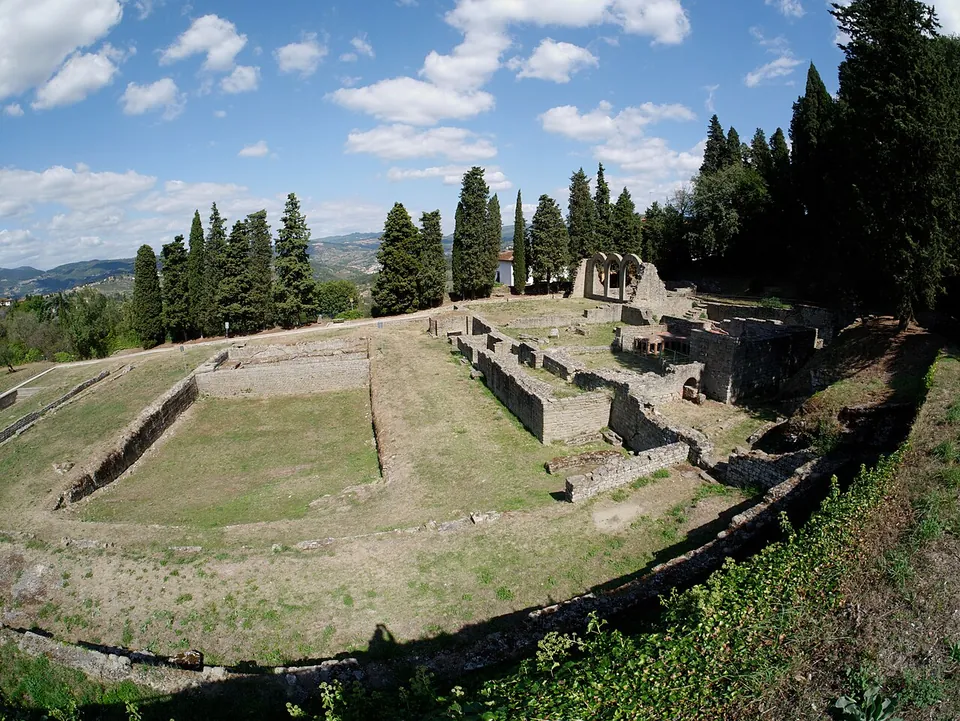
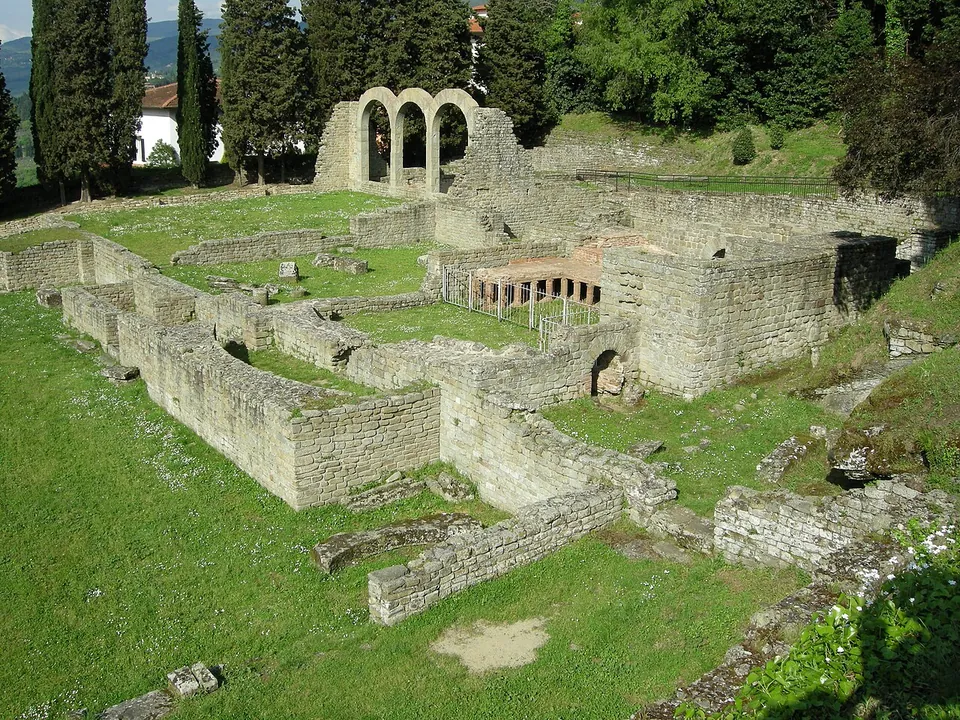
The Roman baths of Fiesole are the bath house of Faesulae, the Roman town on the hill of Fiesole north-east of Florence, and they lie in the eastern part of its archaeological area, behind the theatre (the operator, it.wikipedia, de.wikipedia). You see them on the same ticket as the theatre and the temple, which are on the Faesulae – Fiesole page.
What is there today
The complex is almost rectangular, about 75 m by 53 m, between the back of the theatre and the Etruscan city wall (de.wikipedia). It had two parts: an open-air area with pools for swimming and space for exercise, and a covered building with the bath rooms proper – the frigidarium (cold room), the tepidarium (warm) and the calidarium (hot) (the operator).
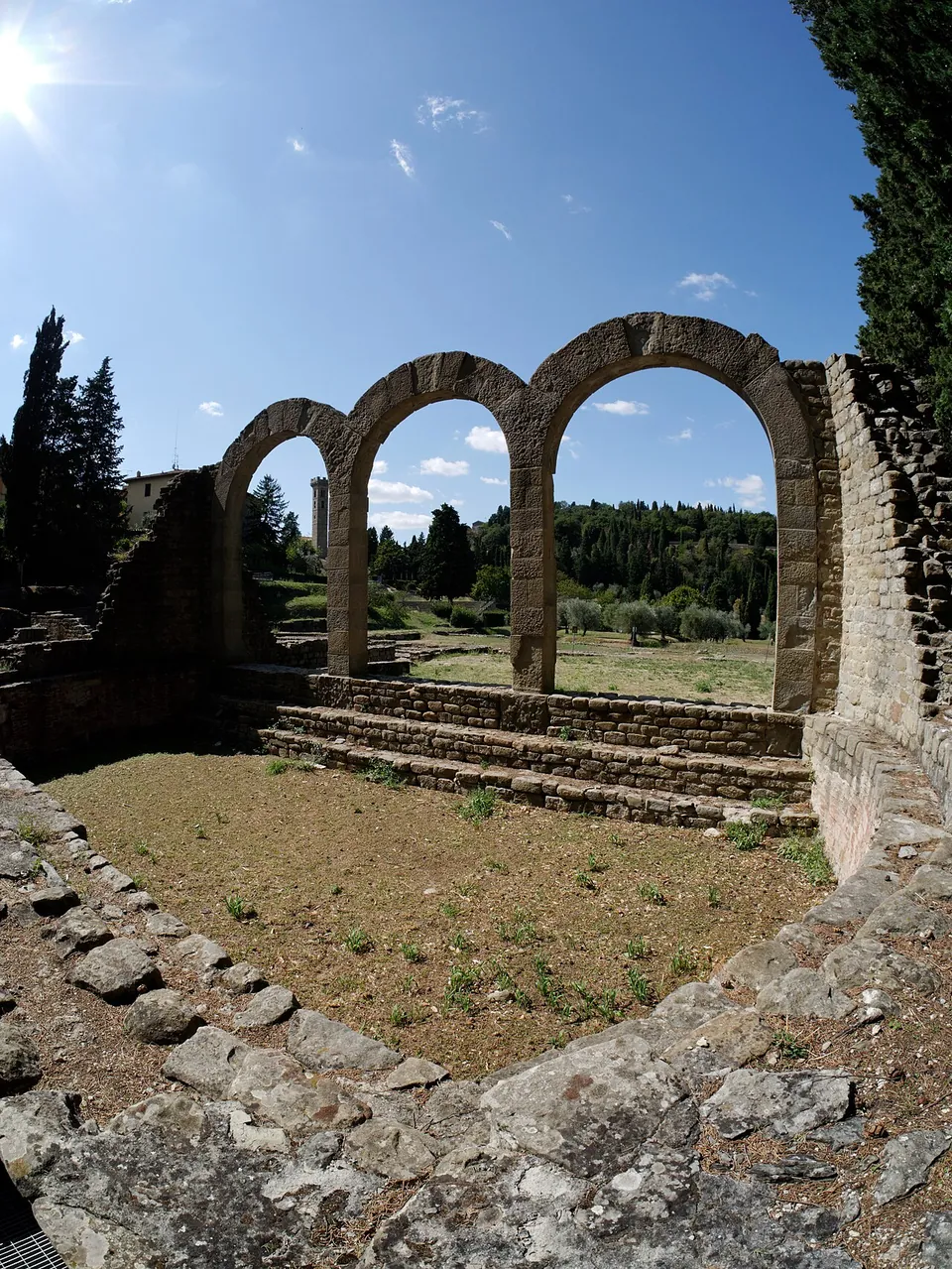
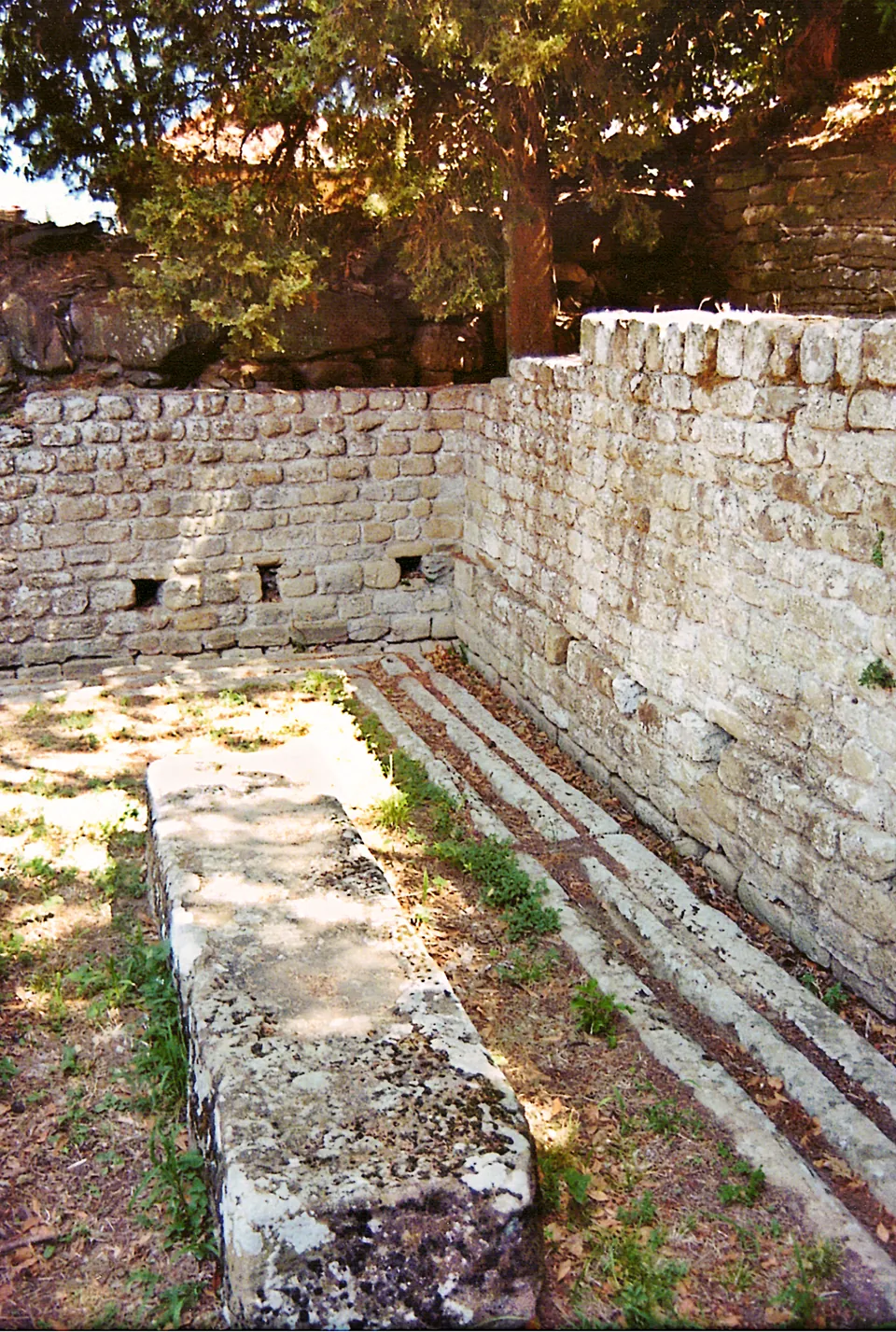
The landmark is the frigidarium, the northernmost and oldest room, divided by three stone arches (it.wikipedia). The arches, 4.40 m high, are built of their original stones, but they were re-erected in the late 19th century and their surfaces reworked, which is why they look almost new; the holes that held their facing of coloured marble can still be seen (de.wikipedia). A cold-water pool lies just east of the arches, and behind it is the latrine, where stone blocks with grooves to carry the water away still run along the walls (de.wikipedia).
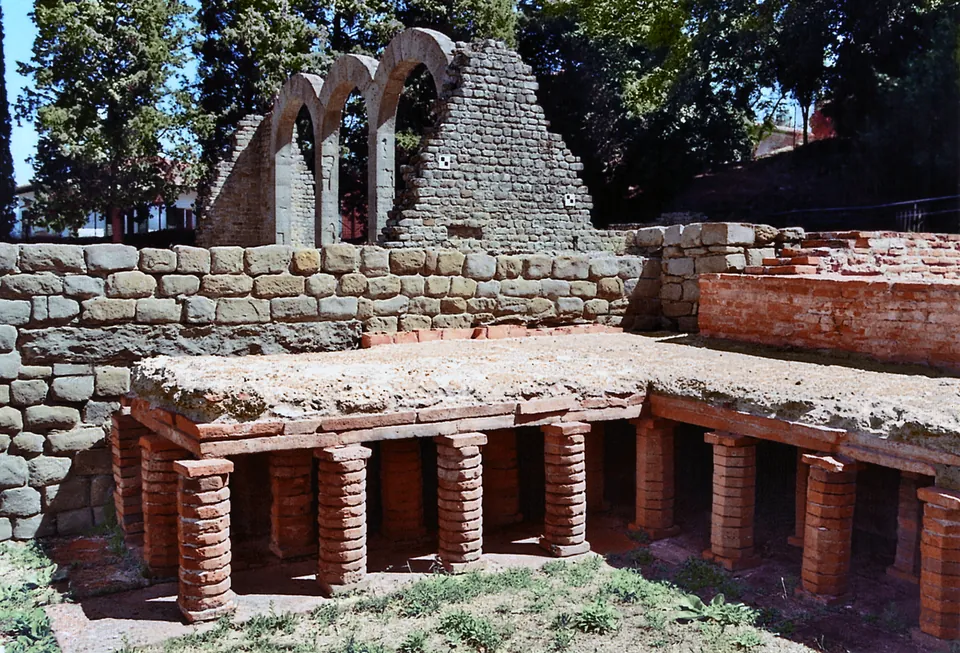
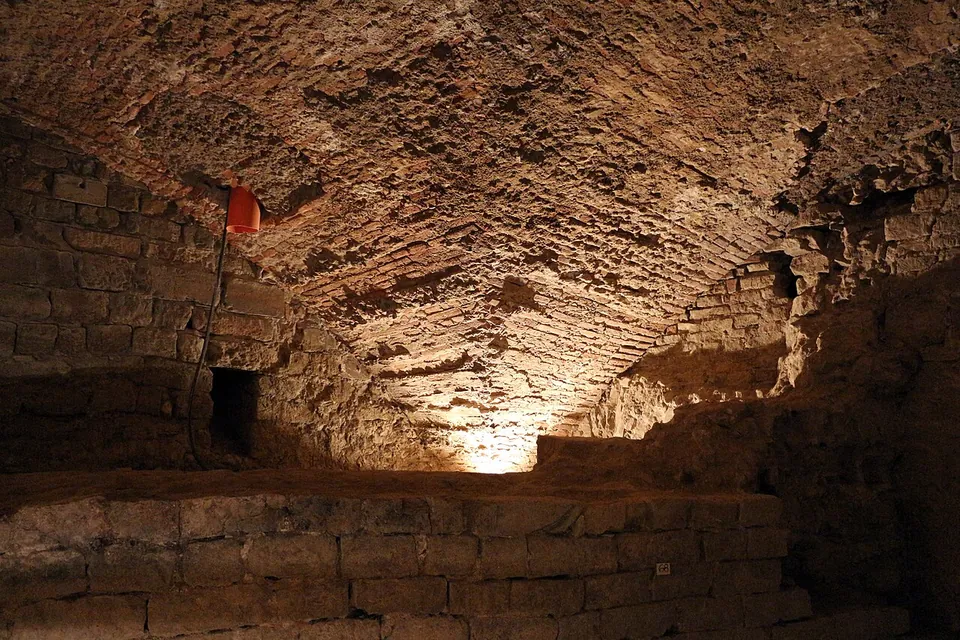
The hot room shows how a Roman bath was heated: the ovens, the small brick pillars that held up the floor so that hot air could pass beneath it, and the hollow bricks set into the walls to carry the heat up them (the operator). Much of this is restoration (the operator), and in the partly rebuilt underfloor heating only some of the visible parts are Roman (de.wikipedia).
On the open-air terrace are the big basins. The larger, about 21 m by 13 m and on average 3 m deep, was made for swimmers; the smaller beside it is read as a cistern (de.wikipedia). A narrower pool on the west side, about 20 m by 6 m, was added under Hadrian according to the archaeologist Edoardo Galli (de.wikipedia). One of the water tanks of the boilers, which still weighs about 600 kg, is in the Archaeological Museum (de.wikipedia).
Is it worth the trip?
Not as a trip of its own, and you will not need to make one: the baths are a few steps from the theatre, inside the same fenced area and on the same ticket. Given that, they are worth the walk across. In one compact plan they show the cold, warm and hot rooms, the furnaces and the raised floors of a Roman bath, and it.wikipedia counts them among the oldest bath buildings in Italy.
Take them as a plan of how the baths worked rather than as untouched ruins. They were heavily restored after they were dug up – so heavily that their building history can no longer be reconstructed precisely (it.wikipedia).
Getting there
The baths are reached through the entrance of the archaeological area, where via Duprè meets via Portigiani. Bus 7 runs from Florence to the terminus “Fiesole, Piazza Mino”; from there cross the road and walk behind the cathedral of San Romolo to via Duprè (the operator). There is no car park of the museums’ own: there are paid bays in the streets round the entrance and free car parks in the town, and disabled bays in via Portigiani and Piazza del Mercato (the operator). A paid car park in Piazza del Mercato is mapped about 50 m from the baths (OpenStreetMap), but the way in is the entrance on via Duprè.
From April to September the area is open every day, 09.00 to 19.00; in March and October every day, 10.00 to 18.00; from November to February 10.00 to 15.00, closed on Tuesdays. The ticket office shuts half an hour before closing, and the area is closed on 25 December. The area alone costs €7 (reduced €5), baths, theatre and temple included; with the Archaeological Museum it is €10 (reduced €6), and €12 (reduced €8) adding the Bandini Museum. Reductions are for ages 7 to 18, groups of ten or more and university students; children up to six go free. A multimedia guide is included, against an ID document left at the desk, and the museums are part of the FirenzeCard (museidifiesole.it, read 24 October 2026 – check before travelling, since prices move).
Visiting details
- Opening hours
- January–February and November–December 10.00–15.00, closed on Tuesdays; March and October daily 10.00–18.00; April–September daily 09.00–19.00. The ticket office closes 30 minutes before the site. Open on public holidays; closed on 25 December. No booking needed except for guided tours.
- Tickets
- The baths are inside the Area Archeologica and need its ticket: €7 for the area alone, theatre and temple included (reduced €5). €10 with the Archaeological Museum (reduced €6, family €20); €12 adding the Bandini Museum (reduced €8, family €24). Reduced for ages 7–18, groups of ten or more and university students; free up to age 6 and for disabled visitors with a companion. A multimedia guide to the area and the Archaeological Museum is included, against an ID document left as a deposit. Part of the FirenzeCard circuit.
- Parking
- No car park of the museums' own (the operator): paid bays in the streets round the entrance, and free car parks in the town signposted from the roads in. The nearest disabled bays are in via Portigiani and Piazza del Mercato (the operator); a paid car park in Piazza del Mercato is mapped about 50 m from the baths (OSM way/1252896741), but the way in is the area's entrance on via Duprè.
Before you go
- From November to February the area closes at 15.00 and all day on Tuesdays.
Hours and prices checked 24 October 2026 on the operator's own site. Confirm before travelling.
History
The date is disputed. Pleiades and fr.wikipedia put the building in the time of Sulla, whose veterans were settled at Faesulae (it.wikipedia); it.wikipedia, from the masonry, dates it to the first decades of Augustus’s reign, and the operator to the end of the 1st century BC or the start of the 1st century AD. Either way it is an early Roman bath house: de.wikipedia notes that no sweating room was found, which may point to a kinship with the oldest Roman bath plans.
The water came from the Montereggi area, partly in an open channel (it.wikipedia) – most likely from springs there about 4 km away (de.wikipedia). The baths were probably enriched with marble later (it.wikipedia); fr.wikipedia says they were restored and enlarged under Trajan. They were restored in the 3rd century AD, as the theatre was, and abandoned in the 4th (the operator); it.wikipedia holds that the end cannot be dated securely, but that the 3rd-century repairs show the baths in use until before the crisis of the 5th century. From the end of the 6th century the ruined theatre, baths and temple became a Lombard cemetery (it.wikipedia).
The excavation dates differ too: it.wikipedia has the baths dug from 1871–72, de.wikipedia and fr.wikipedia from 1891. De.wikipedia follows the work season by season to 1899, under the town’s archaeological commission, and says most of what was restored then has to be counted as partial reconstruction. Vandals damaged the floors and walls in 1899, and the commission asked the town to fence the site (de.wikipedia). In 2016 the basins of the hot rooms were decaying and under conservation (it.wikipedia).
More photographs
Nearby
5 km · city · Tuscany
Florentia – Florence
The theatre is the one place where Roman structures can be seen where they were built.


Straight-line distances.
Sources
Every fact on this page comes from the records below, each used under the licence noted.
| Source | Licence |
|---|---|
| Pleiades 394362505 | CC BY |
| Wikidata Q111759028 | CC0 |
| Vici.org 2418 | CC BY-SA (text), CC0 (metadata) |
| OpenStreetMap way/166738741 | ODbL |
| Pleiades — Faesulae, the ancient city (413124) | licence not recorded |
| Wikipedia (it) — Area archeologica di Fiesole | CC BY-SA 4.0 |
| Wikipedia (de) — Archäologische Zone Fiesole | CC BY-SA 4.0 |
| Wikipedia (fr) — Site archéologique de Fiesole | CC BY-SA 4.0 |
| Musei di Fiesole — Area Archeologica (the operator) | licence not recorded |
| Musei di Fiesole — opening hours (the operator) | licence not recorded |
| Musei di Fiesole — tickets (the operator) | licence not recorded |
| Musei di Fiesole — how to get there (the operator) | licence not recorded |