

What is there today
Four groups of remains, all on the hill of the old town, none of them a self-contained ruin field: the Romans’ town lies under the modern one, and you meet it street by street. The amphitheatre is at the top, on the Civitella; the theatre lies on the slope below it, the temples in the centre, and the baths on the eastern slope (the operator, it.wikipedia).
The amphitheatre and La Civitella
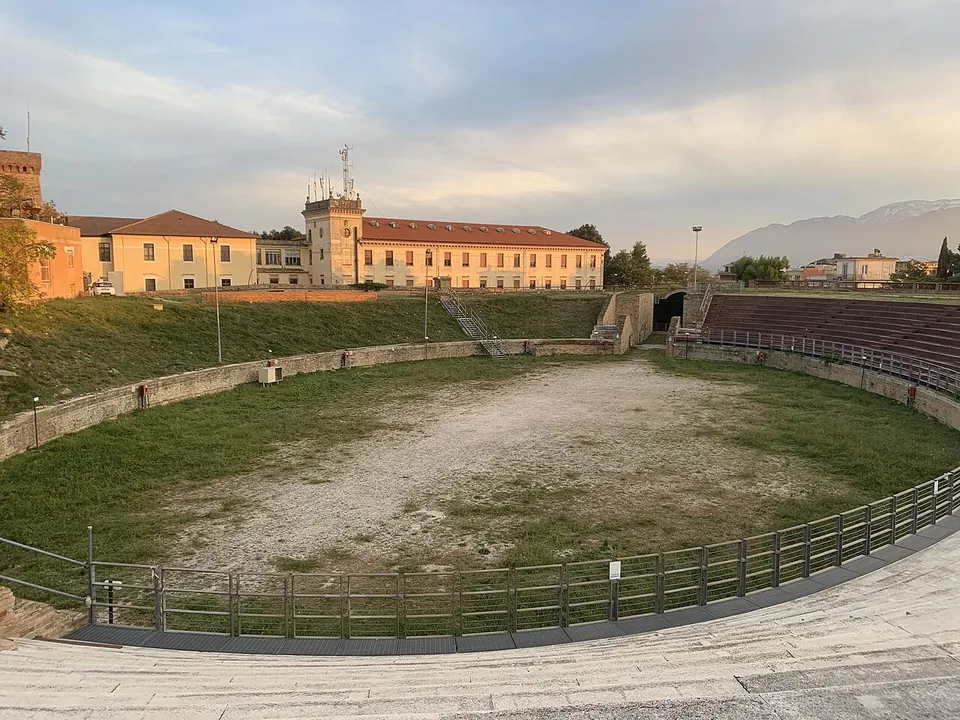
The amphitheatre was built in the first half of the 1st century AD on a natural terrace below the acropolis; its arena measured 60 by 40 m, cut out of a small saddle in the hill, and the natural slopes were shaped to carry the seating. The two main entrances, on the long axis, were faced in two-coloured stone network masonry (the operator). It has been partly reconstructed, after the football stadium that stood on the site was moved away in the 1980s (it.wikipedia), and it is used for events through the year (the operator).
Beneath it is the Museo archeologico nazionale La Civitella, opened on 18 November 2000 to show the temples of the acropolis, the amphitheatre and the finds from Chieti and the territory of the Marrucini. One hall holds reconstructions of the pediments of the Republican temples that stood on the acropolis, with their painted terracotta roof decoration; the Roman section shows finds from the theatre, the amphitheatre, the forum and the baths, and its funerary monuments include the mausoleum of Lusius Storax, carved with scenes of gladiators fighting (the operator).
The temples
In Piazza dei Templi Romani, on the site of the forum, stand the so-called Tempietti. The first sanctuary here grew up beside a sacred well: two temples side by side in squared travertine blocks, inside a sacred enclosure. Between the end of the 1st century BC and the start of the 1st century AD two new temples on a high podium were built over their walls, aligned square to the forum and the main street, now Corso Marrucino, and a smaller third building was added against one of them. Remains of a fourth temple can be seen in the structure of the post-office building (the operator). In the 8th century one temple became the church of Saints Peter and Paul; it was deconsecrated in 1927 so that it could be excavated (the operator, it.wikipedia).
The theatre
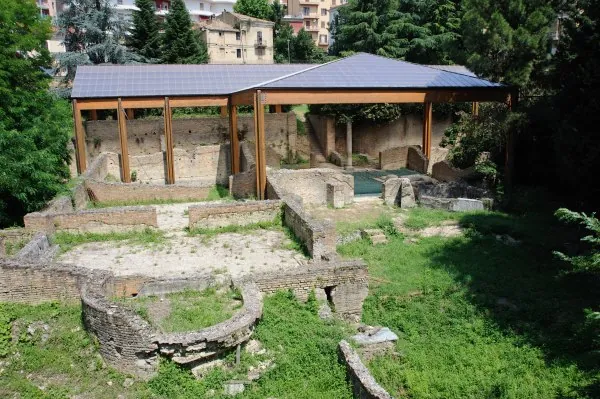
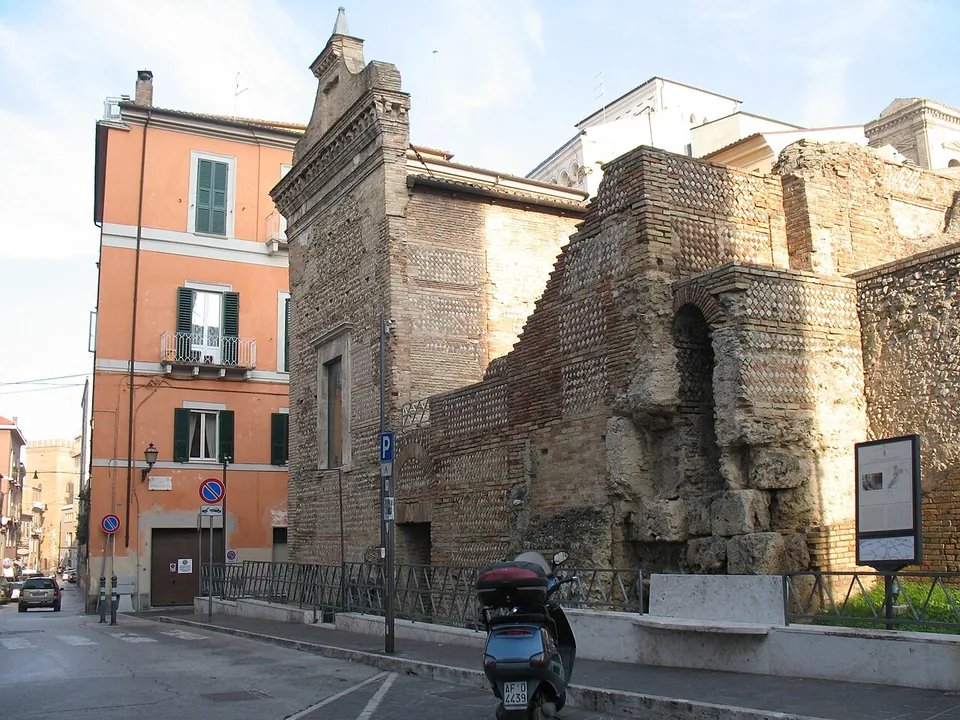
The theatre was built in the 1st century AD beside one of the town’s entrances, on a branch of the Via Tiburtina Valeria. Its seating, banked against the hillside, reached 80 m across, with the Maiella massif as the backdrop to the stage. Stripped over the centuries and swallowed by the modern town, it was rediscovered during building work in the mid-19th century; since excavation began in the 1930s the eastern part of the seating and some of the arched entrances can be seen (the operator). It is at the junction of Via di Porta Napoli and Via Generale Pianell, where the buildings around it cover the orchestra and the stage entirely (it.wikipedia).
The baths and the cistern
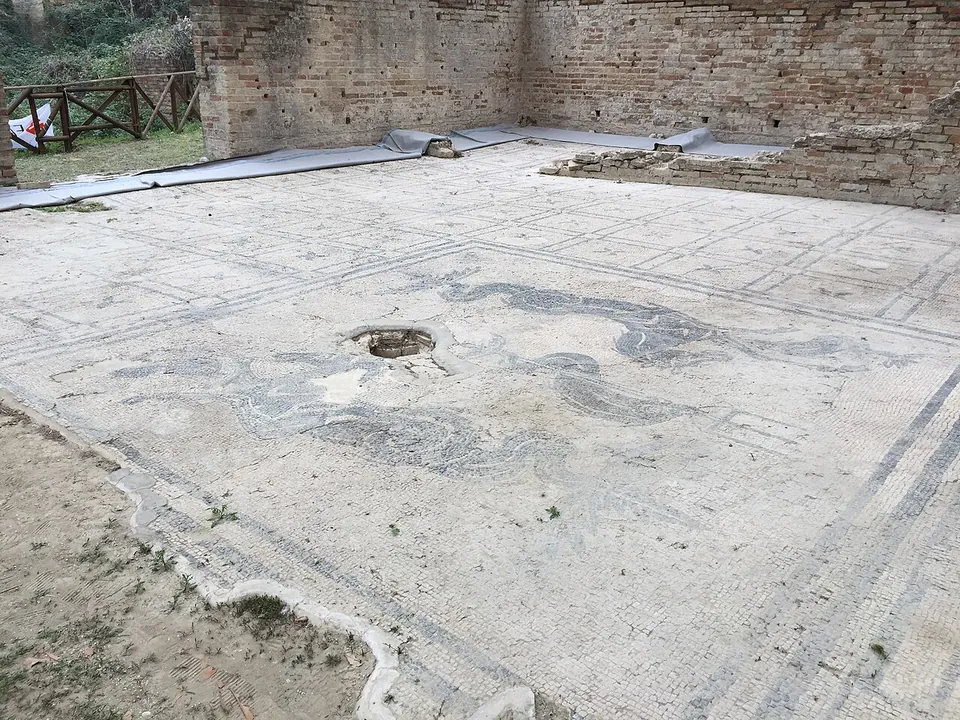
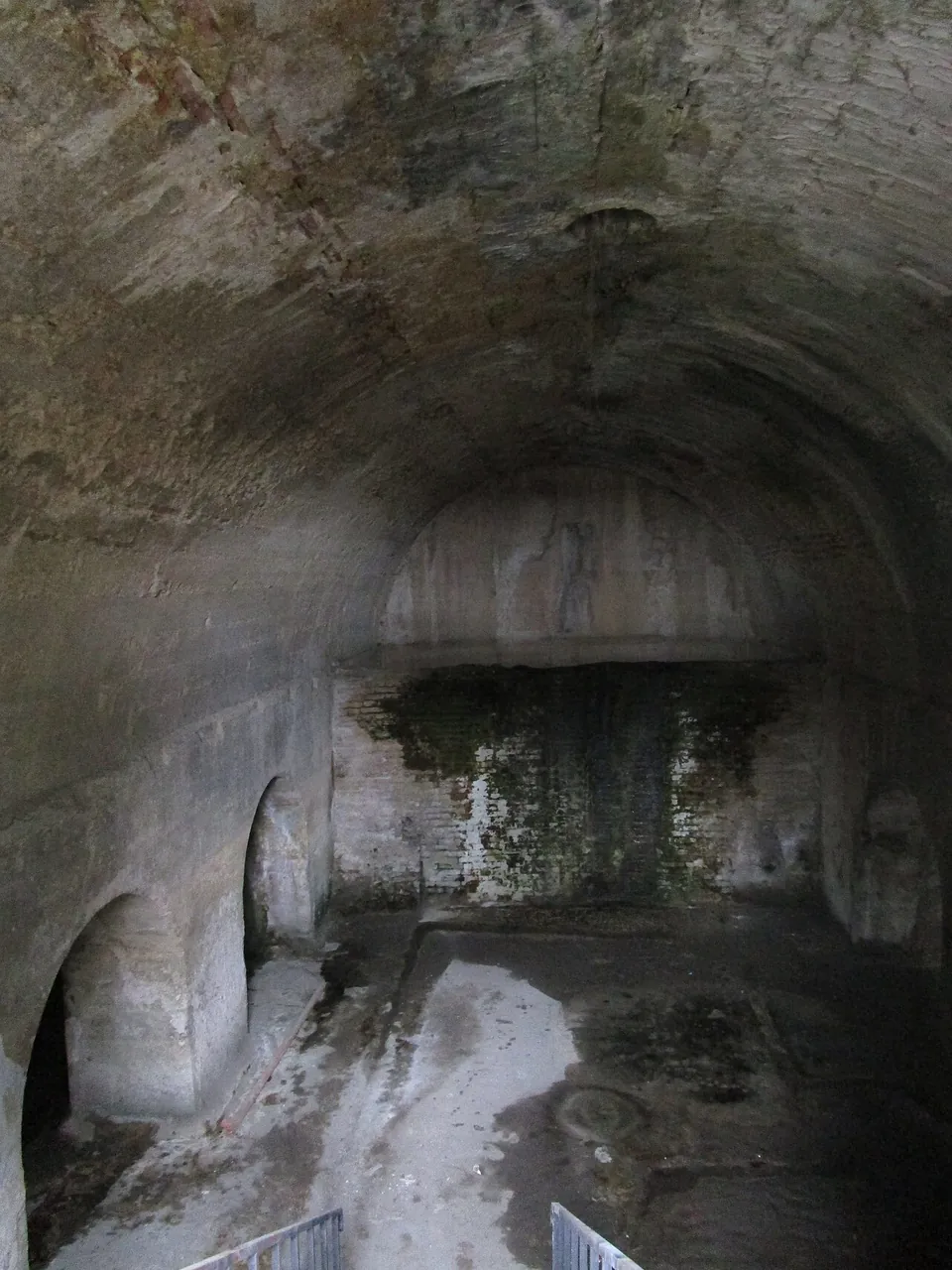
The baths, dated to the 1st to 2nd century AD (the operator), were fed by a great cistern on the slope above them: a concrete barrel-vaulted reservoir lined with waterproof crushed-tile mortar, holding about 3,300 m³ and one of the main water stores of the whole town. Its front towards the baths was a row of nine brick niches that also served as the baths’ monumental backdrop. A corridor paved in black and white tiles led into the building; the central room keeps a mosaic panel of sea creatures, among them fish-tailed horses. The side rooms of the warm and hot baths are still visible, while the octagonal hall of the cold baths has partly collapsed because the ground is unstable (the operator).
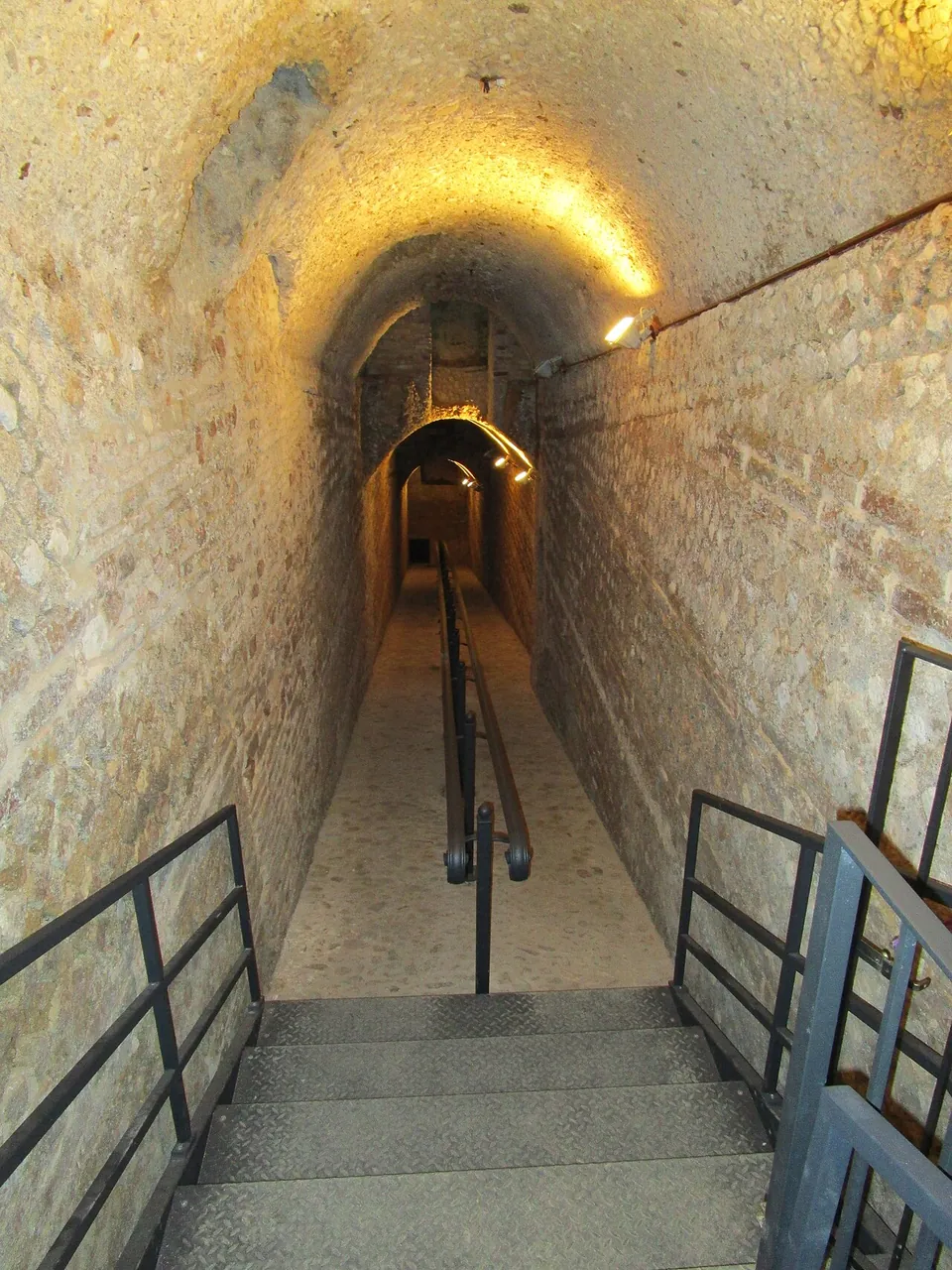
Under Palazzo de’ Mayo on Corso Marrucino runs the Via Tecta, a barrel-vaulted Roman passage in mixed brick and stone network masonry, which it.wikipedia describes as part of the water system that ran down to the baths; it has not been fully explored.
Is it worth the trip?
If you are in Abruzzo, yes, for half a day. The museum is the anchor: it is open six days a week, costs €5, sits under the Roman amphitheatre, which belongs to the museum complex, and its displays cover finds from the rest of the town. Then the other three groups are a short walk apart.
Be clear about what they are, though. The baths and the theatre are seen from the outside only, the amphitheatre has been partly rebuilt and doubles as an events venue, and the temples stand among the buildings of the town centre. This is a Roman town to be pieced together on a walk through a modern city, not a ruin to wander in, and on its own it is not worth a long detour.
Getting there
The remains are in the centre of Chieti, within about half a kilometre of one another in a straight line; the walk between them climbs, since the amphitheatre is at the top of the hill. A bus stop served by lines A, B, 2, 5 and 9 is mapped about 190 m from the baths, and free street-side parking about 60 m away, with two car parks within about 200 m (OpenStreetMap). The museum entrance is on Via Generale Pianell (the operator).
The Museo archeologico nazionale La Civitella opens Tuesday to Sunday, 09.00 to 19.30, with the ticket office closing at 19.00; it is closed on Mondays. A ticket is €5, €2 for visitors aged 18 to 25, and free under 18. The baths and the theatre can be seen from outside on any day with no booking (Ministry of Culture listings, read 24 October 2026 - check before travelling). No current opening times are published for the Via Tecta.
Visiting details
- Opening hours
- The Museo archeologico nazionale La Civitella, whose complex includes the amphitheatre, opens Tuesday to Sunday 09.00–19.30 (ticket office until 19.00) and is closed on Mondays. The baths and the theatre are seen from outside only, on any day, with no booking.
- Tickets
- Museum: €5; €2 for visitors aged 18 to 25; free under 18. The baths, the theatre and the temples cost nothing to look at from the street.
- Parking
- Free street-side parking is mapped about 60 m from the baths (OSM node/10110733068), and two surface car parks about 170–200 m away (way/1213144718, way/1213144716).
Before you go
- The baths and the theatre cannot be entered on an ordinary visit; the Ministry of Culture lists both as seen from outside only.
- No current opening times are published for the Via Tecta, the Roman passage under Palazzo de' Mayo.
Hours and prices checked 24 October 2026 on the operator's own site. Confirm before travelling.
History
Teate was the principal settlement of the Marrucini; Strabo attributed its origins to Arcadian Greeks (Pleiades). It existed from the Iron Age, as its early tombs show, and the earliest centre lay on the Civitella, a fortified citadel with its temples (it.wikipedia). The temples of the acropolis date from the middle of the 2nd century BC (the operator), and the town grew from then on, above all under the Empire (it.wikipedia). It became a Roman municipium in the 1st century BC under the name Teate Marrucinorum (the operator) and was placed in Regio IV Samnium (it.wikipedia).
With Rome the sacred area moved down the hill in the 1st century BC, and the amphitheatre was built over the old citadel (it.wikipedia). The main street, today’s Corso Marrucino, ran through the town, with houses and shops along it and the forum a short way to the west (it.wikipedia). Inscriptions found in Piazza dei Templi name Marco Vezio Marcello and his wife Elvidia Priscilla (as it.wikipedia gives their names), of a leading family of the town in Nero’s time, and one records a building project the couple managed at the temples (it.wikipedia). The Via Tiburtina Valeria, from Rome to the port of Aternum, ran along the Pescara valley below the town (it.wikipedia).
After the Western Empire fell the town kept its ancient street plan and built over the old houses (it.wikipedia). The amphitheatre, stripped of its stone fittings, was used for a small cemetery until an earthquake in the 7th century brought the structure down over it (the operator).
More photographs



Nearby
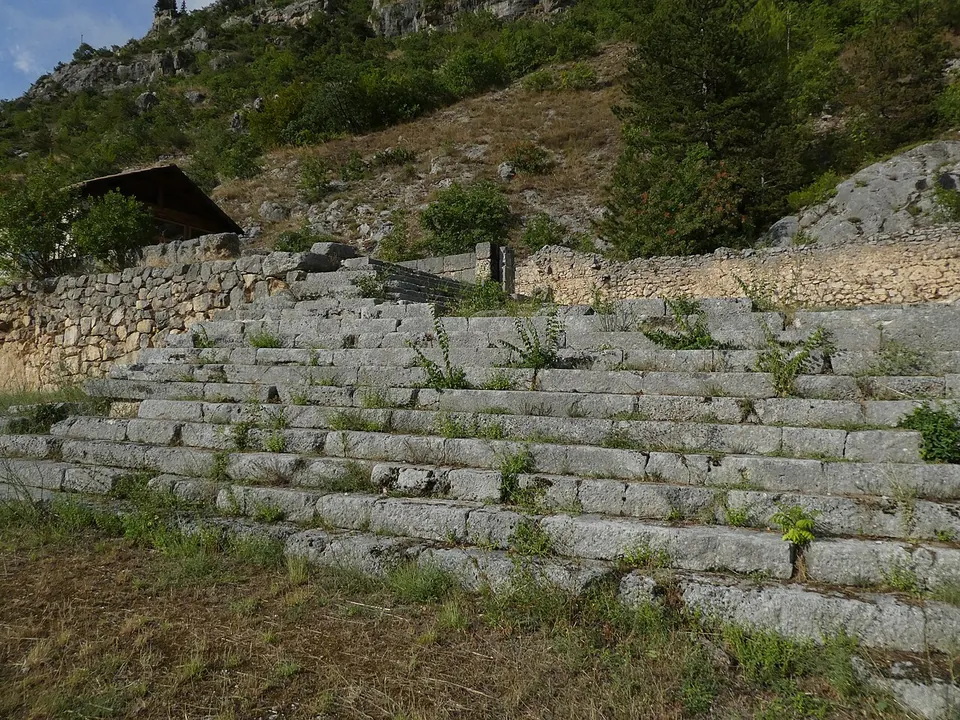
Photo: Syrio · CC BY-SA 4.0 · Commons
35 km · sanctuary · Abruzzo
Shrine of Hercules Curinus
The sanctuary stood on artificial terraces that step down the mountainside (the Ministry).
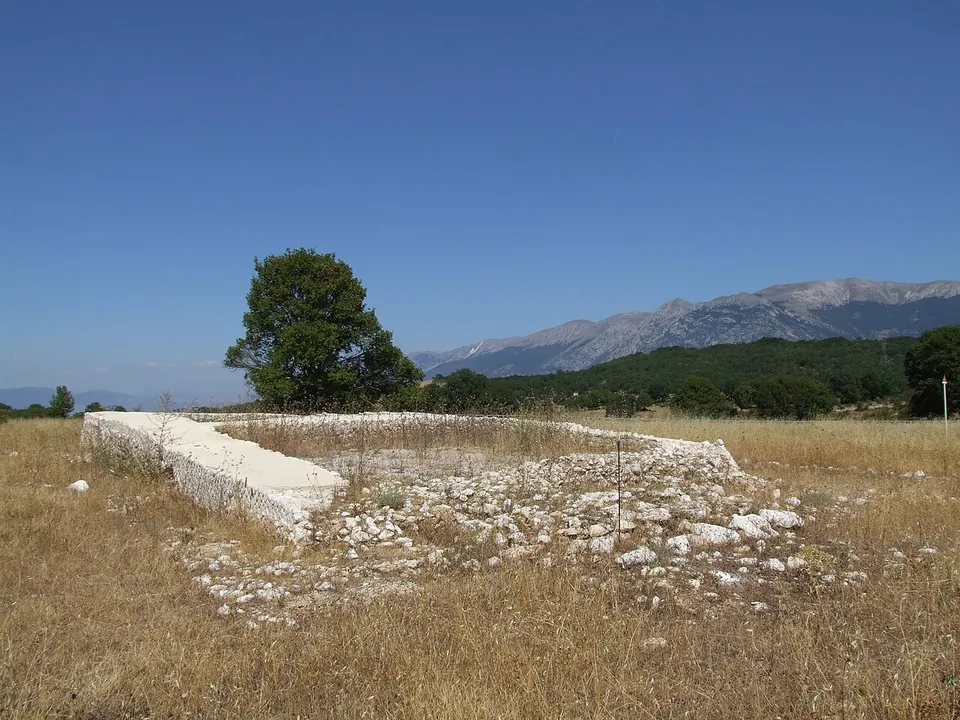
Photo: Pasquale Di Giannantonio · Public domain · Commons
41 km · sanctuary · Abruzzo
Ocriticum
The excavated sanctuary is a walled sacred precinct on two terraces (Ministry of Culture).


Straight-line distances.
Sources
Every fact on this page comes from the records below, each used under the licence noted.