The Shrine of Hercules Curinus is the ruin of a sanctuary of Hercules built in terraces up the slope of Monte Morrone, under 5 km from Sulmona in Abruzzo, looking out over the valley below. It was rebuilt on a grand scale in the early 1st century BC, and its upper terrace was buried by a landslide in the 2nd century AD (the Ministry of Culture; Pleiades).
What is there today
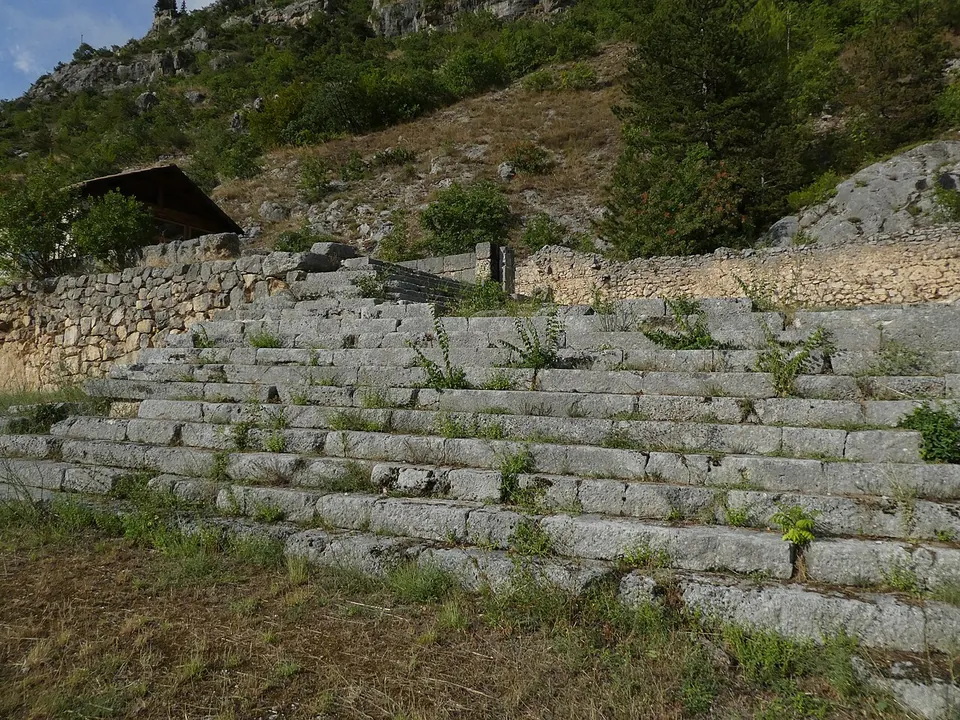
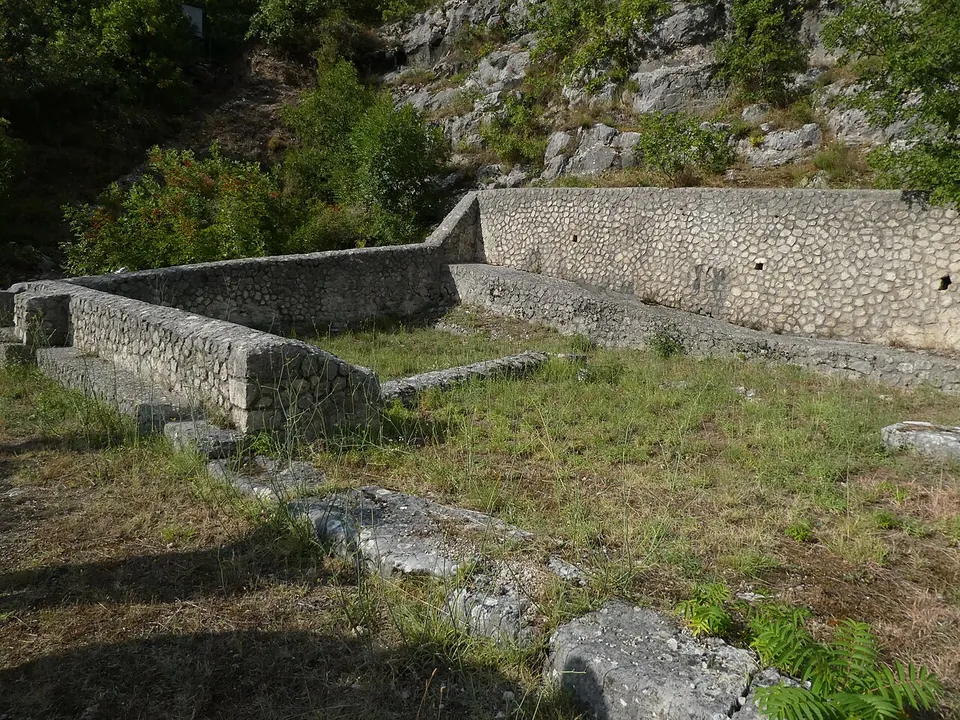
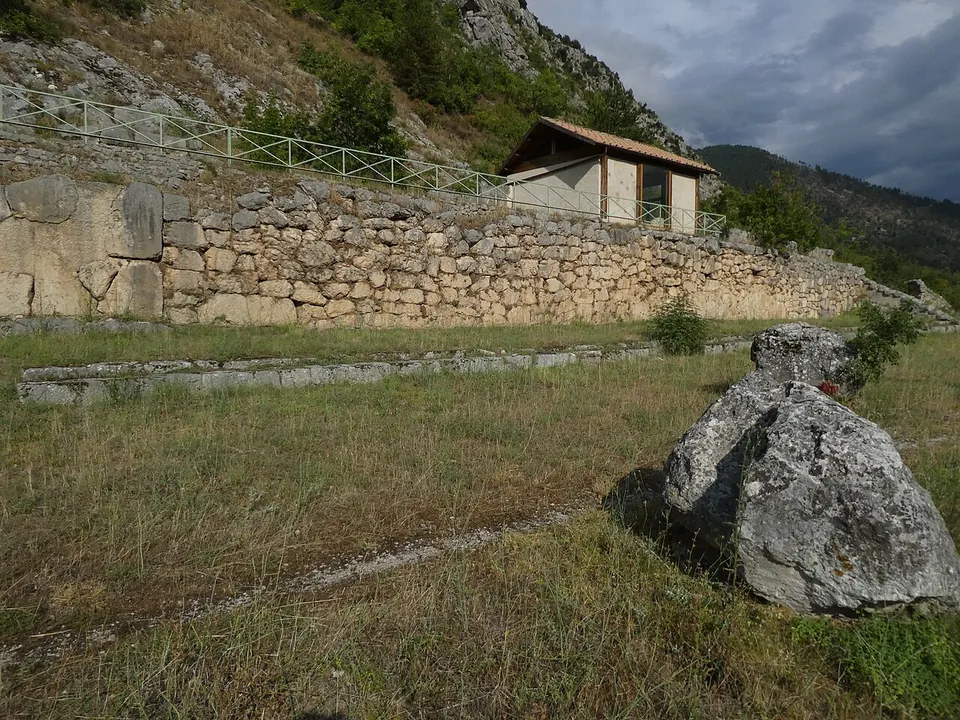
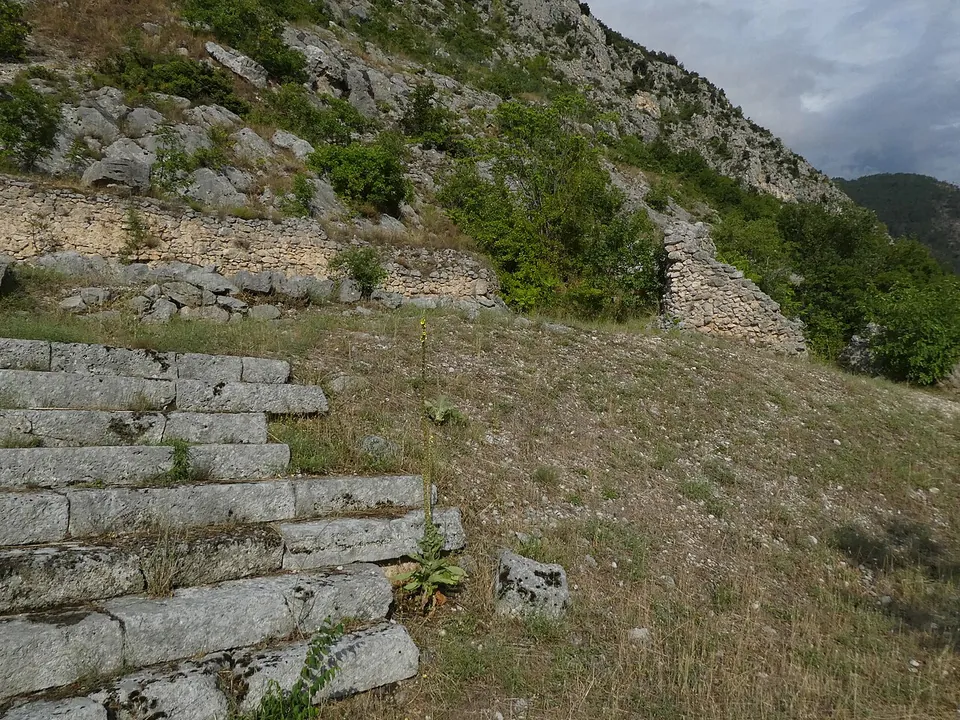
The sanctuary stood on artificial terraces that step down the mountainside (the Ministry). The lower terrace is the later of the two, built in Roman concrete on a massive podium 71 m long that holds 14 rooms with barrel-vaulted ceilings; the upper, older terrace was closed on three sides by a colonnaded portico, of which some bases remain (it.wikipedia). A great stairway on the south side may have been the monumental entrance, perhaps also a meeting place for local assemblies (it.wikipedia). At the centre of the upper terrace stood the altar, unusually clad in bronze plates, and the small shrine of the god, the sacellum (it.wikipedia). Photographs taken in 2024 show tall terrace walls of mortared stone, a broad flight of stone steps and grassed terraces with scattered blocks, in open mountain country.
The finds are not on site. The sacellum yielded the most important of them: two cult statues of Hercules, one in bronze, now in the Archaeological Museum in Chieti, and one in marble, and a small column scratched with twelve lines of verse attributed to Ovid (it.wikipedia).
Is it worth the trip?
Worth a detour if you are in Sulmona and can confirm it is open: it is a sizeable terraced sanctuary of the same family as the great one at Palestrina, on a mountainside with a view over the valley. It is not a reason to travel far. The best finds are in Chieti, what remains is walls, terraces and steps rather than a standing temple, and the Ministry of Culture recorded no visitors here at all in 2024, which in its tables means a site that was closed or not counted. No current timetable is published, so ring before you go.
Getting there
The site is in the Badia area of Sulmona, on the Morrone mountains between the abbey of Santo Spirito dei Celestini and the hermitage of Celestine V (it.wikipedia). A free car park for about 20 cars is mapped about 240 m away near Via Badia, and footpaths are mapped at the site; the nearest mapped bus stop is about 1 km away and Sulmona railway station about 3.8 km (OpenStreetMap).
Entry is free (Ministry of Culture visitor statistics for 2024). No opening hours are published for now: the last timetable the Ministry put out was for 2020, when the site opened from 8 June to 30 September until sunset, without booking. The site is listed under the Soprintendenza Archeologia, Belle Arti e Paesaggio for the provinces of L’Aquila and Teramo, which can be reached on 0862 21730 or at [email protected] (the Ministry, read from copies archived in 2026).
Visiting details
- Opening hours
- No current opening hours are published. The last timetable the Ministry of Culture put out was for 2020, when the site opened from 8 June to 30 September until sunset, without booking.
- Tickets
- Free, according to the Ministry of Culture's visitor statistics for 2024.
- Parking
- A free car park for about 20 cars is mapped about 240 m from the ruins, near Via Badia (OpenStreetMap way/59354078); footpaths are mapped up to the site.
Before you go
- The Ministry of Culture recorded no visitors here in 2024, and its tables use zero for sites that are closed or not counted. Ring the Soprintendenza for L'Aquila and Teramo, which looks after the site (0862 21730, [email protected]), before making the trip.
- OpenStreetMap tags the site as open at all hours but with access by permit; neither tag comes from the operator.
- The nearest mapped bus stop is about 1 km away and Sulmona railway station about 3.8 km; in practice the site needs a car or a walk.
Hours and prices checked 2 September 2026 on the operator's own site. Confirm before travelling.
History
The sanctuary lay in the territory of the Paeligni, above the town of Sulmo (Pleiades). It was in use from the Hellenistic age, the 4th to 3rd century BC, until the middle of the 2nd century AD (the Ministry). The epithet Curinus, or Quirinus, was also given to other gods in the Republican period, such as the Jupiter Quirinus of Superaequum, and the Romans linked it with Romulus deified (it.wikipedia).
The Ministry traces the building in phases. The earliest stood on the highest level: a temple on a high podium. A later extension of the terrace brought the so-called sacellum and a monumental stairway broken by a paved forecourt, with porticoes at its foot facing the Peligna basin. At the start of the 1st century BC the whole sanctuary was rebuilt, with a lower terrace held up by a wall in near-reticulate stonework that carries the vaulted rooms below the forecourt. it.wikipedia puts the enlargement after the end of the Social War, in 89 BC, when the shrine grew from a local sanctuary into a great terraced one like those of Fortuna Primigenia at Palestrina and Hercules Victor at Tivoli, built in the same period.
Around the middle of the 2nd century AD a landslide buried the buildings and votive offerings on the upper terrace (the Ministry). The place kept its sacred character: in Christian times a small church was built against the southern stairway, and Pope Celestine V later enlarged it (the Ministry; it.wikipedia). The ruins were long taken for the villa of Ovid, who was born in Sulmo. Excavations begun in 1957, for the two-thousandth anniversary of the poet’s birth, found votive material and dedications to Hercules instead, and the archaeological area was opened in the 1970s (the Ministry; it.wikipedia).
More photographs
Nearby
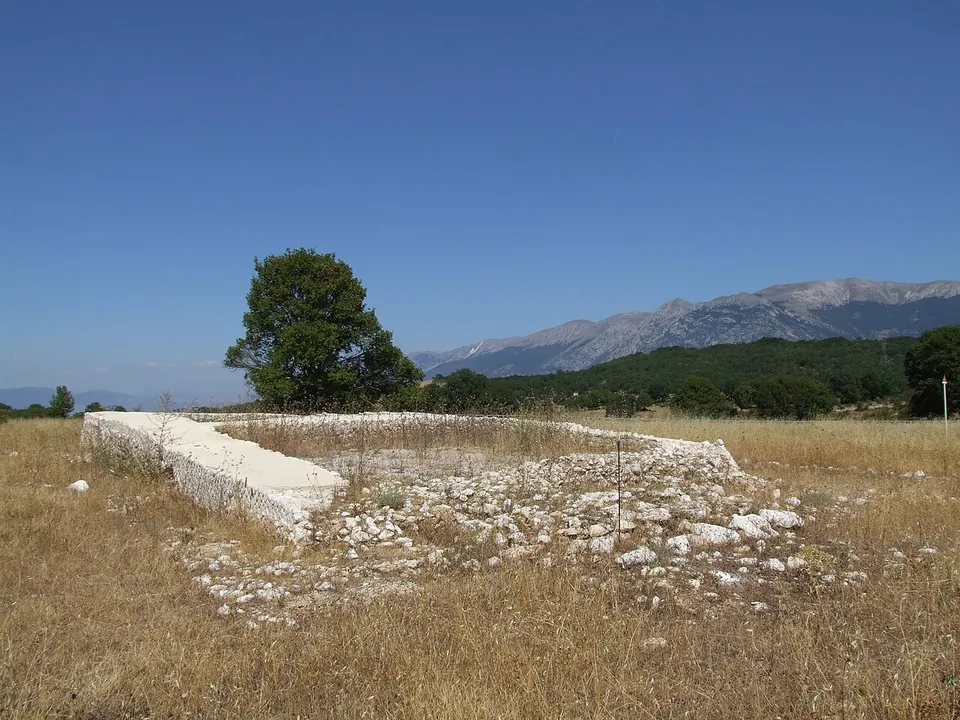
Photo: Pasquale Di Giannantonio · Public domain · Commons
11 km · sanctuary · Abruzzo
Ocriticum
The excavated sanctuary is a walled sacred precinct on two terraces (Ministry of Culture).
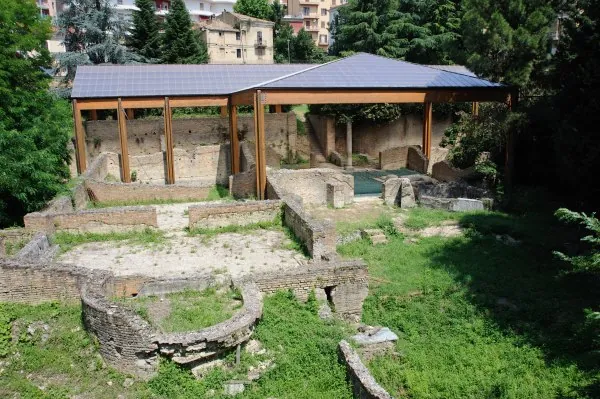
Photo: Cats' photos · CC BY-SA 4.0 · Commons
35 km · city · Abruzzo
Teate
Four groups of remains, all on the hill of the old town, none of them a self-contained ruin field: the Romans' town lies under the modern one, and you meet it street by street.


Straight-line distances.
Sources
Every fact on this page comes from the records below, each used under the licence noted.