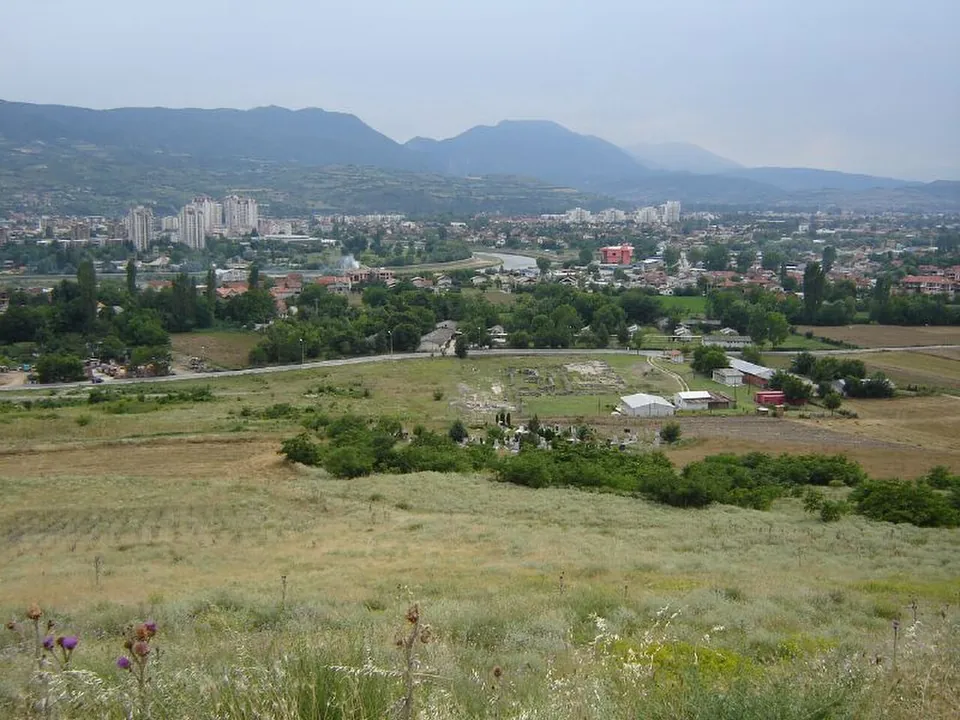
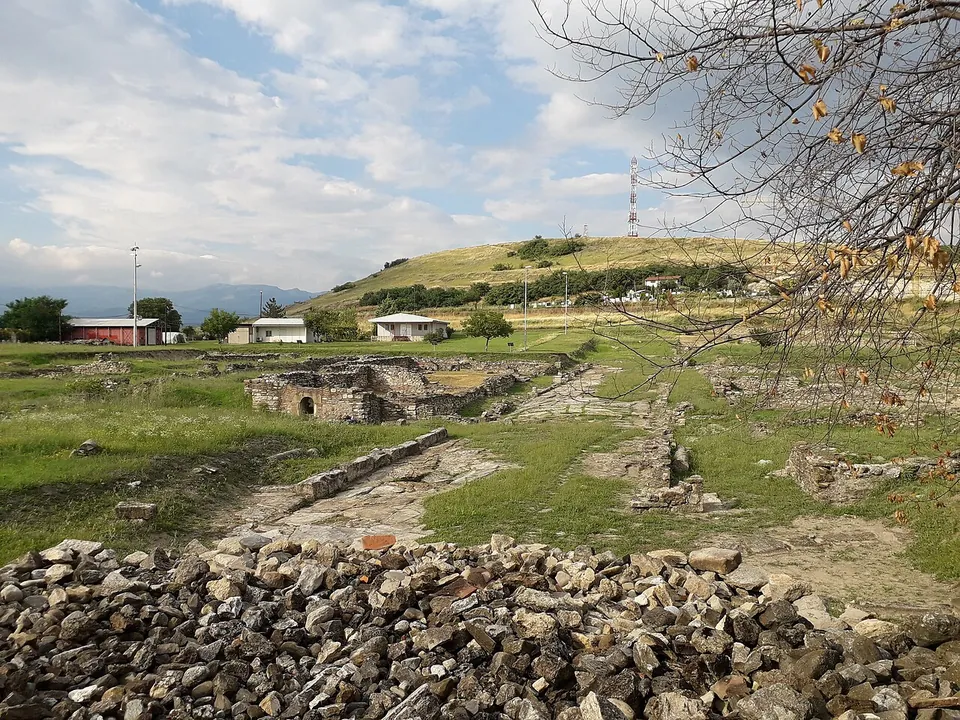
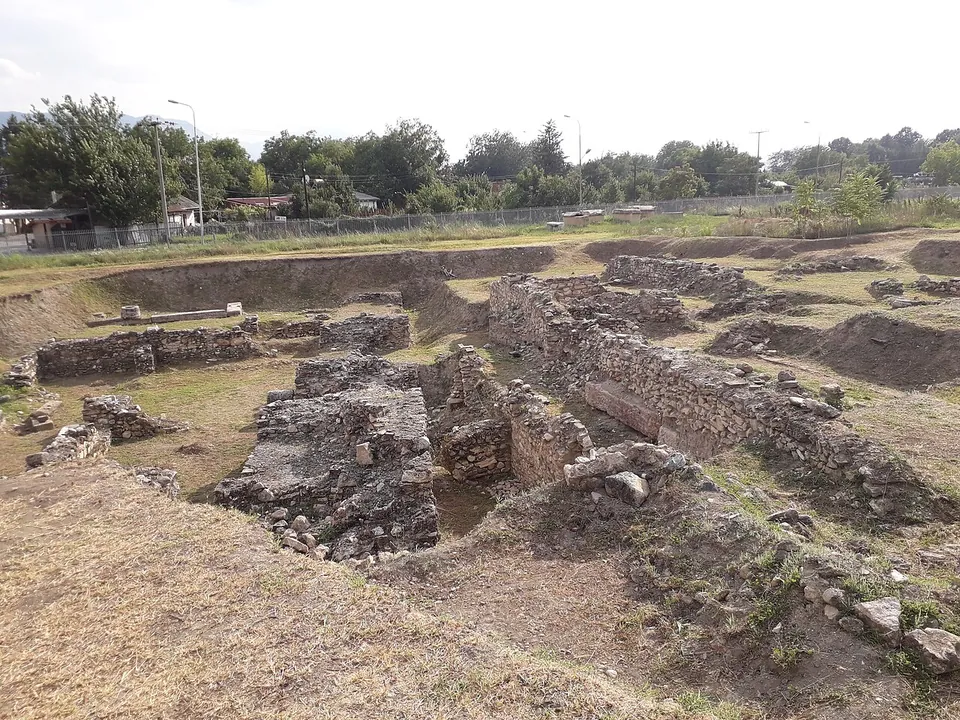


Scupi is the Roman city on the north-western edge of Skopje, the only Roman colony on the territory of today’s North Macedonia, with the largest ancient theatre in the country. The photographs available show an excavation rather than a presented site, and no source says what can be visited today.
What is there today
The city covered about 43 hectares — twice the size of Stobi, in the archaeologist Ivan Mikulčić’s comparison (quoted by MARH). Excavation by the Museum of the City of Skopje, which holds the site, has uncovered all or part of the city walls, the theatre, a civil basilica with a mosaic floor, a private town house, the city baths, the colonnaded main street and a Christian basilica, as well as parts of the cemeteries east and west of the town (mk.wikipedia). The photographs available show a fenced field with low foundations and large stone finds set out on the grass.
The theatre
The theatre was built under Hadrian, in the 2nd century AD, and is the largest of the ancient theatres on the territory of North Macedonia, for about 9,000 spectators; its stage building is 98 m long and was richly decorated in marble (mk.wikipedia). Excavation ran from 2013 to May 2016; the stage building was conserved between March and June 2016, and in October 2016 work began on conserving the seating, with a full reconstruction planned (the heritage office).
The baths
The city baths stood in the centre of the town, east of the main street, with rooms for hot and lukewarm bathing heated from below the floor, a changing room and a cold pool; they date from the 4th and 5th centuries (mk.wikipedia).
Is it worth the trip?
For the history, yes; for things to see, only if you are keen. Scupi became the capital of the Roman province of Dardania (mk.wikipedia) and its theatre is the country’s largest, but no source says what visitors can see of the theatre today, and what the photographs show is low foundations in a fenced field. If you have time for one Roman site near Skopje, the aqueduct, about 2.3 km away, is the more visible; if you have a day, Stobi is the site to see.
Getting there
The site lies about 5 km north-west of central Skopje, near the village of Zlokućani, where the Lepenec flows into the Vardar at the foot of Zajčev Rid (mk.wikipedia). OpenStreetMap maps bus stops about 90 and 105 m from the site at Zlokućani, and one named Skupi about 230 m away.
The Museum of the City of Skopje, which holds the site, publishes no opening hours or fee for it, and no source says whether it is open to visitors.
Visiting details
- Tickets
- Unknown
Before you go
- The Museum of the City of Skopje, which holds the site, publishes no opening hours or fee for it; photographs from 2014 show the excavated area fenced.
- Conservation of the theatre began in 2016 (Cultural Heritage Protection Office); no source says what can be visited today.
History
The Roman city began with the army: legions were stationed here, probably in 13–11 BC, and the town grew after the province of Moesia was formed. Under Domitian, in 84–85, it became a colony, Colonia Flavia Scupiorum, settled with veterans of the Seventh Legion Claudia (mk.wikipedia). A colony was the highest rank a city outside Rome could hold (the heritage office). In the 4th century the city built again and became a bishop’s seat; the emperor Theodosius I stayed in Scupi in 379 and 388 (mk.wikipedia). In 518 an earthquake destroyed the city and it was abandoned (en.wikipedia); mk.wikipedia notes signs of a small Slavic village on the site until the 10th–11th century. The site was first identified by Arthur Evans in 1883, and systematic excavation began in 1966 (mk.wikipedia; the heritage office).
Nearby
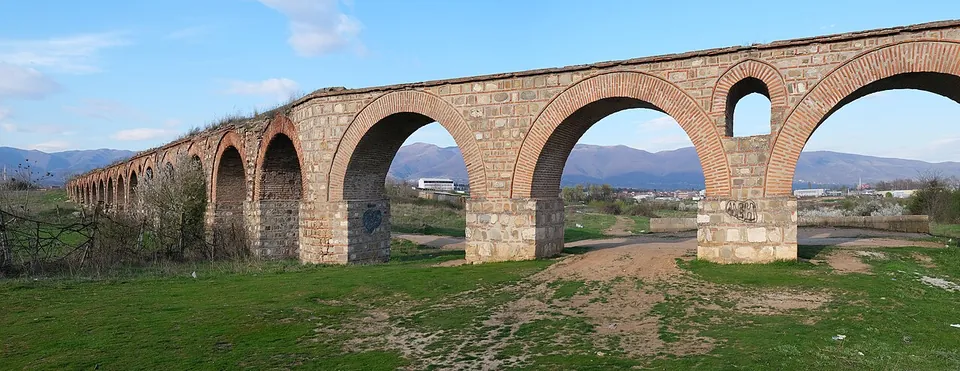
Photo: kallerna · CC BY-SA 4.0 · Commons
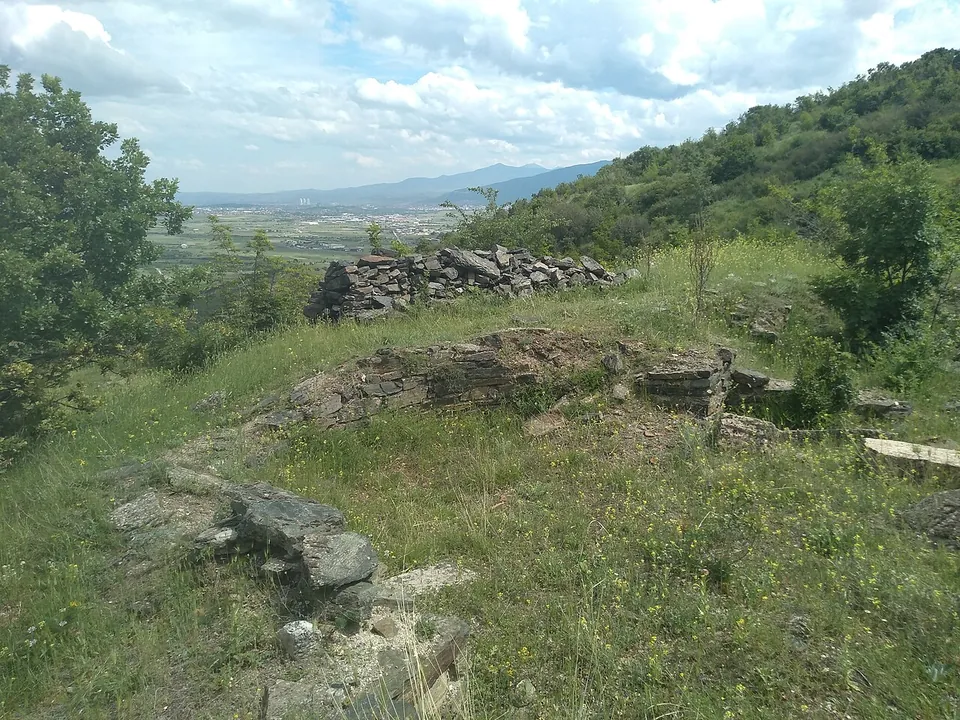
Photo: Македонец · CC BY-SA 4.0 · Commons
8 km · city · Municipality of Čučer-Sandevo
Davina Kula
At the southern, highest end of the hill stands the acropolis: an oval castle of about 185 × 110 m whose towered walls of stone and lime date from the late Roman 4th century and were rebuilt in the 6th, after the earthquake of 518.


Straight-line distances.
Sources
Every fact on this page comes from the records below, each used under the licence noted.
| Source | Licence |
|---|---|
| Pleiades 481987 | CC BY |
| Wikidata Q149203 | CC0 |
| OpenStreetMap way/32463336 | ODbL |
| Cultural Heritage Protection Office (Управа за заштита на културното наследство) — the theatre at Scupi project | licence not recorded |
| Wikipedia (mk) — Скупи | CC BY-SA 4.0 |
| Wikipedia (en) — Scupi | CC BY-SA 4.0 |
| MARH — Римскиот град Скупи (quoting I. Mikulčić, 1985) | licence not recorded |