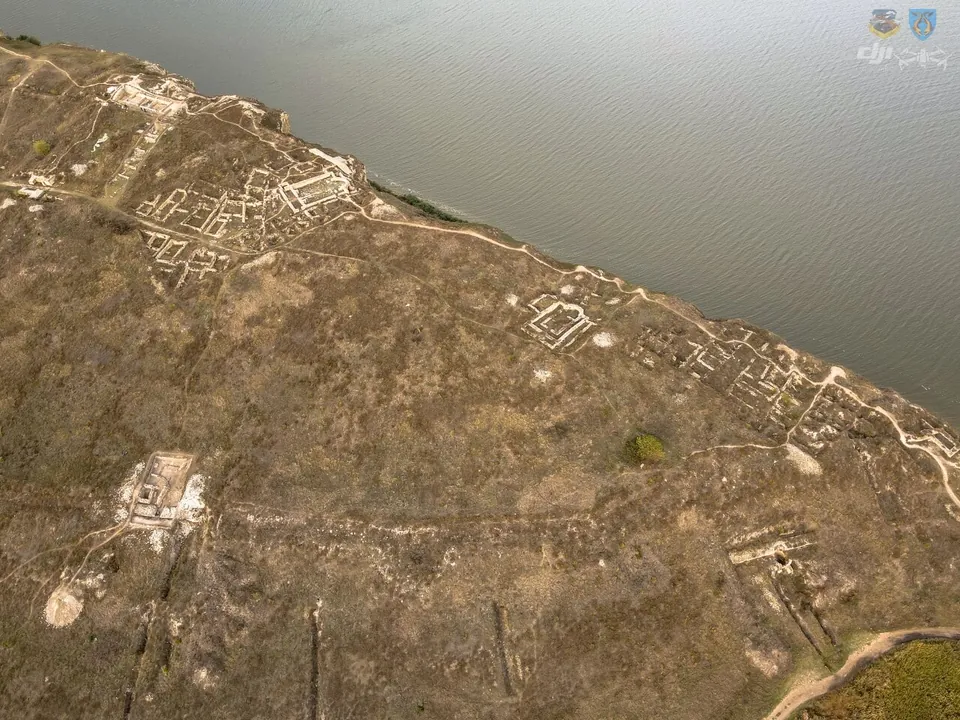
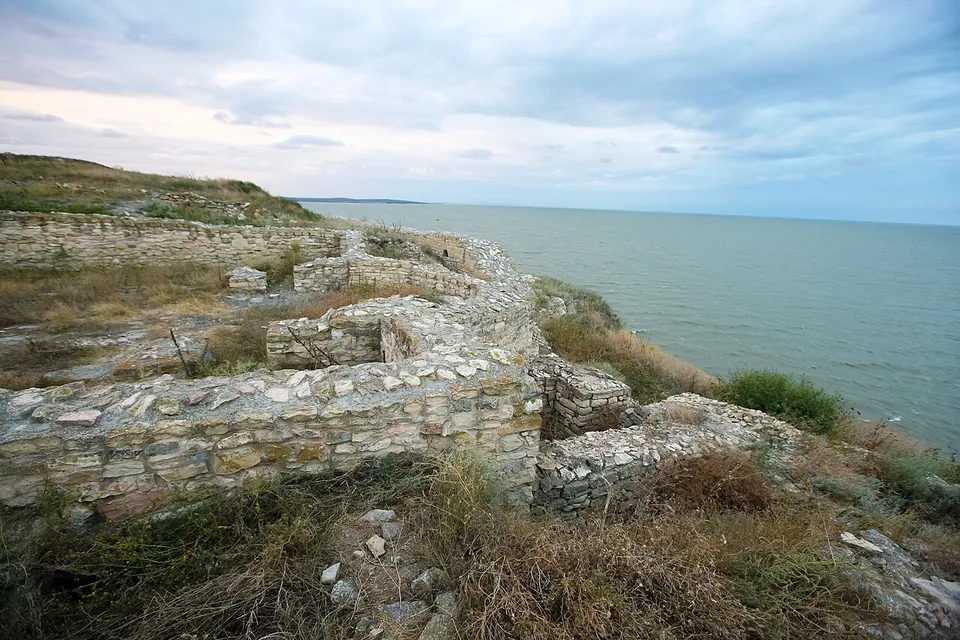
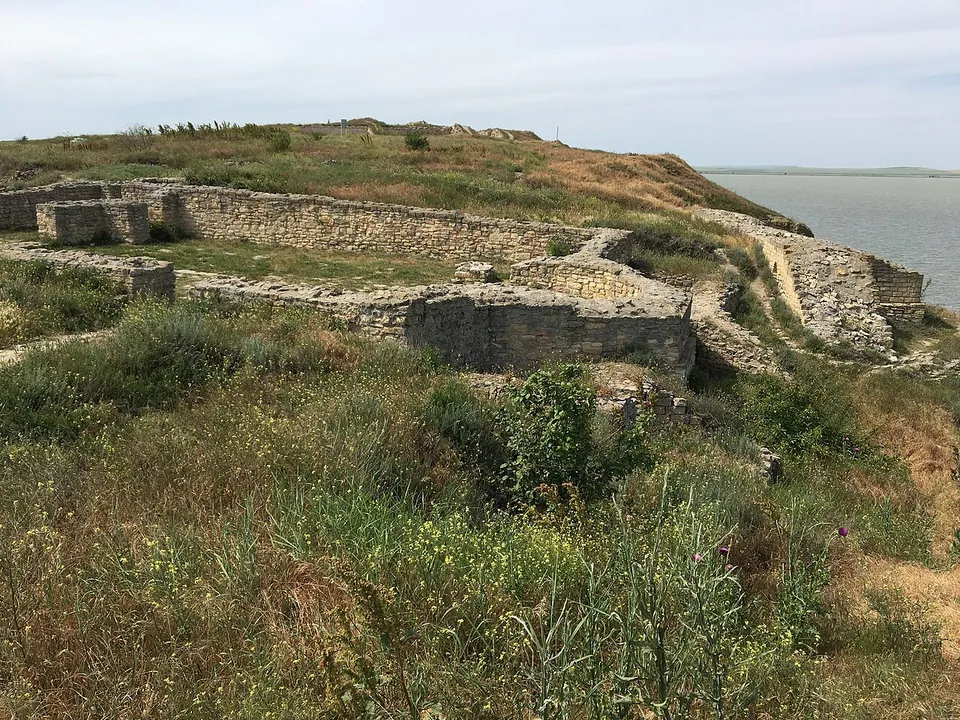


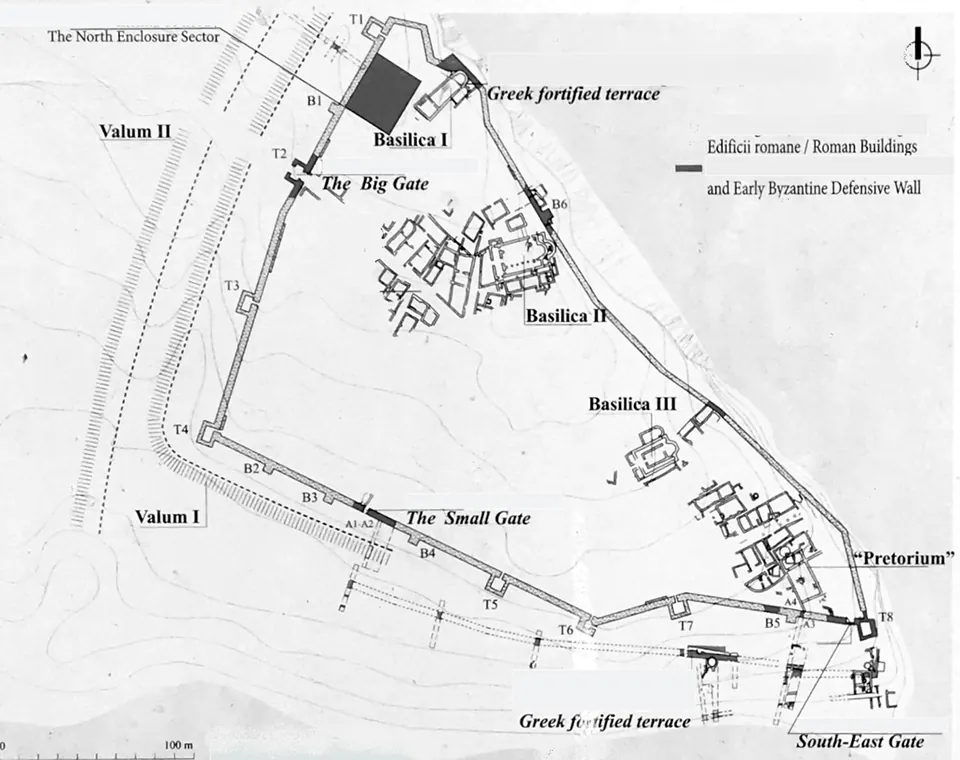
Argamum, the Greek Orgame, is a city on the cliffs of Cape Doloșman above Lake Razim, near Jurilovca, in northern Dobruja, where excavation has found the earliest Greek presence on the western shore of the Black Sea. It ended as a late Roman town, and its walls, gate, streets and four early Christian basilicas lie open on a headland over the water.
What is there today
The ruins, partly excavated and restored, stand 6 km from the fishing village of Jurilovca on the high, steep shore of the lake: a city gate, the fortress wall, streets, early Christian basilicas and earthworks (de.wikipedia). The four large basilicas, of the 5th and 6th centuries, show the city’s importance in that late period, and a barracks of the same time stood in its north-western corner (en.wikipedia). The city’s 6th-century BC Greek walls lie south of the later Roman wall, and outside the walls to the south-west a district of Roman buildings along a street 9 m wide was destroyed in the Gothic invasion of 378 (en.wikipedia).
The basilicas, the barracks and the gate on show belong to the late Roman city (en and de.wikipedia).
Is it worth the trip?
Yes, for the setting as much as the ruins: walls and basilicas on a cliff above a wide lagoon, well away from any town. It is remote, with nothing recorded for visitors on site, so combine it with Histria or the Danube Delta rather than making it a trip of its own.
Getting there
Argamum lies 6 km from Jurilovca on the shore of Lake Razim (de.wikipedia), about 23 km from Babadag (OpenStreetMap). No car park, bus stop or railway station is mapped within 300 m.
No operator publishes opening hours or admission for the site (searched 3 October 2026).
Visiting details
- Tickets
- Unknown
Before you go
- No operator page publishes opening hours or admission for the site (searched 2026-10-03).
- The ruins stand on a high, steep shore above Lake Razim; no car park, bus stop or railway station is mapped within 300 m.
History
Orgame is the oldest city mentioned by Hecataeus of Miletus, in the 6th century BC; it was probably founded in the 7th century BC by Greek colonists from Asia Minor on a cliff with easy access to the Danube Delta, and it was destroyed by fire between 520 and 490 BC, in the same period as Histria (en.wikipedia). The Romans occupied Dobruja in 71 BC without leaving garrisons and annexed it in 29 BC, when Orgame became a Roman city in Moesia, later Scythia Minor (en.wikipedia). The name Argamum appears on an inscription of about 100 AD (de.wikipedia). In the 7th century the arrival of the Bulgars and the silting of the bay, which became Lake Razim, led to the city’s abandonment (en.wikipedia). Excavations ran from 1926 to 1932 and resumed in 1965 (de.wikipedia).
More photographs

Nearby
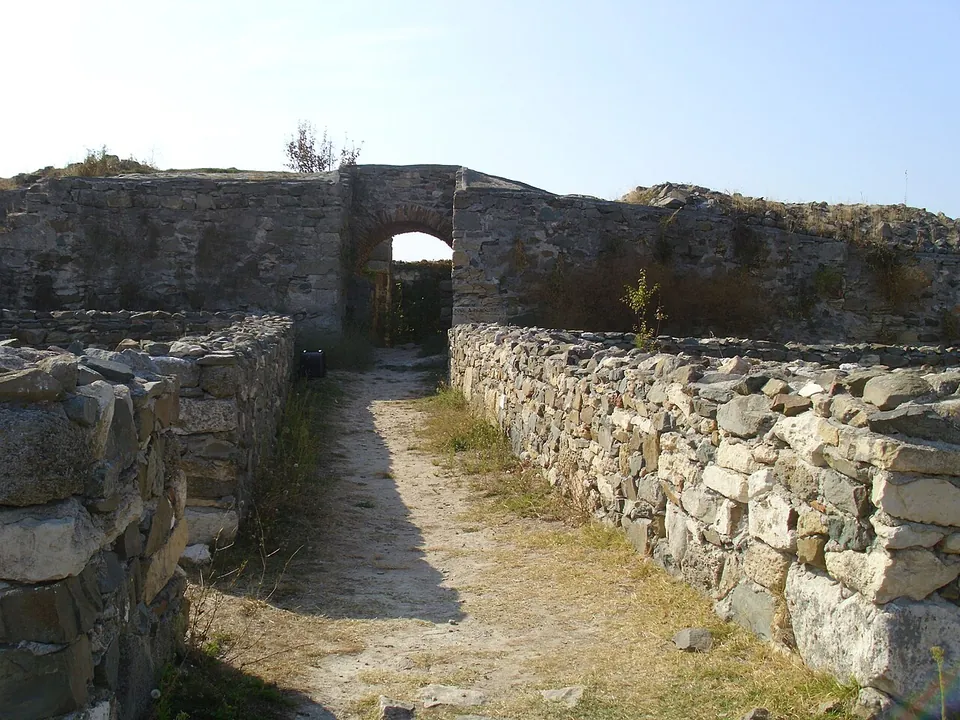
Photo: Mv ank · CC BY-SA 3.0 · Commons
27 km · city · Constanța County
Histria
The site is two cities in one, and it helps to know which is which.
Photo: Cucospetrudaniel · CC BY-SA 3.0 ro · Commons
36 km · fort · Tulcea County
Halmyris
The late Roman fortress is an irregular polygon with 15 towers and at least two gates, to the north and west (en and ro.wikipedia).


Straight-line distances.
Sources
Every fact on this page comes from the records below, each used under the licence noted.
| Source | Licence |
|---|---|
| Pleiades 216710 | CC BY |
| Wikidata Q2860898 | CC0 |
| OpenStreetMap way/220202643 | ODbL |
| Wikipedia (en) — Argamum | CC BY-SA 4.0 |
| Wikipedia (de) — Orgame | CC BY-SA 4.0 |