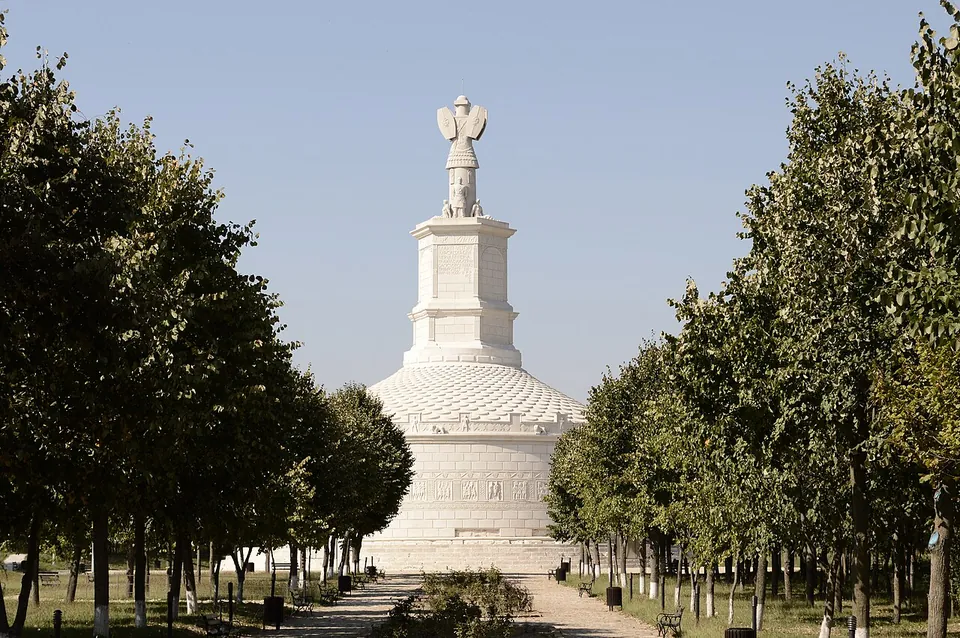
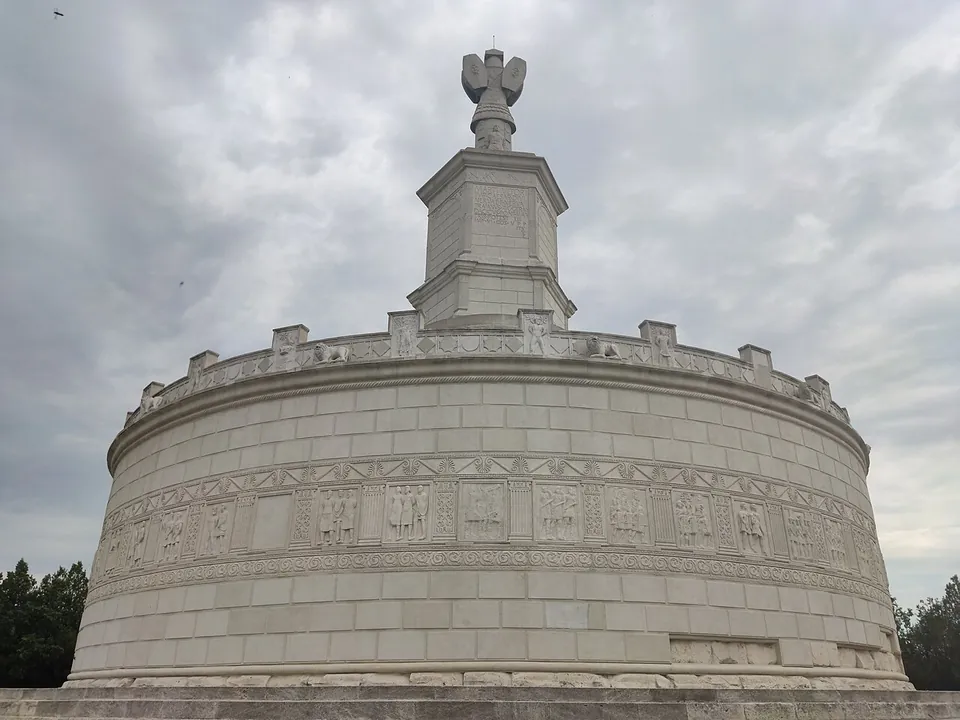


Tropaeum Traiani is the victory monument the emperor Trajan raised at Adamclisi in 109 to mark his victory over the Dacians: a stone drum 40 m across, ringed with carved battle scenes and crowned by a trophy. What stands today is a reconstruction of 1977; most of the original carved panels are in the museum in the village.
What is there today
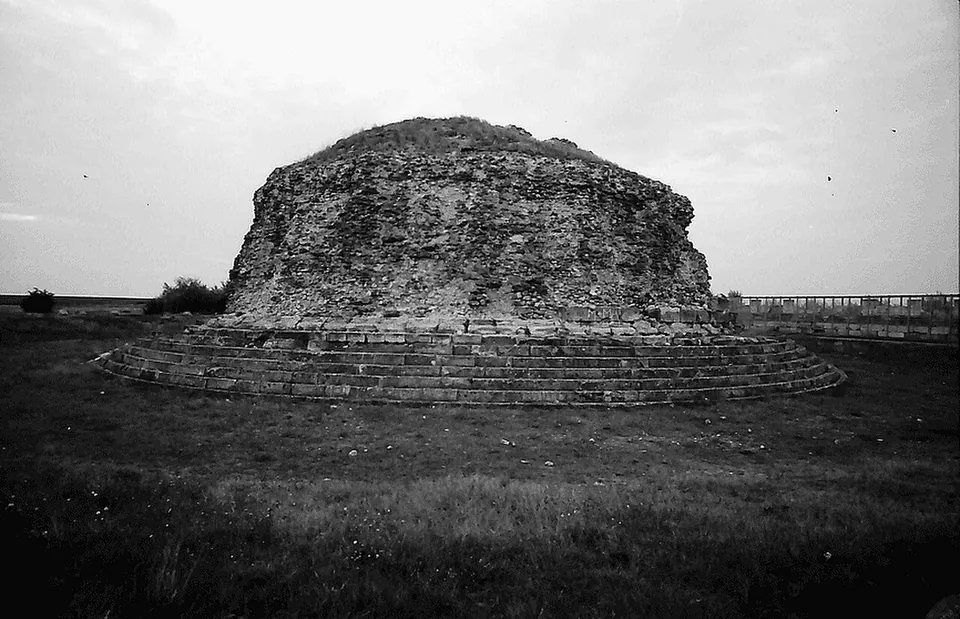
The monument is the reconstruction, built in 1977 on one of the hypothetical models of the ruined original (ro.wikipedia). The original was a cylinder with steps at the base, 40 m in diameter, with a cone-shaped roof of stone slabs and the trophy on top, and the reconstruction in the photographs takes the same form. Round its side ran 54 carved panels (metopes) showing Romans fighting Decebalus’s allies, framed by friezes, with 27 battlements above, each showing prisoners (en.wikipedia). By the 20th century the original had been reduced to a mound of stone and mortar, with many of its reliefs scattered around it (en.wikipedia), as the archive photograph shows; OpenStreetMap maps the remains of the original monument’s wall about 85 m from the point this page uses.
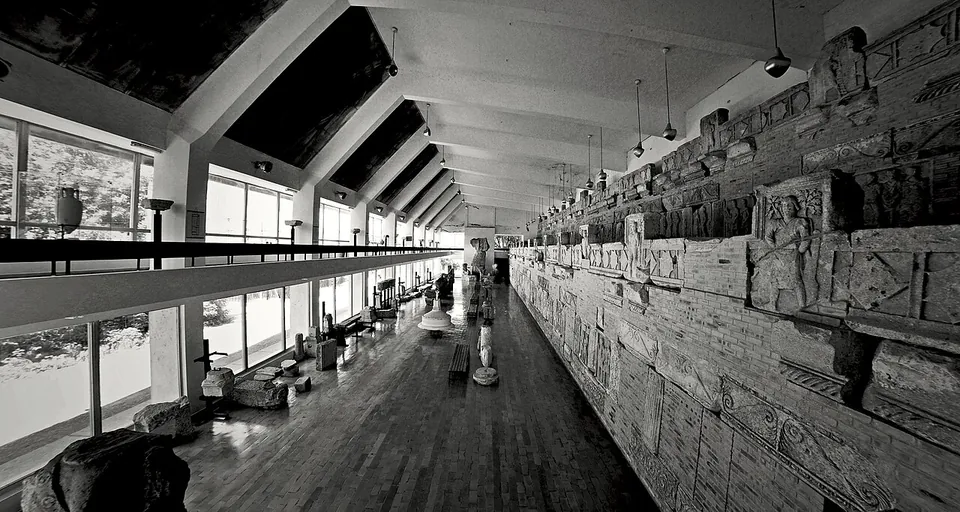
The originals are the real reason to come. Of the 54 metopes, 48 are in the site museum in the village and one is in the Istanbul Archaeology Museum; the rest are lost (en.wikipedia). Next to Trajan’s Column in Rome, which celebrates the same victories, they are the work of sculptors of provincial training, carved in what has been called a “naive idiom” (en.wikipedia).
Near the monument stood an altar raised in 102 for soldiers who died fighting, perhaps in the battle here, 12 m long and 6 m high, inscribed with the names of some 4,000 soldiers, and a tumulus grave built shortly after it for a Roman officer killed in the battle here (en.wikipedia). The tumulus is mapped about 170 m from the point this page uses (OpenStreetMap).
Is it worth the trip?
Yes, with the right expectations. The white monument you walk up to is a 1970s reconstruction, not a Roman structure. The museum is where the Roman sculpture is, and the walled town of Civitas Tropaensium, 1.4 km away, is where Roman Adamclisi actually survives. Together the three are one visit, on the road between Constanța and Ostrov.
Getting there
Adamclisi lies on the DN3 between Constanța and Ostrov, about 63 km by road from Constanța (the operator). There is a car park about 190 m from the monument; no bus stop or railway station is mapped near it.
From 1 October 2026 to 30 April 2027 the operator, the Museum of National History and Archaeology in Constanța (MINAC), opens the Tropaeum Traiani museum complex daily from 09.00 to 17.00. The monument is 16 RON, about €3.00, with 8 RON for pensioners and 4 RON for pupils and students; the museum (Str. Muzeului 15) is a separate ticket at the same prices, and a guide costs 75 RON, about €14 (minac.ro, read 3 October 2026). The summer schedule for 2027 was not yet published.
Visiting details
- Opening hours
- Daily 09.00–17.00 from 1 October 2026 to 30 April 2027 (the operator's cold-season schedule). The summer schedule for 2027 was not yet published on 3 October 2026.
- Tickets
- 16 RON (about €3.00); 8 RON for pensioners, 4 RON for pupils and students. The site museum in the village, which holds most of the original reliefs, is a separate ticket at the same prices. A guide costs 75 RON (about €14).
- Parking
- A surface car park about 190 m from the monument (OSM way/35460865).
Before you go
- No bus stop or railway station is mapped near the monument; it needs a car.
- The monument you see is a 1977 reconstruction; most of the original carved panels are in the museum in the village.
Hours and prices checked 3 October 2026 on the operator's own site. Confirm before travelling.
History
The monument stands on the battlefield of Trajan’s First Dacian War: in the winter of 101–102 the Dacians crossed the frozen Danube and were defeated nearby at Adamclisi, and the altar to the fallen followed in 102. The Trophy came after the Second Dacian War, in 109 (en.wikipedia; ro.wikipedia gives 109–113). Its inscription, preserved in fragments, dedicates it to Mars Ultor, the Avenger, in the name of Trajan, “Germanicus” and “Dacicus”. It was probably the work of Apollodorus of Damascus, Trajan’s favoured architect, and was inspired by the Mausoleum of Augustus (en.wikipedia).
Four Prussian officers made the first excavations in 1837, and the monument was studied through the later 19th and 20th centuries before the reconstruction of 1977 (en.wikipedia). The walled town nearby, named after the monument, is a separate stop with its own page.
More photographs

Nearby
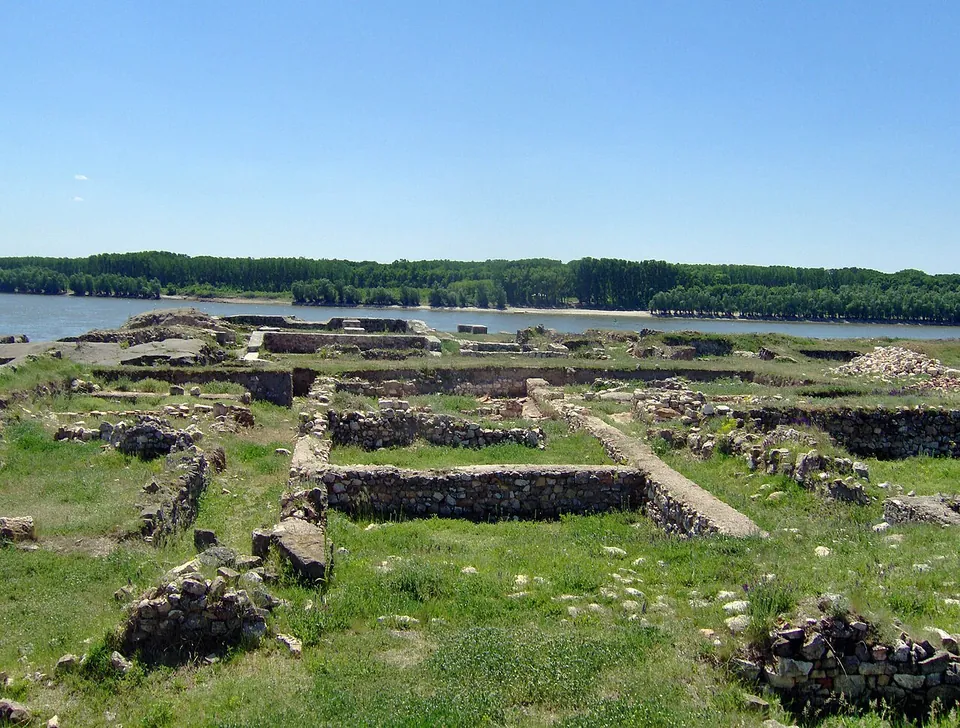
Photo: Elerium at Romanian Wikipedia · Public domain · Commons
45 km · fort · Constanța County
Capidava
The fortress is a rectangle of 105 by 127 m with walls over 2 m thick; it had seven towers, three rectangular, two quarter-circle and two horseshoe-shaped, and a gate 2.5 m wide on the south-east side, with an outlet towards the river port on the south-west (en.wikipedia).

Straight-line distances.
Sources
Every fact on this page comes from the records below, each used under the licence noted.
| Source | Licence |
|---|---|
| Pleiades 406510719 | CC BY |
| Wikidata Q932599 | CC0 |
| Vici.org 11437 | CC BY-SA (text), CC0 (metadata) |
| OpenStreetMap way/228772727 | ODbL |
| Wikipedia (en) — Tropaeum Traiani | CC BY-SA 4.0 |
| Wikipedia (ro) — Tropaeum Traiani | CC BY-SA 4.0 |
| Wikipedia (de) — Tropaeum Traiani | CC BY-SA 4.0 |
| Wikipedia (hu) — Tropaeum Traiani | CC BY-SA 4.0 |
| MINAC — visiting hours and prices (the operator) | licence not recorded |
| MINAC — cold-season visiting hours, from 1 October 2026 (the operator) | licence not recorded |