

What is there today
The ruins are not one enclosure but a set of monuments spread through the town and the fields beyond it. The operator’s signposted archaeological walk takes in ten of them: the amphitheatre, the temple of the Grange des Dîmes, the Cigognier sanctuary, the theatre, the Perruet baths, the town wall with its Tornallaz tower, the east and west gates, and the palace of Derrière la Tour. Each has an explanatory panel in three languages, and the operator reckons on half a day for the whole walk (aventicum.org). The town wall was 5.6 km long, built more for show than for defence (en.wikipedia).
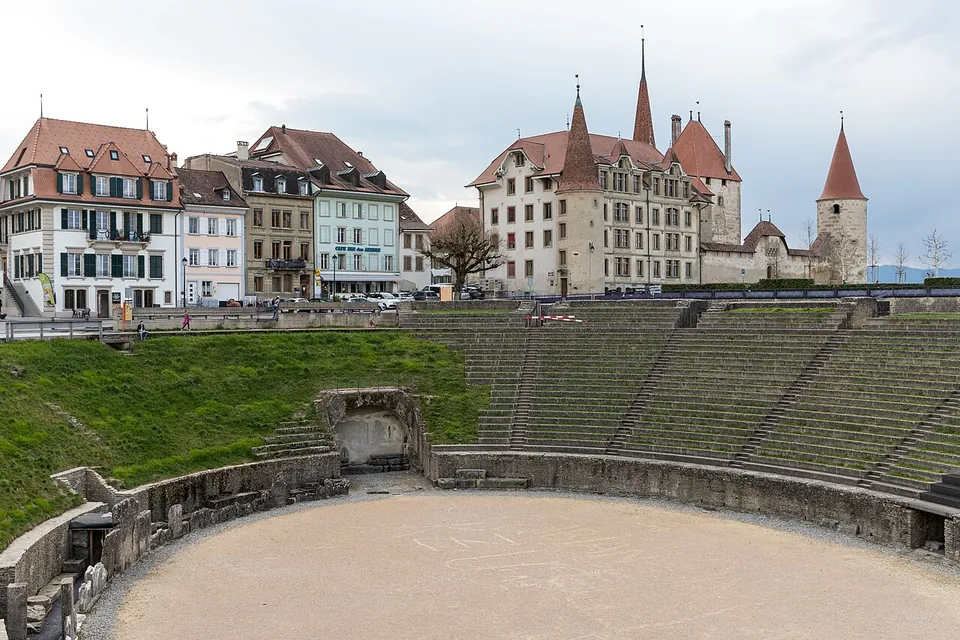
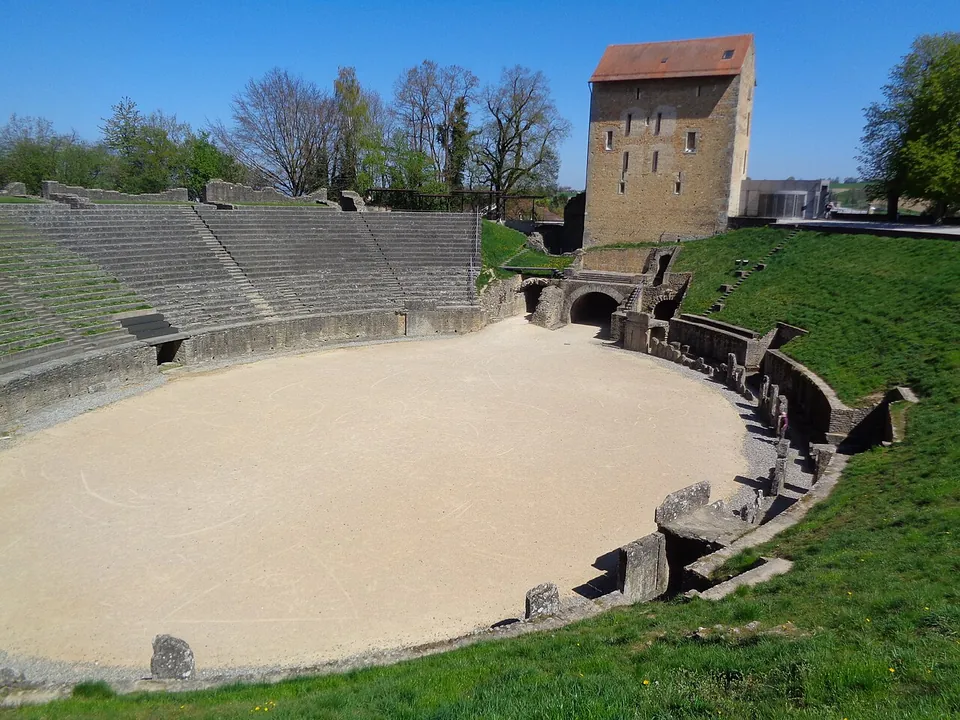
The amphitheatre is the set piece, beside the old town. It was built around 130 and enlarged some thirty years later to look more like the great amphitheatres of the empire; in the 6th century it was partly taken apart to burn its limestone for lime, and in the Middle Ages buildings were set on its structure. Restored in the 1990s, it became a venue for cultural events (fr.wikipedia). The tower over its main entrance, built in the 11th century, houses the Roman Museum on four floors (the operator): monumental sculpture, inscriptions naming the town’s goddess Aventia, the mosaic of Hercules and Antaeus and panels of the Winds mosaic, a wall painting known as the “red salon”, and a copy of the gold bust of Marcus Aurelius.
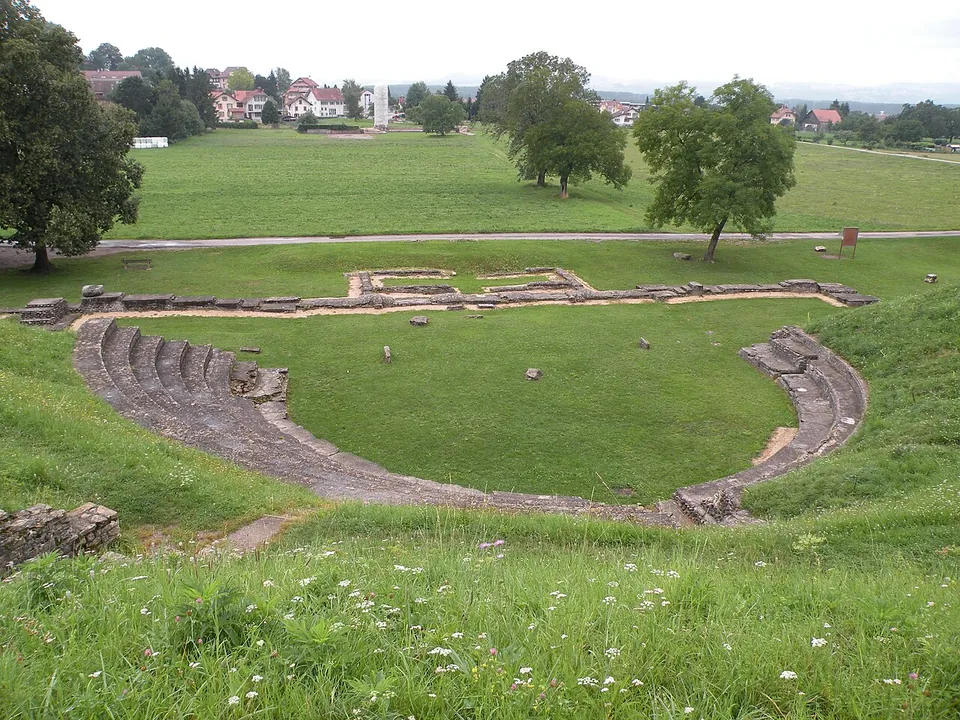
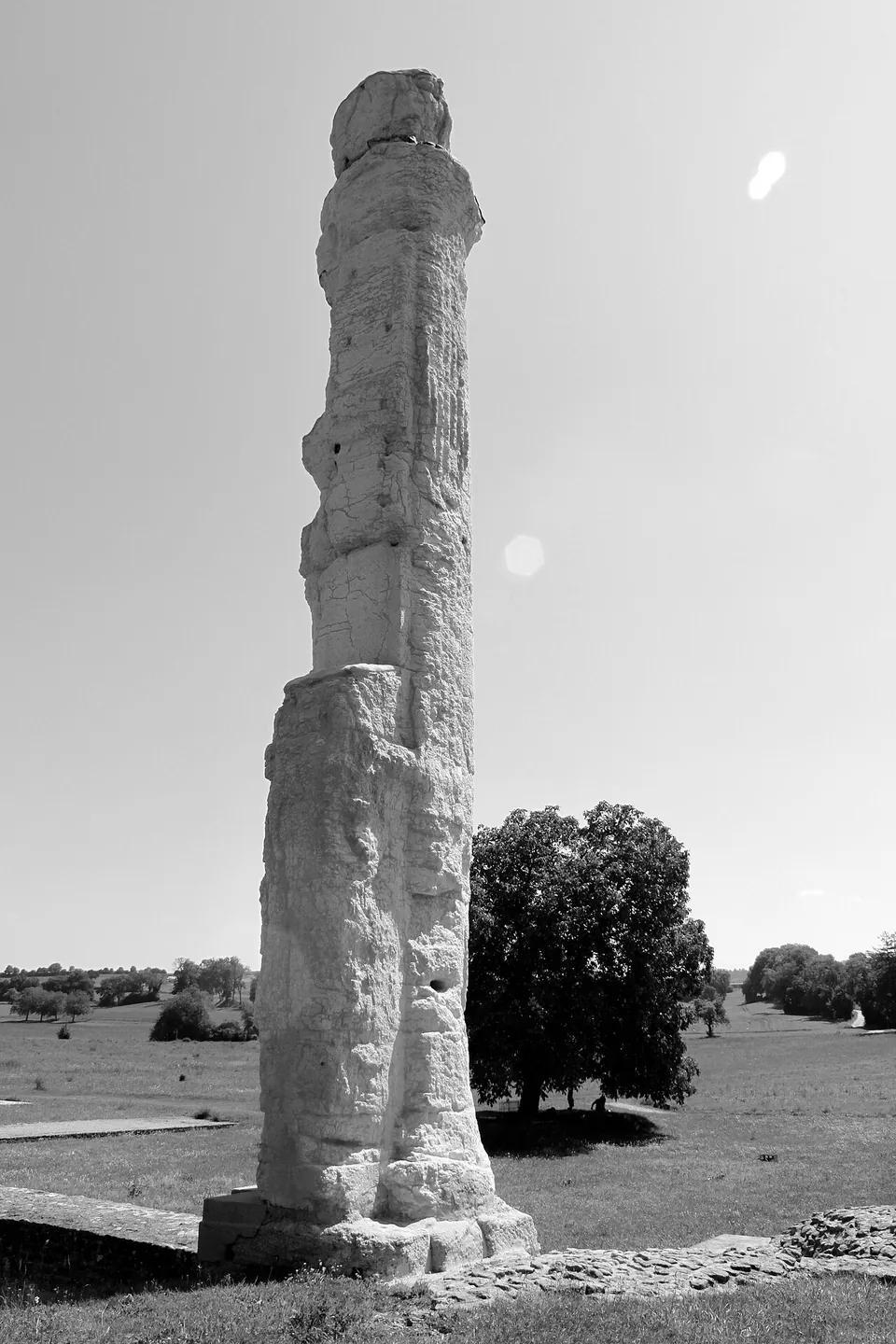
The theatre lies about 500 m east of the amphitheatre (Wikidata coordinates), its curved rows of stone seating set in a grassy slope above the fields. At the Cigognier sanctuary a tall column still stands in the grass.
Is it worth the trip?
Yes, and it is unusually easy to say so: there is no ticket to buy for anything. The museum is free, the monuments are open all year, and the walk is signposted, so Avenches, in the Three Lakes region (fr.wikipedia), works as a half-day stop or as a destination in its own right.
One thing to know before going: the amphitheatre, the most impressive monument, is a restoration site. The Canton of Vaud decided in 2021 to close it for about five years, with a partial reopening planned for 2027, and the operator says only that the museum in its tower stays open during the works. Until then the theatre, the Cigognier column and the walls carry the outdoor part of the visit.
Getting there
Avenches has a railway station, about ten minutes’ walk from the museum, and the town is reached from the A1 motorway by the Avenches exit, with car parks in the centre and on the edge of town (the operator).
The archaeological site is open all year. The museum opens 10.00–17.00 from 1 April to 30 September and 14.00–17.00 from 1 October to 31 March. It is closed on Mondays, except Easter Monday, Whit Monday and every Monday in June; on Tuesdays from November to January; and on 24–25 December and 1–2 January, opening 14.00–17.00 on 26 and 31 December 2026. Entry is free for everyone, groups and schools included (aventicum.org, read 7 October 2026 — check before travelling).
Visiting details
- Opening hours
- Archaeological site: open all year. Roman Museum: 10.00–17.00 from 1 April to 30 September, 14.00–17.00 from 1 October to 31 March; closed on Mondays (except Easter Monday, Whit Monday and every Monday in June), on Tuesdays from November to January, and on 24–25 December and 1–2 January (it opens 14.00–17.00 on 26 and 31 December 2026).
- Tickets
- Free, both the museum and the archaeological site.
- Parking
- Car parks in the town centre and on its edge (the operator); Avenches station is about ten minutes' walk from the museum.
Before you go
- The amphitheatre is closed for restoration; the canton planned a partial reopening in 2027. The Roman Museum in its tower stays open during the works.
Hours and prices checked 7 October 2026 on the operator's own site. Confirm before travelling.
History
The town was probably founded from nothing early in the 1st century AD as the capital of the newly conquered Helvetii, on the road from Italy towards Britain built under Claudius (en.wikipedia). Under Vespasian, who had grown up there, it was raised to a colonia in AD 72 and entered its golden age (en.wikipedia); at its height it had some 20,000 inhabitants (de.wikipedia has more than 20,000 at times, fr.wikipedia up to 20,000). Its position on the roads between Lake Geneva, Vindonissa and Augusta Raurica, and a canal to Lake Murten, made it a junction (it.wikipedia).
Among the finds of the excavations are a nearly complete water organ and a gold bust of Marcus Aurelius made around 180, found in 1939 in the drain of a temple (it.wikipedia); the museum shows a copy of the bust. In the Christian era Aventicum was a bishop’s seat; its best-known bishop, Marius Aventicensis, wrote a chronicle of the years 455 to 581, and shortly after 585 he moved the seat to Lausanne because the town was declining fast (en.wikipedia).
More photographs

Nearby
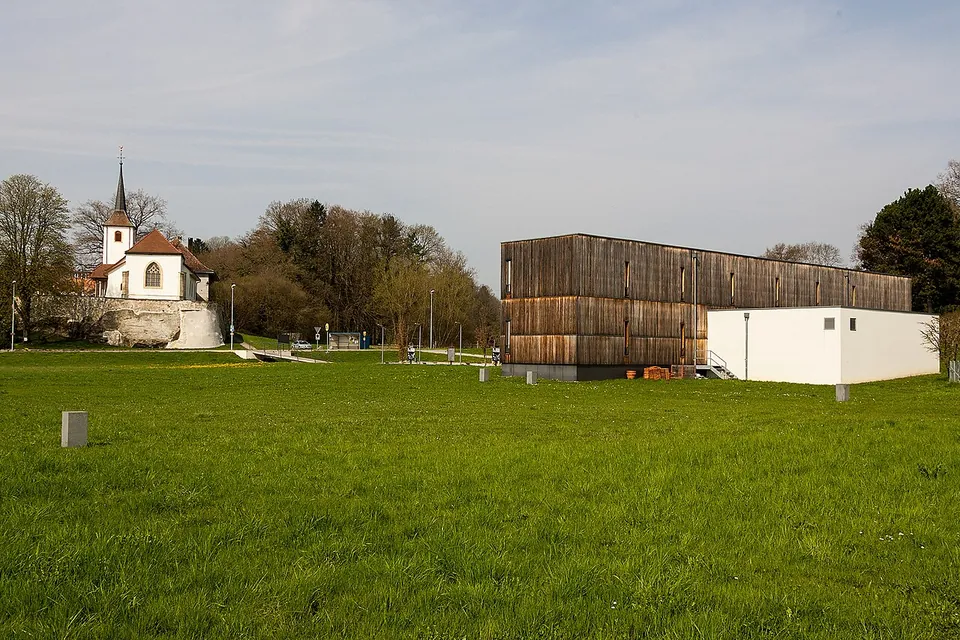
Photo: Roland Zumbuehl · CC BY-SA 4.0 · Commons
6 km · villa · Broye District, Fribourg
Roman villa of Vallon
The museum stands on the site of the villa and its L-shaped building follows the plan of the Roman one (fr.wikipedia).
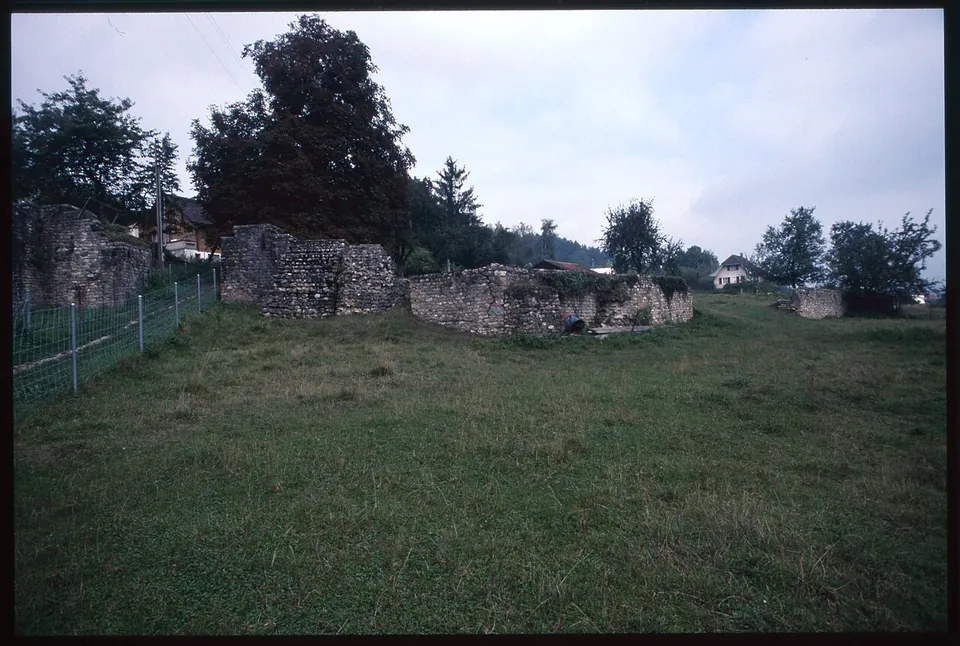
Photo: André Corboz · CC BY-SA 4.0 · Commons
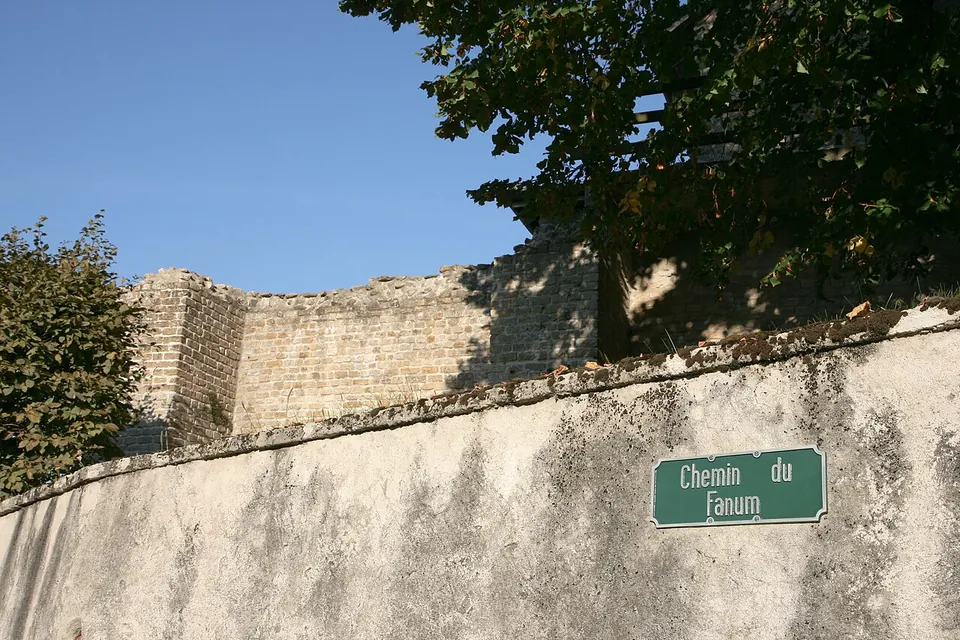
Photo: Olivier Anh · CC BY-SA 2.5 · Commons
33 km · temple · Jura-Nord vaudois District, Vaud
Gallo-Roman temple of Ursins
The Roman walls are the thing to see.


Straight-line distances.
Sources
Every fact on this page comes from the records below, each used under the licence noted.
| Source | Licence |
|---|---|
| Pleiades 177495 | CC BY |
| Wikidata Q670912 | CC0 |
| Vici.org 2837 | CC BY-SA (text), CC0 (metadata) |
| OpenStreetMap way/51444104 | ODbL |
| Pleiades — Avenches amphitheatre | licence not recorded |
| Wikidata — Roman amphitheatre of Avenches (Q2844395) | licence not recorded |
| Wikidata — Roman theatre of Aventicum (Q56117519) | licence not recorded |
| Wikipedia (en) — Aventicum | CC BY-SA 4.0 |
| Wikipedia (de) — Aventicum | CC BY-SA 4.0 |
| Wikipedia (fr) — Aventicum | CC BY-SA 4.0 |
| Wikipedia (it) — Aventicum | CC BY-SA 4.0 |
| Wikipedia (fr) — Amphithéâtre d'Avenches | CC BY-SA 4.0 |
| KGS inventory 5918 — Aventicum, ville romaine (BABS) | licence not recorded |
| Site et Musée romains d'Avenches — practical information (the operator) | licence not recorded |
| Site et Musée romains d'Avenches — the archaeological walk (the operator) | licence not recorded |
| Site et Musée romains d'Avenches — permanent exhibition (the operator) | licence not recorded |
| Canton of Vaud, Grand Council, 22 June 2021 — restoration of the amphitheatre | licence not recorded |