

What is there today
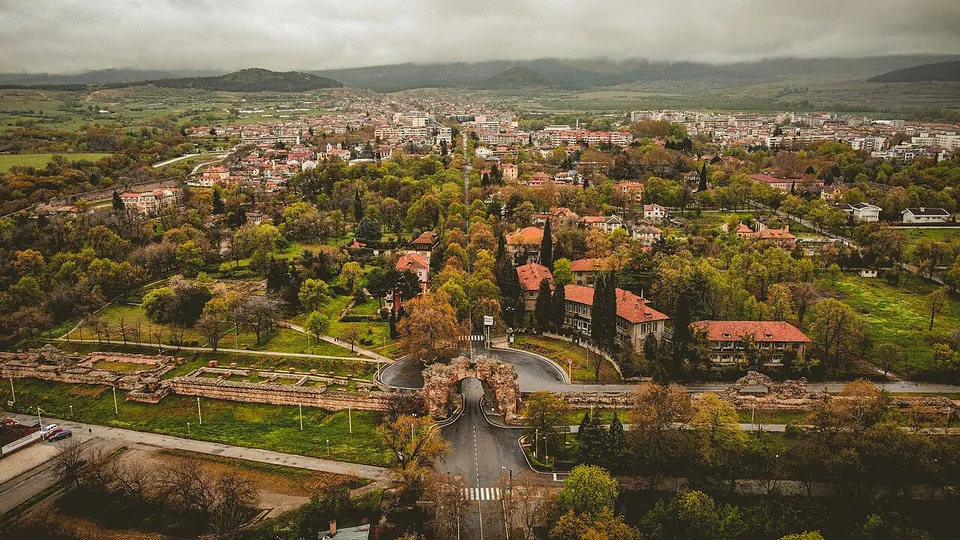
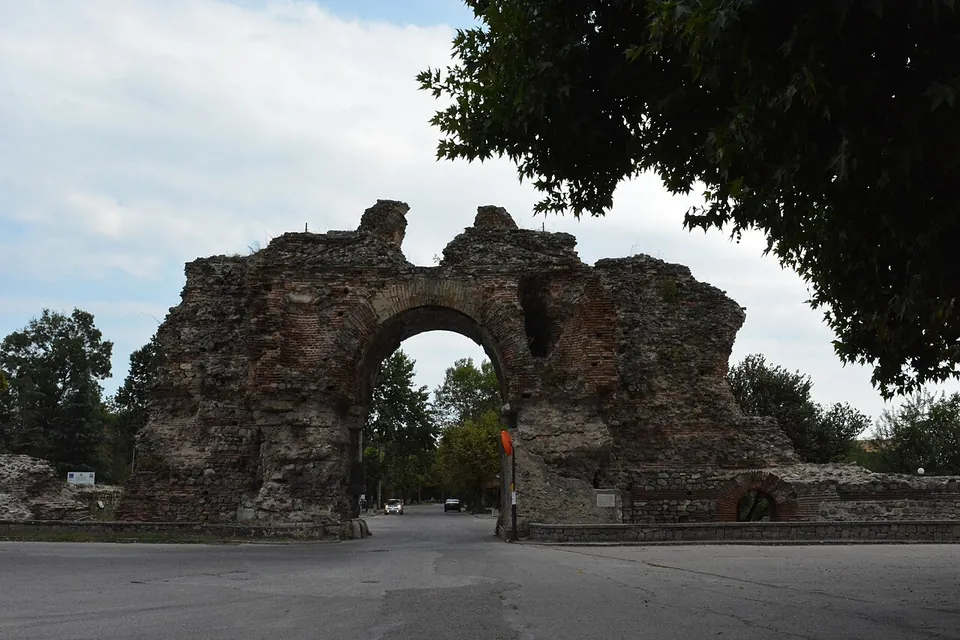
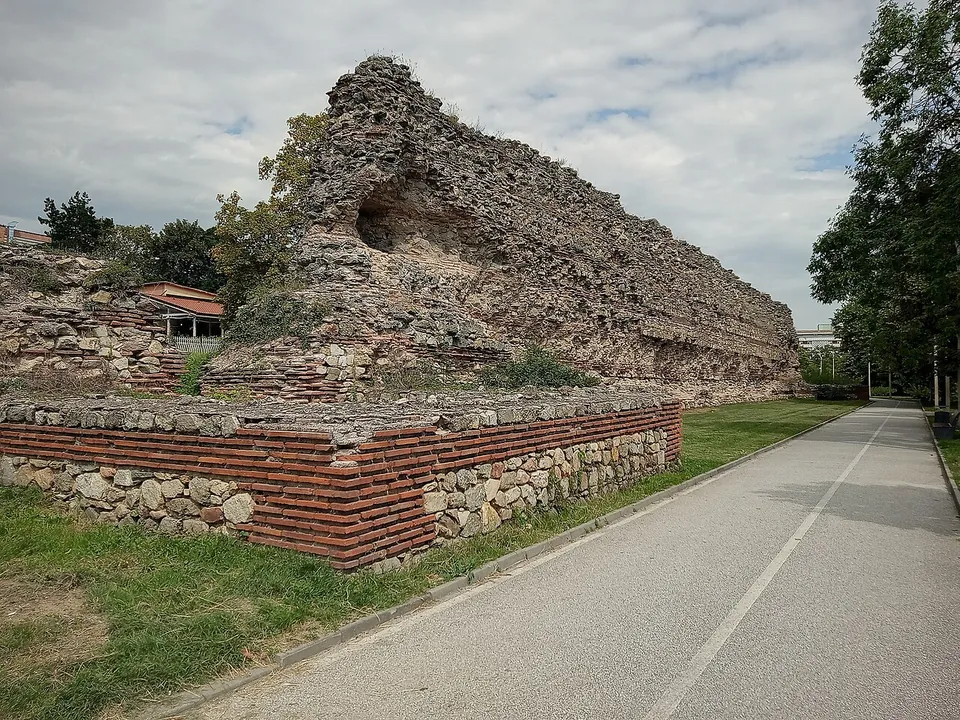
The walls run for 2,327 m round about 20 ha, 2.60–4 m thick and up to 12.5 m high, and once had 44 towers, four main gates and six smaller ones; the south and west gates survive best, the south gate rising to 13 m (bg.wikipedia). The south gate is known as the Camels (its photographs’ own descriptions). Along the north side, where no valley protected the town, a second, double wall was added against the Goths (en.wikipedia). Barracks for a garrison of about 600 men, built in the second half of the 4th century along the south wall, are shown west of the south gate, and the foundations of many early Christian churches of the 4th–6th centuries have been found in and around the town (bg.wikipedia).
About 300 m south of the walls is a Roman tomb, preserved as built and open to visitors, with a long passage, a burial chamber and a coloured floor mosaic (bg.wikipedia); en.wikipedia dates it to the second half of the 4th century and mentions its frescoes. The town’s archaeological museum shows finds from the excavations and a model of the amphitheatre (en.wikipedia; bg.wikipedia).
The baths
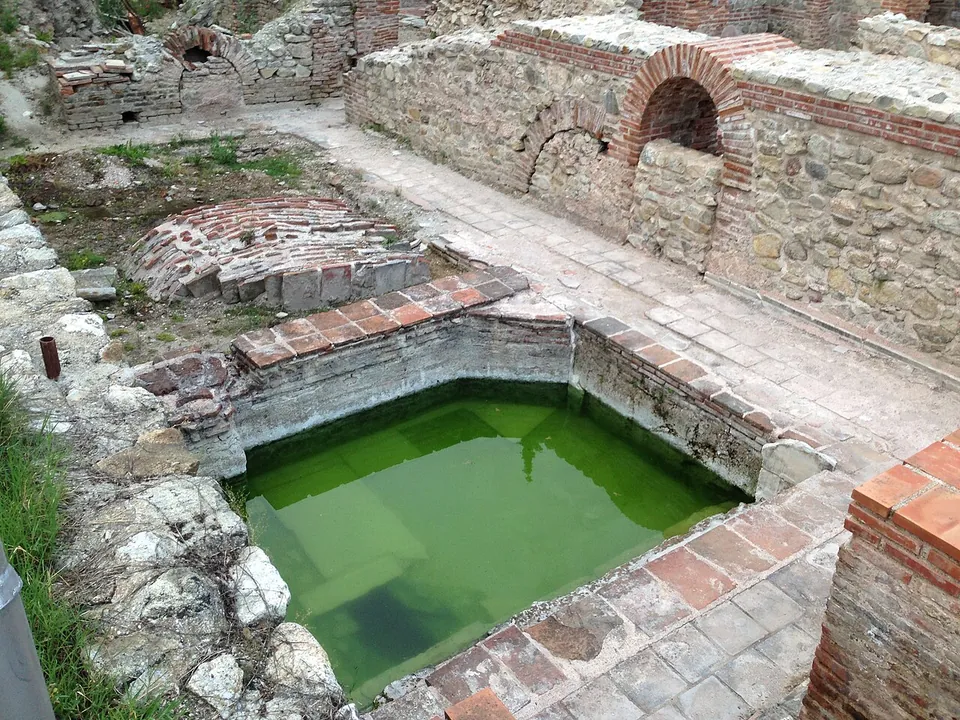
The town grew up around hot springs. A nymphaeum was first built round them in the middle of the 2nd century, extended into baths at the end of the century and enlarged again in the 4th; unusually for Roman baths, all the rooms were heated by channelling the hot spring water rather than by furnaces, and the pools are still fed by the springs (en.wikipedia). The complex covers about 2,000 m², and its rooms were lined with white marble (bg.wikipedia).
The amphitheatre
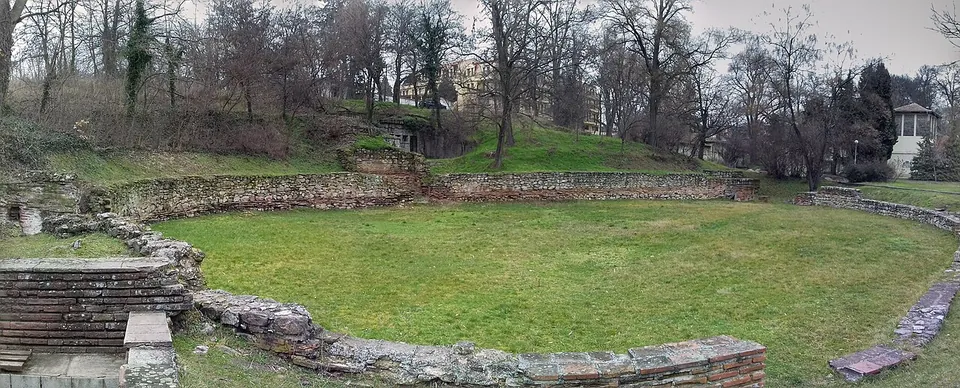
The amphitheatre, built in the 3rd century beside the Momina Salza spring, is unusual for standing close to the centre of town, inside the walls, and for its irregular pear shape (bg.wikipedia; en.wikipedia). It was used for gladiator fights and, after the empire became Christian, for sports and fights with animals; its arena is preserved whole (bg.wikipedia).
Is it worth the trip?
Yes. Walls standing this close to their full height round most of a Roman town are rare, and here they come with a gate you drive through, baths still fed by their springs and a spa town to stay in. The amphitheatre and the baths are low ruins in a park, so the walls carry the visit.
Getting there
Hisarya is in Plovdiv Province, north of Plovdiv. The walls are in the town itself, and the baths and the amphitheatre lie close together in its central park, 50–60 m apart (bg.wikipedia; OpenStreetMap). No bus stop is mapped within 300 m of the centre of the ancient town (OpenStreetMap). The monuments are shown in parks open to visitors (bg.wikipedia); we could find no published hours or prices for the museum or the tomb.
Visiting details
- Tickets
- The walls, the baths and the amphitheatre are shown in parks open to visitors (bg.wikipedia). The archaeological museum and the Roman tomb publish no prices that we could find (searched 2 October 2026).
- On foot
- At the parking
History
People lived here from about 6000 BC, probably for the hot springs, and a Thracian settlement traded with the Greek cities of the northern Aegean in the 4th and 5th centuries BC. After the Roman conquest of Thrace it became a Roman town, first called Augusta; an inscription shows the area as an imperial estate under Hadrian, in 135–136, and Septimius Severus visited it. In 293 Diocletian, drawn by the springs, raised its status and named it after himself (en.wikipedia). Its walls, 2.3 km long, were built in the early 4th century after the Gothic invasions (en.wikipedia), and it became a bishop’s seat (bg.wikipedia). It declined after the fall of the Danube frontier and was destroyed by the Slav migrations at the end of the 6th or the start of the 7th century (en.wikipedia).
More photographs


Nearby
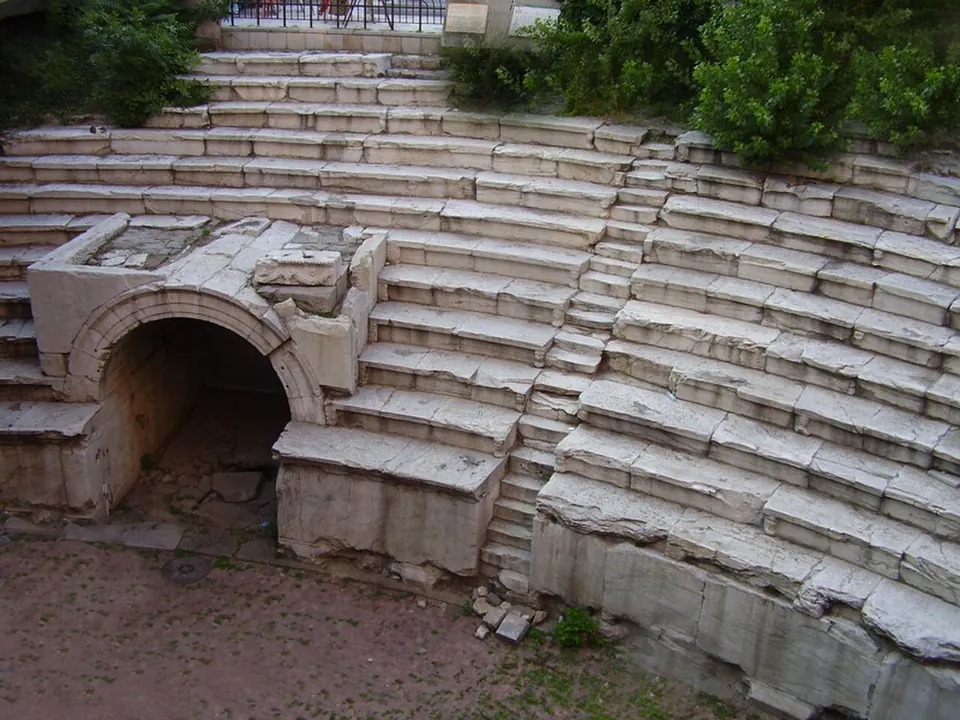
Photo: Kmrakmra · CC BY-SA 3.0 · Commons
40 km · site · Plovdiv Province
Stadium of Philippopolis
What you see is the sphendone, the curved end of the stadium, partly restored.
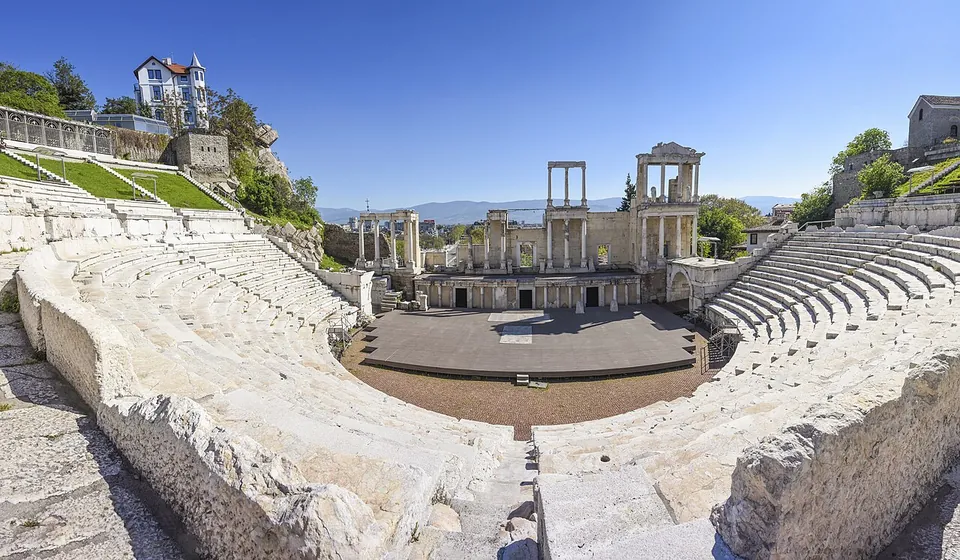
Photo: Община Пловдив · CC BY-SA 4.0 · Commons
40 km · city · Plovdiv Province
Philippopolis – Plovdiv
The stops each have their own page: the Roman theatre, set into the hillside of the Old Town and one of the best-preserved Roman theatres anywhere; the stadium, whose northern curved end has been partly restored on Roman Stadium Square; the odeon, the council house of the Roman city, which also served as a theatre; the Small Basilica, an early Christian church found during building work in 1988; and the Eirene Residence, a 3rd-century house with 160 m² of mosaic floors in the underpass beneath Tsar Boris III Boulevard (en.wikipedia).
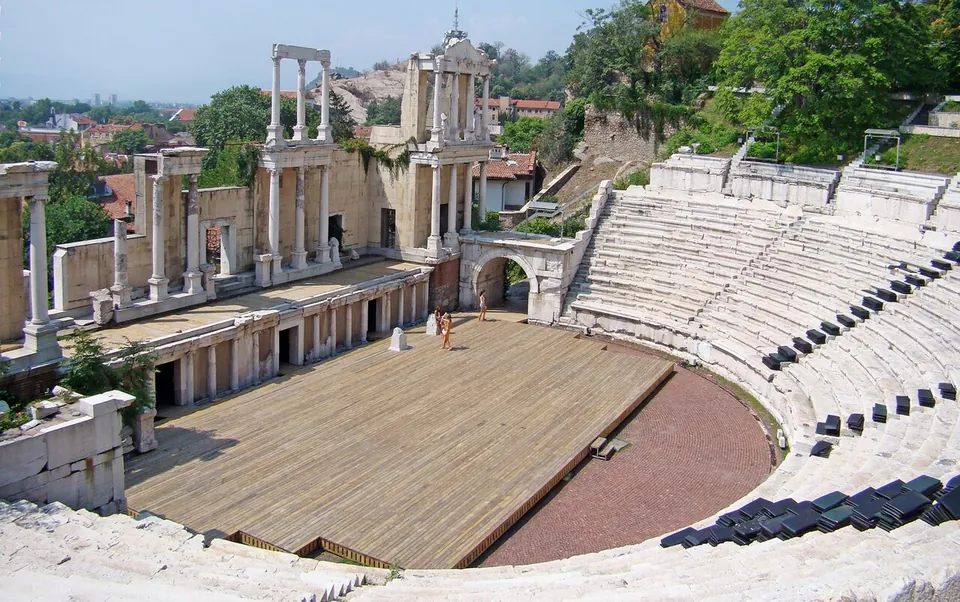
Photo: Edal Anton Lefterov · CC BY-SA 3.0 · Commons
40 km · theatre · Plovdiv Province
Roman theatre of Philippopolis
The theatre is a semicircle 82 m across.


Straight-line distances.
Sources
Every fact on this page comes from the records below, each used under the licence noted.
| Source | Licence |
|---|---|
| Pleiades 216792 | CC BY |
| Wikidata Q3655356 | CC0 |
| Vici.org 11009 | CC BY-SA (text), CC0 (metadata) |
| OpenStreetMap way/246542316 | ODbL |
| Wikidata — Hisarya amphitheatre (Q28971088) | licence not recorded |
| Wikidata — Hisarya Roman Thermae (Q114815607) | licence not recorded |
| Wikipedia (en) — Diocletianopolis (Thrace) | CC BY-SA 4.0 |
| Wikipedia (bg) — Диоклецианопол | CC BY-SA 4.0 |
| Wikipedia (bg) — Амфитеатър (Хисаря) | CC BY-SA 4.0 |