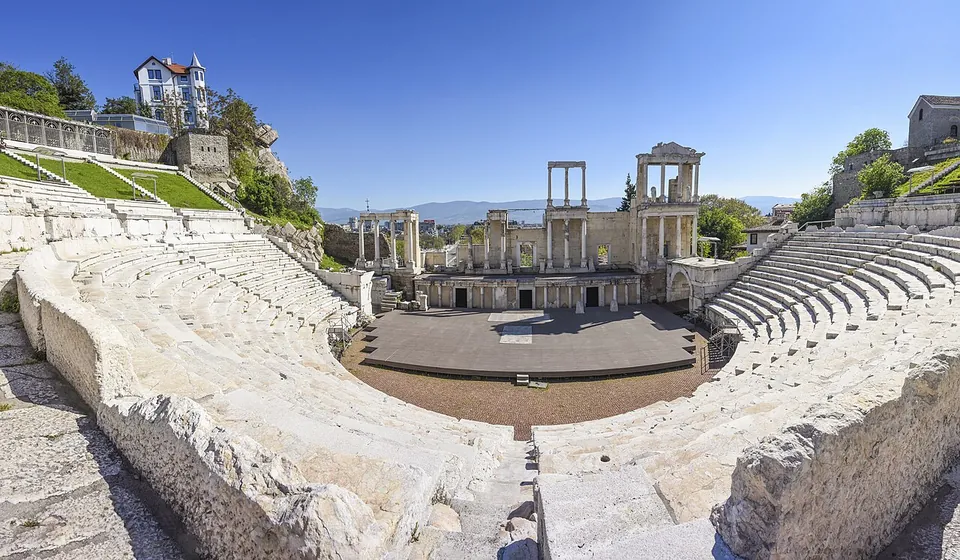
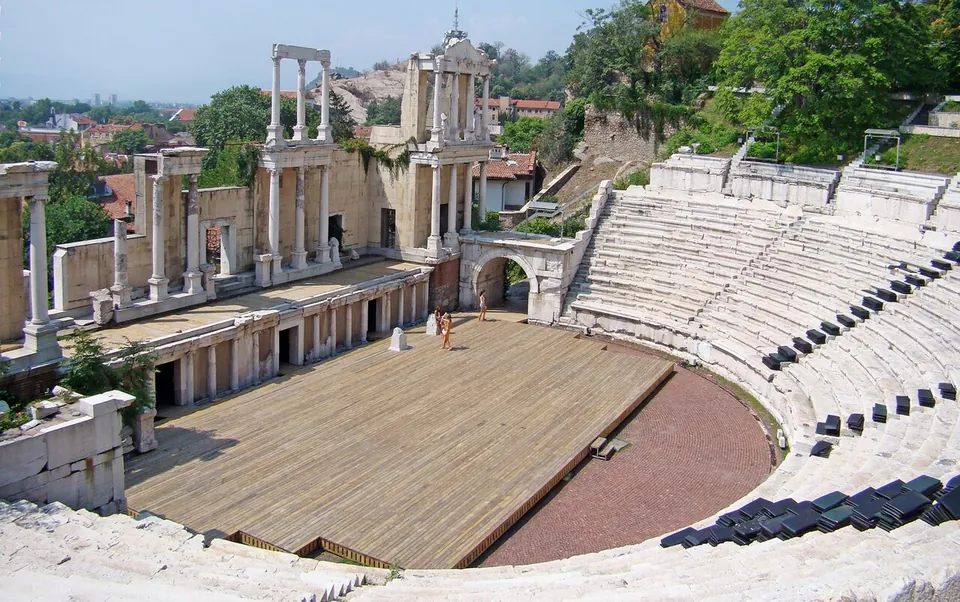


The Roman theatre of Philippopolis is the theatre of Roman Plovdiv, built into the slope of the Old Town’s hills and facing south over the city to the Rhodope mountains. It is one of the best-preserved Roman theatres in the world, and it is a working stage again (en.wikipedia).
What is there today
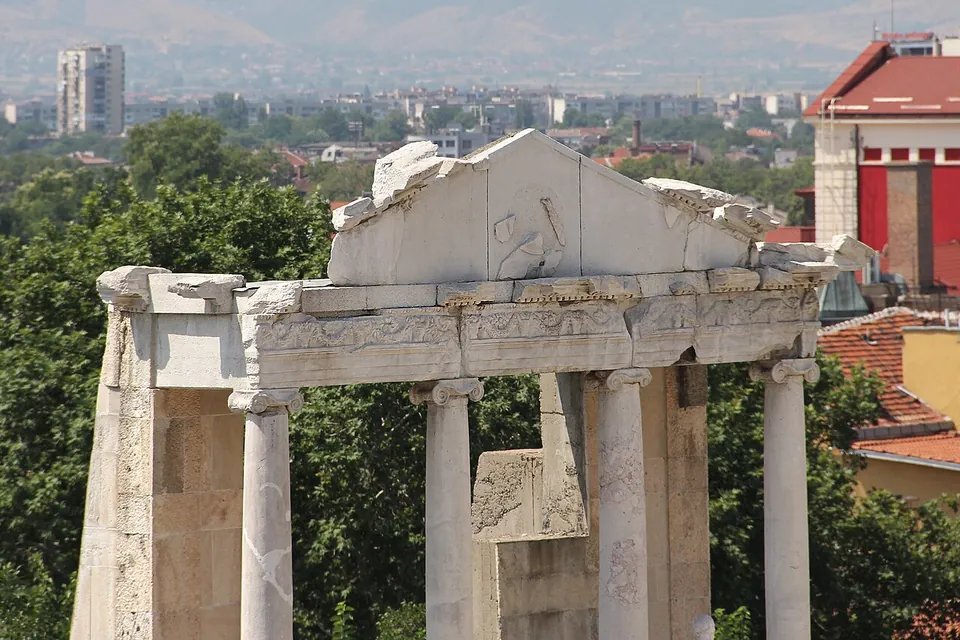
The theatre is a semicircle 82 m across. Its 28 rows of marble benches, in two tiers divided by a walkway, wrap round a horseshoe-shaped orchestra; behind the stage rises the stage building, whose front had two storeys of columns, Ionic below and Corinthian above, cut by three doorways (bg.wikipedia). A vaulted passage runs from the middle of the orchestra under the stage building and out of the theatre (en.wikipedia).
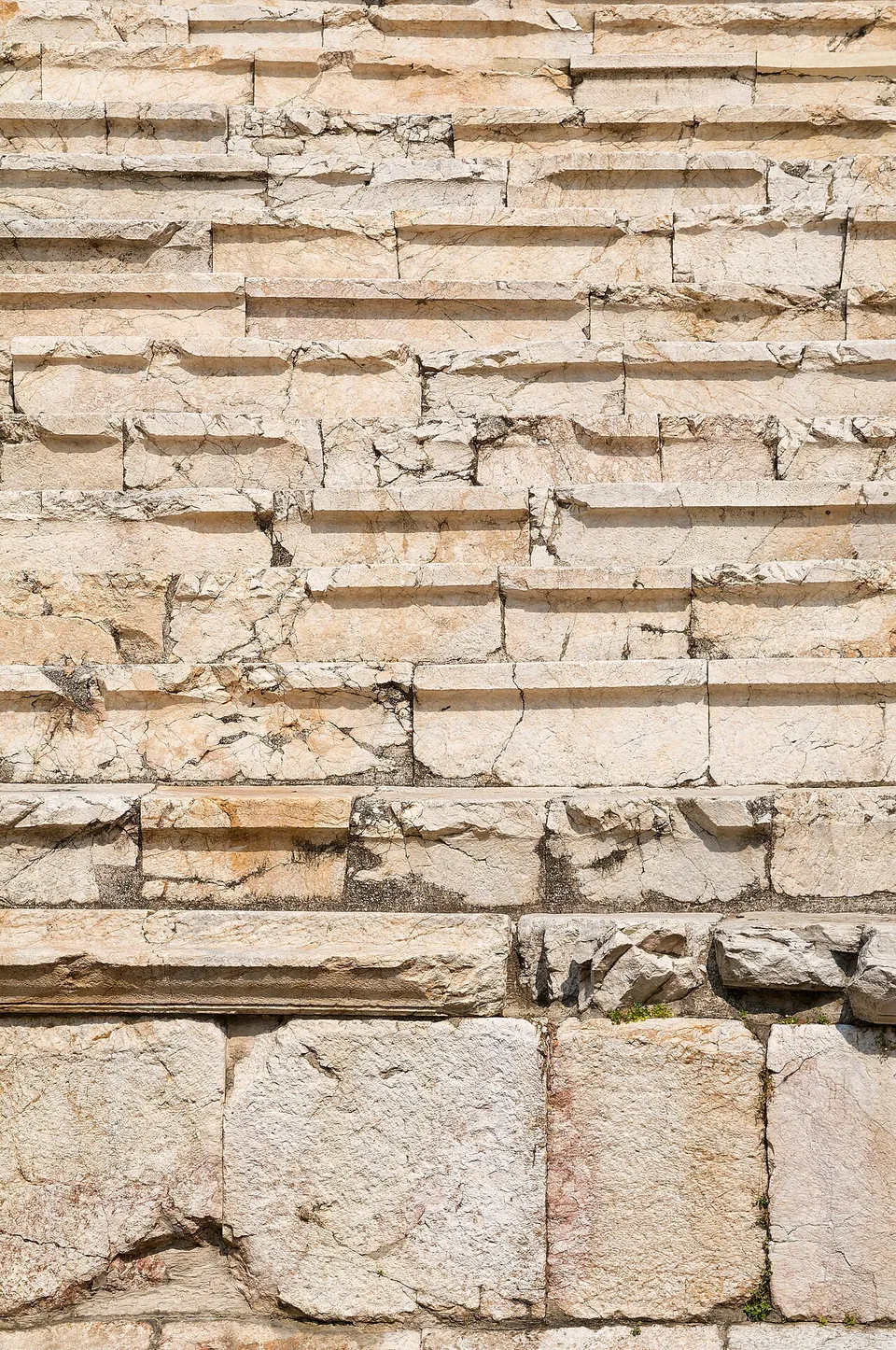
What stands today was restored from the original stones by anastylosis, with the new material clearly marked; the work is counted among the best achievements of Bulgarian conservation (bg.wikipedia). Inscriptions survive on the seats: honorary places were reserved for city councillors, magistrates and friends of the emperor (bg.wikipedia), and according to en.wikipedia each section carried the name of a city quarter, so citizens knew where to sit. The theatre seats about 3,500 people for performances today (en and bg.wikipedia).
Is it worth the trip?
Yes. If you see one Roman monument in Plovdiv, make it this one: a Roman theatre you can still sit in, in the middle of a city, facing the same view of the Rhodopes as its first audience. Bear the restoration in mind — much of what you see was put back together from fallen stones — but it is the original material, re-erected rather than rebuilt.
Getting there
The theatre is in the Old Town, beside Tsar Boris III Boulevard; the operator gives its address as ul. Tsar Ivaylo 4. A paid car park is mapped about 140 m away and the Tunela bus stops about 250 m away (OpenStreetMap).
It is open daily, 09.30 to 18.00 from April to October and 09.00 to 17.30 from November to March, with a lunch break from 12.30 to 13.00. An adult ticket is €3.58; students and visitors over 65 pay €1.53, and children under 7 go free. For €5.11 the ticket adds the screening shown under the stage. The operator still prints each price in leva beside the euro amount (oldplovdiv.bg, read 1 October 2026 — check before travelling). In summer the theatre is used for plays and concerts (en.wikipedia).
Visiting details
- Opening hours
- Daily 09.30–18.00 from April to October and 09.00–17.30 from November to March, closed for lunch 12.30–13.00.
- Tickets
- €3.58 for adults; €1.53 for students and visitors over 65; free under 7 and for visitors with a disability of over 50%; €7.16 for a family (parents with children aged 7–16). The theatre together with the screening under the stage costs €5.11 for adults. A 72-hour "Ancient and Eternal" ticket at €30.68 covers every Old Plovdiv site and the screening at the stadium.
- Parking
- A paid car park is mapped about 140 m away (OSM way/205344384, fee=yes); the nearest bus stops, Tunela, are about 250 m away (OpenStreetMap).
- On foot
- About 2 min from the parking
Before you go
- The theatre is a working stage for plays and concerts in the summer months (en.wikipedia); the operator's page does not say whether it closes to sightseers on performance days.
Hours and prices checked 1 October 2026 on the operator's own site. Confirm before travelling.
History
Published dates for its construction differ. An inscription naming Titus Flavius Cotys, a descendant of the Thracian royal house and the official in charge of the building works, dates it to the reign of Domitian (bg.wikipedia), emperor from 81 to 96 (en.wikipedia); it.wikipedia, also from an inscription, gives 114–117 under Trajan. Honorary inscriptions show that the building also served as the seat of the Thracian provincial assembly (bg.wikipedia).
Remains of safety barriers in front of the first row suggest that fights with animals and gladiators were staged here, perhaps for the emperor Caracalla’s visit to Philippopolis in 214 (bg.wikipedia). A large part of the theatre was destroyed at the end of the 4th century, by fire or earthquake. Plovdiv’s archaeological museum excavated it between 1968 and 1979 (bg.wikipedia).
More photographs

Nearby
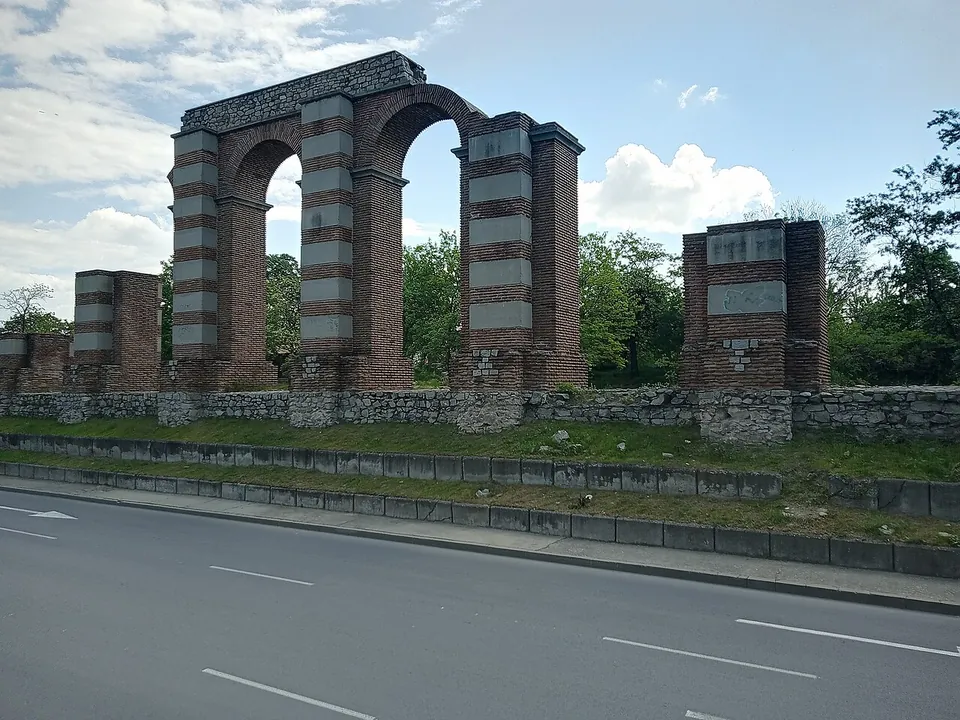
Photo: Gitanes232 · CC BY-SA 4.0 · Commons
3 km · aqueduct · Plovdiv Province
Aqueducts of Plovdiv
What you see is a row of tall piers in opus mixtum, courses of squared stone alternating with courses of brick, with a few arches restored between them, in the central strip of Komatevsko Shose Boulevard at the Komatevo junction.
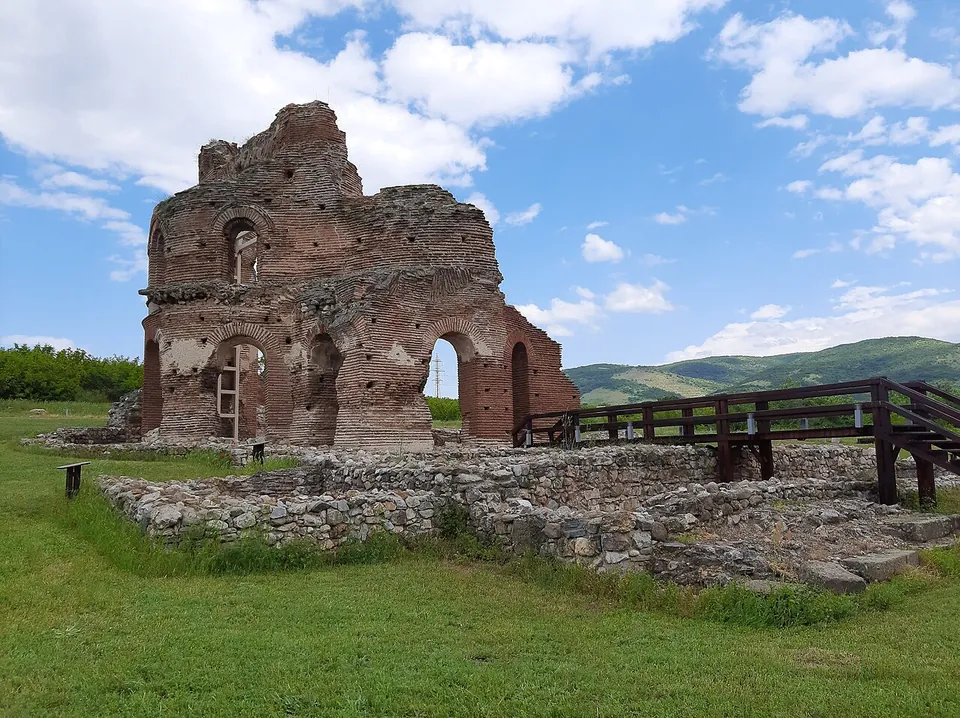
Photo: Spasimir Pilev · CC BY-SA 4.0 · Commons
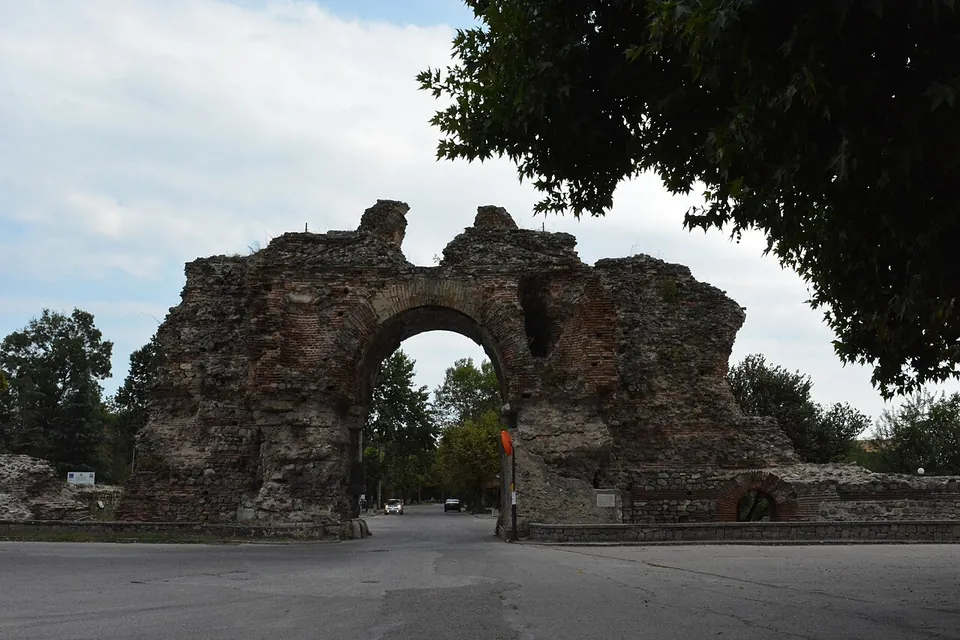
Photo: BlackfishFoto · CC BY-SA 4.0 · Commons
40 km · city · Plovdiv Province
Diocletianopolis
The walls run for 2,327 m round about 20 ha, 2.60–4 m thick and up to 12.5 m high, and once had 44 towers, four main gates and six smaller ones; the south and west gates survive best, the south gate rising to 13 m (bg.wikipedia).


Straight-line distances.
Sources
Every fact on this page comes from the records below, each used under the licence noted.
| Source | Licence |
|---|---|
| Pleiades 229714163 | CC BY |
| Wikidata Q1363208 | CC0 |
| Vici.org 10515 | CC BY-SA (text), CC0 (metadata) |
| OpenStreetMap way/556227410 | ODbL |
| Wikipedia (en) — Roman theatre of Philippopolis | CC BY-SA 4.0 |
| Wikipedia (bg) — Античен театър (Пловдив) | CC BY-SA 4.0 |
| Wikipedia (it) — Teatro romano (Plovdiv) | CC BY-SA 4.0 |
| Wikipedia (en) — Domitian | CC BY-SA 4.0 |
| Old Plovdiv (Starinen Plovdiv), the municipal institute — ticket prices and opening hours | licence not recorded |