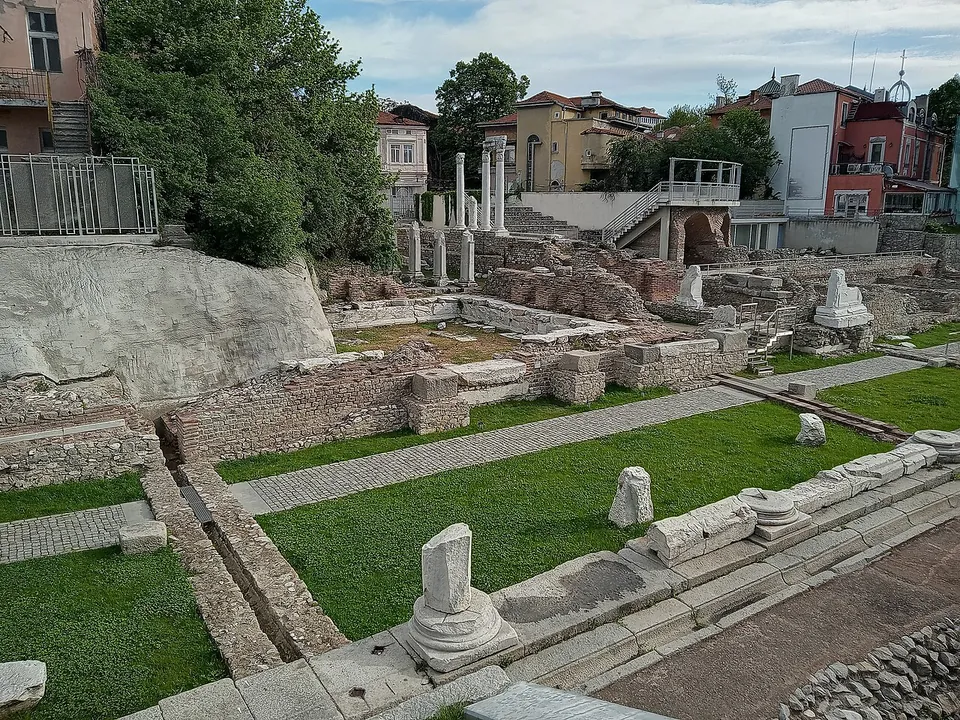
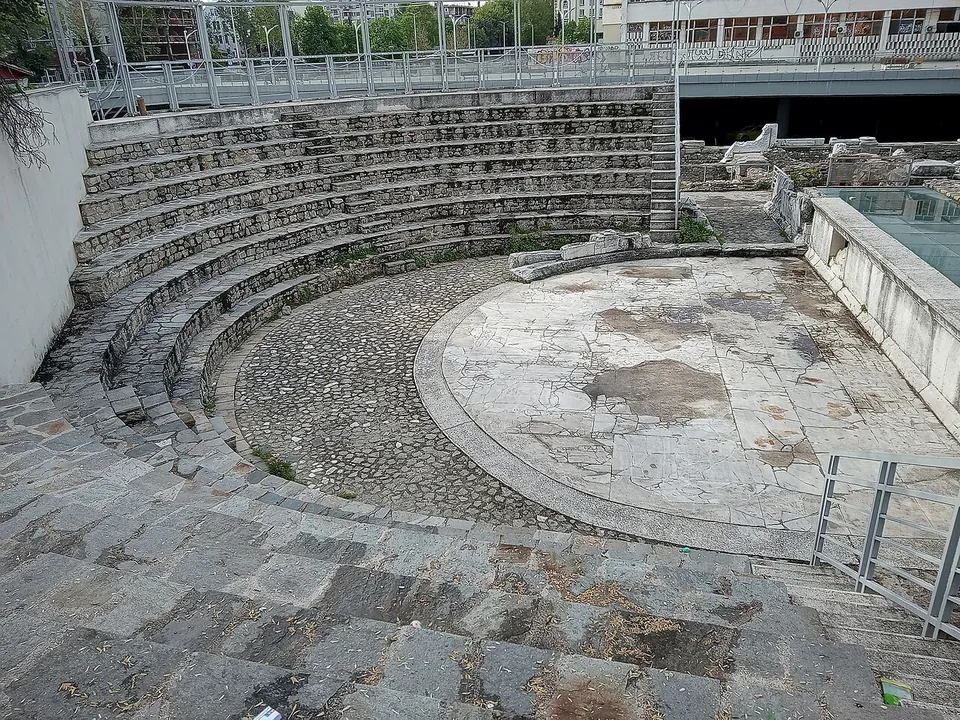


The Odeon of Philippopolis was the council house of Roman Plovdiv, a small covered theatre of 300–350 seats on the north side of the city’s forum. Its seating and orchestra have been restored, and it is used for concerts again (the operator; bg.wikipedia).
What is there today
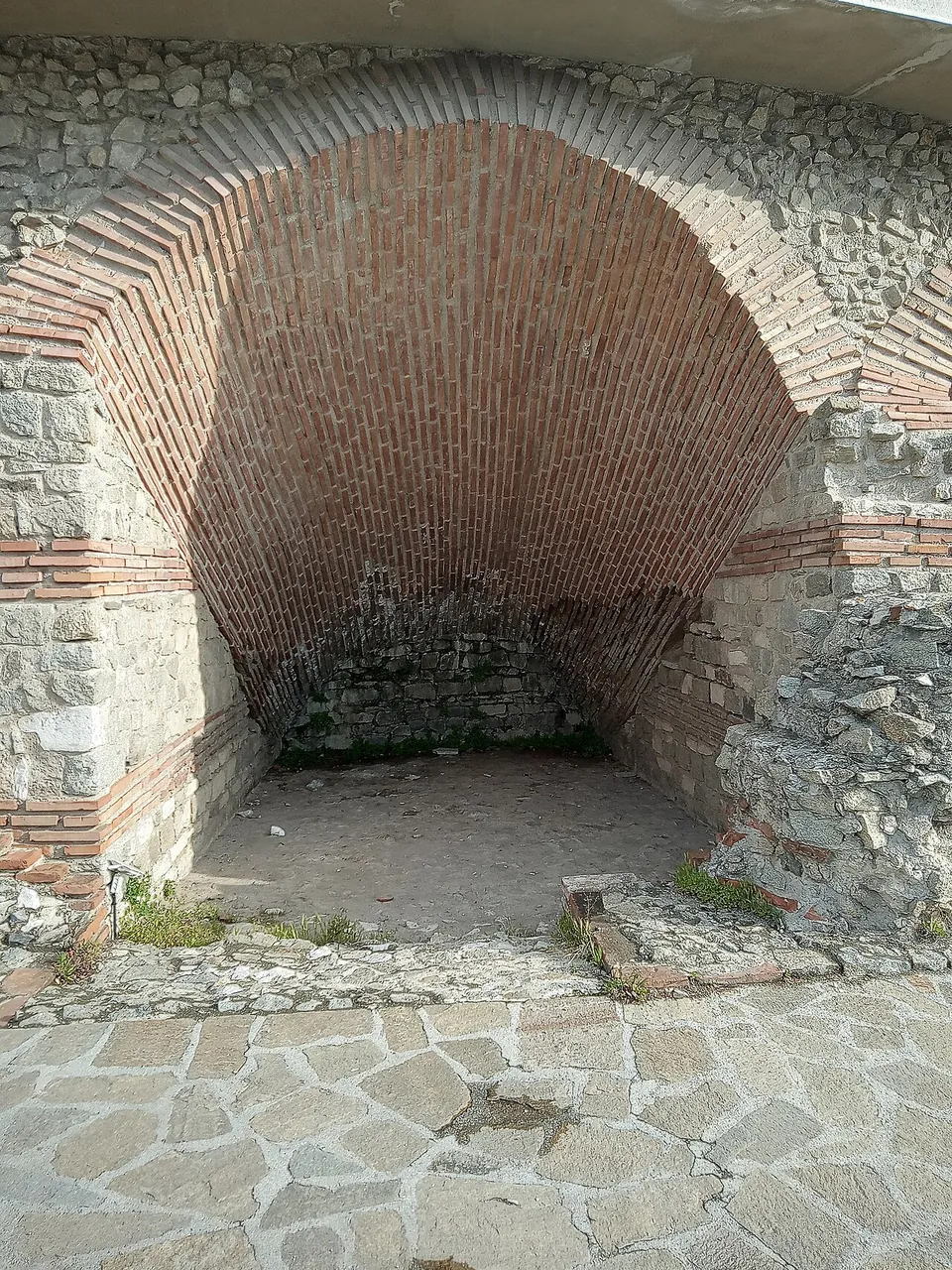
The odeon has all the parts of a covered theatre: a stage building, an orchestra and tiered seating. The stage stood 1.50 m above the orchestra, and its front rose two storeys in the Corinthian order; vertical grooves in the stage wall suggest machinery for raising and lowering a curtain. The orchestra is paved with large marble slabs, and the seats rest on vaults (bg.wikipedia). Excavation turned up marble fragments of the building, an inscription on the base of an imperial statue, original marble columns and 87 silver coins, probably hidden during the Gothic invasion (the operator).
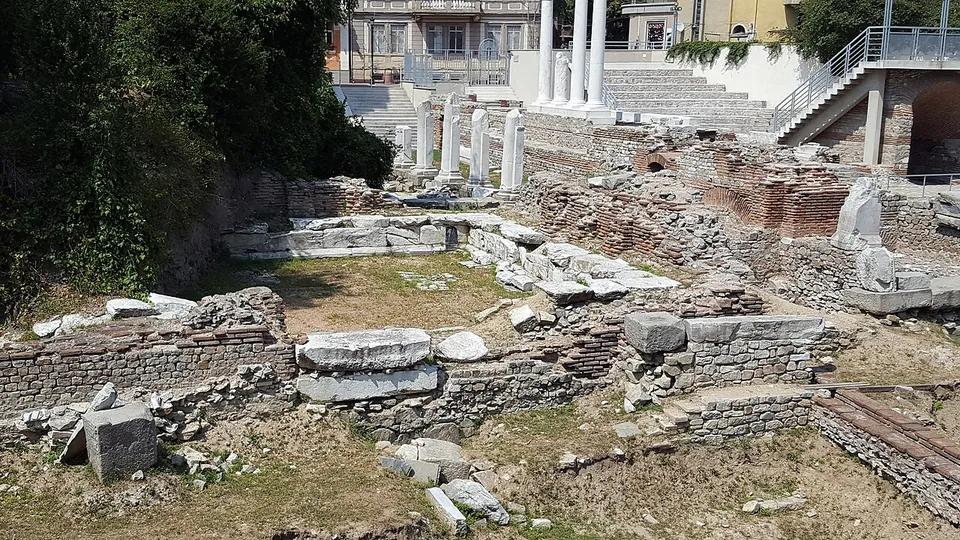
The odeon stands on the north side of the forum, the largest forum complex in Bulgaria, which measured 143 m by 136 m; much of it is on show in the open, together with restored columns, while the rest lies under modern buildings. An underpass for Knyaginya Maria Luiza Boulevard, built in the 1980s, cut the forum in two and separated it from the odeon (bg.wikipedia; the operator).
The library
Just west of the odeon, also on the north side of the forum, are the remains of the city’s library, a rectangular building about 15 m by 20 m. It held manuscripts and scrolls and was used for teaching, readings, public debates and speeches (bg.wikipedia).
Is it worth the trip?
As part of a walk through Roman Plovdiv, yes. It is small, a fraction of the size of the main theatre, and what you see was conserved and partly restored in 2002, but with the forum and the library next to it, it shows the civic heart of the Roman city rather than its entertainments.
Getting there
The odeon is on General Gurko Street in the city centre, near the main pedestrian street and the Central Post Office (bg.wikipedia). A paid car park is mapped about 90 m away, and bus stops at the Central Post Office underpass about 80 m away (OpenStreetMap).
It is open Tuesday to Sunday, 09.00 to 18.00, closed for lunch from 13.00 to 14.00 (the operator). The operator’s standard single-site ticket is €3.58 for adults and €1.53 for students and visitors over 65; its price list does not name the odeon separately (oldplovdiv.bg, read 1 October 2026).
Visiting details
- Opening hours
- Tuesday to Sunday 09.00–18.00, closed for lunch 13.00–14.00; closed on Mondays.
- Tickets
- The operator's standard single-site ticket, which covers all its sites except the Bishop's Basilica, is €3.58 for adults and €1.53 for students and visitors over 65; free under 7. Its price list does not name the odeon separately.
- Parking
- A paid car park is mapped about 90 m away (OSM node/8962842472, fee=yes); bus stops at the Central Post Office underpass are about 80 m away (OpenStreetMap).
- On foot
- About 1 min from the parking
Hours and prices checked 1 October 2026 on the operator's own site. Confirm before travelling.
History
The odeon was built under Hadrian, emperor from 117 to 138, as the council house (bouleuterion) of the city, and was later used as a theatre. It went through four building periods, from the 2nd to the 4th century, when it was abandoned (en and bg.wikipedia). Evidence of the Gothic destruction of 250/251 has been found around it (en.wikipedia).
The forum around it was laid out under Vespasian in the 1st century and completed in the 2nd; life there faded in the middle of the 5th century, when barbarian raids drove the people of Philippopolis from the plain up to the acropolis (bg.wikipedia). The odeon was found in 1988 by the archaeologists Z. Dimitrov and Maya Martinova, declared a cultural monument of national importance in 1995, and conserved and opened to visitors in 2002 with the help of the Leventis Foundation (bg.wikipedia).
More photographs

Nearby
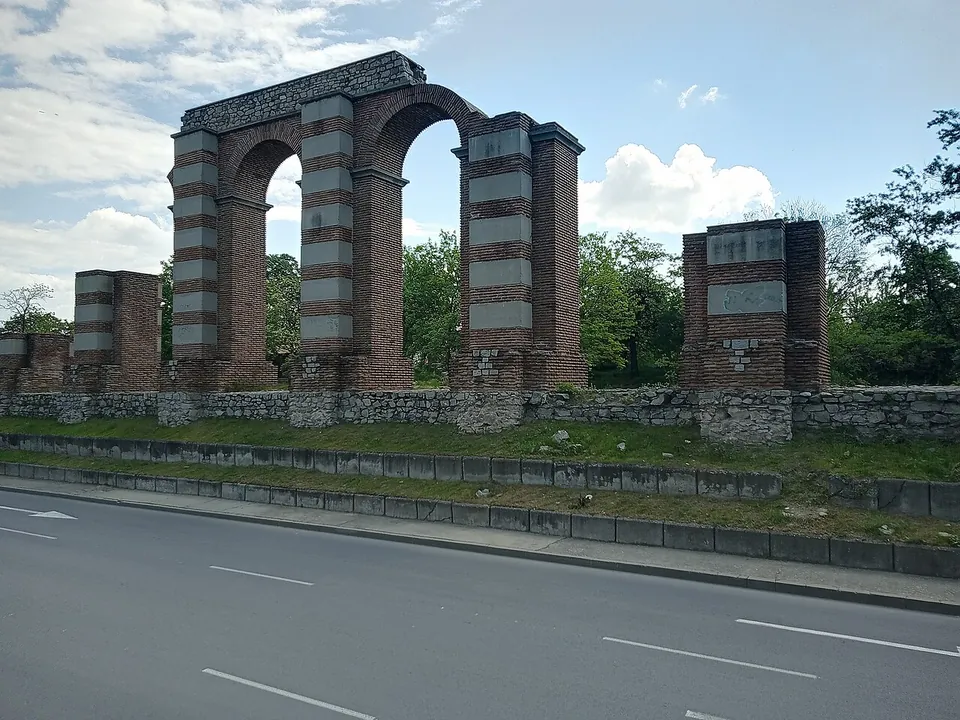
Photo: Gitanes232 · CC BY-SA 4.0 · Commons
3 km · aqueduct · Plovdiv Province
Aqueducts of Plovdiv
What you see is a row of tall piers in opus mixtum, courses of squared stone alternating with courses of brick, with a few arches restored between them, in the central strip of Komatevsko Shose Boulevard at the Komatevo junction.
Photo: Spasimir Pilev · CC BY-SA 4.0 · Commons
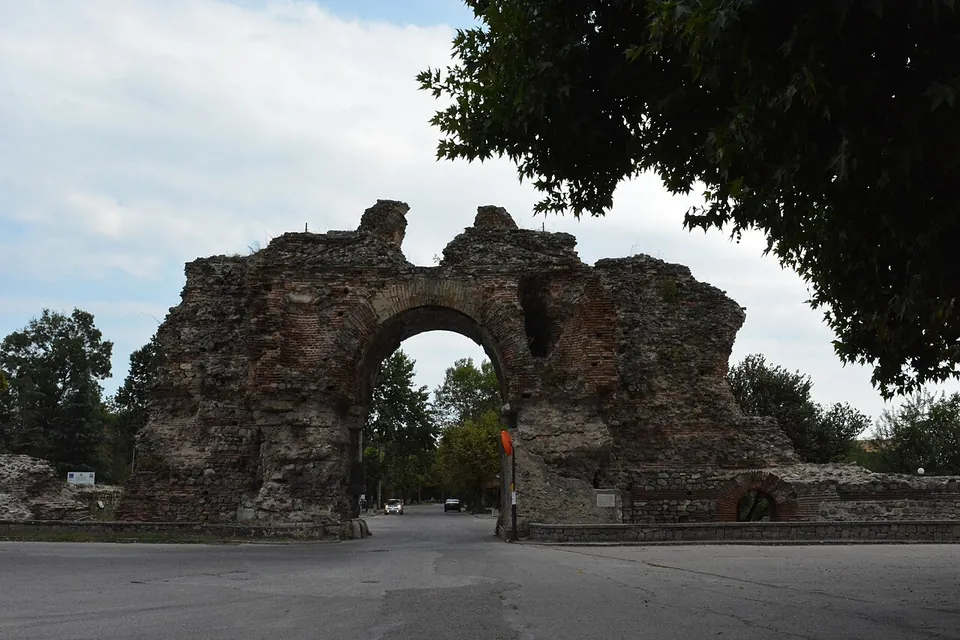
Photo: BlackfishFoto · CC BY-SA 4.0 · Commons
40 km · city · Plovdiv Province
Diocletianopolis
The walls run for 2,327 m round about 20 ha, 2.60–4 m thick and up to 12.5 m high, and once had 44 towers, four main gates and six smaller ones; the south and west gates survive best, the south gate rising to 13 m (bg.wikipedia).


Straight-line distances.
Sources
Every fact on this page comes from the records below, each used under the licence noted.
| Source | Licence |
|---|---|
| Pleiades 229782807 | CC BY |
| Wikidata Q26046109 | CC0 |
| OpenStreetMap way/103432948 | ODbL |
| Wikipedia (en) — Odeon of Philippopolis | CC BY-SA 4.0 |
| Wikipedia (bg) — Античен одеон (Пловдив) | CC BY-SA 4.0 |
| Wikipedia (bg) — Форум на Филипопол | CC BY-SA 4.0 |
| Wikipedia (en) — Library of Philippopolis | CC BY-SA 4.0 |
| Wikipedia (bg) — Антична библиотека (Пловдив) | CC BY-SA 4.0 |
| Wikipedia (en) — Hadrian | CC BY-SA 4.0 |
| Old Plovdiv (Starinen Plovdiv), the municipal institute — Ancient Odeon of Philippopolis | licence not recorded |
| Old Plovdiv (Starinen Plovdiv) — ticket prices and opening hours | licence not recorded |