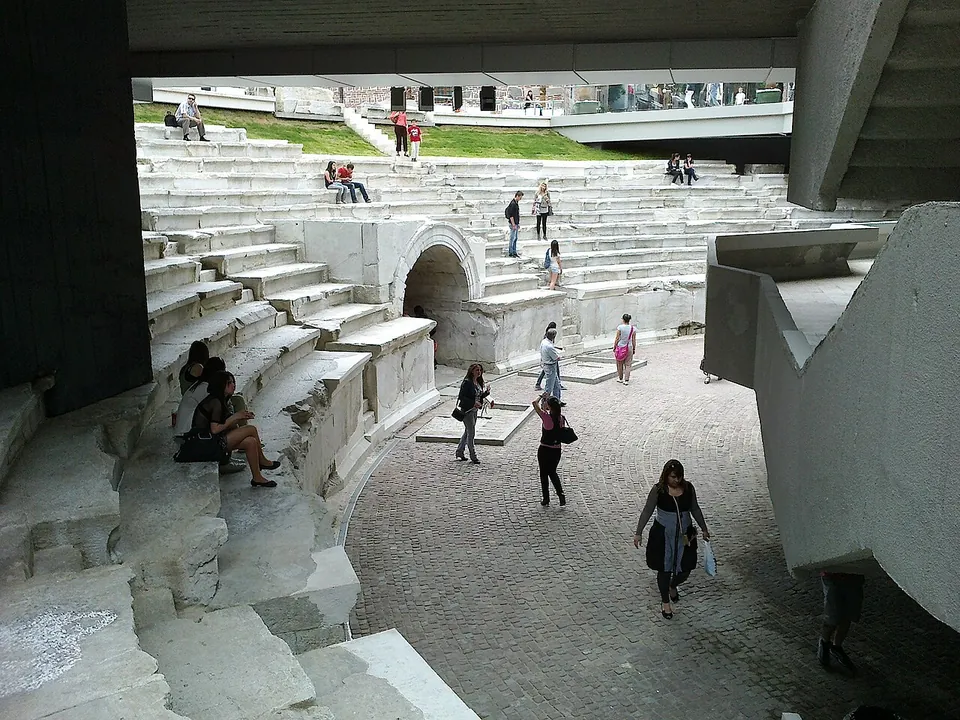
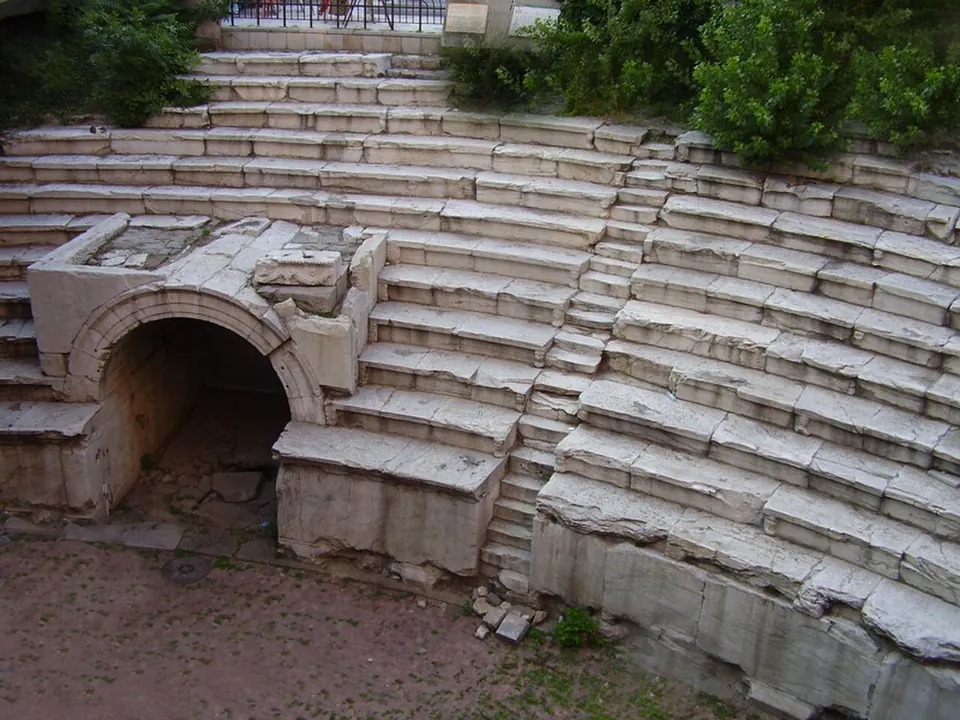
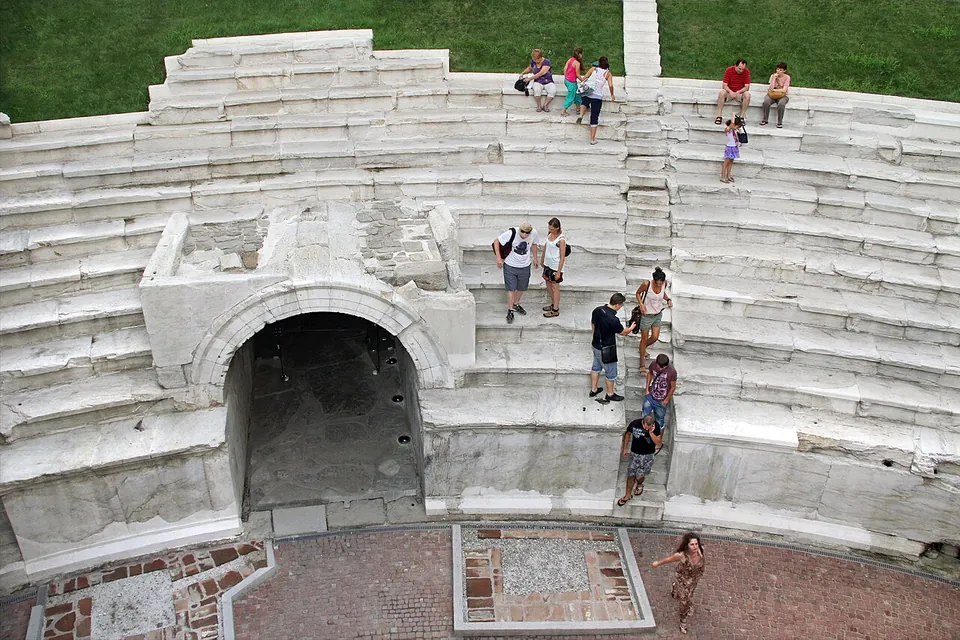


The Stadium of Philippopolis was the athletics ground of Roman Plovdiv, built for up to 30,000 spectators. It lies under the main pedestrian street of the modern city: its curved north end is open below Roman Stadium Square, and the rest is still under the shops (en.wikipedia; bg.wikipedia).
What is there today
What you see is the sphendone, the curved end of the stadium, partly restored. Its 14 rows of seats are solid marble blocks carved at the front with stylised lion’s paws, the front of the first row is faced with marble slabs 1.80 m high, and the top row had backrests. A vaulted entrance under the seats links the track with a passage outside, with a box for dignitaries above it (en.wikipedia; bg.wikipedia). Some honorary seats carry Greek inscriptions reserving them for people of rank, and beside the passage are a stretch of the city wall and a pier of the aqueduct that crossed the area in the 4th century (bg.wikipedia; en.wikipedia).
The rest of the stadium runs south under the main street, and parts of it can be seen in the basements of several shops (en.wikipedia). The final stage of renovation, begun in 2013, added an information centre and a small cinema of about 40 seats that shows films about the ancient city (bg.wikipedia).
Is it worth the trip?
Yes, and it costs nothing: you will walk past it in central Plovdiv anyway. It is one end of a stadium rather than the whole of one, so a few minutes on the marble seats is enough, unless you pay for the film and the eastern sector.
Getting there
The stadium lies on Roman Stadium Square, on the main pedestrian street in the centre of Plovdiv (the operator; en.wikipedia), about 260 m from the Roman theatre. Paid street parking is mapped about 85 m away (OpenStreetMap).
The curved end on the square is free. The operator, Old Plovdiv, opens the stadium daily, 09.30 to 18.00 from April to October and 09.00 to 17.30 from November to March, with a lunch break; its film costs €3.68 for adults, and the eastern sector together with the film €5.11 (oldplovdiv.bg, read 1 October 2026).
Visiting details
- Opening hours
- Daily 09.30–18.00 from April to October and 09.00–17.30 from November to March, closed for lunch 12.30–13.00. The curved north end lies open below the square.
- Tickets
- The curved north end on Roman Stadium Square is free. The film in the projection hall costs €3.68 for adults and €1.84 for students and visitors over 65; the eastern sector, in the building at Knyaz Aleksandar I Street 11, together with the film is €5.11.
- Parking
- Paid street parking is mapped about 85 m away (OSM way/461685786, fee=yes).
- On foot
- About 1 min from the parking
Hours and prices checked 2 October 2026 on the operator's own site. Confirm before travelling.
History
The stadium was built at the beginning of the 2nd century, under Hadrian. Published figures for its length range from 240 m to 250 m; its track was one stadion, about 180 m. Unusually, it stood inside the city walls, in the natural hollow between two of the city’s hills (en.wikipedia).
Games like the Pythian Games of Greece were held here, organised by the assembly of the province of Thrace: for Caracalla’s visit in 214 they were called the Alexandrian games, and for Elagabalus in 218 the Kendrisian games. Athletes competed as men and boys, with contests for heralds and trumpeters, music and poetry; a marble slab found in the excavations shows that games were also held in honour of Antinous, Hadrian’s favourite (en.wikipedia; bg.wikipedia). From the end of the 4th century, according to it.wikipedia, the stadium was used for chariot races after Theodosius banned athletic games.
It was discovered in 1923 and excavated more fully about half a century later by Liliya Botusharova; it became a cultural monument of national significance in 1995 (en.wikipedia).
Nearby
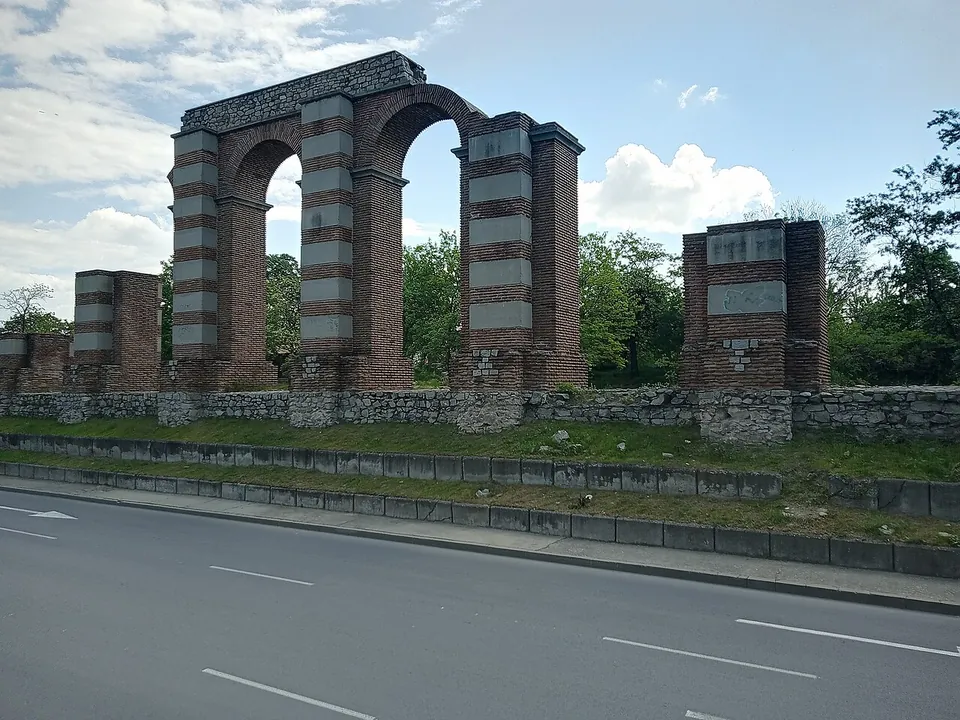
Photo: Gitanes232 · CC BY-SA 4.0 · Commons
3 km · aqueduct · Plovdiv Province
Aqueducts of Plovdiv
What you see is a row of tall piers in opus mixtum, courses of squared stone alternating with courses of brick, with a few arches restored between them, in the central strip of Komatevsko Shose Boulevard at the Komatevo junction.
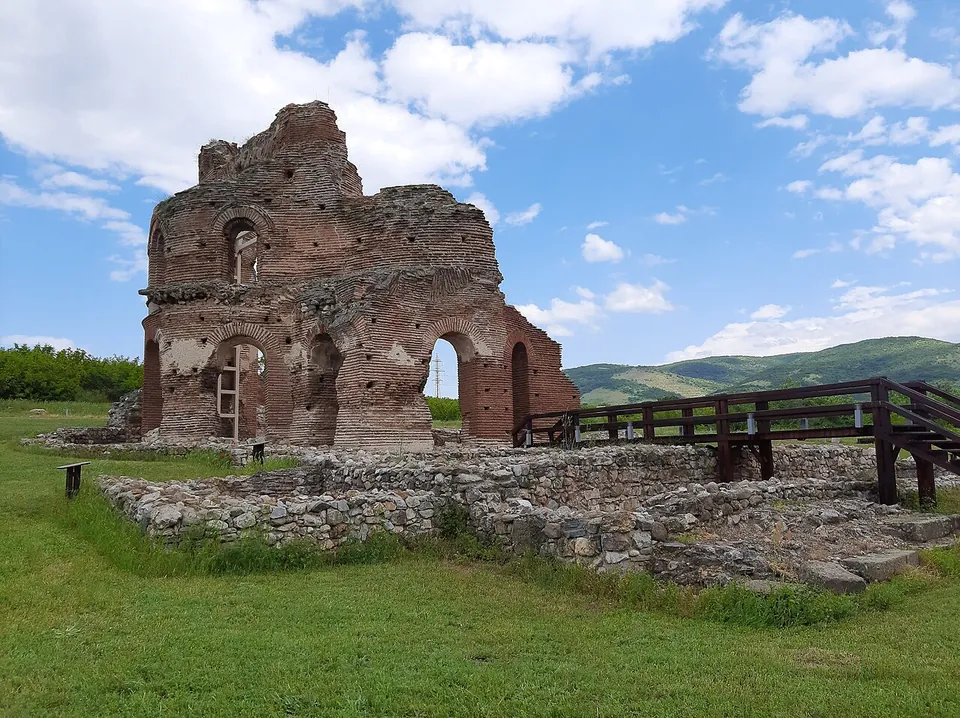
Photo: Spasimir Pilev · CC BY-SA 4.0 · Commons
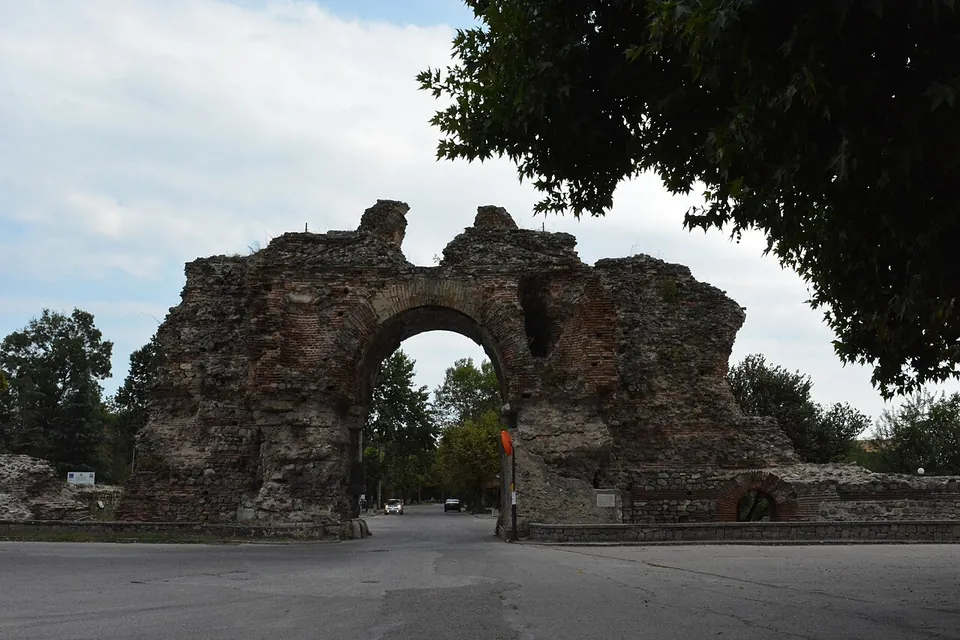
Photo: BlackfishFoto · CC BY-SA 4.0 · Commons
40 km · city · Plovdiv Province
Diocletianopolis
The walls run for 2,327 m round about 20 ha, 2.60–4 m thick and up to 12.5 m high, and once had 44 towers, four main gates and six smaller ones; the south and west gates survive best, the south gate rising to 13 m (bg.wikipedia).


Straight-line distances.
Sources
Every fact on this page comes from the records below, each used under the licence noted.
| Source | Licence |
|---|---|
| Pleiades 925968978 | CC BY |
| Wikidata Q7205170 | CC0 |
| OpenStreetMap way/378627103 | ODbL |
| Wikipedia (en) — Stadium of Philippopolis | CC BY-SA 4.0 |
| Wikipedia (bg) — Античен стадион (Пловдив) | CC BY-SA 4.0 |
| Wikipedia (it) — Stadio antico (Plovdiv) | CC BY-SA 4.0 |
| Old Plovdiv (Starinen Plovdiv), the municipal institute — ticket prices and opening hours | licence not recorded |