
What is there today
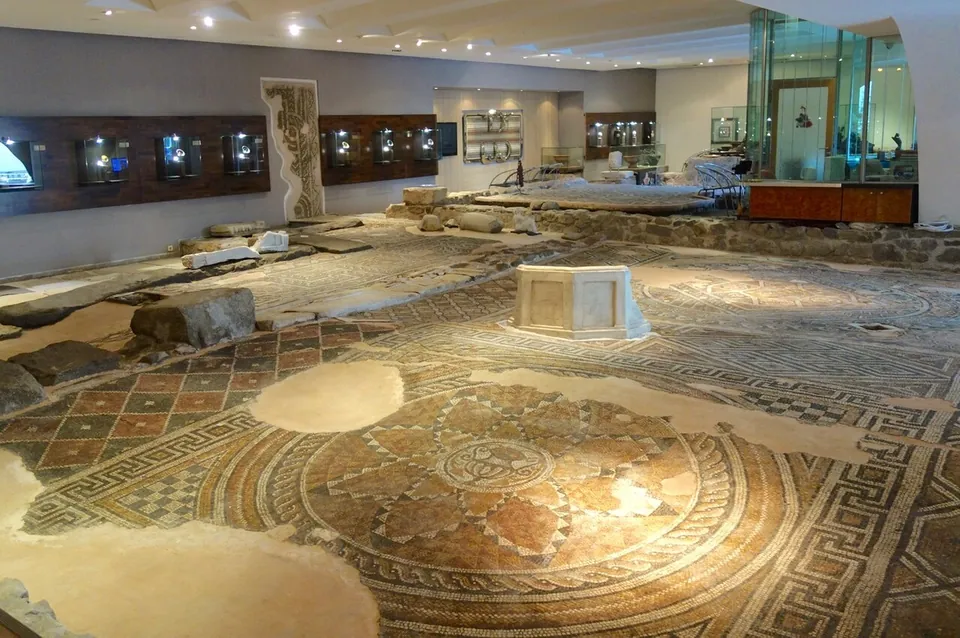
The house was a peristyle house, its living rooms grouped round a courtyard with columns, the service rooms to the south, and a separate wing for the servants with its own door to the street. It filled a whole city block. Its floors, laid in the 4th and 5th centuries, have geometric figures, endless knots, flowers and greetings to visitors. The finest mosaic, in the middle of the main room, is a portrait of Eirene, the Greek goddess of peace, worked in finer tesserae than the rest, and the house is named after her (en.wikipedia; bg.wikipedia). An octagonal marble basin in the middle of a floor served as a fountain (en.wikipedia). The excavated area is 668 m², and a paved Roman street runs past it in the same underpass (en.wikipedia; bg.wikipedia).
Is it worth the trip?
Yes, if you like mosaics. The house is shown indoors, below street level, so it is a museum visit rather than a ruin, and it is a few minutes’ walk from the Roman theatre.
Getting there
The house is in the archaeological underpass of Tsar Boris III Boulevard, part of the Trakart cultural centre (bg.wikipedia), about 190 m from the Roman theatre. A paid car park is mapped about 60 m away and the Tunela bus stops about 75 m away (OpenStreetMap).
It is open daily, 09.00 to 18.00, with a lunch break from 12.30 to 13.30. A ticket is €3.58 for adults and €1.53 for students and visitors over 65; a combined ticket with the Bishop’s Basilica and the Small Basilica is €12.78 (oldplovdiv.bg, read 1 October 2026).
Visiting details
- Opening hours
- Daily 09.00–18.00, closed for lunch 12.30–13.30.
- Tickets
- €3.58 for adults and €1.53 for students and visitors over 65 (the operator's single-site ticket); free under 7. A combined ticket for the Bishop's Basilica, the Small Basilica and the Eirene Residence costs €12.78.
- Parking
- A paid car park is mapped about 60 m away (OSM way/1547061809, fee=yes); the Tunela bus stops are about 75 m away (OpenStreetMap).
- On foot
- About 1 min from the parking
Hours and prices checked 2 October 2026 on the operator's own site. Confirm before travelling.
History
The house was probably built in the middle of the 3rd century, after the destructive Gothic siege of Philippopolis in 250–251, over the ruins of several older houses destroyed in that invasion. It was badly damaged when Attila’s Huns invaded in 441–442, then repaired and enlarged, and abandoned at the end of the 6th century (en.wikipedia). It was found in 1983–1984, when the underpass was built, declared a cultural monument of national importance, and opened to the public in 2003 (en.wikipedia).
Nearby
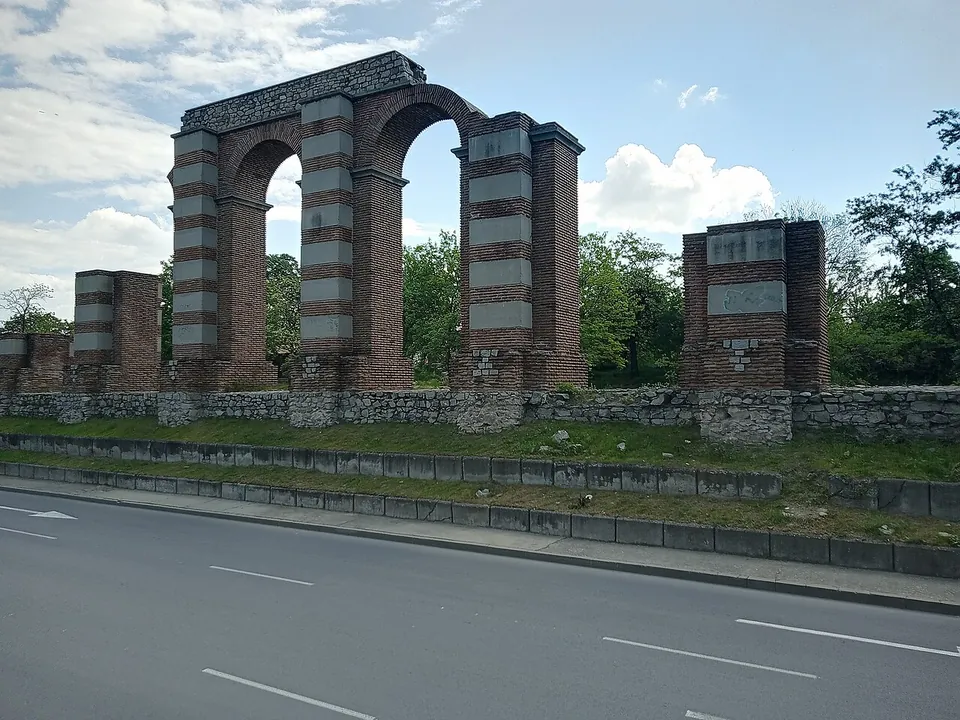
Photo: Gitanes232 · CC BY-SA 4.0 · Commons
3 km · aqueduct · Plovdiv Province
Aqueducts of Plovdiv
What you see is a row of tall piers in opus mixtum, courses of squared stone alternating with courses of brick, with a few arches restored between them, in the central strip of Komatevsko Shose Boulevard at the Komatevo junction.
Photo: Spasimir Pilev · CC BY-SA 4.0 · Commons
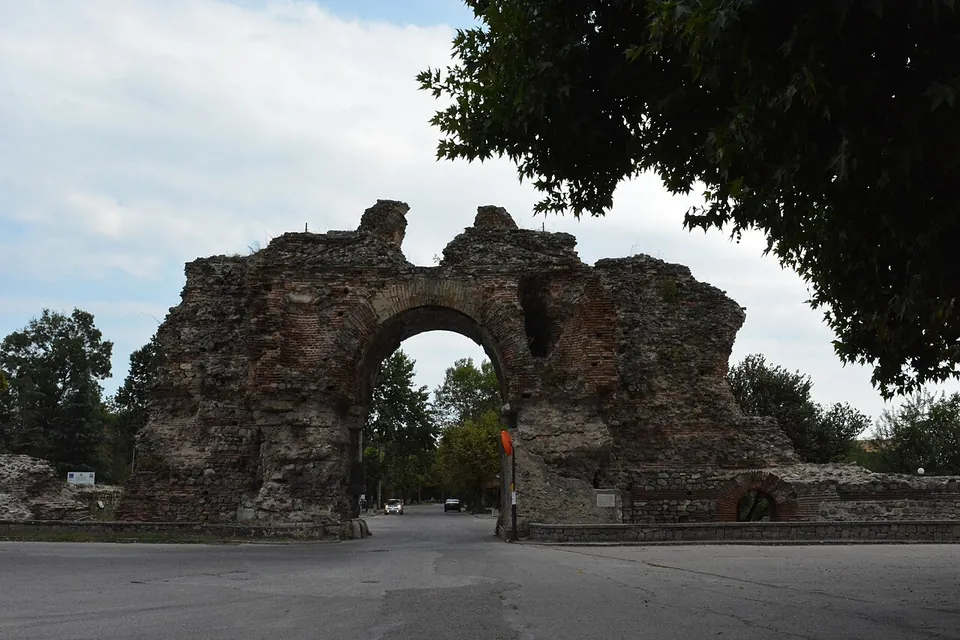
Photo: BlackfishFoto · CC BY-SA 4.0 · Commons
40 km · city · Plovdiv Province
Diocletianopolis
The walls run for 2,327 m round about 20 ha, 2.60–4 m thick and up to 12.5 m high, and once had 44 towers, four main gates and six smaller ones; the south and west gates survive best, the south gate rising to 13 m (bg.wikipedia).


Straight-line distances.
Sources
Every fact on this page comes from the records below, each used under the licence noted.
| Source | Licence |
|---|---|
| Wikidata Q26898191 | CC0 |
| OpenStreetMap node/9036247844 | ODbL |
| Wikipedia (en) — Domus Eirene | CC BY-SA 4.0 |
| Wikipedia (bg) — Ейрене (Пловдив) | CC BY-SA 4.0 |
| Old Plovdiv (Starinen Plovdiv), the municipal institute — ticket prices and opening hours | licence not recorded |