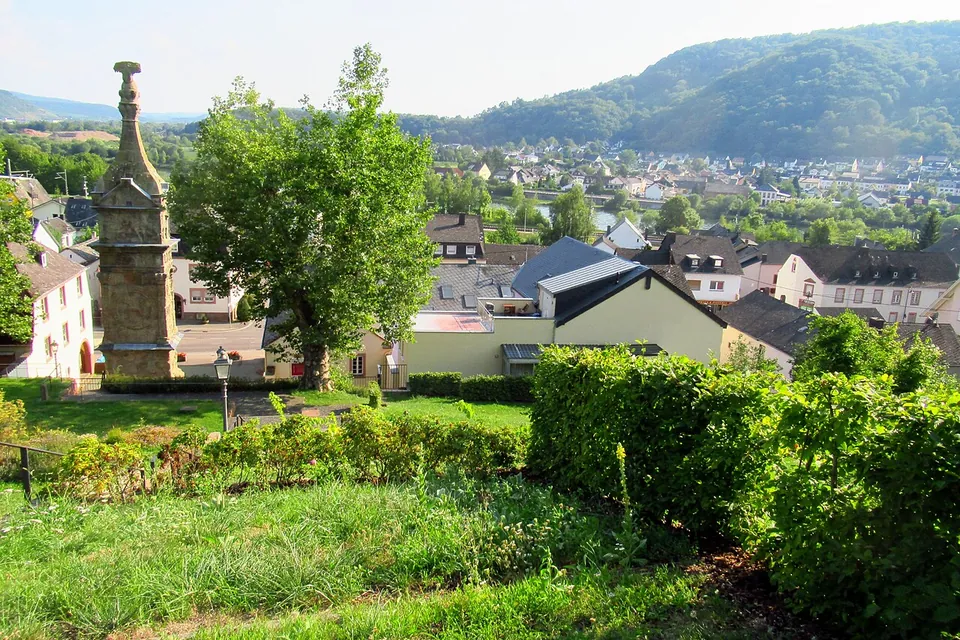
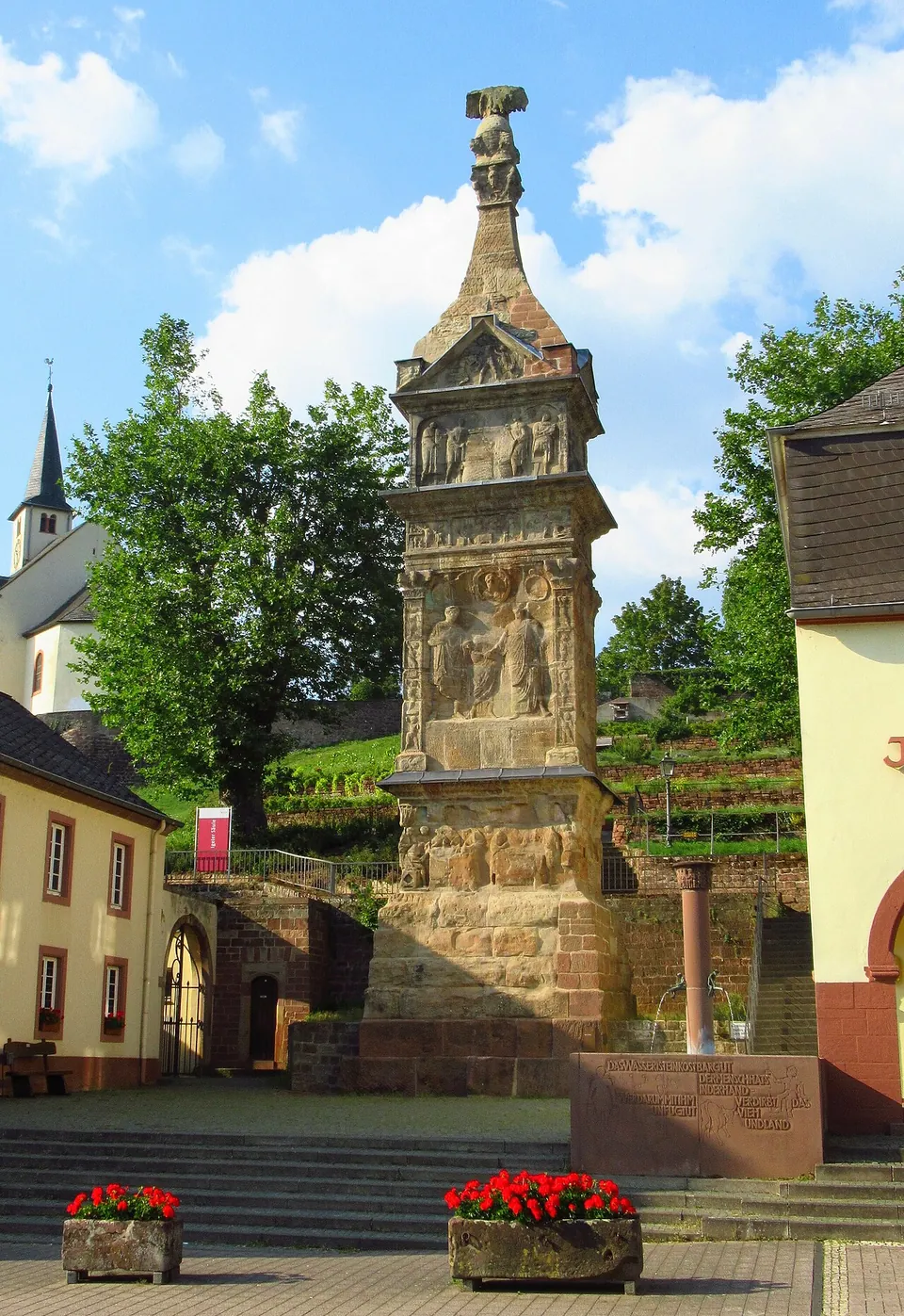


The Igel Column is a 23-metre Roman family tomb of red sandstone, carved with reliefs and standing in the middle of the village of Igel on the Moselle, a few kilometres from Trier. It and the Drusus stone in Mainz are the only Roman tombs north of the Alps that have stood above ground on their original sites since antiquity (de.wikipedia).
What is there today
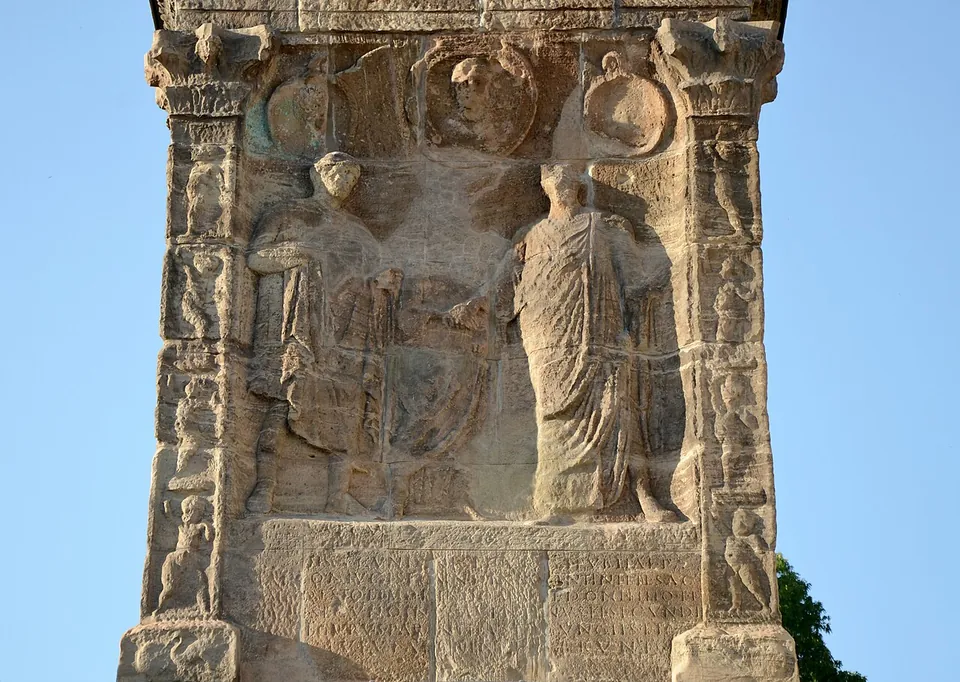
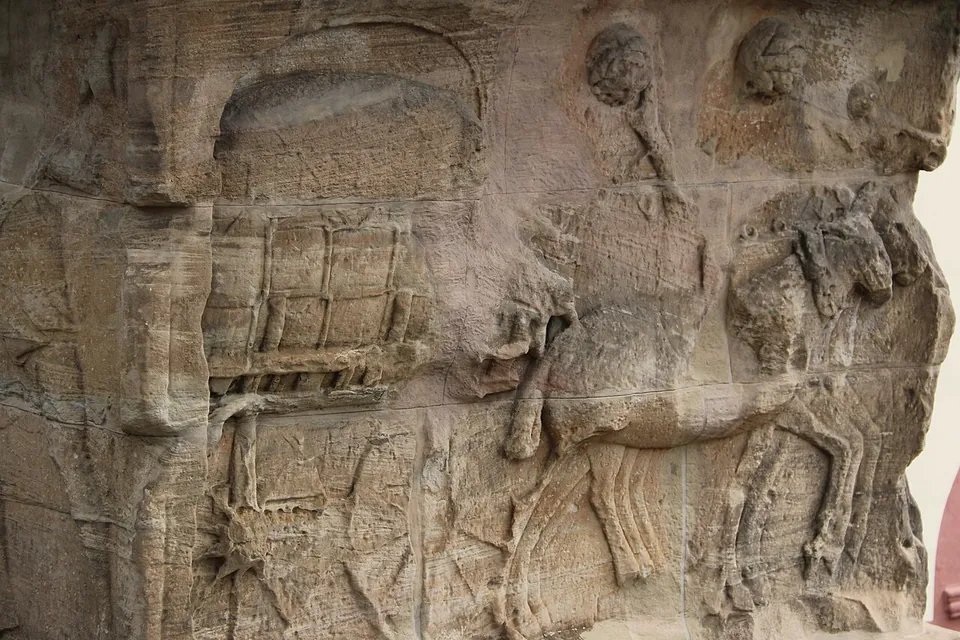
The monument itself, still standing where the Romans built it. It is a pillar tomb rising in storeys from a stepped base (en.wikipedia), and its faces are covered in reliefs: scenes from the everyday and working life of the cloth merchants who built it, and scenes from mythology (de.wikipedia). On the main panel, on the south side, a family scene that medieval viewers took for the wedding of Constantine’s parents saved the column from being broken up (the operator; de.wikipedia). The carving was originally painted, but only traces of colour survived into the 19th century, and the eagle with spread wings on the top is now so weathered it is hard to recognise (de.wikipedia).
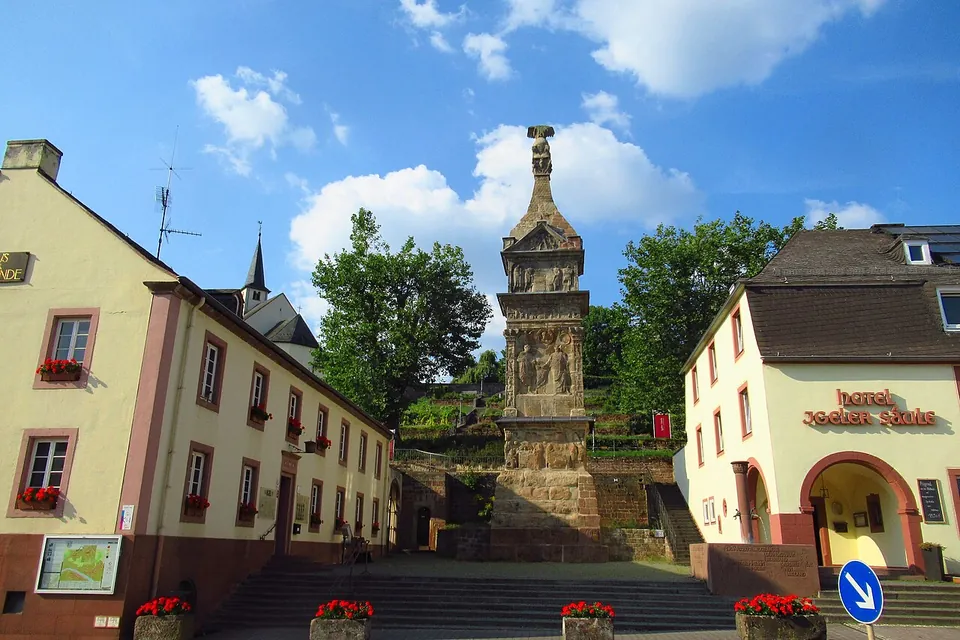
The column stands at the top of a flight of steps beside Trierer Straße, with information boards around it and a terraced “column garden” laid out on the slope opposite (de.wikipedia).
Is it worth the trip?
If you are in Trier, yes: it is a short trip, it is free, and it is one of only two Roman tombs north of the Alps still standing on their original sites. The operator calls it the largest surviving pillar tomb on that side of the Alps, and it is part of Trier’s UNESCO World Heritage listing. Be clear about the scale, though: this is one monument on a village street, not a site to spend a day in. Pair it with Trier, or with the Grutenhäuschen, a second Roman tomb in the vineyards 1.5 km away (below).
One thing you will not find any more is the painted full-size copy that used to stand in the courtyard of the Rheinisches Landesmuseum in Trier. It was taken down at the end of 2021 because it could not be repaired, and a new copy is planned for the same spot (the operator).
Getting there
Igel lies on the Moselle, about 9 km in a straight line south-west of the Porta Nigra in Trier and 2 km from the town of Konz. The column is on Trierer Straße; a bus stop named “Igel, Igeler Säule” is mapped beside it, and there are two free public car parks within about 170 m (OpenStreetMap).
It is free and accessible all year. The operator, the Zentrum der Antike of Rhineland-Palatinate’s heritage directorate, warns that weather can restrict access to the steps around the monument and that entry is at your own risk (zentrum-der-antike.de, read 30 October 2026).
Visiting details
- Opening hours
- Freely accessible all year; the column stands in the open on Trierer Straße in the village of Igel.
- Tickets
- Free.
- Parking
- Two free public car parks are mapped nearby, about 85 m (way/238173036) and 170 m (way/1198278871, unpaved, 20–25 spaces) from the column; the one about 70 m away is for customers only (OpenStreetMap).
Before you go
- The operator warns that weather can restrict access to the flight of steps around the monument, and that entry is at your own risk.
Hours and prices checked 30 October 2026 on the operator's own site. Confirm before travelling.
History
The inscription names the builders: two brothers, Lucius Secundinius Aventinus and Lucius Secundinius Securus (de.wikipedia). The family are taken to have been cloth merchants, mainly from the trade shown on the reliefs, and the monument stood beside a road near the Moselle where every traveller would see their wealth and success (the operator). It is a tomb in form and inscription, but excavation found no burial close to it, so it may have been a cenotaph, with the family’s actual graves on their own land; it probably also advertised the family business (de.wikipedia).
The date is debated. It is usually given as about 250 (the operator; en.wikipedia), but proposals range from about 200–215 to the second third of the 3rd century (de.wikipedia). The operator places it among the last monuments of its kind, built as Trier’s prosperity began to fade.
The medieval mistake that saved it did not save it from damage: people tried to tear out the iron clamps between its blocks for the metal. In the 16th century Peter Ernst von Mansfeld, the Spanish governor of Luxembourg, is said to have planned to take it down and rebuild it in the park of his palace at Clausen; whether that is true is unclear, but heavy damage low down on the monument may come from a failed attempt to dismantle it (de.wikipedia). The village’s name is traditionally derived from the Latin aquila, eagle, after the figure on top, though another reading links it to agulia, the medieval word for the obelisks of Rome; both tie the name to the monument (de.wikipedia).
It was first made structurally safe in 1765 (the operator). Goethe saw it in August and October 1792 and drew and described it (de.wikipedia); Crown Prince Friedrich Wilhelm IV, Victor Hugo and Friedrich Schinkel are among its other famous visitors (the operator). It has been part of the UNESCO World Heritage Site “Roman Monuments, Cathedral of St Peter and Church of Our Lady in Trier” since 1986 (de.wikipedia).
Nearby: the Grutenhäuschen
About 1.5 km from the column, on a vineyard slope near Igel, stands the Grutenhäuschen, a two-storey Roman tomb temple of the 3rd or 4th century. Its lower storey is a vaulted chamber that held the stone coffins of the dead; above it is an almost square room used for commemorating them. The Rheinisches Landesmuseum Trier restored it on the remains of the original burial chamber in 1962, and its upper and front parts were reconstructed in 2001, so part of what you see is modern. It is used today for celebrations and civil weddings (de.wikipedia, Grutenhäuschen). No source used here gives its opening times.
More photographs


Nearby
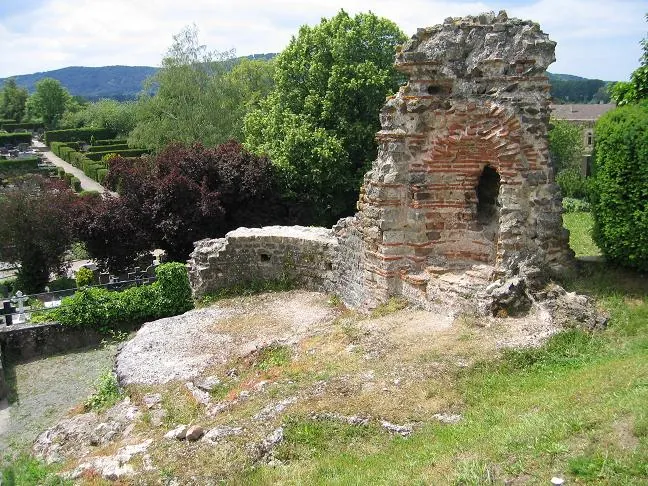
Photo: Johannes Simon · Public domain · Commons
2 km · villa · Rhineland-Palatinate
Kaiservilla Konz
The piece the tourist board points to is part of a cold-water basin, about 4 m high.
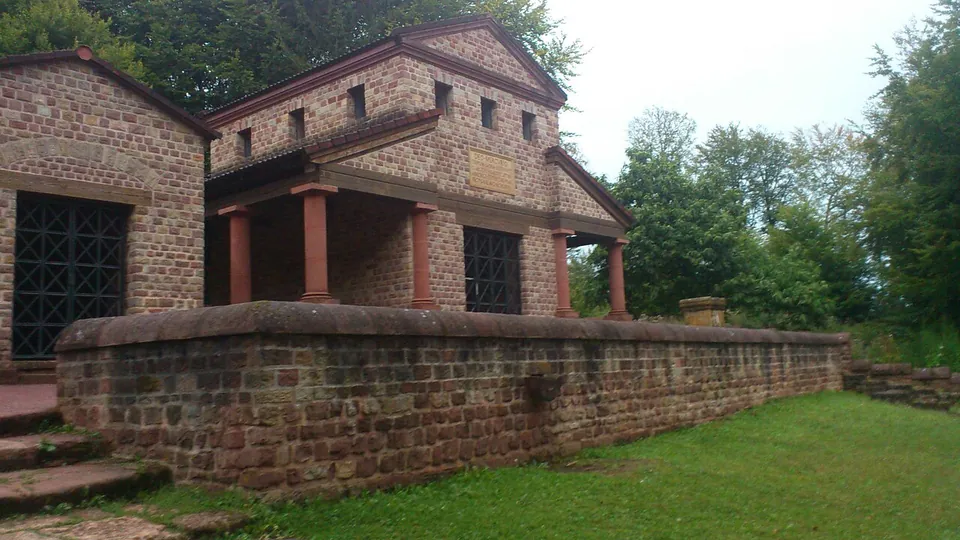
Photo: Ecemaml · CC BY-SA 3.0 · Commons
6 km · sanctuary · Rhineland-Palatinate
Roman temple of Tawern
Inside a walled precinct of about 46 × 36 m (de.wikipedia), the main temple has been rebuilt: a Gallo-Roman ambulatory temple with a portico on three sides, Tuscan columns, and a central chamber, the cella, rising above the portico roof.
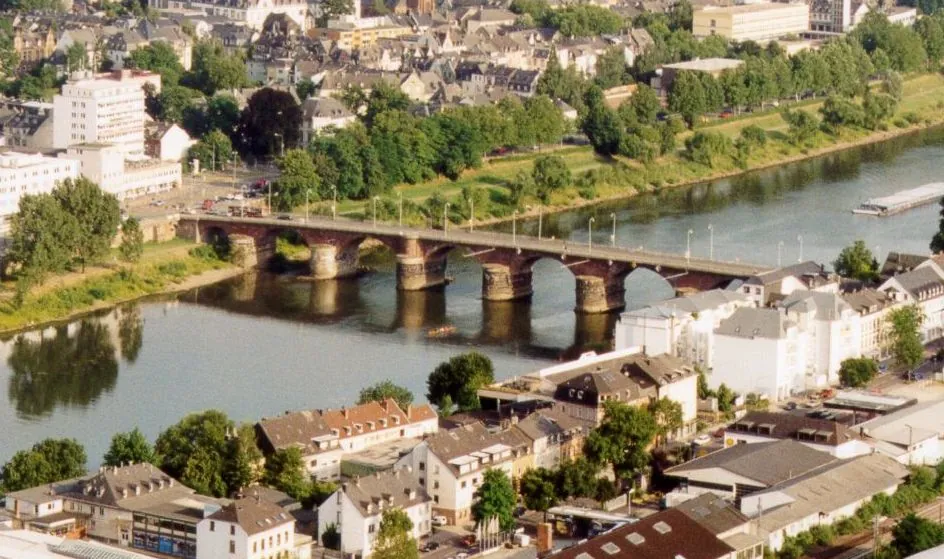
Photo: Stefan Kühn · CC BY-SA 3.0 · Commons
7 km · bridge · Rhineland-Palatinate
Roman Bridge
What you are looking for is the piers, not the arches.


Straight-line distances.
Sources
Every fact on this page comes from the records below, each used under the licence noted.
| Source | Licence |
|---|---|
| Pleiades 109063 | CC BY |
| Wikidata Q338834 | CC0 |
| Vici.org 4401 | CC BY-SA (text), CC0 (metadata) |
| OpenStreetMap node/321349168 | ODbL |
| Wikipedia (de) — Igeler Säule | CC BY-SA 4.0 |
| Wikipedia (en) — Igel Column | CC BY-SA 4.0 |
| Wikipedia (it) — Colonna di Igel | CC BY-SA 4.0 |
| Wikipedia (de) — Grutenhäuschen | CC BY-SA 4.0 |
| Zentrum der Antike (GDKE Rheinland-Pfalz, the operator) — Igeler Säule, access and history | licence not recorded |