

What is there today
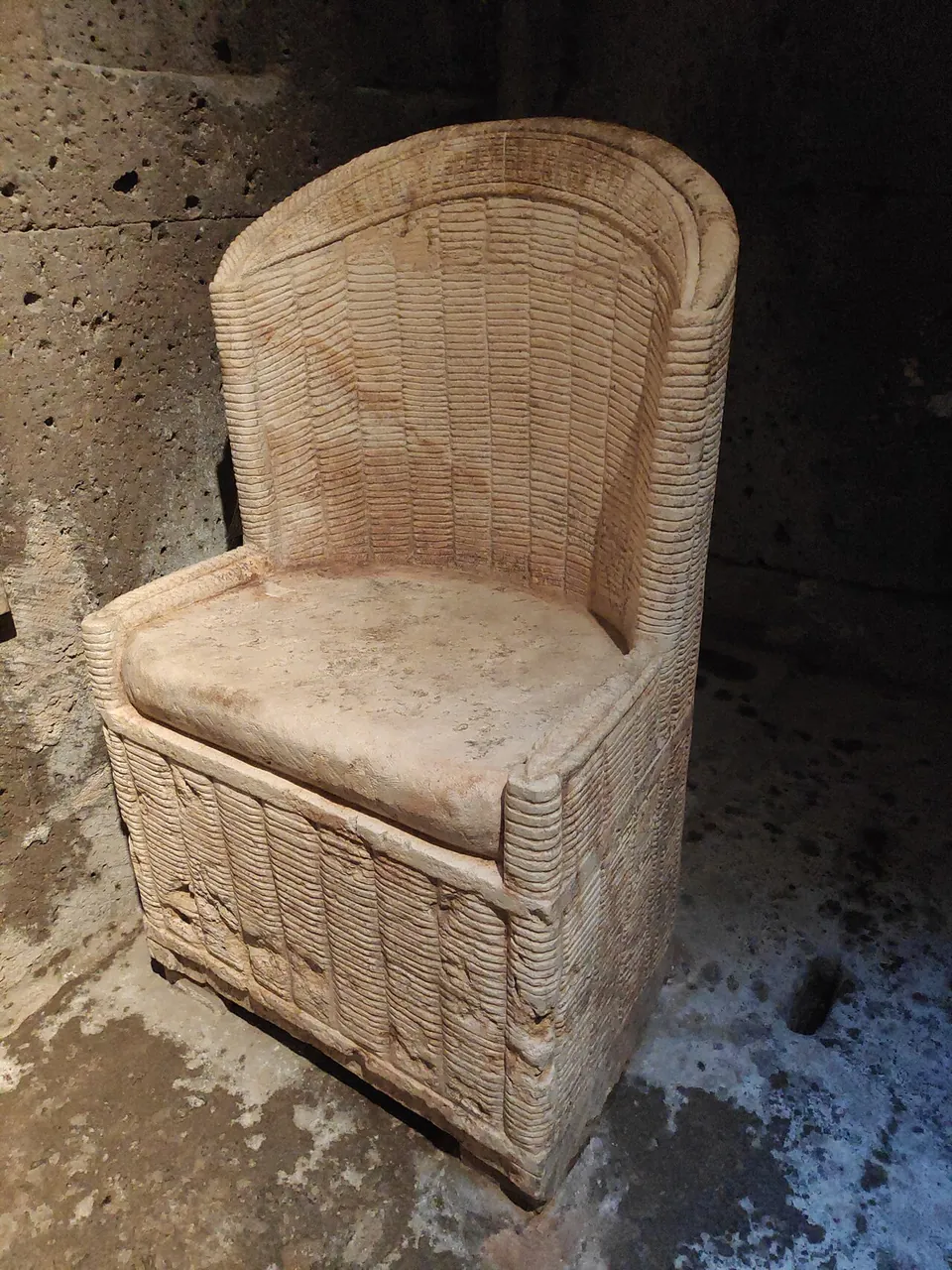
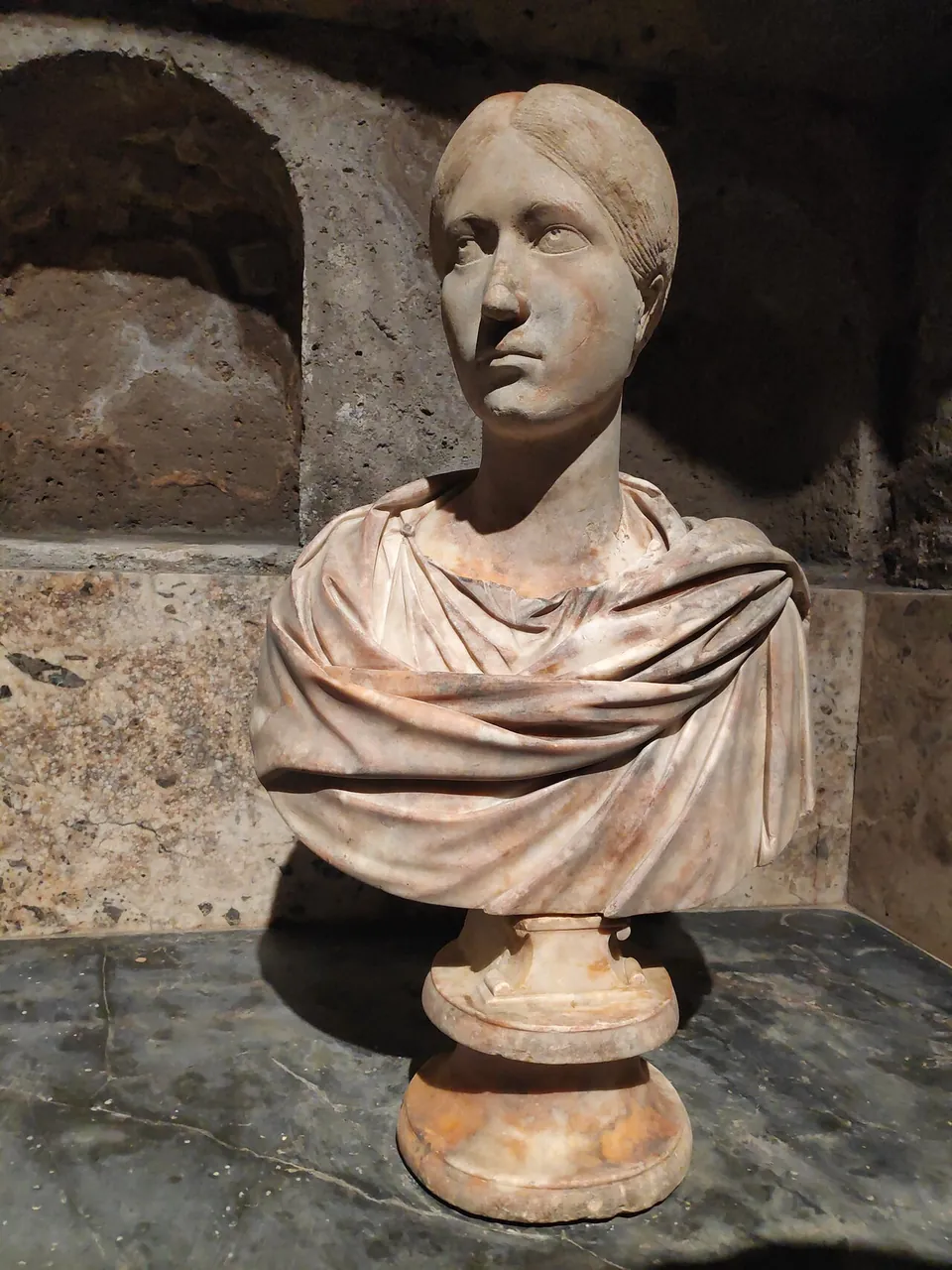
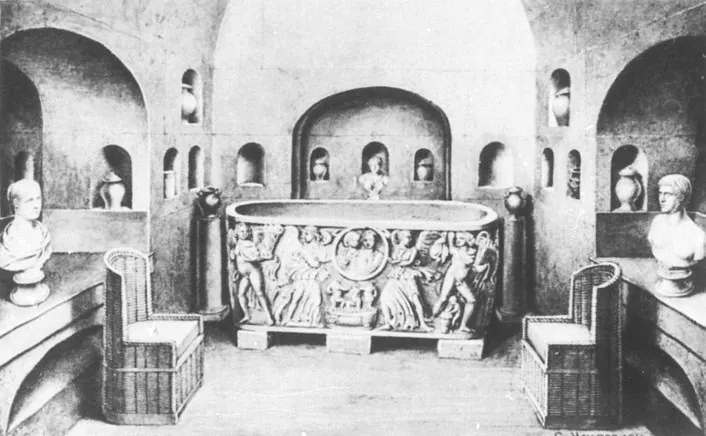
A flight of stairs takes you down to a doorway about six metres below ground and into a single vaulted room built of tuff stone, roughly 3.6 by 4.4 metres and 4 metres high under the vault. Three large niches open off it, each with a couch set off in marble; 29 smaller niches in the walls held ash urns and offerings. In front of the side niches stand armchairs carved in limestone to look like wickerwork, so that couches and chairs together set the room out like a Roman dining room - stone furniture of this kind is unique in the northern provinces (de.wikipedia). Portrait busts stand in the niches.
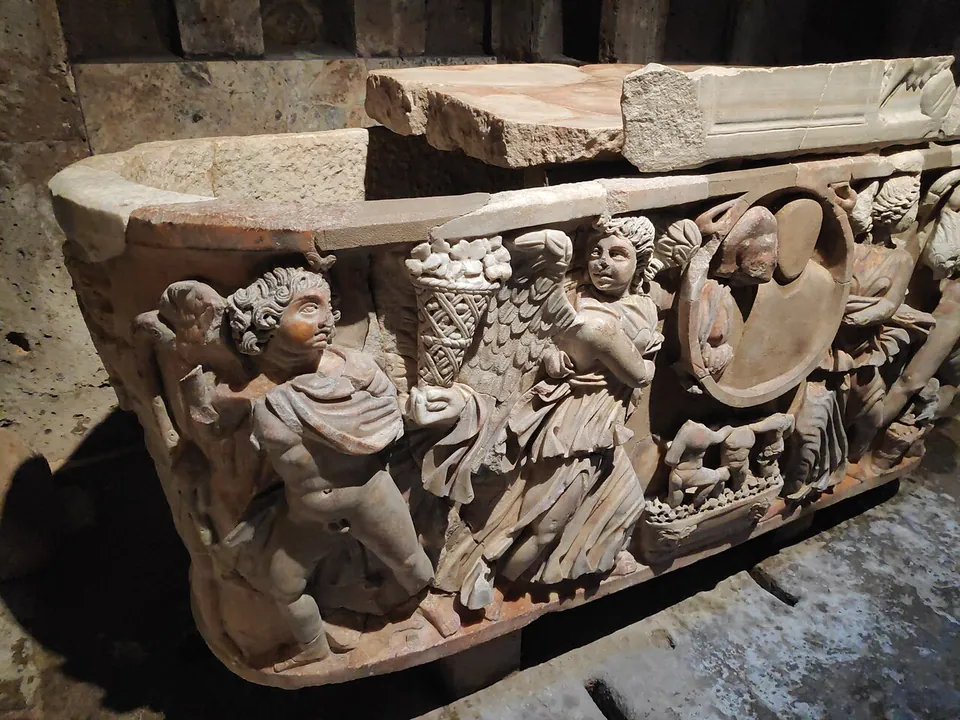
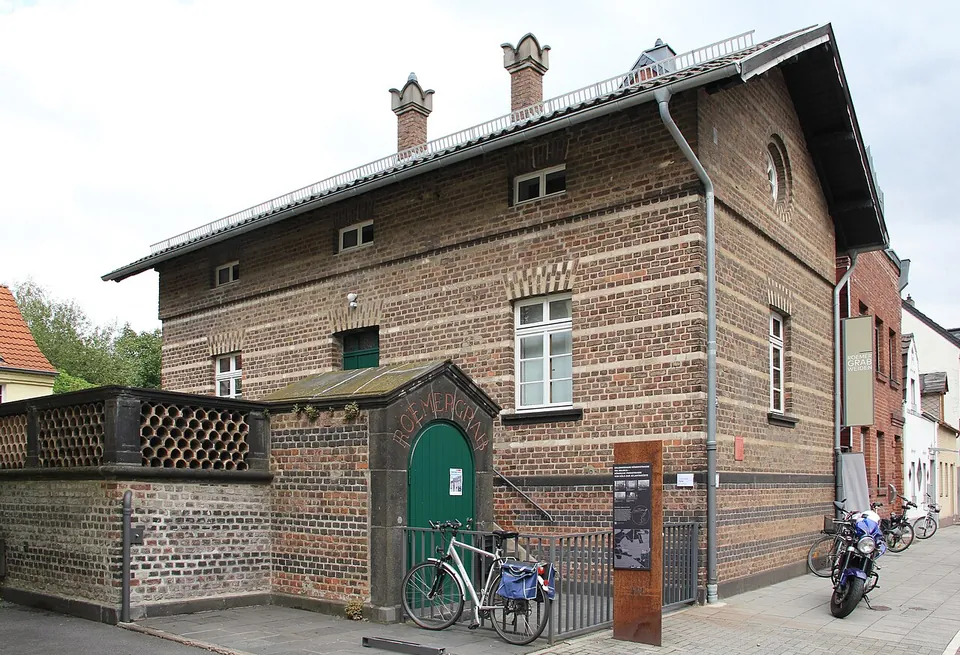
The centrepiece is a tub-shaped sarcophagus of Carrara marble carved with figures that may stand for the seasons, probably imported from Rome and dated to the late 3rd century (de.wikipedia). The operator says the chamber still shows most of its original furnishings. Up at street level stand the small protective building over the chamber, with an opening in its floor through which a dim light falls into the room below, and the keeper’s house beside it, both put up in the 1840s (de.wikipedia; the operator). Information displays have been added on the ground floor (de.wikipedia), and since May 2024 the garden has been planted with herbs, vines and shrubs known from the Roman Rhineland (the operator).
Is it worth the trip?
Yes, if you are in Cologne on a day it opens. It ranks among the most important Roman tombs north of the Alps (de.wikipedia), and it is a room you stand inside, with its furniture still in place, rather than a monument seen from outside or objects behind glass in a museum. It is also easy to reach: the tram from Neumarkt stops 300 metres away.
The catch is the timetable. It opens for three hours on Thursday, Saturday and Sunday only, never on public holidays, and you see it with a member of staff. It is one small room, so plan it around the opening slot rather than as a detour on spec. The historic stairs are not suitable for visitors with limited mobility (the operator). Entry is €5.
Getting there
The tomb is at Aachener Straße 1328 in the western district of Weiden, about 9 km out from where Roman Cologne’s west gate stood (de.wikipedia). Take KVB tram line 1 from Neumarkt towards Weiden West to the stop Weiden Römergrab, renamed after the tomb in 2019, then walk about 300 m out of town along Aachener Straße; the tomb is on the right. By car, leave the A1 at Köln-Lövenich and follow Aachener Straße out of town. Parking near the chamber is limited; the Park+Ride car park at Weiden West is about 800 m away (the operator).
It opens on Thursday and Saturday 10.00-13.00 and Sunday 14.00-17.00, and is closed on public holidays. Entry is €5, or €3.50 reduced for children from five, pupils, students, trainees, Köln-Pass holders, visitors with disabilities and over-65s; cash and cards are taken. On the third Saturday of each month the operator runs a public guided tour at €10 (€8.50 reduced), which must be booked at least two working days ahead. Groups must book in any case, and groups of more than 15 are split. Dogs stay outside (roemergrab.de, read 1 November 2026 - check before travelling). For the rest of Roman Cologne, see the Cologne page.
Visiting details
- Opening hours
- Thursday 10.00–13.00, Saturday 10.00–13.00 and Sunday 14.00–17.00. Closed on public holidays. The chamber is seen only with a member of staff; groups must book ahead, and groups of more than 15 are split.
- Tickets
- €5; €3.50 reduced (children from 5, pupils, students, trainees, Köln-Pass holders, visitors with disabilities, over-65s). No group discount; cash or card. A public guided tour runs on the third Saturday of each month at €10 (€8.50 reduced), booked at least two working days ahead.
- Parking
- Only limited parking near the chamber (the operator); the Park+Ride car park at Weiden West is about 800 m away.
Before you go
- Open on only three half-days a week, and never on public holidays.
- The historic stairs down to the chamber are not suitable for visitors with limited mobility.
- Dogs must stay outside.
Hours and prices checked 1 November 2026 on the operator's own site. Confirm before travelling.
History
Roman tombs usually lined the roads out of a town, where travellers passing by would remember the dead. This one stood on the long-distance road from Tongeren to Cologne (de.wikipedia), the Via Belgica, which linked Roman Cologne with inner Gaul and the Channel coast (the operator). It was the burial chamber of a nearby country estate, a villa rustica, and several generations of a wealthy family were buried in it (de.wikipedia); the estate itself has not been found, but is presumed to have lain close by (the operator). A tomb building is assumed to have stood above ground over the chamber, but all that was found of it in the rubble are fragments of Tuscan columns. The sarcophagus is too large to have passed through the chamber’s doorway, so it is thought to have stood in that upper building and to have fallen into the chamber when the vault collapsed. Three portrait busts from the late 2nd century, a man, a woman and a girl, may show members of the family; no inscription gives their names. Coins show the tomb was still visited in the 4th century (de.wikipedia).
A carter, Ferdinand Sieger, found it in April 1843 while digging for a new outbuilding. He came upon a stair leading down more than five metres to a stone slab, smashed the slab in hope of treasure, and found only more rubble behind it; the mayor of Üsdorf and a landowner from Lövenich then paid for a further excavation, supervised by a miner, in return for a share of the finds. In 1844 Ernst Friedrich Zwirner, Cologne’s cathedral master builder, bought the plot and the chamber for the Kingdom of Prussia for 2,300 thalers. He rebuilt it using materials that set his additions apart from the original tuff, put up the protective building and the keeper’s house, made a new entrance for visitors, and opened the tomb to the public in 1848 (de.wikipedia) - among the earliest examples of state care for monuments in Germany (the operator). Almost all the small finds were taken to Berlin soon afterwards, and most of them were lost in the Second World War. The most precious had been a 10.2 cm figure of a young woman carved in chalcedony (de.wikipedia).
After Weiden became part of Cologne in 1975 the city’s Römisch-Germanisches Museum took the tomb over and had it extensively conserved. A supporters’ association, founded in 2017 and working with the museum, runs it today, and regular opening hours began in July 2019 (de.wikipedia).
More photographs


Nearby
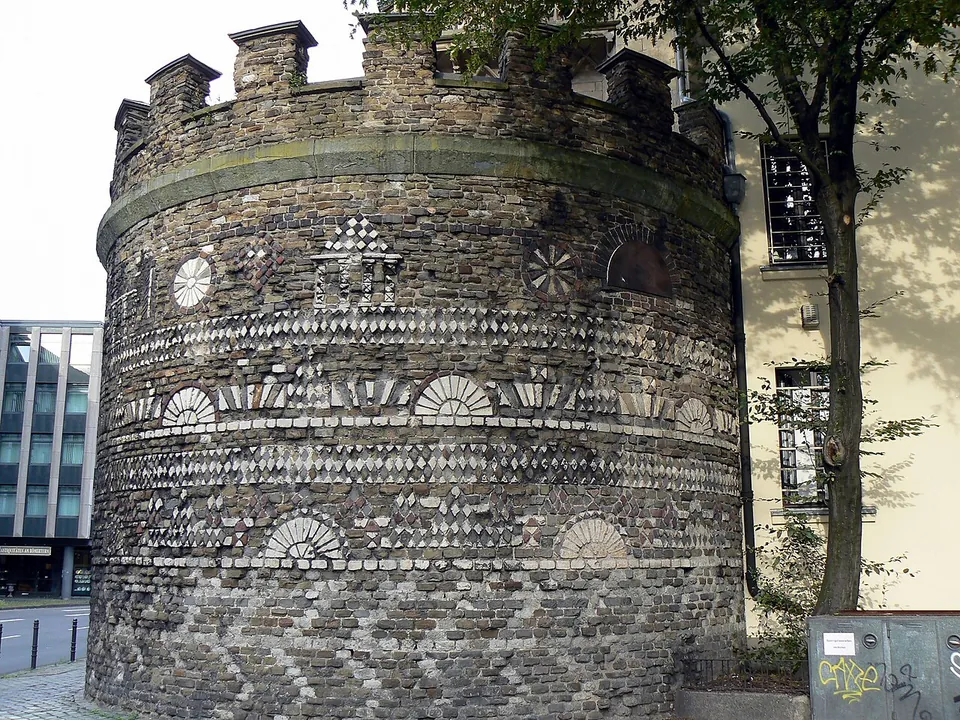
Photo: VollwertBIT · CC BY-SA 2.5 · Commons
9 km · wall · North Rhine-Westphalia
Römerturm
The tower stands on a street corner at Zeughausstraße 13 in the Altstadt-Nord district, where it marked the north-west corner of the Roman city.
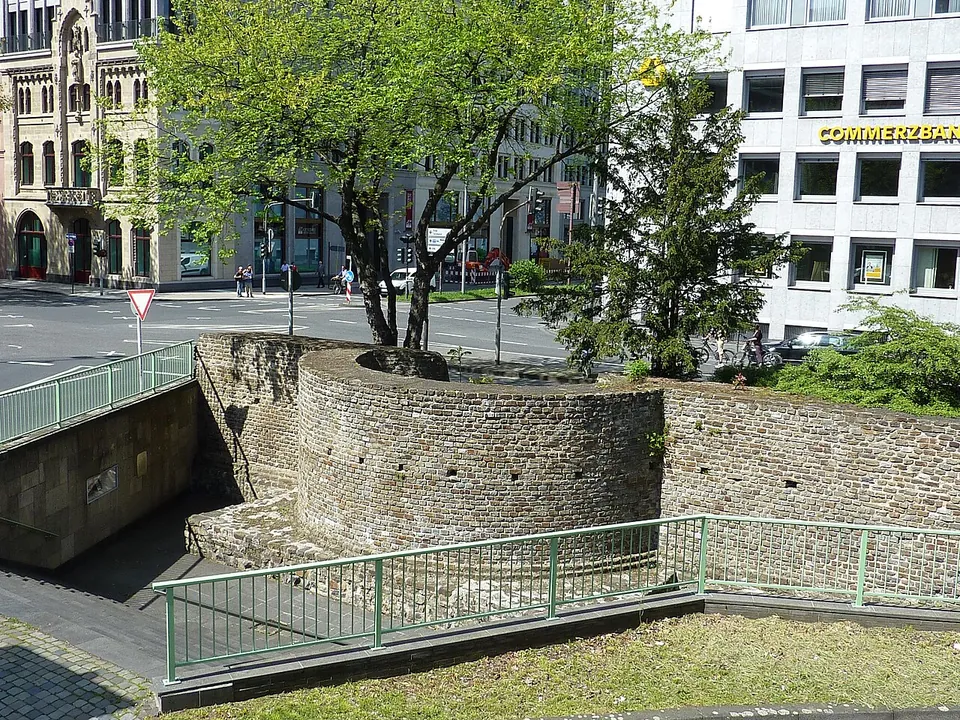
Photo: Chris06 · CC BY-SA 4.0 · Commons
9 km · wall · North Rhine-Westphalia
Lysolphturm
What survives is, in the words of the information board beside it, the inner curve of a defensive tower together with remains of the north wall of the Roman city (OpenStreetMap).
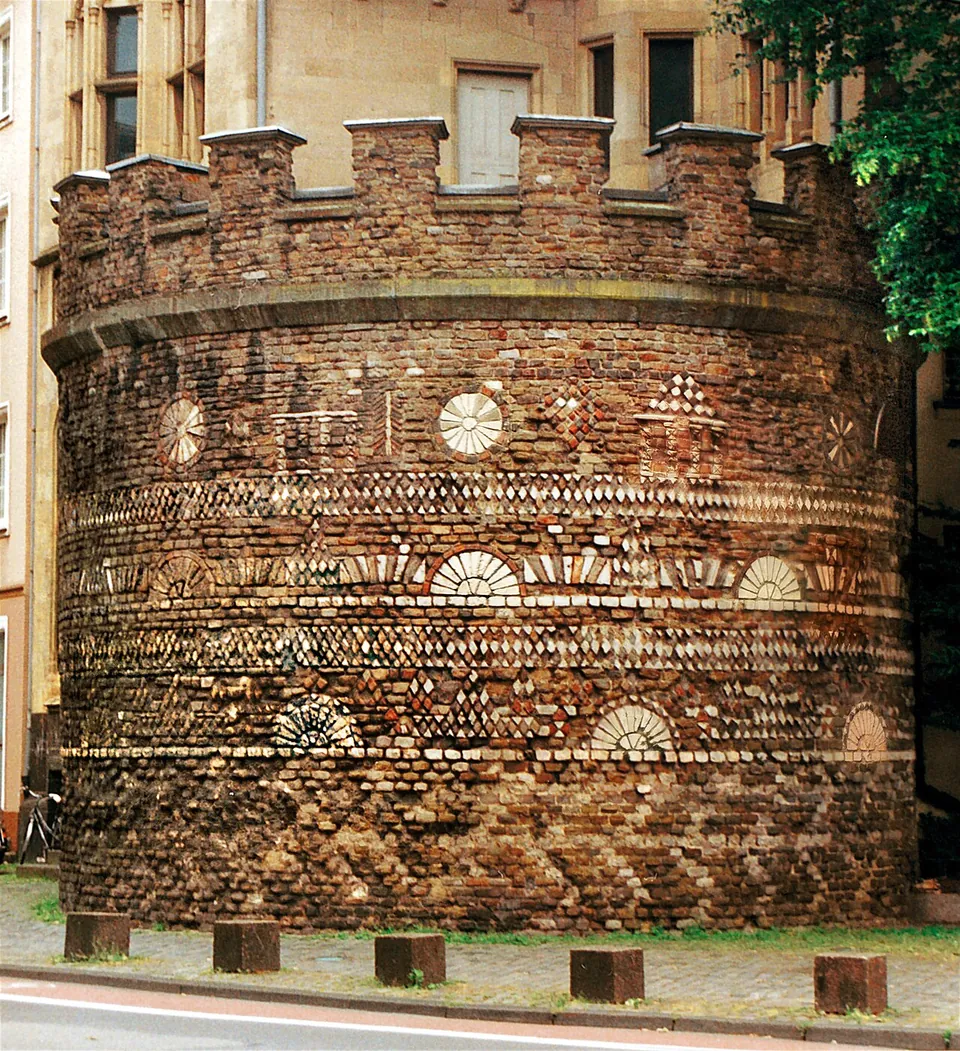
Photo: Mediatus · CC BY-SA 3.0 · Commons
9 km · city · North Rhine-Westphalia
Colonia Claudia Ara Agrippinensium – Cologne
The stops each have their own page; this is the outline of what the city holds.


Straight-line distances.
Sources
Every fact on this page comes from the records below, each used under the licence noted.
| Source | Licence |
|---|---|
| Wikidata Q1611898 | CC0 |
| Vici.org 13246 | CC BY-SA (text), CC0 (metadata) |
| OpenStreetMap node/3097141267 | ODbL |
| Wikipedia (de) — Römergrab Köln-Weiden | CC BY-SA 4.0 |
| Förderverein Römergrab Weiden — visitor information (the operator) | licence not recorded |
| Förderverein Römergrab Weiden — the burial chamber (the operator) | licence not recorded |