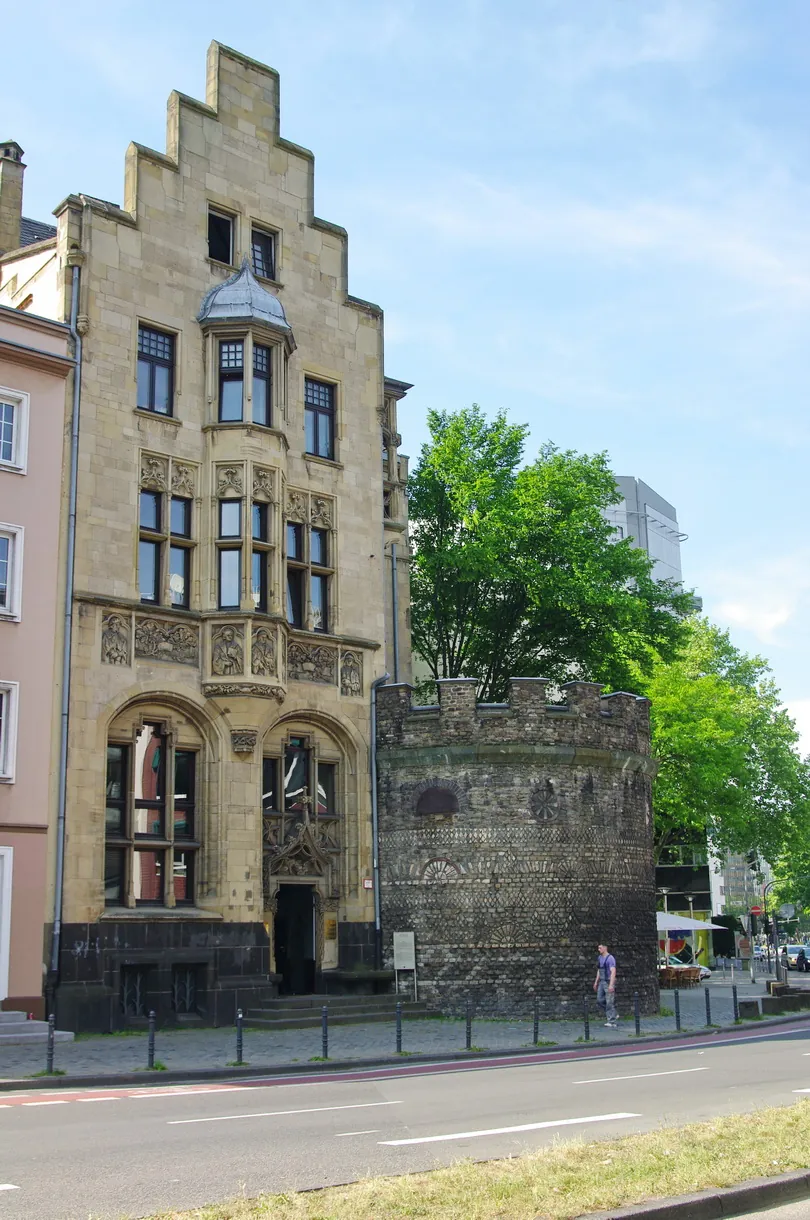
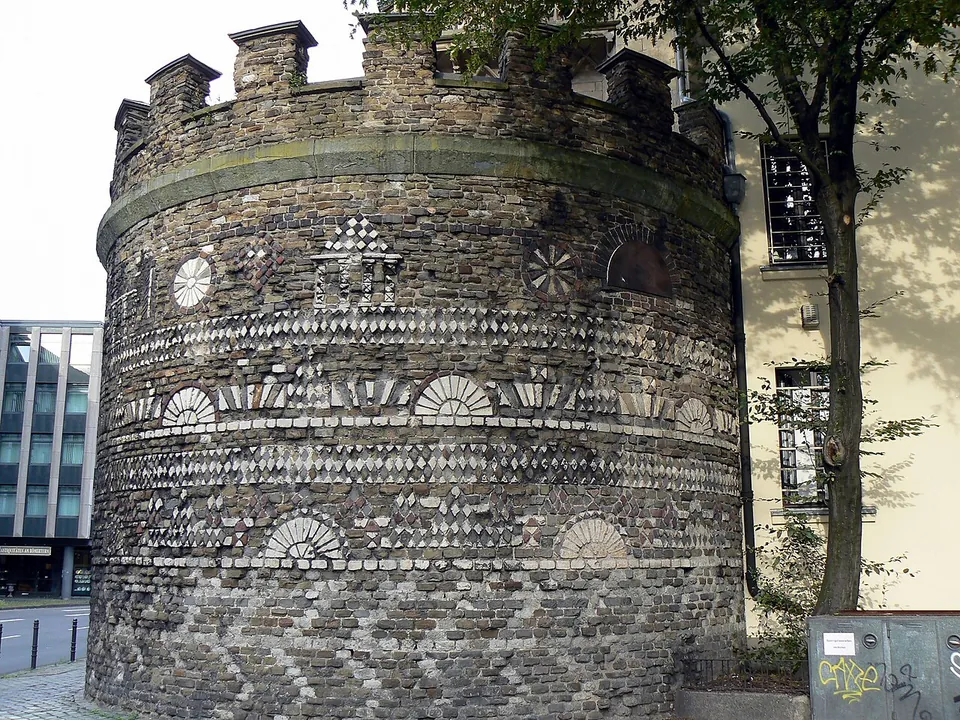
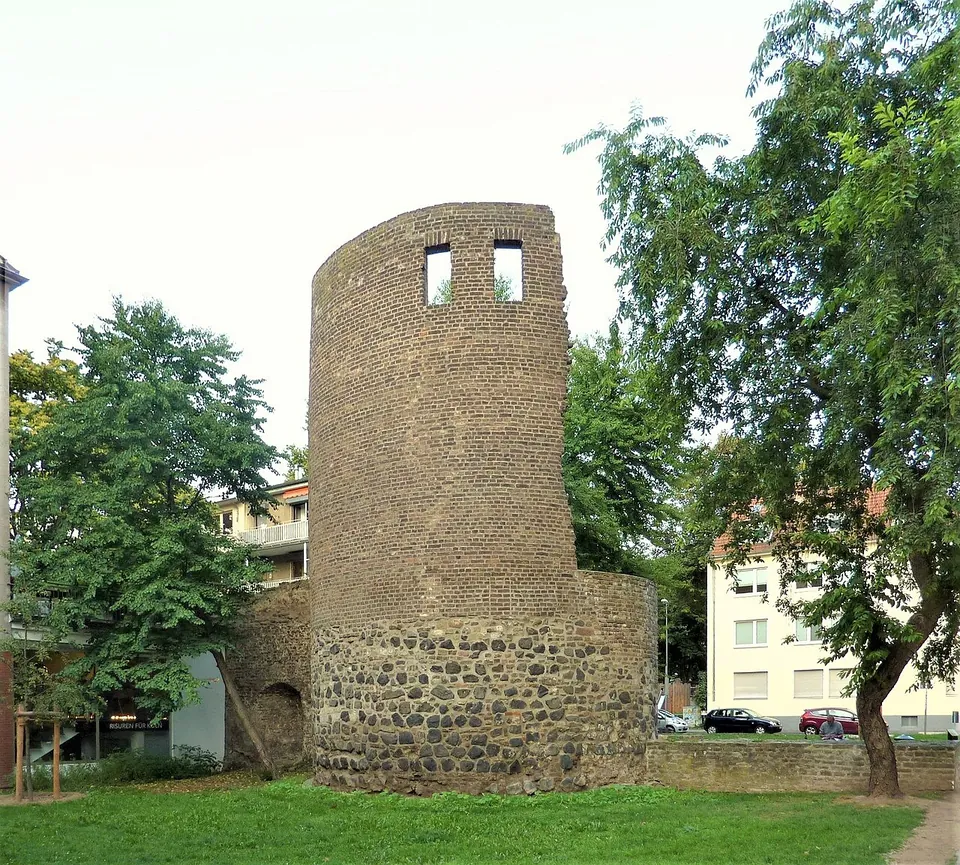
The Römerturm is a round corner tower of the Roman city wall of Cologne, and the best-preserved piece of that wall (de.wikipedia): its outer face is still patterned with bands of differently coloured stone laid like a mosaic. Restoration is planned for 2025 to 2027 (KuLaDig), so the tower may be partly behind scaffolding or a site fence when you visit.
What is there today
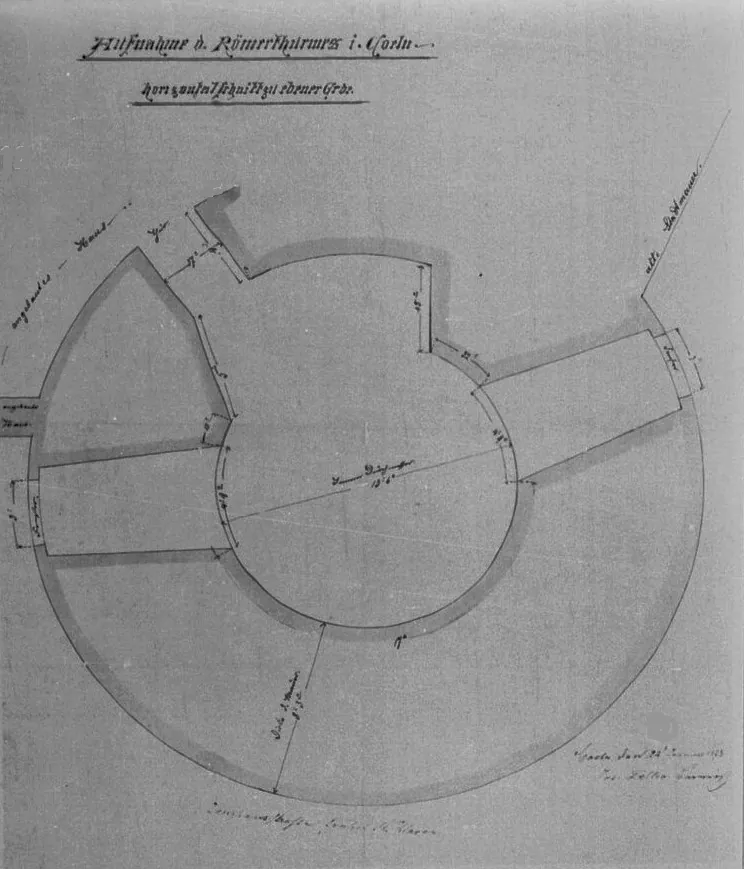
The tower stands on a street corner at Zeughausstraße 13 in the Altstadt-Nord district, where it marked the north-west corner of the Roman city. It is about 9.20 m across (de.wikipedia). The Roman masonry rises 5.75 m above today’s pavement (Stadt Köln). Its facing is the point: herringbone at the bottom, then registers of half-rosettes, triangles and diamonds of net-pattern stonework, and higher up circles and stylised temple fronts with four columns. The patterns are worked in greywacke, white limestone from the upper Moselle, trachyte from the Drachenfels, sandstone in red, yellow and green, tuff, brick and, in one spot, imported red porphyry (Förderverein Römische Stadtmauer Köln). The Deutsche Stiftung Denkmalschutz counts it among the earliest examples of such decorative masonry north of the Alps.
The Roman fabric ends just above the band of circles (Förderverein; Deutsche Stiftung Denkmalschutz). The battlements on top were added in the late 19th century, and the neo-Gothic house against its side dates from 1898/99 (de.wikipedia; KuLaDig). The Förderverein describes the surface as so soiled that the original effect of the colours can only be guessed at; conserving the facing is part of the restoration now under way (KuLaDig).
More of the same wall is close by. About 100 m south stands the Helenenturm, a plain ruined tower of the same circuit (de.wikipedia). The wall along Zeughausstraße and Burgmauer survives above ground because it was built into the city granary from 1441 to 1837 (Förderverein), and OpenStreetMap marks another stretch, with explanations, in the cellar of Café Fromme, about 250 m south.
Is it worth the trip?
It is worth a short detour, not a journey. There is nothing to go inside and nothing to pay; you see it from the pavement in a few minutes. But it is the best-preserved piece of Cologne’s Roman wall, and it shows that the wall was built for display as well as defence, a “stone advertising banner” for Roman culture, as the Deutsche Stiftung Denkmalschutz puts it. It is a short walk from the cathedral. Take it as one stop on a walk round Roman Cologne, with the Helenenturm next door and the Lysolphturm and the north-gate arch along the line of the north wall towards the cathedral (see the Cologne page).
Restoration is planned in phases from 2025 to 2027 (KuLaDig). The photographs released with the Deutsche Stiftung Denkmalschutz’s press release of November 2025 show scaffolding and a fence against the tower, so part of the patterned face may be covered when you come.
Getting there
The tower is in the city centre, about 200 m from the Appellhofplatz underground station; the cathedral is 500 to 800 m away by the published figures (de.wikipedia; KuLaDig). It can be seen at any time and costs nothing. No source mentions visits to the inside.
Visiting details
- Opening hours
- Stands on the street corner at Zeughausstraße 13 and can be seen from the pavement at any time. No source mentions visits to the inside.
- Tickets
- Free; the tower is seen from the street.
Before you go
- Restoration of the stonework is planned in several phases between 2025 and 2027. Photographs released by the Deutsche Stiftung Denkmalschutz in November 2025 show scaffolding and a site fence against the tower, so part of its face may be screened.
Hours and prices checked 31 October 2026 on the operator's own site. Confirm before travelling.
History
The Roman city wall of Cologne ran for about 3.9 km round the colony of Colonia Claudia Ara Agrippinensium, with 19 round towers on its outer side, and the Römerturm was its north-west corner, built in one campaign with the stretches of wall that meet it (KuLaDig; Förderverein). Published dates for its building range from about AD 50 to about 90: de.wikipedia gives around 50, while according to the Förderverein excavations date the wall to the end of the 1st century, built probably when Cologne became capital of the new province of Germania Inferior under Domitian. At least the upper part of the decoration may belong to the 3rd century (de.wikipedia). The wall went on serving as a defence until the 12th century (Förderverein).
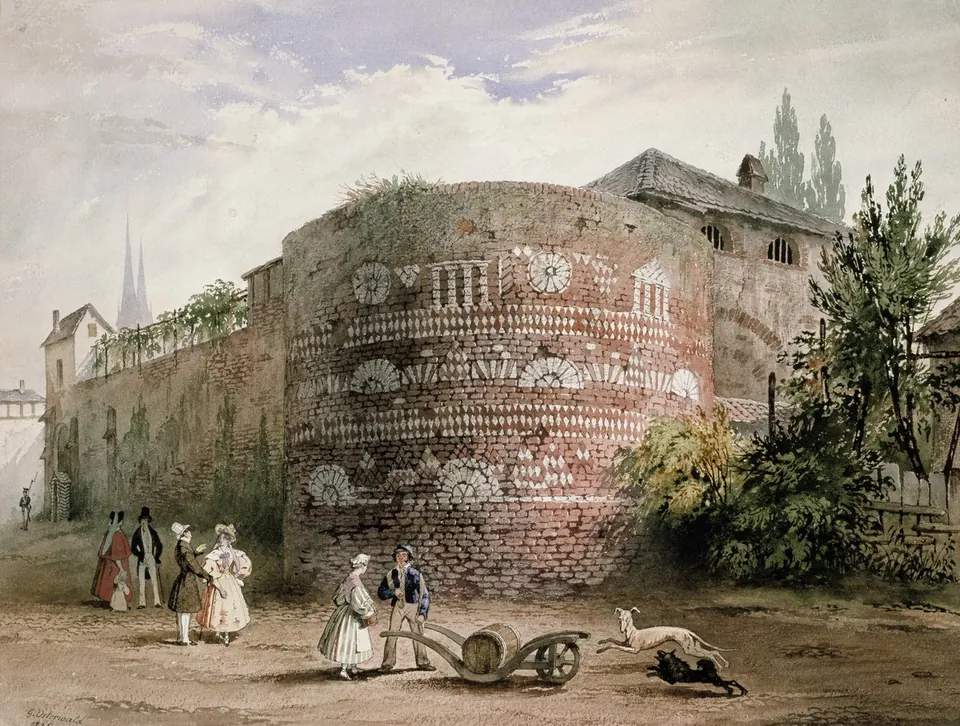
The tower survived because it stayed in use. From 1304 the convent of St Clare was built beside it, and the nuns used it as their latrine; it was known as the Clarenturm (de.wikipedia; KuLaDig). After the convent was dissolved in 1802 the ground was sold, and in 1833 the tower was given a superstructure that did not match its original form, visible in Georg Osterwald’s watercolour of 1836. In 1873 the city of Cologne bought it for 19,000 thalers to save it from demolition. The later additions were removed, and when the neo-Gothic house next to it was built in 1898/99 the top was completed with the present battlements (de.wikipedia). Two incendiary bombs that struck it in the Second World War failed to go off (KuLaDig).
A bulge in the facing was noticed when the underground railway was built in the 1960s (KuLaDig). Investigations in 2020 found the outer skin of stone coming away from the concrete core over several square metres, with a gap of up to 16 cm, and in 2022 it was fixed back with 91 small anchors set in the mortar joints (Stadt Köln). The full restoration, planned for 2025 to 2027, is directed by the Römisch-Germanisches Museum and funded partly by donations raised by the Deutsche Stiftung Denkmalschutz and the Förderverein (KuLaDig; Deutsche Stiftung Denkmalschutz).
More photographs
Nearby
9 km · tomb · North Rhine-Westphalia
Römergrab Köln-Weiden
A flight of stairs takes you down to a doorway about six metres below ground and into a single vaulted room built of tuff stone, roughly 3.6 by 4.4 metres and 4 metres high under the vault.
45 km · fort · Rhineland-Palatinate
Rigomagus
The Römisches Museum occupies a 15th-century chapel on Kirchstraße.
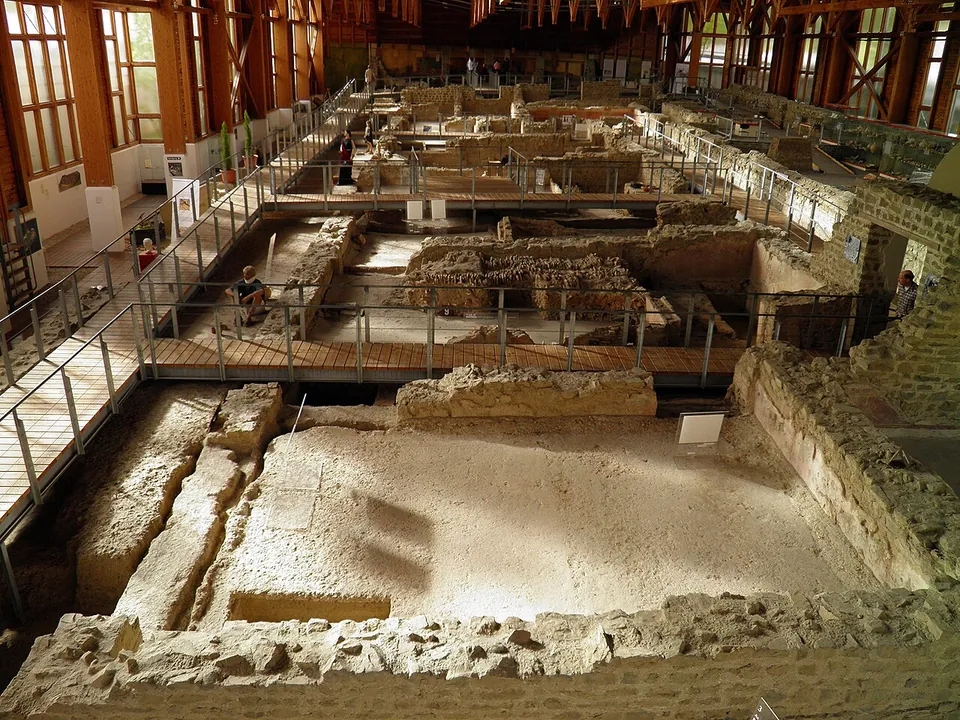
Photo: Carole Raddato from FRANKFURT, Germany · CC BY-SA 2.0 · Commons
46 km · villa · Rhineland-Palatinate
Römervilla von Bad Neuenahr-Ahrweiler
The house is 72 m long and 18 to 20 m deep (de.wikipedia), and walkways take you through and over its rooms.


Straight-line distances.
Sources
Every fact on this page comes from the records below, each used under the licence noted.
| Source | Licence |
|---|---|
| Wikidata Q2179667 | CC0 |
| OpenStreetMap way/122628380 | ODbL |
| Wikipedia (de) — Römerturm (Köln) | CC BY-SA 4.0 |
| KuLaDig (LVR) — Römerturm an der Zeughausstraße | licence not recorded |
| Förderverein Römische Stadtmauer Köln — the Roman city wall and the Römerturm | licence not recorded |
| Deutsche Stiftung Denkmalschutz — Römerturm in Köln wird restauriert (17 November 2025) | licence not recorded |
| Stadt Köln — Römerturm muss restauriert werden (press release, 14 February 2020) | licence not recorded |
| Stadt Köln — Erster Schritt der Sanierung des Römerturms beendet (press release, 25 November 2022) | licence not recorded |