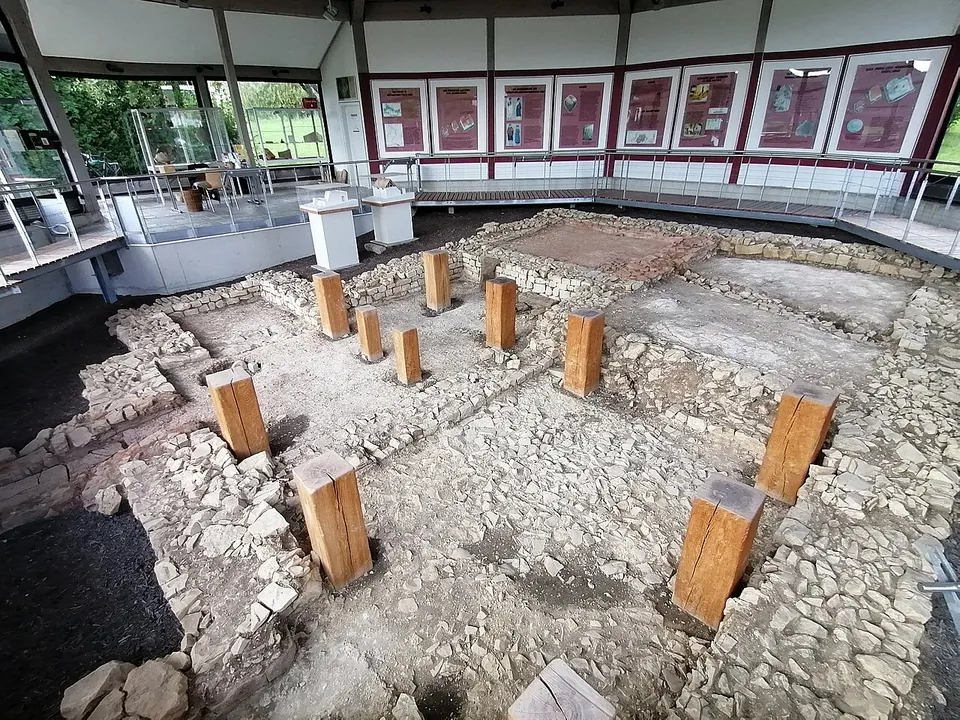
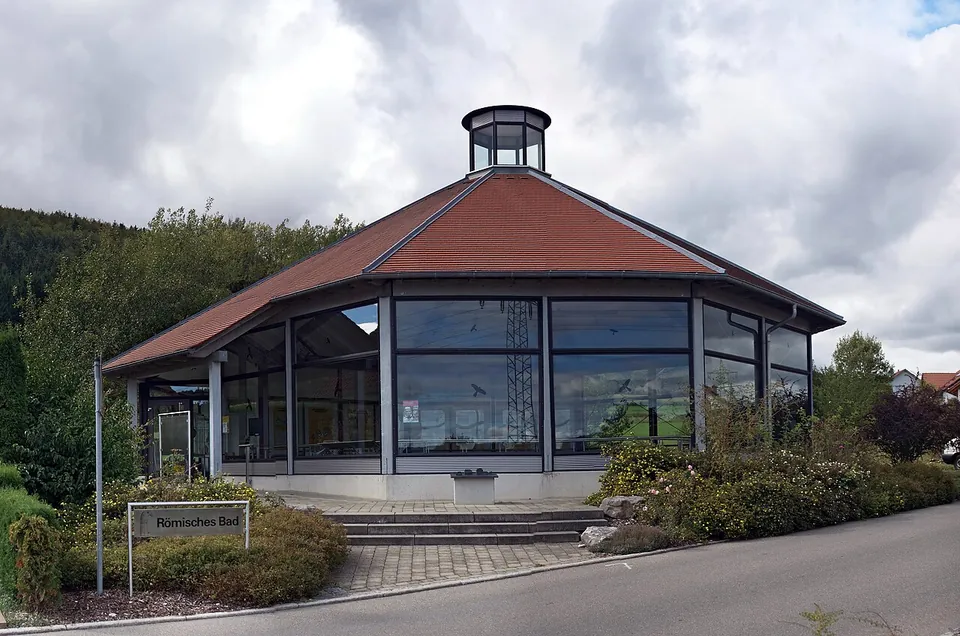
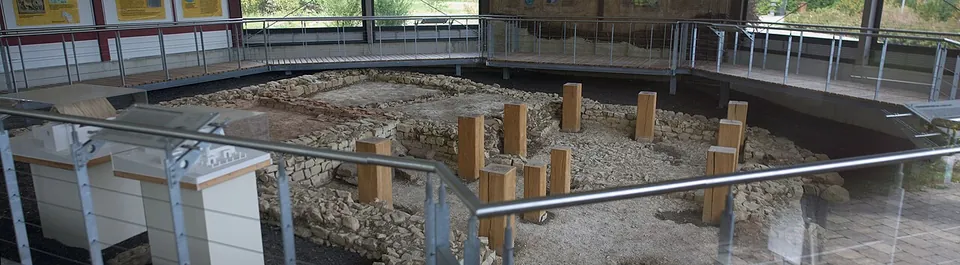


The Römisches Bad is the small stone bath house of a Roman estate, probably a farm, on the south-western edge of Wurmlingen, near Tuttlingen, conserved under a glass shelter for what happened to it after the Romans left: Alamanni put up a timber building, probably a store, inside its walls. The shelter opens only on Sundays from 14.00 to 16.00, from May to September; at other times a visit has to be arranged with the municipal office (wurmlingen.de).
What is there today
What you see are the bath’s foundation walls, conserved where they were excavated and roofed over with a shelter that has been open to the public since May 1998, so a visit works in any weather (de.wikipedia; the operator). The building is tiny: about 9.2 by 7.7 m on the outside, with a small annex. It was a compact bath of the “block” type, with a changing room, a warm room heated by an underfloor hypocaust, a hot room with its own furnace and a hot-water pool in a small apse, and a cold room (de.wikipedia).
Displays in the shelter tell the Roman and the Alamannic story of the site, and finds from the excavation are shown with the remains, among them a bronze eagle’s-head mount from a Roman travelling carriage (de.wikipedia). The operator adds original finds on loan from the state archaeological museum, including a vase of the kind called a snake pot and a bottle painted with stripes, and replicas of the Wurmlingen gold-leaf cross and of a spearhead with runes from the Alamannic period. Most of the finds from Wurmlingen are kept in the Landesmuseum Württemberg and the Colombischlössle museum in Freiburg (de.wikipedia).
Is it worth the trip?
Only if you plan for it. This is a single small bath, laid out at foundation level, not a villa you can walk through, and it opens for two hours on summer Sunday afternoons. What makes it worth a stop is the story the shelter tells: when it was excavated, Wurmlingen was the only site in south-western Germany with archaeological proof that the Alamanni reused a Roman stone building, when they normally avoided Roman masonry and built in timber elsewhere. Finds since, such as the villa at Bietigheim, have shown that they often resettled Roman sites, so the find is no longer unique, but this is still where the change from Roman to Alamannic use can be seen on the ground (de.wikipedia). If you are in Tuttlingen on a summer Sunday, or travelling with a group that can book a visit, it is worth the stop. It is not worth a long detour on its own.
Getting there
The shelter stands on Etterweg, on the south-western edge of Wurmlingen, about 4 km from the centre of Tuttlingen (de.wikipedia; OpenStreetMap). There is a small free car park with five spaces about 30 m away. No bus stop is mapped near the site, so in practice this is a visit by car or bicycle.
From May to September it is open on Sundays from 14.00 to 16.00; at other times, all year round, a visit can be arranged with the municipal office in Wurmlingen (+49 7461 92760), which also arranges guided tours for groups and school classes (wurmlingen.de and the shelter’s own site, read 31 October 2026). Neither publishes an admission charge.
Visiting details
- Opening hours
- May to September, Sundays 14.00–16.00. At other times, all year round, by arrangement with the municipal office in Wurmlingen (+49 7461 92760), which also arranges guided tours for groups and school classes.
- Tickets
- Neither the municipality nor the support association that runs the shelter publishes an admission charge.
- Parking
- Small free car park with five spaces about 30 m from the shelter, on Etterweg (OSM way/971379247).
Before you go
- Open only two hours a week, and only on summer Sundays; outside them a visit has to be booked with the municipal office.
- No bus stop is mapped near the site in OpenStreetMap; plan on a car or bicycle.
Hours and prices checked 31 October 2026 on the operator's own site. Confirm before travelling.
History
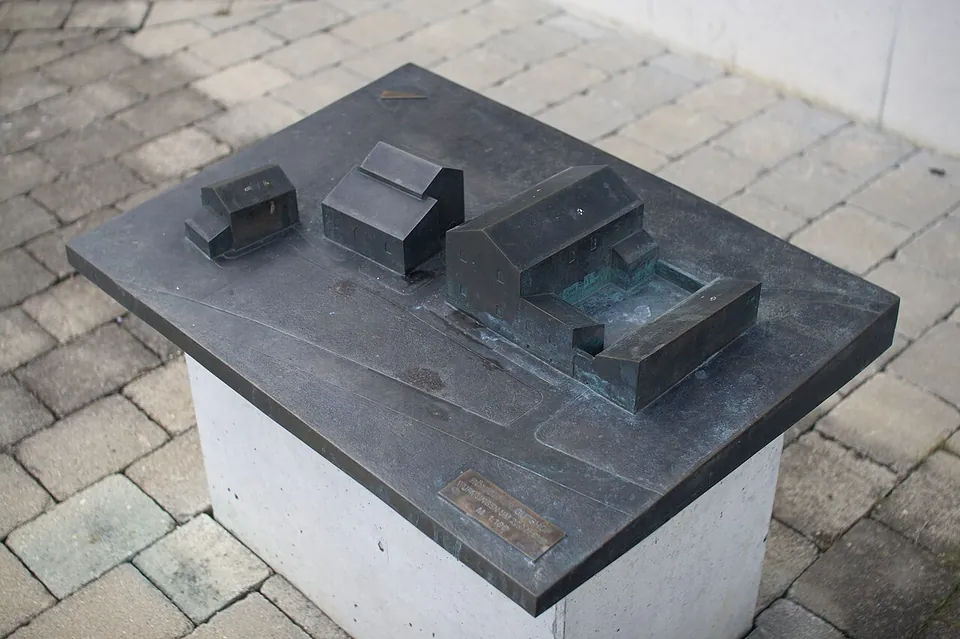
The Roman estate stood on a dry slope facing south to south-east about 200 m from a spring, which was probably why the site was chosen, about 3 km north-west of the presumed Roman fort at Tuttlingen. A Roman road from Strasbourg through Rottweil to Tuttlingen may have passed within a few hundred metres. Three buildings have been found: a main house, a smaller working building just south of it, and the bath. It is usually read as a villa rustica, a farming estate, but it may also have been a road station, an inn or a place to change horses, for the nearby road (de.wikipedia).
The estate began around AD 100 with timber buildings, while the bath was built in stone from the start (de.wikipedia); the shelter’s own site dates the stone buildings to about AD 150, so published dates differ. The bath served as a bath until a fire destroyed the main house around 220/240. After that its water supply and the cold pool’s lining were taken out and it was probably lived in. Roman occupation ended some time after 261: a coin minted in that year and a beaker made between 260 and 265 were found here (de.wikipedia).
The Alamanni who followed probably lived a little way uphill, nearer the spring, but used the Roman buildings. Inside the bath they broke out the hypocausts of the warm and hot rooms and the wall between them, lowered the floor, and within the standing outer walls put up a two-aisled timber building of about 6.3 by 3.6 m, traced by 19 post settings. It was probably a store for farm produce. How long they stayed is not settled; continuity to the middle of the 4th century is possible but not proven (de.wikipedia).
A Roman settlement here was suspected in 1879, but the site was found again only by aerial photography in 1989. A building plan for the area led to excavations by the state heritage office from 1993 to 1995; once their importance was clear, the plot was not built on, and the bath was conserved and placed under protection by 1998 (de.wikipedia). In 2002 Deutsche Post put a photograph of its excavation on a stamp in its series on archaeology in Germany (de.wikipedia).
More photographs

Nearby
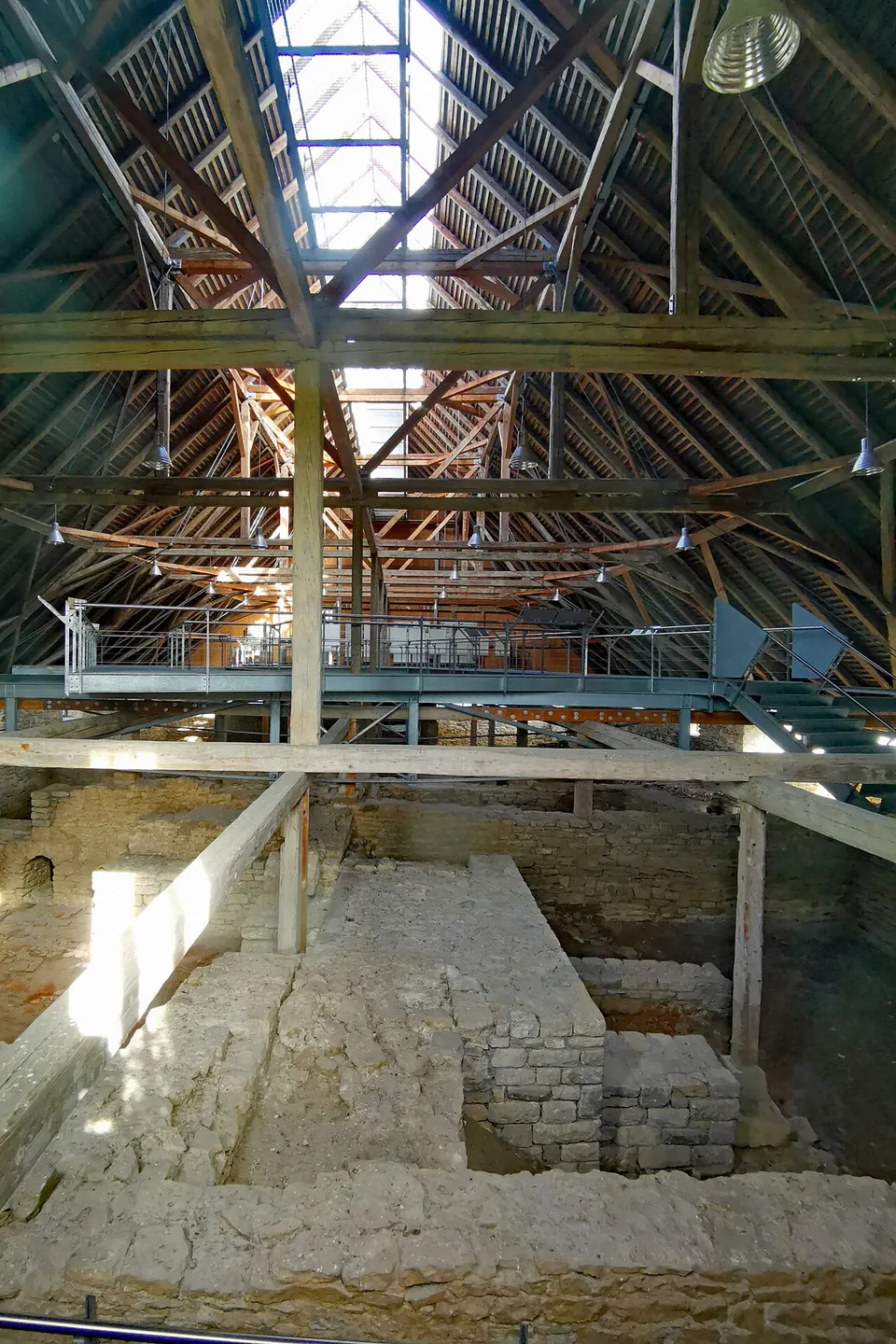
Photo: PaulT (Gunther Tschuch) · CC BY-SA 4.0 · Commons
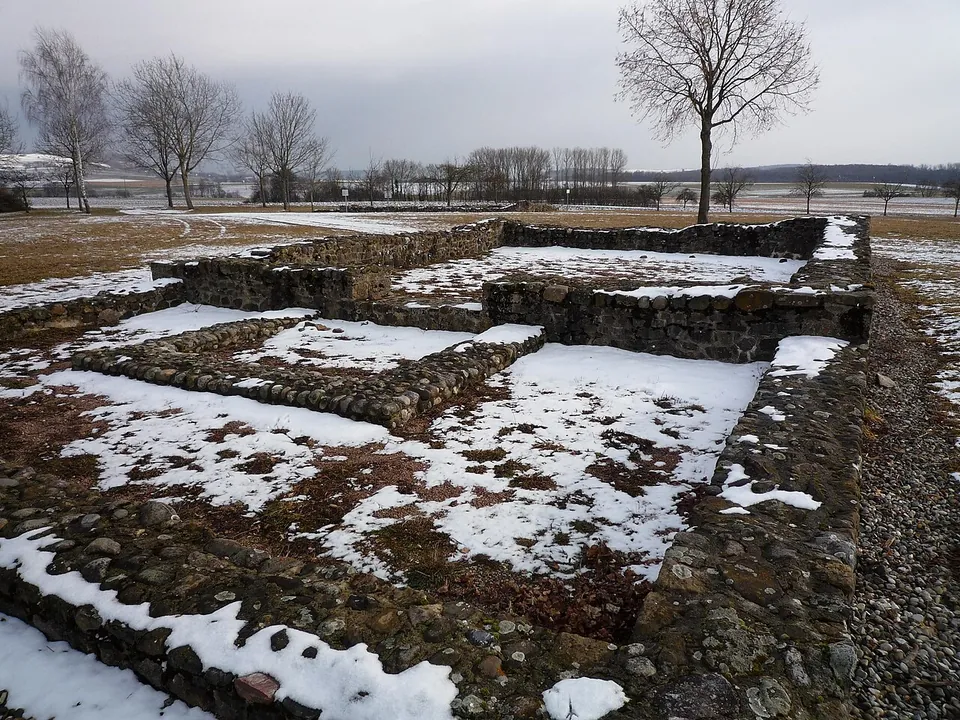
Photo: Kauk0r · CC BY-SA 3.0 · Commons
24 km · villa · Baden-Württemberg
Villa rustica of Büßlingen
The walls are what you see, and they are low: the town of Tengen describes the farm as almost completely restored in its foundations, and de.wikipedia says the ground plans were rebuilt with modern methods, completing whatever original masonry survived.
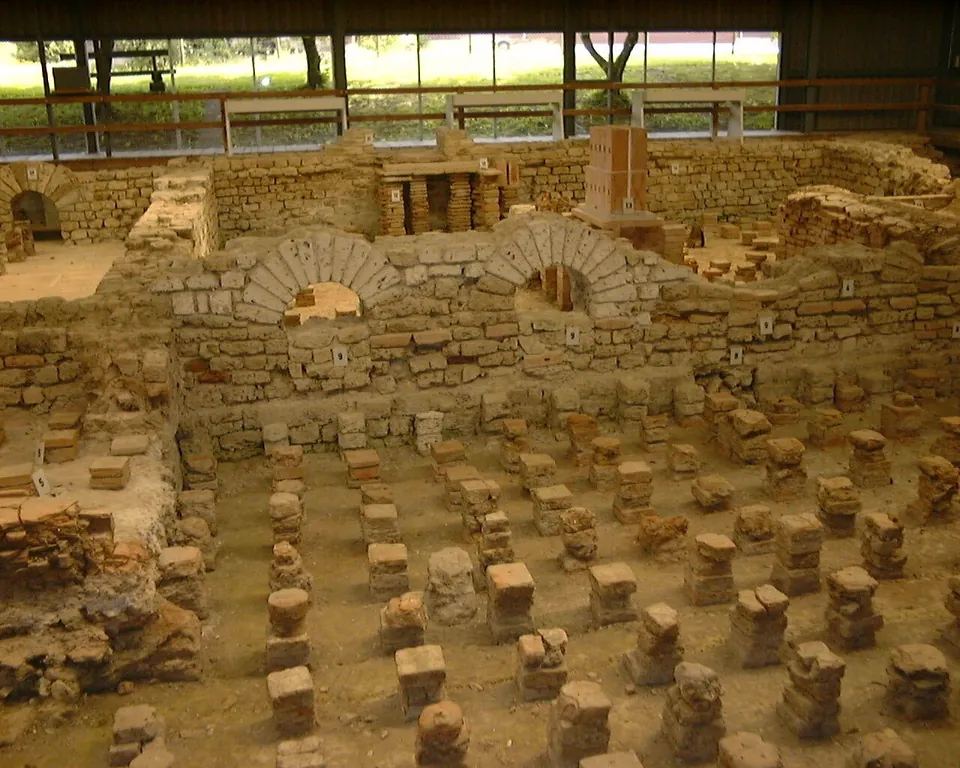
Photo: Nowic · CC BY-SA 3.0 · Commons
36 km · bath · Schleitheim District, Schaffhausen
Iuliomagus
The Thermenmuseum shows the remains of the Roman baths (de.wikipedia): walls of the bath rooms and rows of small brick pillars, under a roof (Wikimedia Commons photograph).


Straight-line distances.
Sources
Every fact on this page comes from the records below, each used under the licence noted.
| Source | Licence |
|---|---|
| Wikidata Q2202606 | CC0 |
| Vici.org 8256 | CC BY-SA (text), CC0 (metadata) |
| OpenStreetMap way/336892486 | ODbL |
| Wikipedia (de) — Römisches Bad (Wurmlingen) | CC BY-SA 4.0 |
| Gemeinde Wurmlingen — Sehenswertes (the municipality that owns the shelter; opening hours) | licence not recorded |
| Schutzhaus Wurmlingen — the shelter's own site (Förderverein Römisches Bad and the municipality) | licence not recorded |
| Schutzhaus Wurmlingen — Aktuelles (news, including what the shelter displays) | licence not recorded |