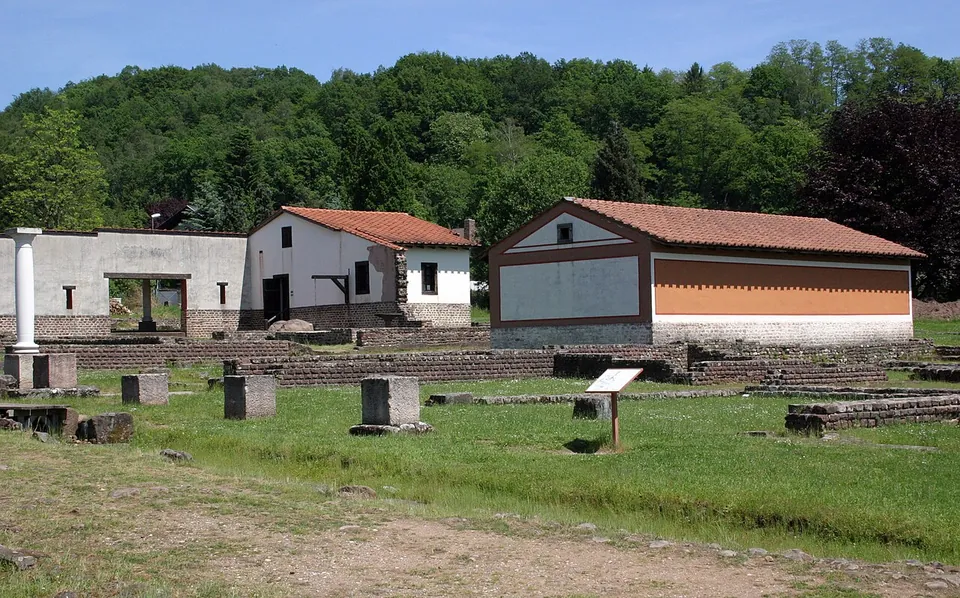
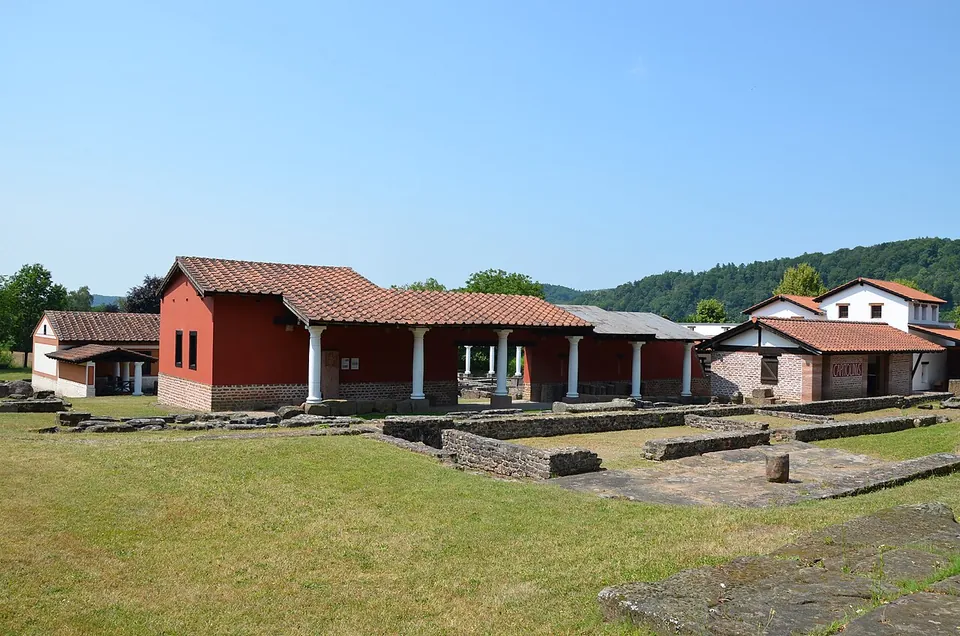
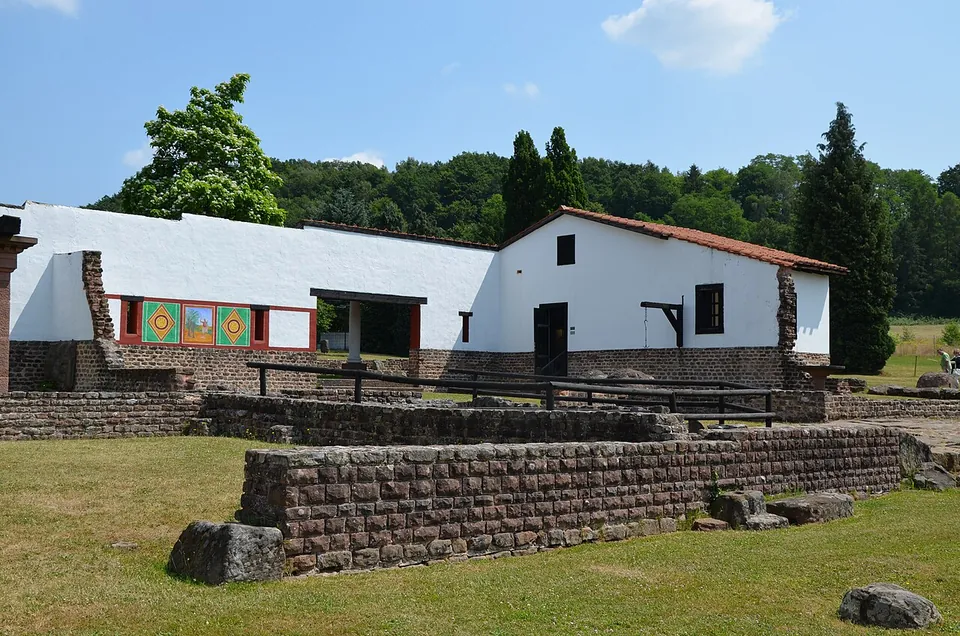
Schwarzenacker, a district of Homburg in Saarland, has an open-air museum on part of a Gallo-Roman roadside town: you walk among its excavated foundations, cellars and streets, step into several buildings rebuilt on the old walls, and finish in an early-18th-century manor house that holds the finds. The museum is closed from November to the end of February and opens again in March.
What is there today
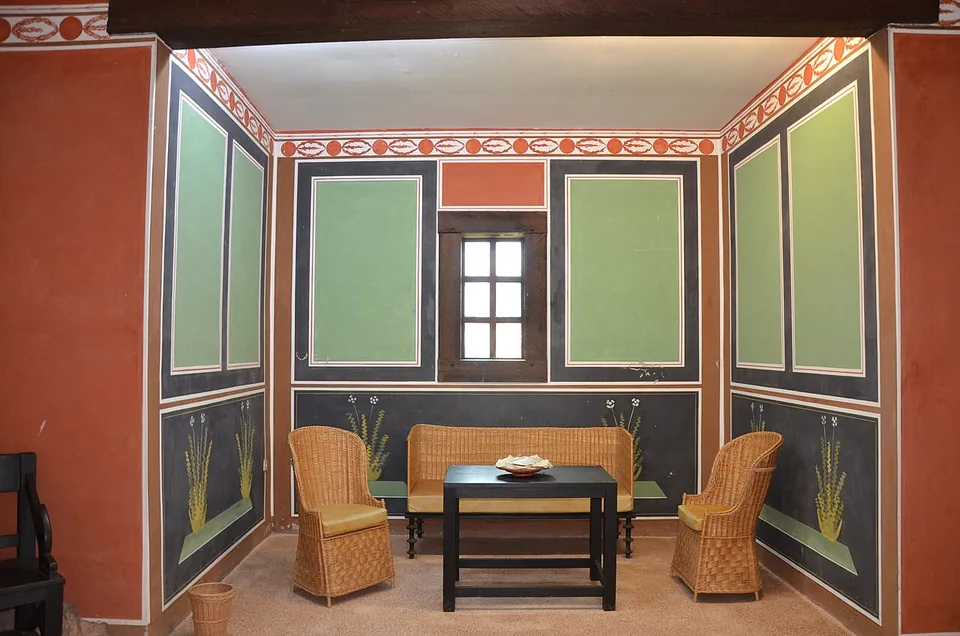
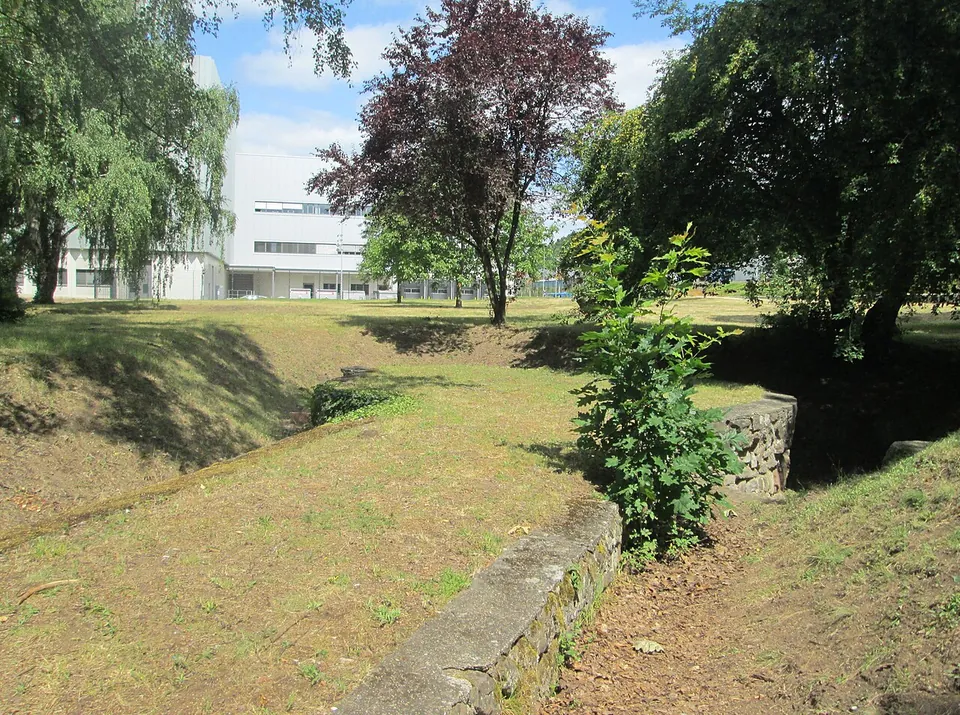
The town covered 25 to 30 hectares, and about one hectare of it has been excavated (de.wikipedia). On that hectare you see the foundation walls and cellars of the buildings, with streets and drains, and several buildings have been rebuilt: among them the “House of the Eye Doctor”, with wall paintings and underfloor heating, the corner tavern of Capitolinus and the bakery next to it (de.wikipedia). The museum also points out its street fronts with covered walkways and the Säulenkellerhaus, a building of administrative character (the operator). Finds from the town and the surrounding area are shown in the rebuilt houses (de.wikipedia).
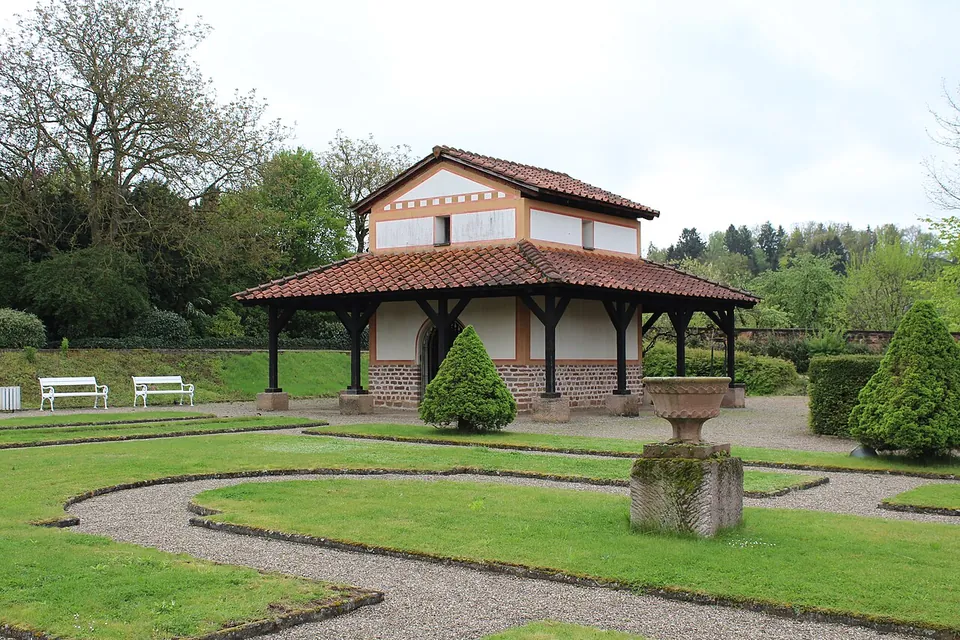
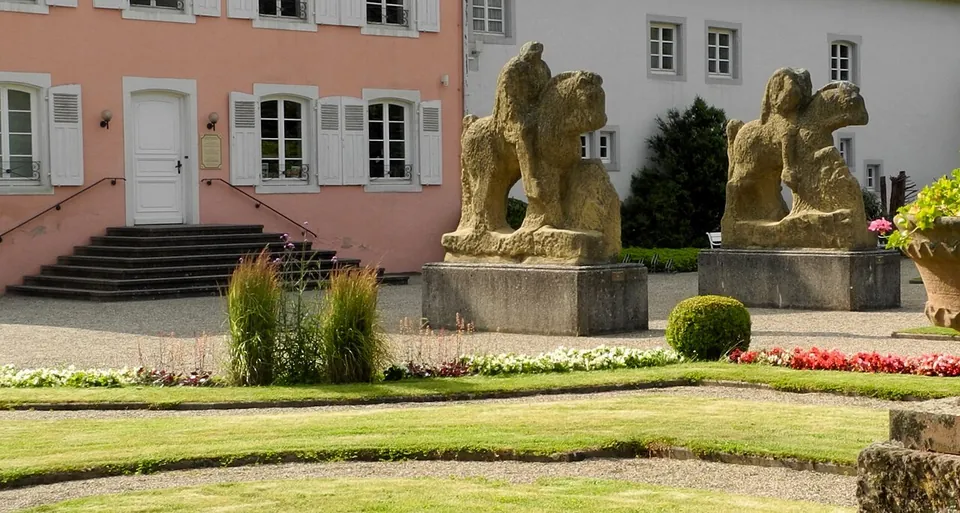
A baroque garden joins the excavations to the Edelhaus, a pink manor house of the early 18th century. It holds the ticket desk, the shop and the museum’s finds upstairs, with late-baroque paintings on loan from Munich on the ground floor (de.wikipedia; the operator). In the garden stand a 7 m copy of a Jupiter-giant column and a replica of the Gallo-Roman temple on the Rödersberg near Bierbach, about 3 km away (de.wikipedia). In front of the house are copies of life-size Roman equestrian statues found at nearby Breitfurt in 1887 (de.wikipedia).
Is it worth the trip?
Yes, if you want to picture everyday life in a small provincial town rather than look at monumental ruins. The original remains are low walls and cellars; what stands to roof height is modern reconstruction on those foundations, and the reconstructions are what make the place readable. With its children’s programmes and reenactment “Roman days” in the main season (de.wikipedia) it suits families, and it pairs with the Schlossberghöhlen caves in Homburg on a combined ticket.
It is closed from November to the end of February. In season a ticket is €7, and the bus from Homburg station stops across the road.
Getting there
By car, leave the A8 at exit 30 (Einöd) and follow Homburger Straße for 1.9 km to the museum car park; from the A6, take exit 9 (Homburg) and follow the same road for 7.9 km through Homburg and Schwarzenbach. From the car park, walk through the baroque garden towards the pink manor house; the ticket desk is up the outside staircase facing the equestrian statues (the operator).
By public transport, take a train to Homburg (Saar) Hauptbahnhof or to Einöd (Saar), then bus R7 to the stop “Schwarzenacker Römermuseum”: about 15 minutes from Homburg, about 6 from Einöd (the operator). The R7 runs every 30 minutes between Homburg station and Zweibrücken (de.wikipedia). Cross Homburger Straße at the pedestrian lights to reach the car park and the garden.
From March to October the museum is open every day: 10.00 to 16.00 in March, then from April to October 09.00 to 17.00 on weekdays and 09.00 to 18.00 at weekends and on public holidays. Admission is €7 for adults, €5 for pupils, students and apprentices with ID, and free under 7; a family ticket for two adults and three children under 18 is €17. A combined ticket with the Schlossberghöhlen is €10 (reduced €7, family €25), and entry is free with the Saarland Card (the operator, read 31 October 2026; check before travelling, since prices move).
Several areas are not step-free: the open-air grounds are uneven, and the manor house has stairs and no lift (OpenStreetMap; the operator, who asks visitors who need help to get in touch first). Dogs on a lead may come into the garden and the open-air site, but not the manor house.
Visiting details
- Opening hours
- Closed November to February. March: daily 10.00–16.00. April to October: Monday to Friday 09.00–17.00; Saturdays, Sundays and public holidays 09.00–18.00.
- Tickets
- €7 adults; €5 for pupils, students and apprentices with ID; free under 7; family ticket (two adults and three children under 18) €17; groups of 10 or more €6.50 per adult, €4.50 per pupil or student. A combined ticket with the Schlossberghöhlen caves in Homburg is €10 (reduced €7, family €25). Free with the Saarland Card. Special events are priced separately.
- Parking
- The museum has its own car park on Homburger Straße (the operator); OSM maps a car park about 100 m from the site (way/364971990). From the museum car park you walk through the baroque garden to the pink manor house; the ticket desk is up the outside staircase facing the equestrian statues.
Before you go
- Closed from November to the end of February.
- Not step-free in several areas; the open-air grounds are uneven and the manor house has stairs and no lift. The operator asks wheelchair users to get in touch before visiting.
- Dogs on a lead are allowed in the garden and the open-air site, not in the manor house.
Hours and prices checked 31 October 2026 on the operator's own site. Confirm before travelling.
History
The settlement was founded under Augustus, around AD 1, where the Roman roads from Metz to Worms and from Trier to Strasbourg crossed (de.wikipedia). It grew into a town of some 2,000 people (de.wikipedia; the operator); its ancient name is not known (de.wikipedia). In 275/276 the Alamanni destroyed it (de.wikipedia). The operator adds that people settled there again afterwards, but the town never regained its former importance as a centre of trade and administration.
The remains were excavated in 1965–67 and 1980–82 by the Saarland’s heritage office (then the Konservatoramt, today the Landesdenkmalamt) and, after restoration, laid out as an open-air museum (de.wikipedia). The archaeologist Alfons Kolling, who directed the excavations, built the museum up from 1966; it is run by a foundation whose founders that year included the town of Homburg, the Saarpfalz district and the Karlsberg brewery (de.wikipedia).
More photographs
Nearby
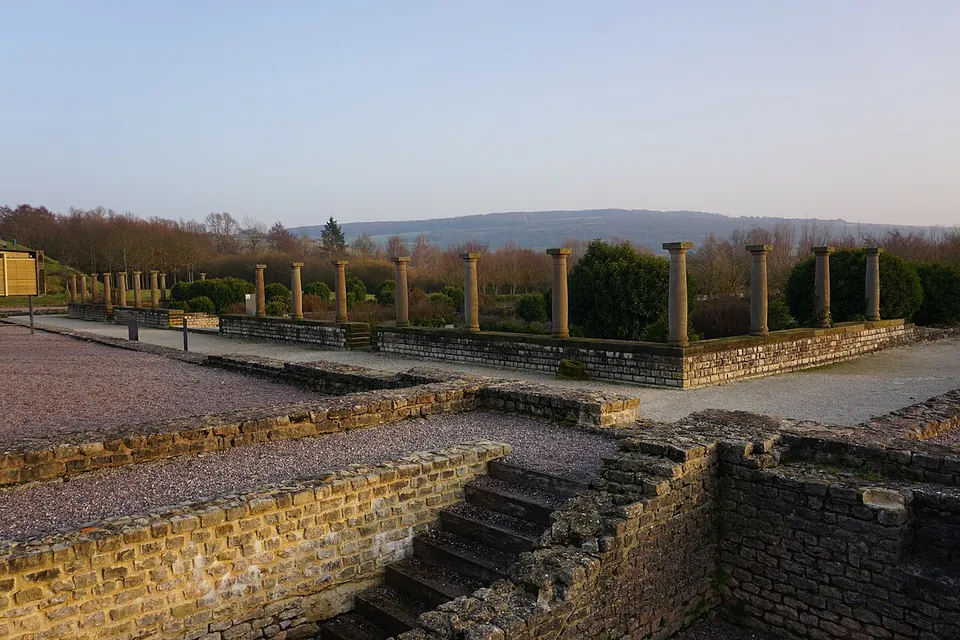
Photo: Starkiller3010 · CC BY-SA 4.0 · Commons
19 km · villa · Saarland
European Archaeological Park of Bliesbruck-Reinheim
On the German side, the villa is the Roman site.
22 km · fort · Saarland
Römerkastell Saarbrücken
Low restored foundation walls in a small park on a street called An der Römerbrücke, in the St. Johann district.
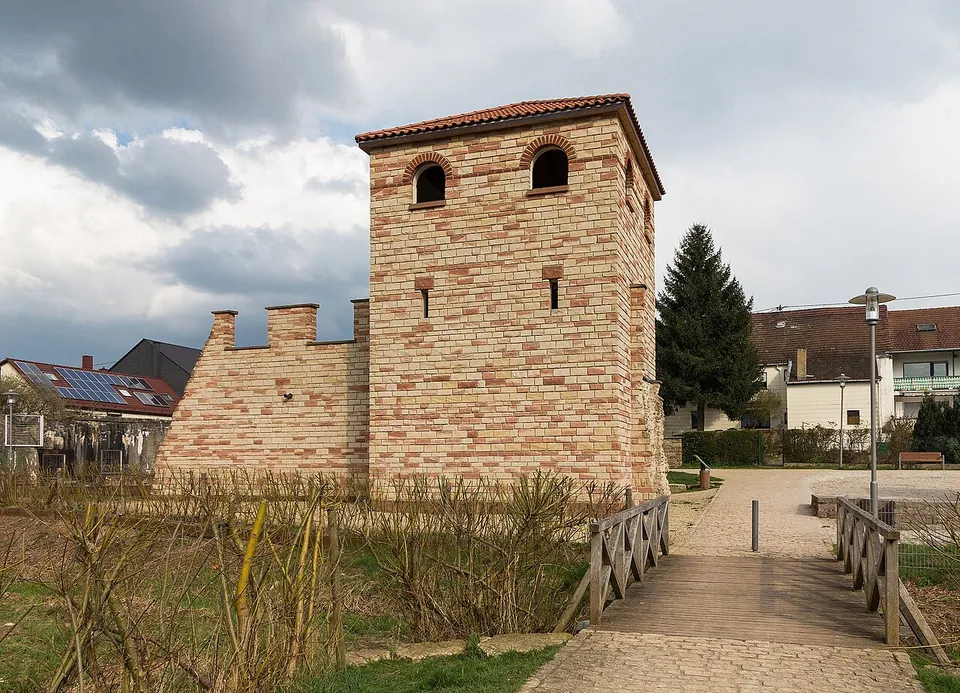
Photo: Amber16 · CC BY-SA 4.0 · Commons
45 km · fort · Saarland
Contiomagus
The Römerpark holds a square tower with arched windows and a tiled roof, joined to a short stretch of crenellated wall, set among gravel paths, meadow and a children's playground.


Straight-line distances.
Sources
Every fact on this page comes from the records below, each used under the licence noted.
| Source | Licence |
|---|---|
| Pleiades 109333 | CC BY |
| Wikidata Q22834 | CC0 |
| OpenStreetMap way/70586628 | ODbL |
| Römermuseum Schwarzenacker — opening hours and prices (the operator) | licence not recorded |
| Römermuseum Schwarzenacker — directions and visitor information (the operator) | licence not recorded |
| Römermuseum Schwarzenacker — the museum (the operator) | licence not recorded |
| Wikipedia (de) — Römermuseum Schwarzenacker | CC BY-SA 4.0 |
| Wikipedia (de) — Schwarzenacker | CC BY-SA 4.0 |
| Wikidata — Römermuseum Schwarzenacker (Q2179623) | licence not recorded |