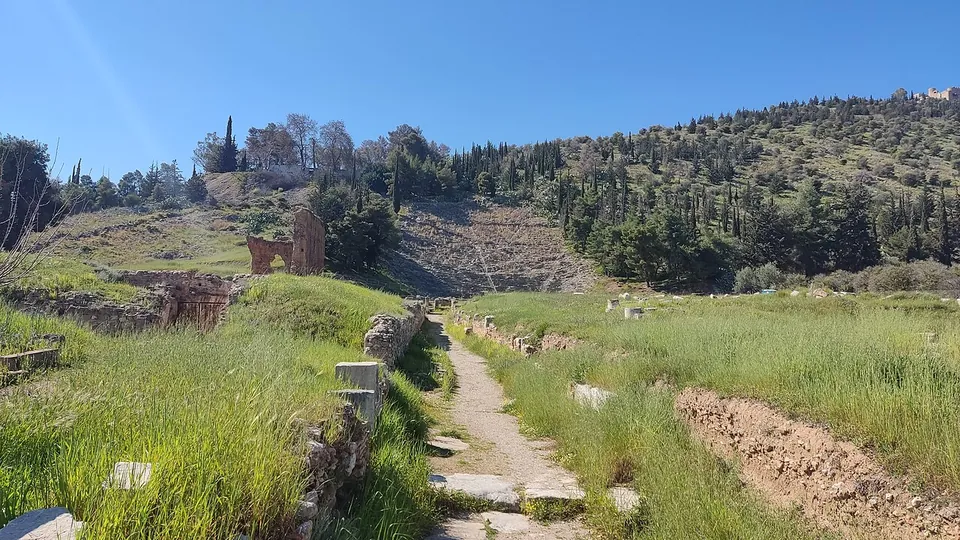
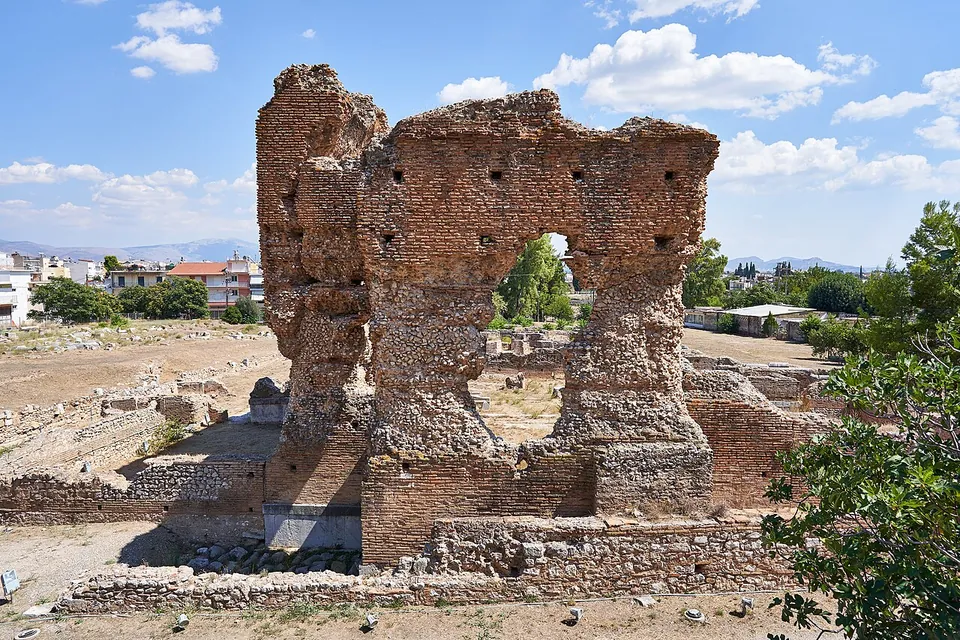


Argos was a city-state of ancient Greece, and its remains lie within the modern town (Wikidata; OpenStreetMap). The two great sights show the city of the Roman emperors: a vast theatre cut into the hill, remodelled under Hadrian for festivals, wild-beast hunts and gladiators, and beside it a Roman bath house whose brick wall still stands 11 m high (the Ephorate; the site’s sign).
What is there today
The theatre, with about 20,000 seats, is among the largest ancient theatres in Greece. It was built in the early 3rd century BC into the south-east side of the castle hill, its seating mostly cut from the rock in 83 rows in the central section. In the Roman period, above all under Hadrian in the 2nd century AD, it was remodelled to host imperial festivals, mock hunts of wild animals and gladiatorial combat: the brick stage building was extended over part of the orchestra and given a two-storey marble front with Corinthian columns, mosaics and statues in niches. A box of three marble seats for distinguished spectators was added in the 3rd century, and in the 4th the orchestra was turned into a pool for water shows and mock sea battles. The theatre was abandoned at the end of the 4th century (the Ephorate).
The Roman baths, south-east of the theatre, were installed under Hadrian on the site of a sanctuary of Serapis and placed under the protection of Asclepius; Pausanias mentions the Asclepieion. A great hall with arched roofs served for meeting and socialising; from there bathers passed through a changing room to the cold bath, with green marble columns and statues in niches, and on to three hot rooms over underfloor heating. The baths stayed in use until the 5th or 6th century, and their brick wall, still 11 m high, was drawn by travellers alongside the theatre seats. French archaeologists excavated them from the 1950s (the site’s sign).
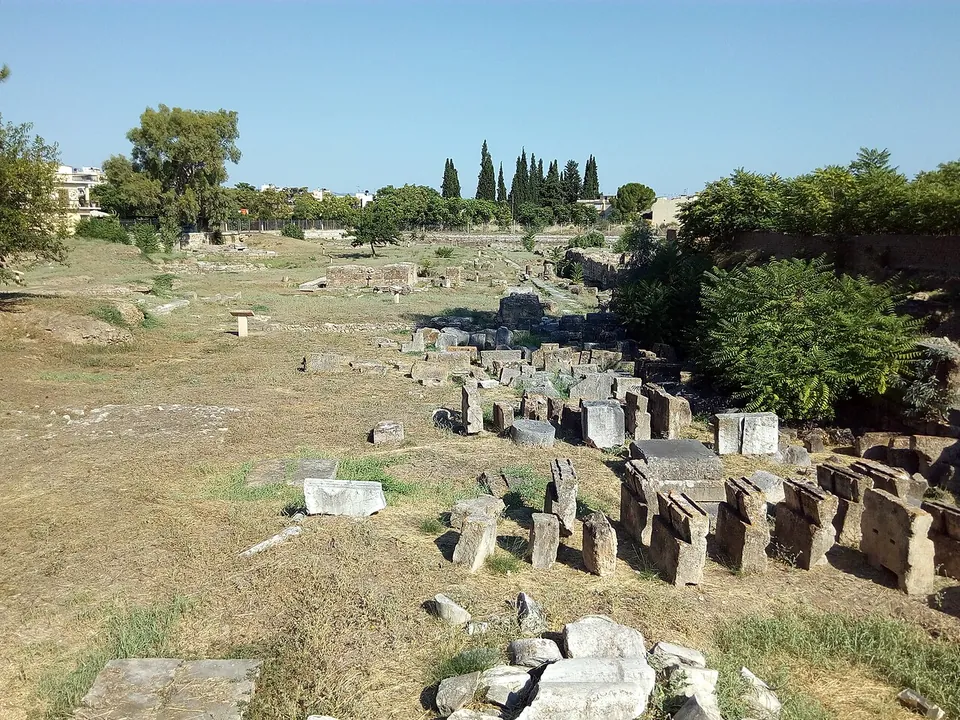
The agora lies just across the street from the theatre (the operator). An older theatre of the 5th century BC, about 100 m to the south (the Ephorate), was converted into an odeon around 120, by en.wikipedia’s account.
Is it worth the trip?
Yes. The theatre is among the largest ancient theatres in Greece and the baths still stand 11 m high, both in the middle of a living town 15 minutes from Nafplio (the Ephorate; the site’s sign; the operator). The €10 ticket covers the theatre and the agora; check the hours, as the site closes at 15.30 all year (the operator).
Getting there
The entrance is at the corner of Theatrou and Tripoleos streets, 10 minutes on foot from the central square of Argos; the town is 15 minutes by car from Nafplio, and served by the Argolis KTEL buses (the operator). Public toilets are mapped near the agora (OpenStreetMap).
The site opens daily, 08.30–15.30, all year. Last entry is 20 minutes before closing; it is shut on 1 January, 25 March, 1 May, Easter Sunday and 25–26 December. A ticket for the theatre and the agora is €10, reduced €5, and entry is free on 6 March, 18 April, 18 May, the last weekend of September, 28 October, and on the first and third Sunday of each month from November to March (hh.gr, read 9 October 2026 — check before travelling). The Heraion of Argos, the city’s old sanctuary of Hera 8 km outside town, is free (the operator).
Visiting details
- Opening hours
- Daily, 08.30–15.30, all year. Last entry 20 minutes before closing. Closed 1 January, 25 March, 1 May, Easter Sunday and 25–26 December.
- Tickets
- Ancient Theatre and Ancient Agora €10; reduced €5. Free on 6 March, 18 April, 18 May, the last weekend of September and 28 October, and on the first and third Sunday of each month from November to March. The Heraion of Argos, 8 km outside the town, is free.
- Parking
- The site is a 10-minute walk from the central square of Argos; the operator lists parking, and public toilets are mapped about 180 m from the agora (OSM node/13811871751).
Hours and prices checked 9 October 2026 on the operator's own site. Confirm before travelling.
History
Argos reached its cultural height under Pheidon in the 7th century BC (Pleiades). The present theatre replaced the older one probably to host the music and drama contests of the Nemean Games, moved to Argos from Nemea, and in the 2nd century BC it also housed the regular sessions of the Achaean League (the Ephorate). Under the emperors the city hosted the Sebasteia and other imperial festivals, and the baths were built under Hadrian (the Ephorate; the site’s sign). In 1829 the theatre was used again, for the Fourth National Assembly of the modern Greek state (the Ephorate). French archaeologists have excavated the theatre in several campaigns since 1890 (the Ephorate).
Nearby
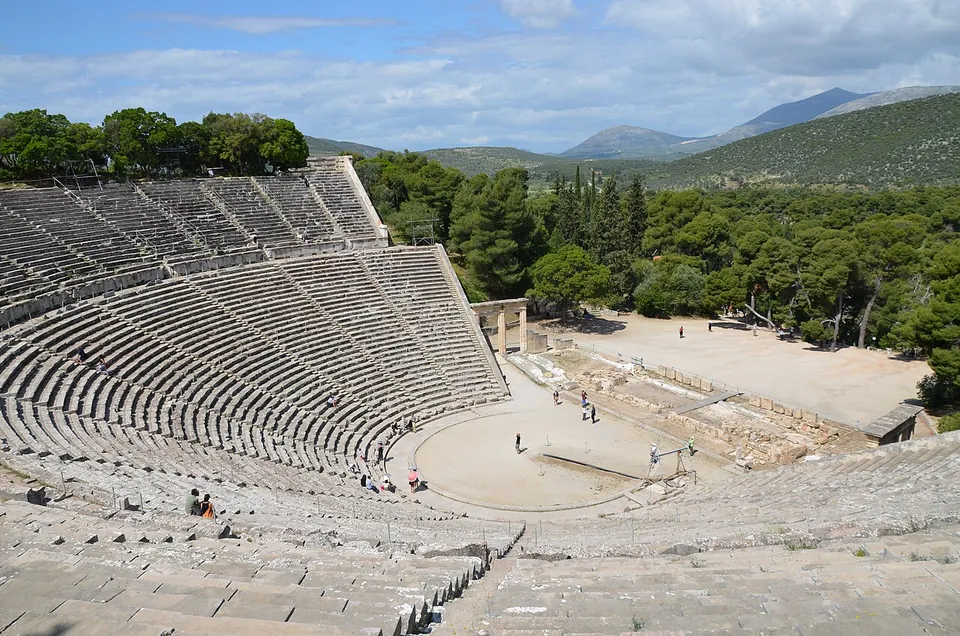
Photo: Carole Raddato from FRANKFURT, Germany · CC BY-SA 2.0 · Commons
31 km · site · Argolis
Sanctuary of Asclepius, Epidaurus
Most of what you see is Greek, from the sanctuary's great building period in the 4th and 3rd centuries BC: the Temple of Asclepius, which once held a gold-and-ivory statue of the god; the Abaton, the colonnade where the healing rituals took place; the Tholos, a round building; the Katagogion, a guest house of 160 rooms; the stadium; and the theatre (the operator).
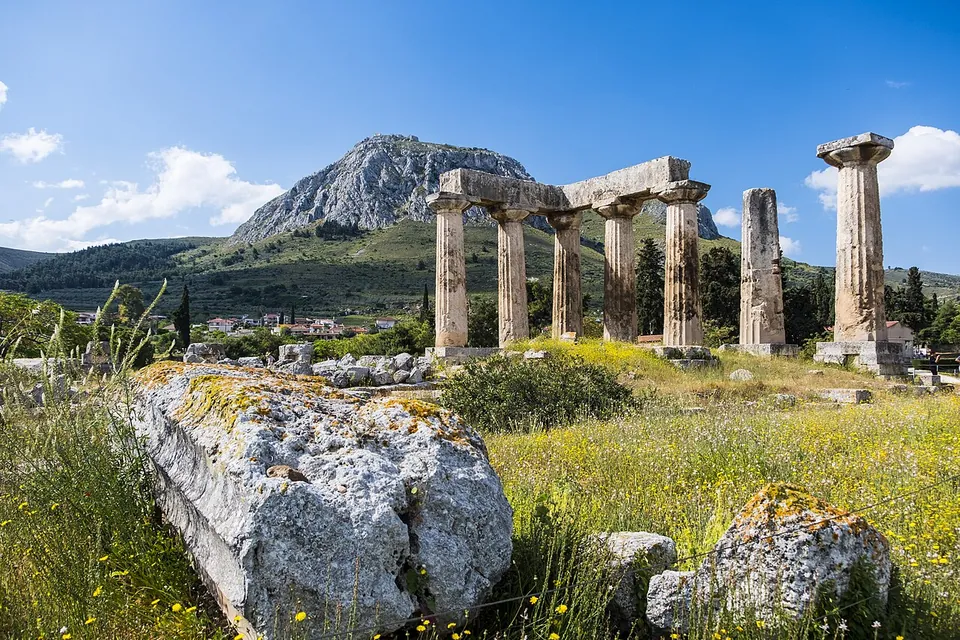
Photo: Davide Mauro · CC BY-SA 4.0 · Commons
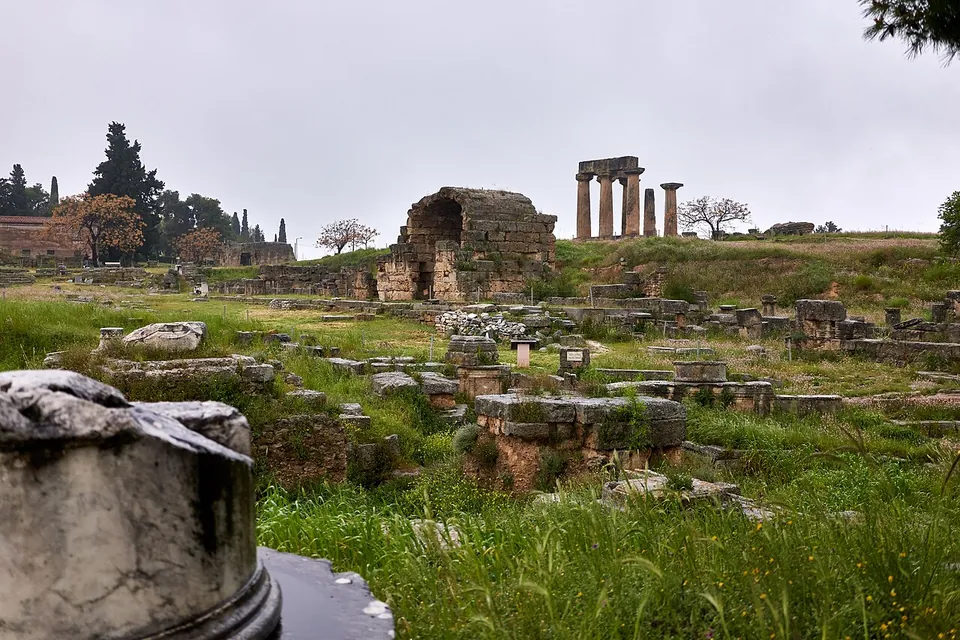
Photo: George E. Koronaios · CC BY-SA 4.0 · Commons
34 km · city · Corinthia
Ancient Corinth
The forum was a huge open space, about 200 m from east to west and 100 m from north to south, laid out along the old Greek South Stoa, which formed its southern edge.


Straight-line distances.
Sources
Every fact on this page comes from the records below, each used under the licence noted.
| Source | Licence |
|---|---|
| Pleiades 570106 | CC BY |
| Wikidata Q13533353 | CC0 |
| Vici.org 2939 | CC BY-SA (text), CC0 (metadata) |
| OpenStreetMap relation/5348847 | ODbL |
| Hellenic Heritage (H.O.C.R.E.D., for the Ministry of Culture) — Ancient Theatre, Ancient Agora and Heraion of Argos, hours and tickets | licence not recorded |
| Ephorate of Antiquities of Argolida — The ancient theatre of Argos | licence not recorded |
| The site's sign at the Roman baths ("Serapeion – Asclepeion, Thermes A"), transcribed on Wikimedia Commons, 2020 | licence not recorded |
| Wikipedia (en) — Argos Theater | CC BY-SA 4.0 |
| Wikipedia (en) — Achaia (Roman province) | CC BY-SA 4.0 |