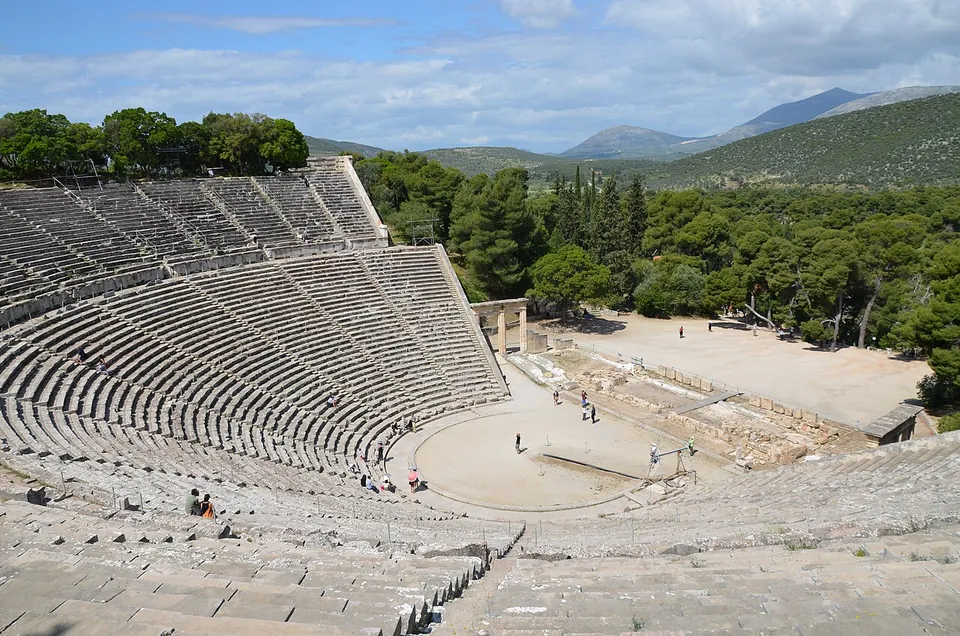
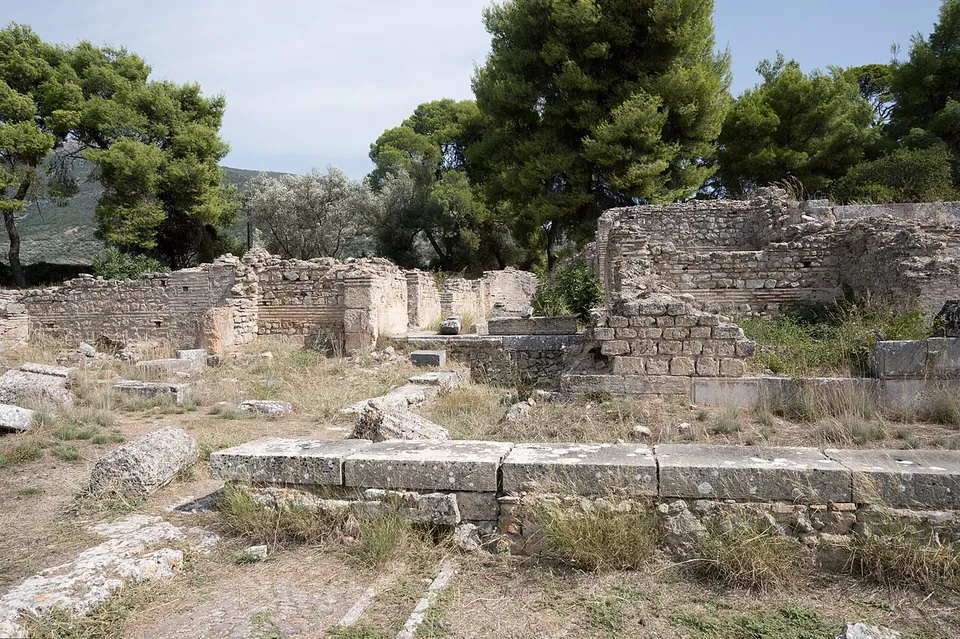
The Sanctuary of Asclepius at Epidaurus was the most famous healing centre of the Greek and Roman world, a place where the sick came to sleep near the god and wait for a cure (the Ephorate; the operator). Its great theatre is Greek, of the 4th century BC. Rome plundered the sanctuary in the 1st century BC and then rebuilt it: in the 2nd century AD a Roman senator paid for new buildings, and the walls of a Roman bath house stand among the Greek ruins (en.wikipedia; the Ephorate; the site’s board).
What is there today
Most of what you see is Greek, from the sanctuary’s great building period in the 4th and 3rd centuries BC: the Temple of Asclepius, which once held a gold-and-ivory statue of the god; the Abaton, the colonnade where the healing rituals took place; the Tholos, a round building; the Katagogion, a guest house of 160 rooms; the stadium; and the theatre (the operator). The temple survives as foundations only, and fragments of its upper parts are in the site museum (en.wikipedia). The theatre, on the hillside north-west of the sanctuary (en.wikipedia), seated 13,000 to 14,000 people by the published figures (the operator; en.wikipedia, Epidaurus) and is famous for its acoustics (the operator).
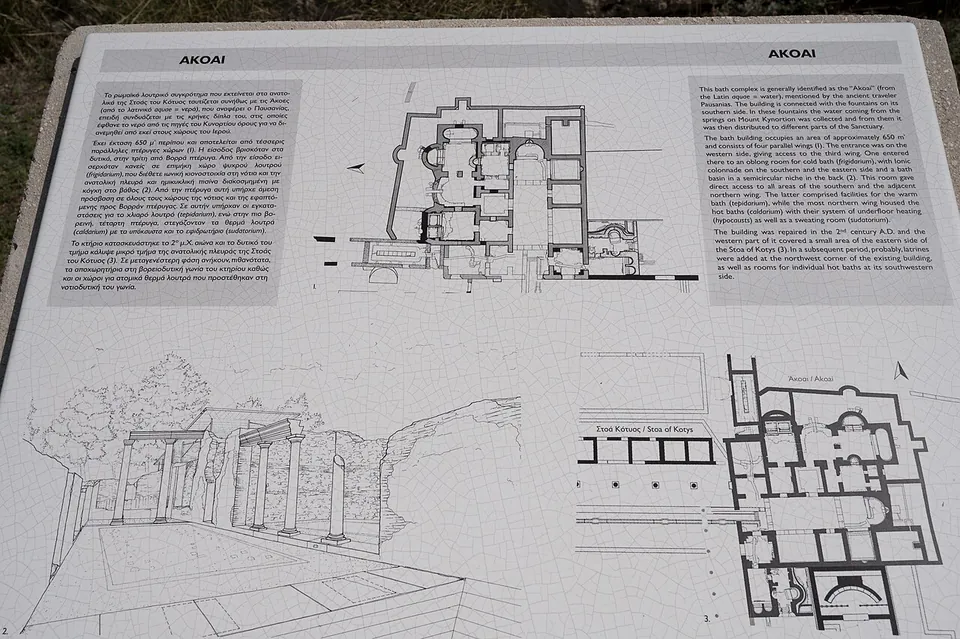
The Roman baths, called the Akoai after the Latin aquae, “waters”, stand east of the Stoa of Kotys. They covered about 650 m² in four parallel wings, entered from the west: a long cold-water hall with Ionic colonnades on two sides and a pool in a semicircular niche, a warm room, and in the northernmost wing the hot baths, with underfloor heating, and a sweating room. Fountains on the south side gathered water from the springs of Mount Kynortion and sent it on round the sanctuary. The board dates the building to the 2nd century AD, and latrines and small private hot baths were probably added later (the site’s information board).
Is it worth the trip?
Yes, for Epidaurus itself: the sanctuary and its theatre have been on UNESCO’s World Heritage List since 1988 (en.wikipedia), and the theatre is the most emblematic ancient theatre in Greece (the operator). For Rome, be clear what you are coming for: the Roman layer here is a revival, not a new sanctuary, and the bath house is its most legible piece. The €20 ticket includes the museum (the operator).
Getting there
The sanctuary lies near Lygourio in the Argolid, 30 minutes by car from Nafplio, 45 from Argos and about 3 hours from Athens (the operator). A free car park is mapped about 250 m from the Temple of Asclepius (OpenStreetMap).
It opens daily: 08.00–19.00 in April, 08.00–20.00 from 1 May to 31 August, closing earlier through September and October (18.00 by the second half of October), 08.00–17.00 from 1 November to the end of February and 08.00–18.00 in March. Last entry is 20 minutes before closing; it is shut on 1 January, 25 March, 1 May, Easter Sunday and 25–26 December. A ticket is €20, reduced €10, and covers the site and its museum; entry is free on 6 March, 18 April, 18 May, the last weekend of September, 28 October, and on the first and third Sunday of each month from November to March (hh.gr, read 9 October 2026 — check before travelling). There is a shop and parking (the operator).
Visiting details
- Opening hours
- Daily, 08.00–19.00 in April, 08.00–20.00 from 1 May to 31 August, then closing earlier through the autumn (19.30 in early September, 18.00 by late October); 08.00–17.00 from 1 November to the end of February and 08.00–18.00 in March. Last entry 20 minutes before closing. Closed 1 January, 25 March, 1 May, Easter Sunday and 25–26 December.
- Tickets
- €20, including the museum; reduced €10. Free on 6 March, 18 April, 18 May, the last weekend of September and 28 October, and on the first and third Sunday of each month from November to March.
- Parking
- A free car park is mapped about 250 m from the Temple of Asclepius (OSM way/150018004, fee=no).
Hours and prices checked 9 October 2026 on the operator's own site. Confirm before travelling.
History
The cult of Asclepius was established here in the 6th century BC, next to an older sanctuary of Apollo Maleatas on Kynortion hill, and the sanctuary grew rich in the 4th and 3rd centuries BC (the Ephorate).
Rome arrived with the Achaean War. In 146 BC the Achaeans turned the sanctuary into a stronghold, and after destroying Corinth the Roman general Lucius Mummius visited it and left two dedications. In 87 BC the Roman general Sulla looted it, and some time before 67 BC pirates plundered it; in the first half of the 1st century BC the guest house, the gymnasium and the water supply were abandoned. In the early 1st century AD the historian Livy wrote that Epidaurus was “once rich with gifts for the god, which are now vestiges of wrecked dedications” (en.wikipedia).
The recovery came under the emperors. The emperor Hadrian visited in 124 and reformed the priesthood and the Asclepieia games, and the Epidaurians dated their documents from his visit. In the 160s and 170s a Roman senator from Asia Minor, Sextus Julius Major Antoninus Pythodorus, paid for a bath house, a temple to Hygieia, Egyptian Asclepius and Egyptian Apollo, and repairs to the Stoa of Kotys and the guest house; a small odeon was built in the gymnasium in the same period (en.wikipedia; the Ephorate calls him “the Roman consul Antonine”). The traveller Pausanias saw and described the sanctuary at this time (the Ephorate).
The sanctuary was damaged in later raids, by the Goths in 267 according to the Ephorate and in 395 according to en.wikipedia. Despite the ban on pagan religions in 426, worship went on until the site was abandoned after the earthquakes of 522 and 551 (the Ephorate). Panagiotis Kavvadias of the Greek Archaeological Society uncovered its main monuments in excavations that lasted into the 1920s (the Ephorate; en.wikipedia).
Nearby
31 km · city · Argolis
Argos
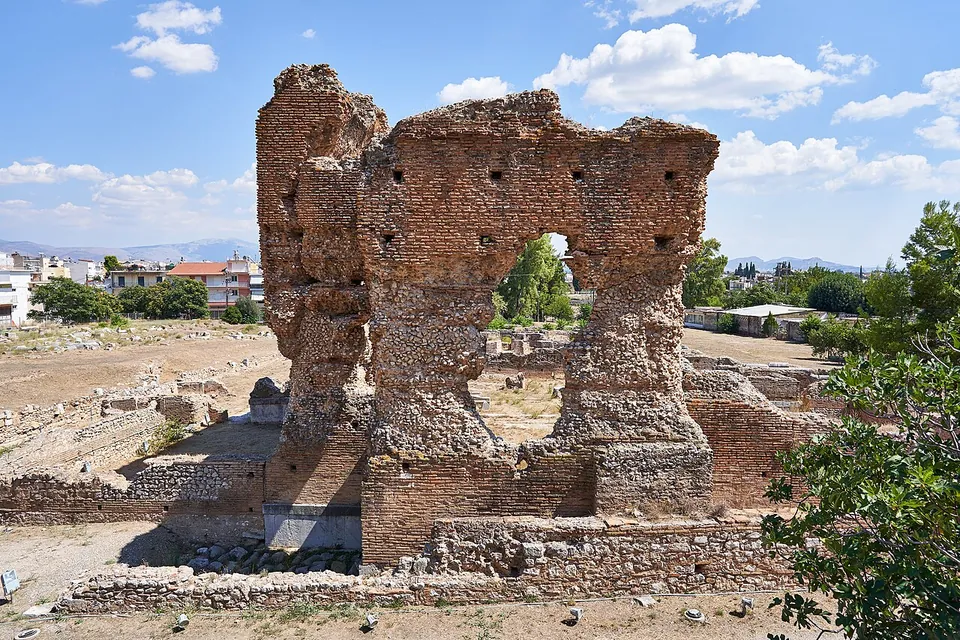
The theatre, with about 20,000 seats, is among the largest ancient theatres in Greece.
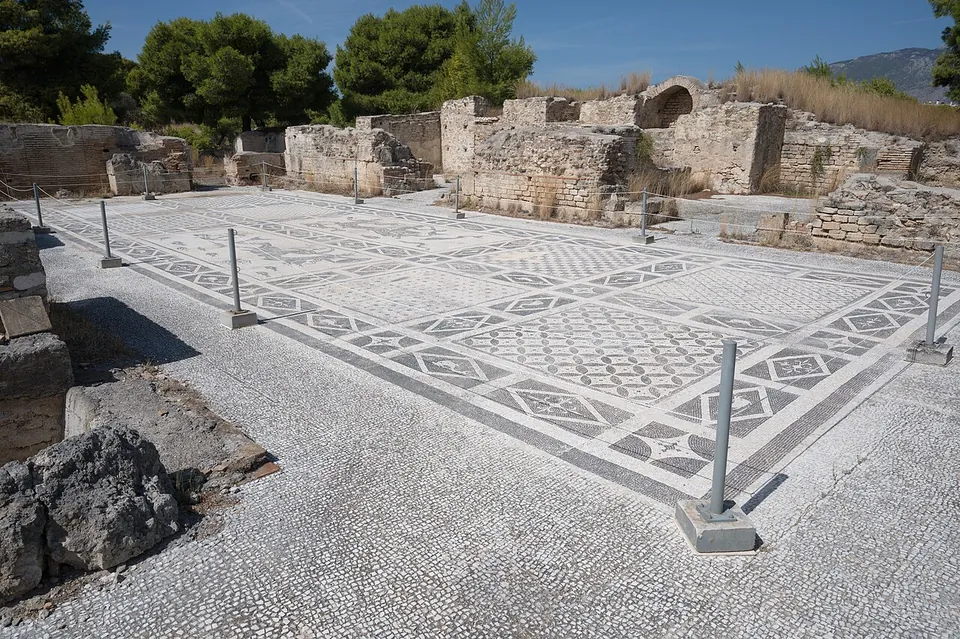
Photo: Zde · CC BY-SA 4.0 · Commons
36 km · site · Corinthia
Isthmia
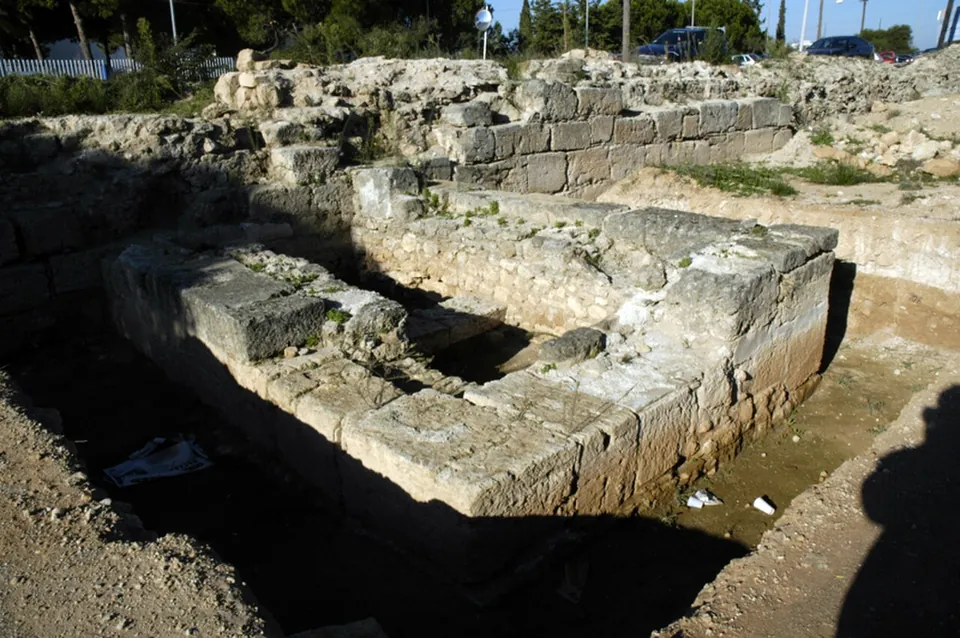
The Roman baths, on the northern edge of the sanctuary, were built about AD 150 in an area probably used by the athletes, on the foundations of a Classical bath of about 360 BC with a swimming pool 30 m square.


Straight-line distances.
Sources
Every fact on this page comes from the records below, each used under the licence noted.
| Source | Licence |
|---|---|
| Pleiades 570127 | CC BY |
| Wikidata Q7698713 | CC0 |
| OpenStreetMap way/30110346 | ODbL |
| Hellenic Heritage (H.O.C.R.E.D., for the Ministry of Culture) — Sanctuary of Asclepius at Epidaurus, hours and tickets | licence not recorded |
| Ephorate of Antiquities of Argolida — The Asklepieion at Epidavros | licence not recorded |
| The site's information board on the Roman baths ("Akoai"), photographed 2020 (Wikimedia Commons) | licence not recorded |
| Wikipedia (en) — Sanctuary of Asclepius, Epidaurus | CC BY-SA 4.0 |
| Wikipedia (en) — Ancient Theatre of Epidaurus | CC BY-SA 4.0 |
| Wikipedia (en) — Achaia (Roman province) | CC BY-SA 4.0 |