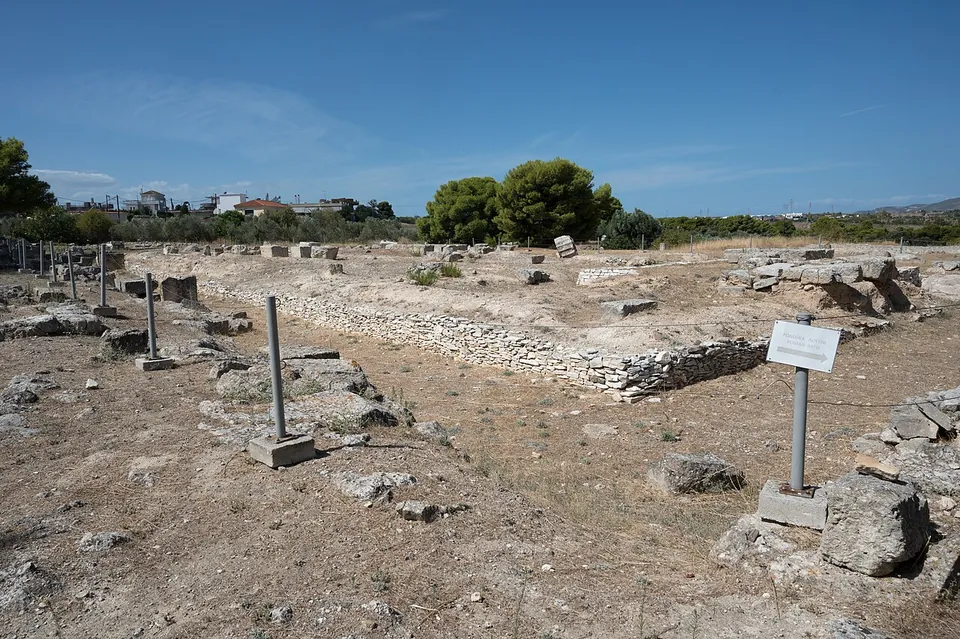
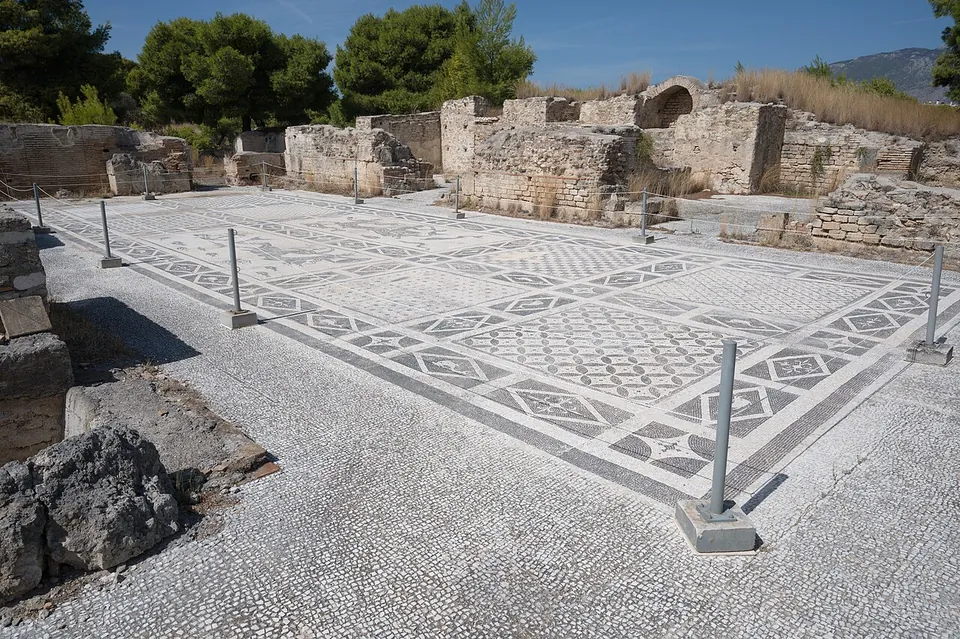
Isthmia was the sanctuary of Poseidon on the Isthmus of Corinth and the home of the Isthmian Games, second only to the Olympic Games in importance (Pleiades; en.wikipedia). The Temple of Poseidon is Greek; what Rome left is more visible: baths of about AD 150 with a great mosaic floor, a temple of the hero Palaimon, and a theatre it rebuilt twice (the site’s board; en.wikipedia).
What is there today
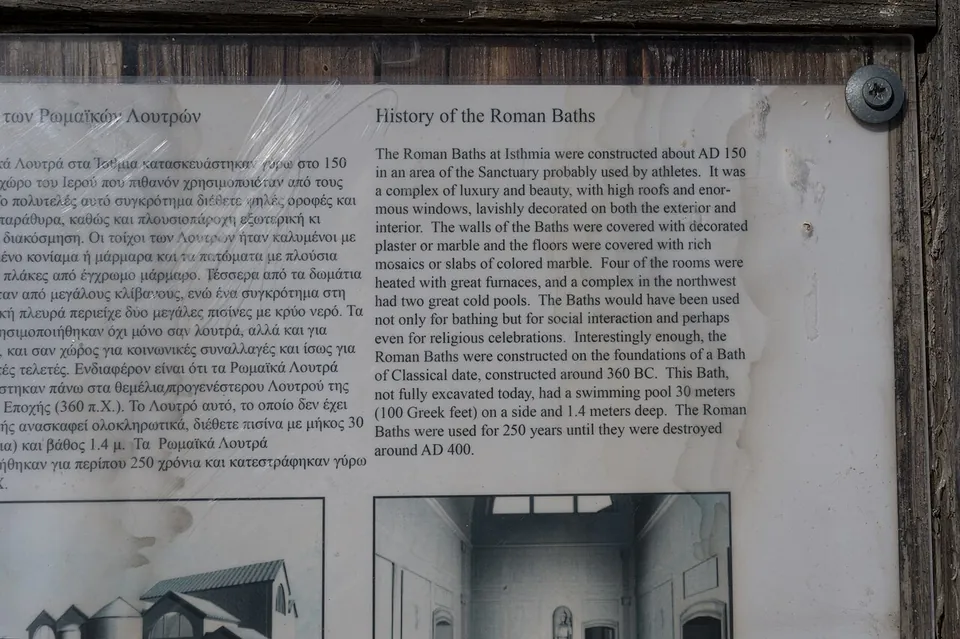
The Roman baths, on the northern edge of the sanctuary, were built about AD 150 in an area probably used by the athletes, on the foundations of a Classical bath of about 360 BC with a swimming pool 30 m square. They were a luxurious building with high roofs and huge windows, walls of decorated plaster or marble and floors of mosaic or coloured marble; four rooms were heated by great furnaces, and a wing in the north-west held two large cold pools. They stood for some 250 years, until they were destroyed around AD 400 (the site’s board). The Great Hall is covered almost entirely by a black-and-white mosaic of geometric designs and Tritons carrying Nereids, which the excavator Timothy Gregory calls the largest monochrome mosaic excavated in the eastern Mediterranean; it was lifted, cleaned and laid back in place (en.wikipedia).
The Palaimonion was a Roman temple for the cult of Palaimon (en.wikipedia), whom Pleiades describes as an embodiment of the Isthmian Games.
The theatre, 80 m north-east of the Temple of Poseidon, goes back to the 5th century BC by en.wikipedia’s account (Pleiades gives about 390 BC). Under Rome it was rebuilt at the end of the 1st century AD, with new seating, a reshaped orchestra and a new upper section, and again in the second half of the 2nd century, when two Ionic columns, probably for statues of the emperors, were set up near the stage (en.wikipedia).
The Temple of Poseidon, at the centre, was first built around 700 BC and burned in 480 BC and again in 390 BC; its stones were later reused in the Hexamilion wall (en.wikipedia). The museum shows finds from the sanctuary and from the harbour of Kenchreai, above all glass panels from a temple of Isis, an early example of stained glass (the operator).
Is it worth the trip?
Yes, especially as a stop on the way between Athens and Corinth: the baths and their mosaic are the Roman highlight, the ticket is €5 for the site and the museum, and Corinth is 10 minutes away by car (the operator; the site’s board). Expect foundations rather than standing buildings.
Getting there
The site is in the village of Isthmia, near the Corinth Canal, 10 minutes by car or 20 minutes by intercity (KTEL) bus from Corinth (the operator).
It opens daily from April to October: 08.00–18.00 in the first half of April, 08.00–18.30 in the second, 08.00–20.00 from 1 May to 15 September, then closing earlier (18.30 by the second half of October). From 1 November to 31 March it opens 08.30–15.30 and is closed on Tuesdays. Last entry is 20 minutes before closing; it is shut on 1 January, 25 March, 1 May, Easter Sunday and 25–26 December. A ticket is €5, reduced €3, for the museum and the site; entry is free on 6 March, 18 April, 18 May, the last weekend of September, 28 October, and on the first and third Sunday of each month from November to March (hh.gr, read 9 October 2026 — check before travelling). There are toilets and parking (the operator).
Visiting details
- Opening hours
- Daily, 08.00–18.00 in the first half of April, 08.00–18.30 in the second, 08.00–20.00 from 1 May to 15 September, then closing earlier through the autumn (18.30 by late October); from 1 November to 31 March 08.30–15.30, closed on Tuesdays. Last entry 20 minutes before closing. Closed 1 January, 25 March, 1 May, Easter Sunday and 25–26 December.
- Tickets
- €5 for the site and the museum; reduced €3. Free on 6 March, 18 April, 18 May, the last weekend of September and 28 October, and on the first and third Sunday of each month from November to March.
- Parking
- The site is in the village of Isthmia; the operator lists parking.
Hours and prices checked 9 October 2026 on the operator's own site. Confirm before travelling.
History
After defeating Macedon, Rome’s general Titus Quinctius Flamininus proclaimed the “freedom of the Greeks” at Isthmia. In 146 BC, after the Achaean War, Rome destroyed Corinth and the sanctuary, and the games passed to Sicyon; they returned to Corinth after Caesar refounded it in 44 BC, but were held in the city, and there is little sign of activity at Isthmia until the mid-1st century AD. The emperor Nero visited in AD 67 and performed in the musical contests, and in the 2nd century the local aristocrat Licinius Priscus Juventianus led a new round of building (en.wikipedia). In the 4th century pagan worship was banned, the temple fell out of use, and in the 5th century parts of the baths were built into the Hexamilion wall and its fortress (en.wikipedia; Pleiades). Oscar Broneer of the University of Chicago excavated the sanctuary from 1952, and from 1967 a second team worked on the baths and the Byzantine fortress (en.wikipedia).
Nearby
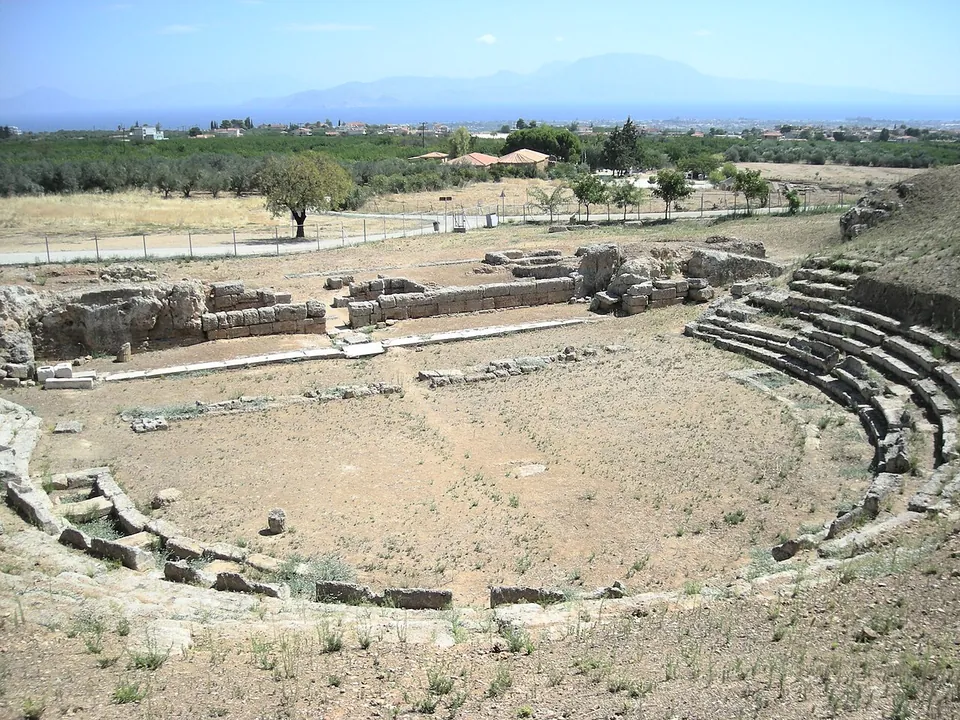
Photo: Future Perfect at Sunrise · Public domain · Commons
26 km · city · Corinthia
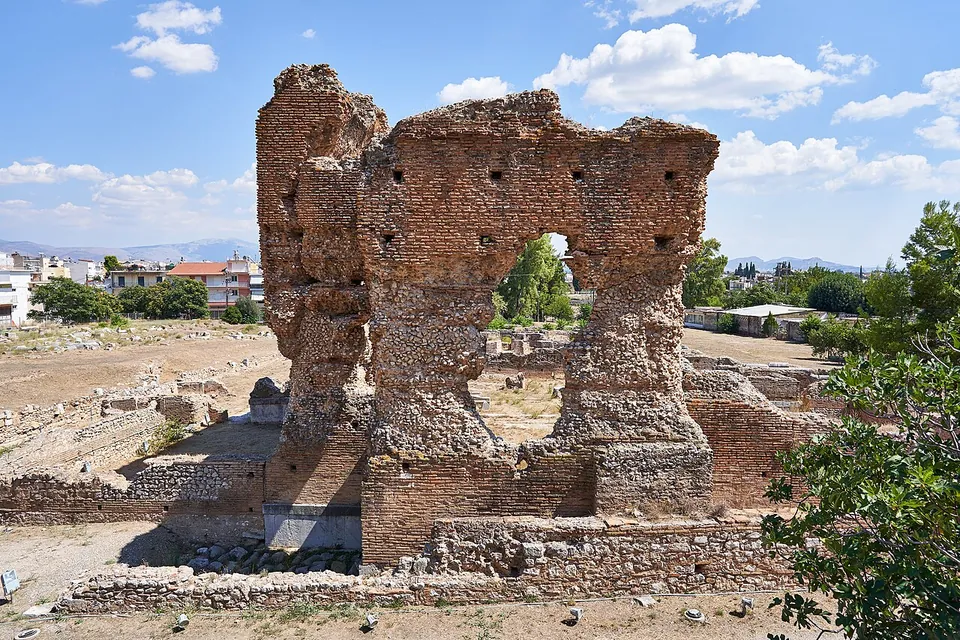
Sicyon
The Roman bath house, north of the agora, was a brick-built public bath, preserved in fairly good condition with walls up to 4 m high.
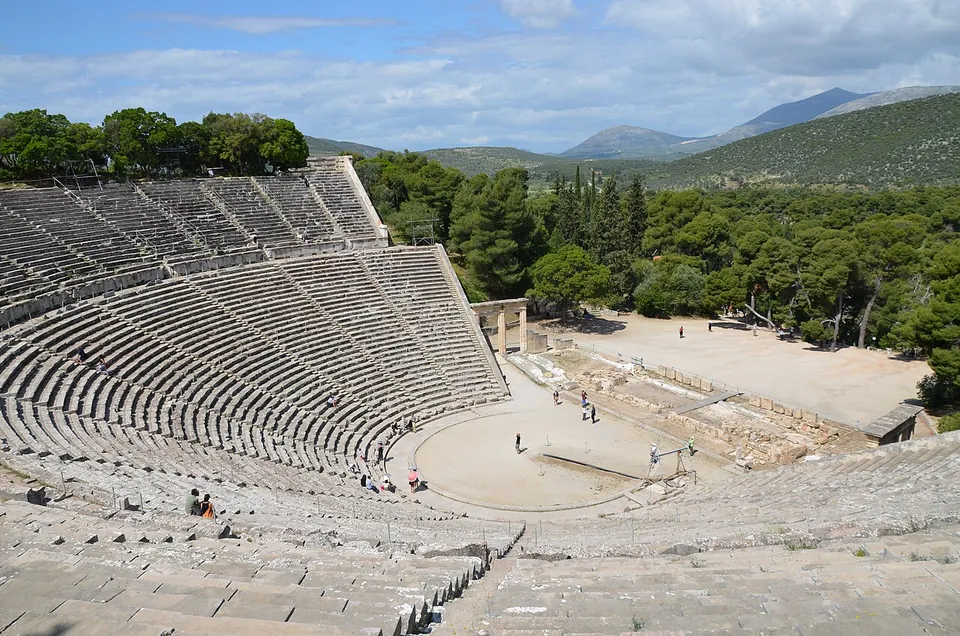
Photo: Carole Raddato from FRANKFURT, Germany · CC BY-SA 2.0 · Commons
36 km · site · Argolis
Sanctuary of Asclepius, Epidaurus
Most of what you see is Greek, from the sanctuary's great building period in the 4th and 3rd centuries BC: the Temple of Asclepius, which once held a gold-and-ivory statue of the god; the Abaton, the colonnade where the healing rituals took place; the Tholos, a round building; the Katagogion, a guest house of 160 rooms; the stadium; and the theatre (the operator).
40 km · city · Argolis
Argos
The theatre, with about 20,000 seats, is among the largest ancient theatres in Greece.


Straight-line distances.
Sources
Every fact on this page comes from the records below, each used under the licence noted.
| Source | Licence |
|---|---|
| Pleiades 570316 | CC BY |
| Wikidata Q1232123 | CC0 |
| OpenStreetMap node/1477749755 | ODbL |
| Hellenic Heritage (H.O.C.R.E.D., for the Ministry of Culture) — Isthmia, museum and site, hours and tickets | licence not recorded |
| The site's board on the Roman baths ("History of the Roman Baths"), photographed 2020 (Wikimedia Commons) | licence not recorded |
| Wikipedia (en) — Isthmia (sanctuary) | CC BY-SA 4.0 |
| Wikipedia (en) — Achaia (Roman province) | CC BY-SA 4.0 |