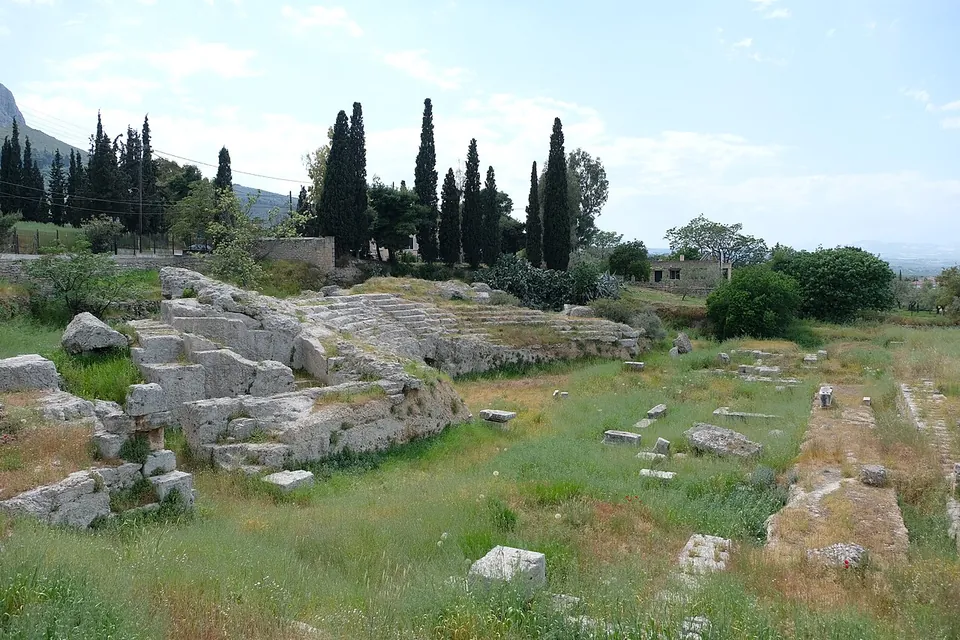
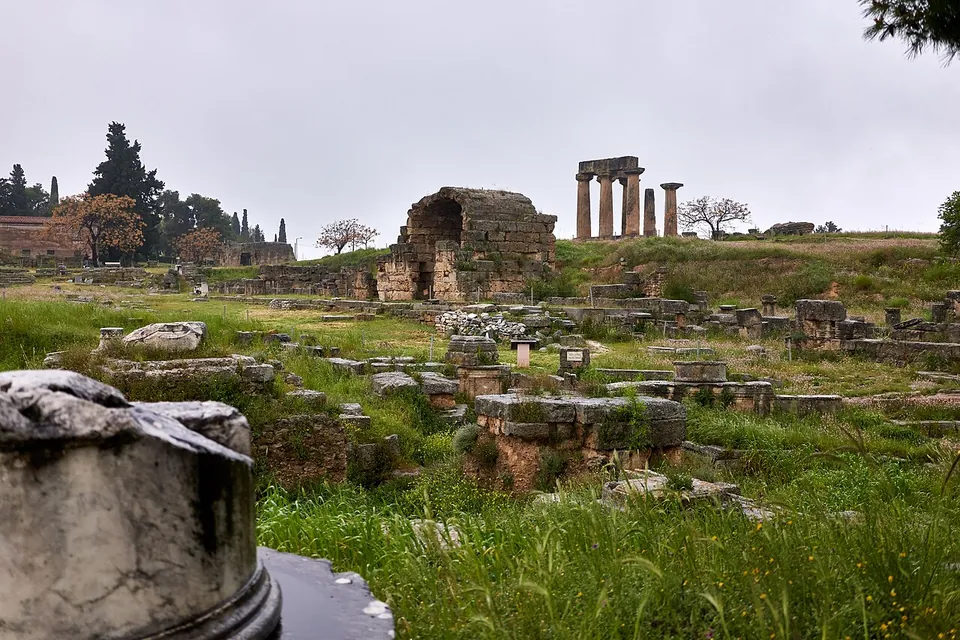
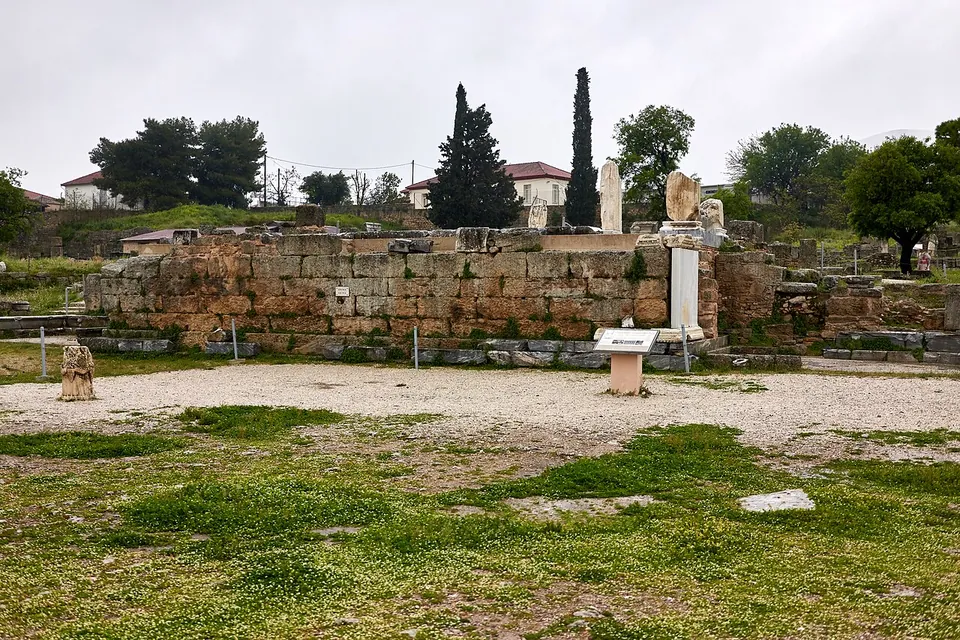


Ancient Corinth is the centre of the Roman colony that Julius Caesar founded in 44 BC on the ruins of the Greek city Rome had destroyed, the capital of the province of Achaia (the Ministry; en.wikipedia). What you walk through is mostly its Roman forum, with temples, fountains, colonnades and a basilica that was probably the province’s law court, under the Archaic Temple of Apollo and the rock of Acrocorinth (the Ministry; the excavators).
What is there today
The forum was a huge open space, about 200 m from east to west and 100 m from north to south, laid out along the old Greek South Stoa, which formed its southern edge. South of its centre stood the rostra, the speakers’ platform, which many identify with the Bema before which the apostle Paul was brought (the excavators). The excavations have uncovered porticoes, baths and latrines as well as temples and fountains (the Ministry), and rows of shops (the excavators).
The Julian Basilica, on the east side, stood on a podium more than 4 m high and dominated that end of the forum until it was destroyed in the 4th century. It held one of the largest known shrines of the imperial cult and was probably the province’s imperial law court (the excavators, Julian Basilica). Its upper hall, 38 by 24 m, was set with statues of the imperial family, among them Augustus at a sacrifice and his adopted sons Gaius and Lucius (the excavators).
Temple E, to the west, was a temple of six by eleven columns on a low base, flanked by long colonnades; whether it was dedicated to Jupiter or was the Temple of Octavia is debated. In front of it stood smaller temples in the Roman style, on high podia with steps, dedicated to Venus and to Clarian Apollo, and a round monument given by Gnaeus Cornelius Babbius (the excavators).
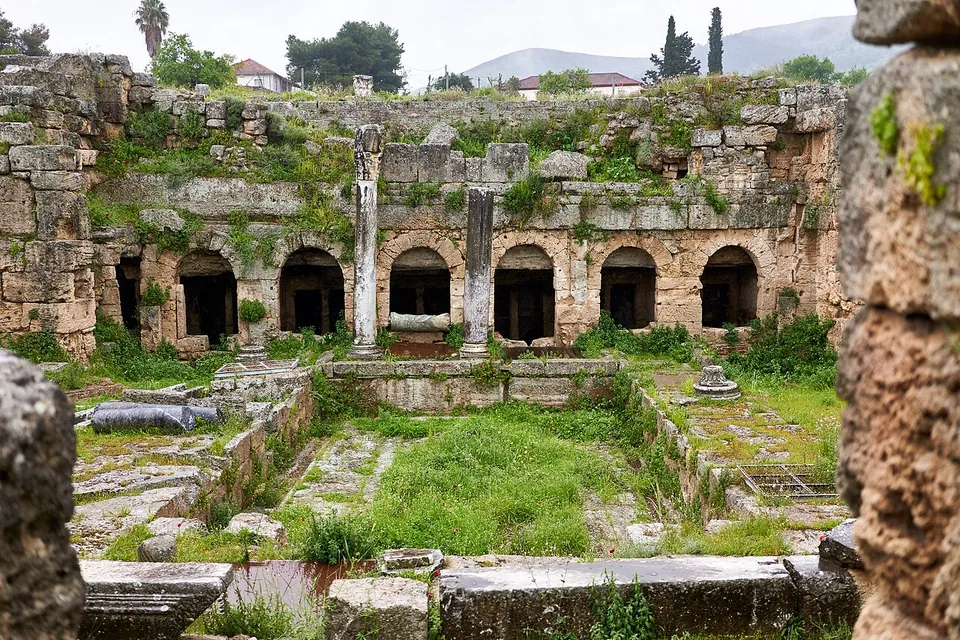
The Fountain of Peirene, beside the road from the port of Lechaion, was rebuilt under Rome: its old front was closed off with a row of arches and a two-storey court with a pool was added to the north. The Lechaion road itself entered the forum up a broad stairway through a triple arch (the excavators).
Rome also kept the Temple of Apollo of 560 BC but reversed its front to face west (the excavators; the Ministry). East of the theatre, a Latin inscription records that Erastus paid for the paving while he was aedile, probably the Erastus whom Paul names in his letter to the Romans (the excavators).
Outside the fenced site lie the theatre, remodelled to Roman taste and renovated again under Hadrian, and the Roman odeon of the 1st century AD (the excavators; Pleiades). Further out are the Asklepieion, a gymnasium of the Roman period and the site of an amphitheatre that may date from the colony’s first years (Pleiades; the Ministry).
Is it worth the trip?
Yes. Here you see the centre of a Roman provincial capital: a forum with its basilica, temples and fountains, laid out for Roman colonists (the Ministry; the excavators). The Greek city shows most visibly in the Temple of Apollo. The €15 ticket includes the museum (the operator).
Getting there
The site is in the village of Ancient Corinth, a 5-minute walk from its centre, 10 minutes by car or 20 minutes by intercity (KTEL) bus from the modern city of Corinth (the operator). A free car park is mapped about 230 m from the forum (OpenStreetMap).
From April to October it opens daily: 08.00–19.00 in April, 08.00–20.00 from May to August, closing earlier through September and October (18.00 by the second half of October). From 1 November to 31 March it opens 08.30–15.30 and is closed on Tuesdays. Last entry is 20 minutes before closing; it is shut on 1 January, 25 March, 1 May, Easter Sunday and 25–26 December. A ticket is €15, reduced €8, and covers the site and its museum; entry is free on 6 March, 18 April, 18 May, the last weekend of September, 28 October, and on the first and third Sunday of each month from November to March (hh.gr, read 9 October 2026 — check before travelling). There is a shop, toilets and a lift (the operator).
Visiting details
- Opening hours
- Daily, 08.00–19.00 in April and 08.00–20.00 from 1 May to 31 August, then closing earlier through the autumn (19.30 in early September, 18.00 by late October); from 1 November to 31 March 08.30–15.30, closed on Tuesdays. Last entry 20 minutes before closing. Closed 1 January, 25 March, 1 May, Easter Sunday and 25–26 December.
- Tickets
- €15, including the museum; reduced €8. Free on 6 March, 18 April, 18 May, the last weekend of September and 28 October, and on the first and third Sunday of each month from November to March.
- Parking
- A free car park is mapped about 230 m from the forum (OSM way/235083635, fee=no), and the operator lists parking at the site.
Hours and prices checked 9 October 2026 on the operator's own site. Confirm before travelling.
History
After the Roman general Lucius Mummius defeated the Achaean League in 146 BC, he sacked Corinth, killed its men and sold its women and children into slavery; for a century it was an almost deserted ghost town (the excavators). Julius Caesar refounded it in 44 BC as a colony for 16,000 colonists, mostly freed slaves and veteran soldiers, on a new grid of streets, and in 27 BC it was made the capital of Achaia (the excavators; the Ministry). It grew rich: Horace’s saying “not every man gets to go to Corinth” reflects what it cost to live there (the Ministry). Paul stayed in the city around AD 50 (en.wikipedia).
A century after the founding, the forum had gained the odeon, another temple, more shops and a new basilica south of the South Stoa (the excavators). The Heruli invaded in 267 and an earthquake struck in 375, but the city stayed strong (the Ministry). In late antiquity it shrank behind a new wall of the early 5th century, and the central shops were turned into the broadest stairway in the Roman world (the excavators). The American School of Classical Studies at Athens has excavated here since 1896 (the Ministry; the excavators).
More photographs

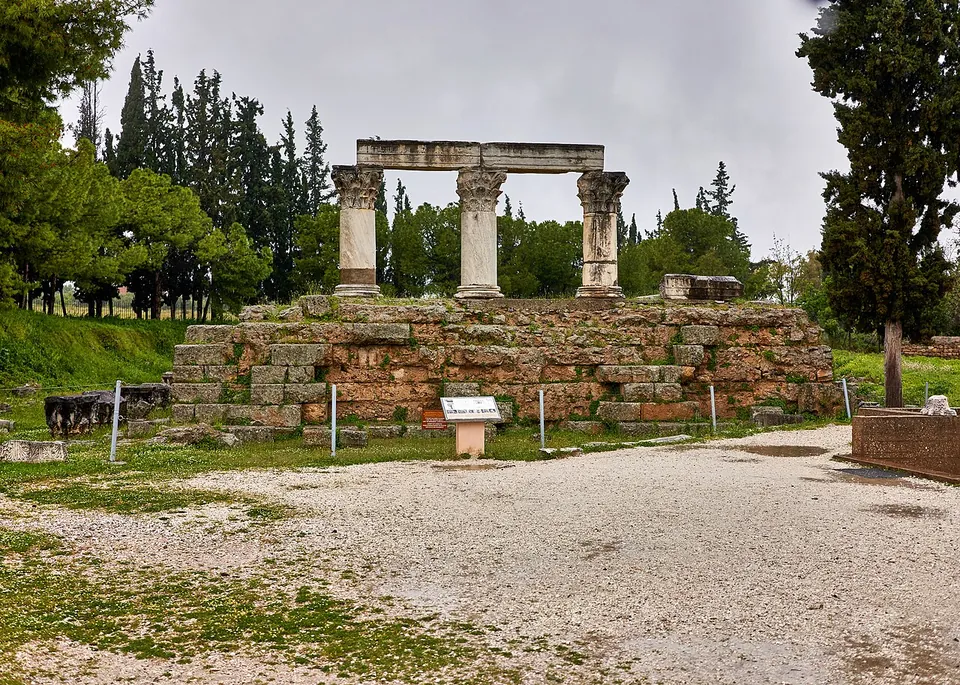

Nearby
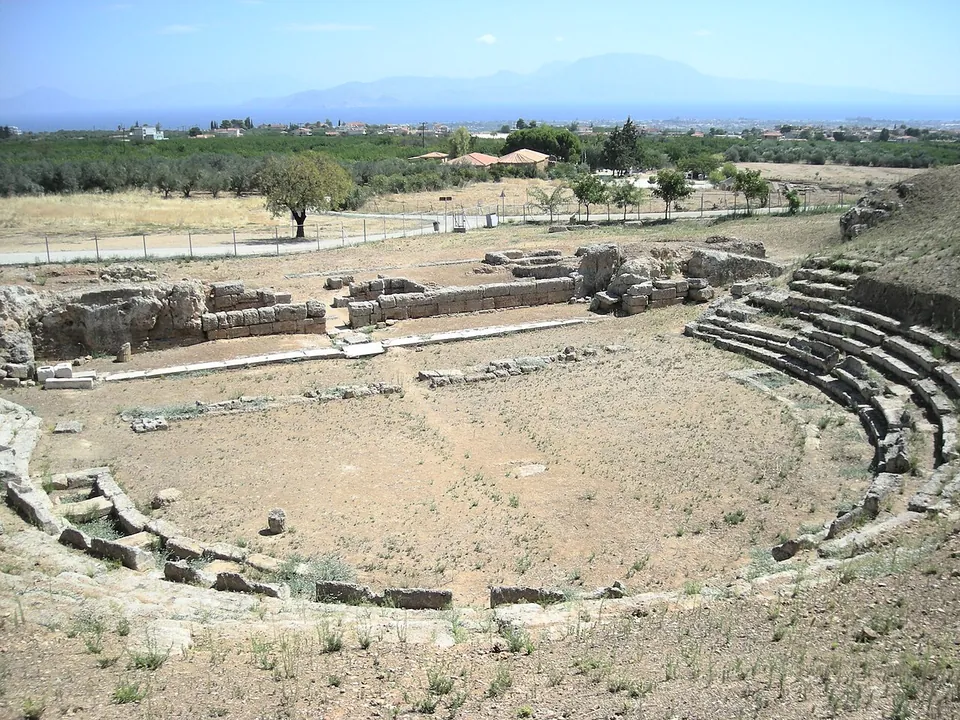
Photo: Future Perfect at Sunrise · Public domain · Commons
17 km · city · Corinthia
Sicyon
The Roman bath house, north of the agora, was a brick-built public bath, preserved in fairly good condition with walls up to 4 m high.
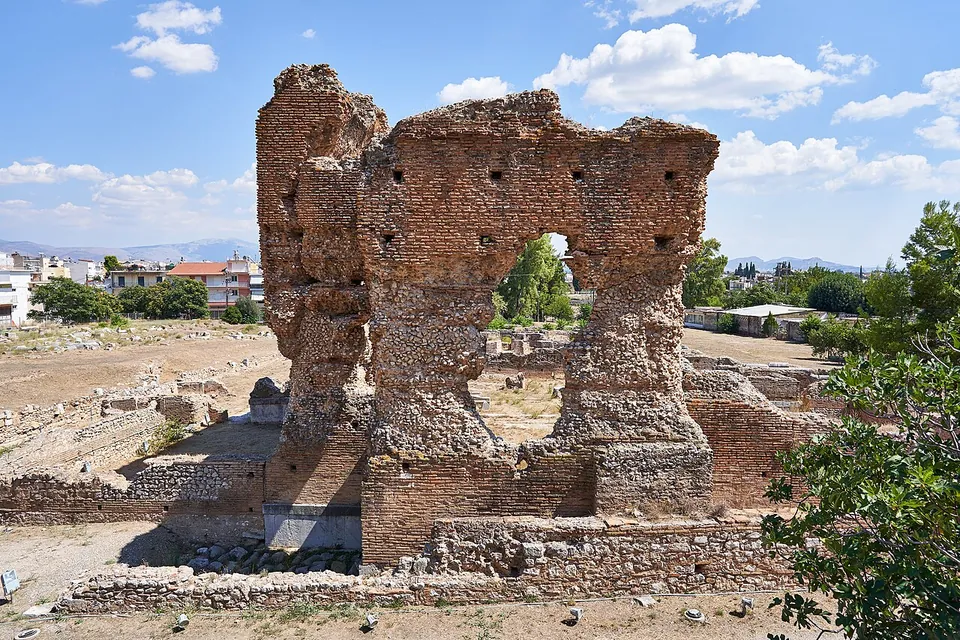
Photo: George E. Koronaios · CC0 · Commons
34 km · city · Argolis
Argos
The theatre, with about 20,000 seats, is among the largest ancient theatres in Greece.
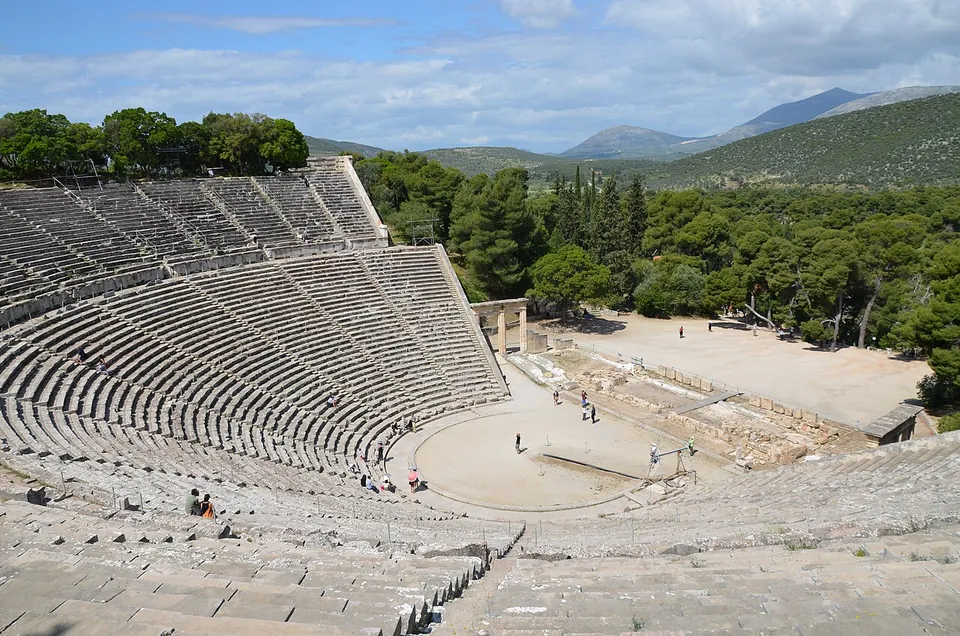
Photo: Carole Raddato from FRANKFURT, Germany · CC BY-SA 2.0 · Commons
38 km · site · Argolis
Sanctuary of Asclepius, Epidaurus
Most of what you see is Greek, from the sanctuary's great building period in the 4th and 3rd centuries BC: the Temple of Asclepius, which once held a gold-and-ivory statue of the god; the Abaton, the colonnade where the healing rituals took place; the Tholos, a round building; the Katagogion, a guest house of 160 rooms; the stadium; and the theatre (the operator).


Straight-line distances.
Sources
Every fact on this page comes from the records below, each used under the licence noted.
| Source | Licence |
|---|---|
| Pleiades 766723266 | CC BY |
| Wikidata Q101834062 | CC0 |
| Hellenic Heritage (H.O.C.R.E.D., for the Ministry of Culture) — Ancient Corinth, hours and tickets | licence not recorded |
| Ministry of Culture and Sports (Odysseus) — Ancient Corinth | licence not recorded |
| American School of Classical Studies at Athens (the excavators) — Corinth, history and timeline | licence not recorded |
| American School of Classical Studies at Athens — The Julian Basilica (Corinth XXII) | licence not recorded |
| Wikipedia (en) — Ancient Corinth | CC BY-SA 4.0 |
| Wikipedia (en) — Achaia (Roman province) | CC BY-SA 4.0 |