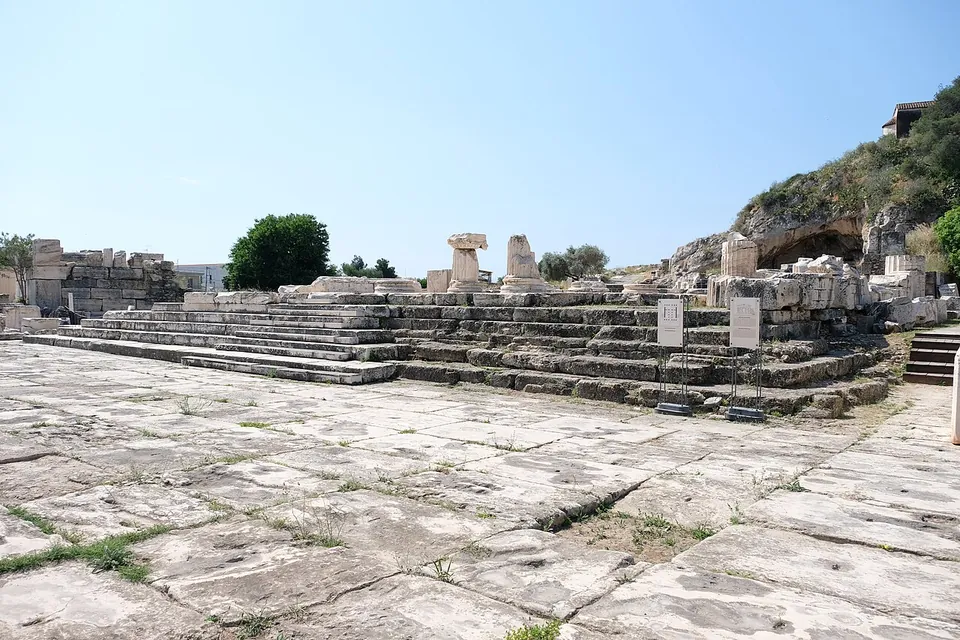
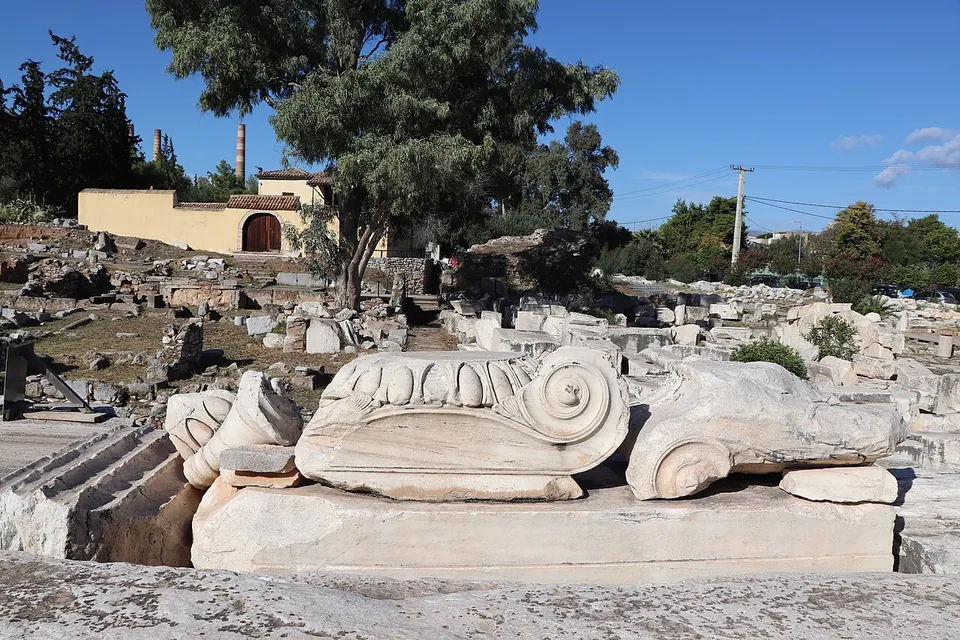
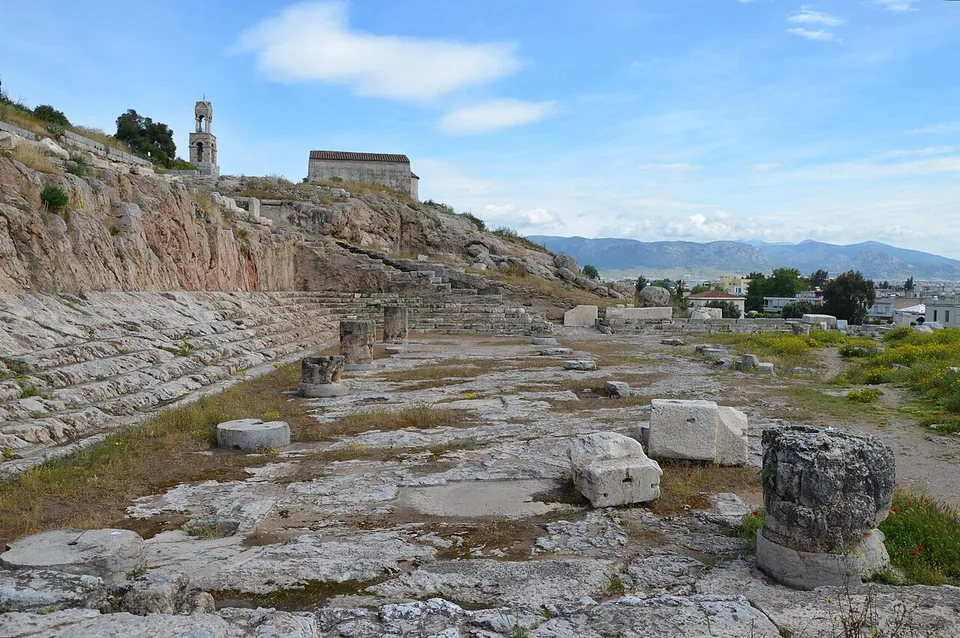
Eleusis was the sanctuary of Demeter and Persephone, where the Eleusinian Mysteries were celebrated from the Bronze Age into the Roman Imperial period, 22 km west of Athens (Pleiades; the operator). Its great initiation hall is Greek, but most of the ruins you walk through are Roman: the sanctuary flourished under Rome, Hadrian was initiated here, and many of its buildings went up under Hadrian and Marcus Aurelius (de.wikipedia; en.wikipedia).
What is there today
The visit follows the Processional Road, the end of the Sacred Way from Athens, through the Greater and the Lesser Propylaia to the Telesterion (the operator).
The Greater Propylaia, the outer gateway of the sanctuary, was completed by the emperor Marcus Aurelius and modelled on the Propylaia of the Acropolis in Athens (Pleiades). You reach it across a paved forecourt (de.wikipedia).
The Telesterion, the hall of initiation, was a square hall of columns with six entrances, of which only the foundations remain; its eight tiers of seating held about 5,000 people (the operator). It was first designed by Ictinus, the architect of the Parthenon, and most of what is visible is of the 5th century BC, but it was altered again in the Roman period, in the 2nd century AD (en.wikipedia). Beside it, a cave in the rock, the Ploutonion, was held to be a gate to the underworld (de.wikipedia).
Roman buildings south of the sanctuary include a small temple of the 1st century AD, which its excavator took for a Mithraeum; Pleiades doubts this, and one suggestion is a cult of Augustus, and a colonnaded building of the same century, perhaps a gymnasium or a sanctuary of the imperial cult (Pleiades). A large Roman house of the priests was found in 1962 (en.wikipedia).
Outside the site, the best-preserved stretches of the aqueduct completed around 160 run along the east side of Dimitros Street, and a Roman bridge of four arches that carried the Sacred Way over the Kephissos survives about 1 km from the sanctuary (en.wikipedia).
Is it worth the trip?
Yes, if you are curious about the Mysteries: it is the place itself, under a modern industrial town, and the €10 ticket includes the museum (the operator). Expect foundations and steps rather than standing buildings, and a sanctuary whose surviving fabric is largely Roman (de.wikipedia). It is 40 minutes by car from central Athens (the operator).
Getting there
The entrance is at the corner of Gioka and Dimitros streets in Elefsina. Bus 876 runs from Agia Marina metro station to the “Eleusis Square” stop; by car it is 40 minutes from the centre of Athens (the operator). A car park is mapped about 250 m from the site (OpenStreetMap).
It opens daily except Tuesday, 08.00–20.00 from 1 April to 31 August, closing earlier through September and October (18.00 by the second half of October), and 08.30–15.30 from 1 November to 31 March. Last entry is 20 minutes before closing; it is shut on 1 January, 25 March, 1 May, Easter Sunday and 25–26 December. A ticket is €10, reduced €5, and covers the site and the museum; entry is free on 6 March, 18 April, 18 May, the last weekend of September, 28 October, and on the first and third Sunday of each month from November to March (hh.gr, read 9 October 2026 — check before travelling). There is a shop, toilets and parking (the operator).
Visiting details
- Opening hours
- Daily except Tuesday, 08.00–20.00 from 1 April to 31 August, then closing earlier through the autumn (19.30 in early September, 18.00 by late October); 08.30–15.30 from 1 November to 31 March. Last entry 20 minutes before closing. Closed 1 January, 25 March, 1 May, Easter Sunday and 25–26 December.
- Tickets
- €10, including the museum; reduced €5. Free on 6 March, 18 April, 18 May, the last weekend of September and 28 October, and on the first and third Sunday of each month from November to March.
- Parking
- A car park is mapped about 250 m from the site (OSM way/1492553218); bus 876 from Agia Marina metro station stops at "Eleusis Square" (the operator).
Hours and prices checked 9 October 2026 on the operator's own site. Confirm before travelling.
History
The Mysteries promised hope of a life after death to those initiated, and what happened at the rite was kept secret (en.wikipedia; the operator). They drew initiates from across the Greek world as early as 600 BC, and under Rome initiation became fashionable among the Roman nobility (en.wikipedia). Hadrian was initiated around 125 and raised embankments against the floods of the river Kephissos (en.wikipedia). The Mysteries declined in the mid to late 4th century, and in 396 Alaric’s Goths destroyed Eleusis (en.wikipedia). Excavation began in the late 19th century, and from 1945 it was continued by Ioannis Travlos and George Mylonas (de.wikipedia).
Nearby
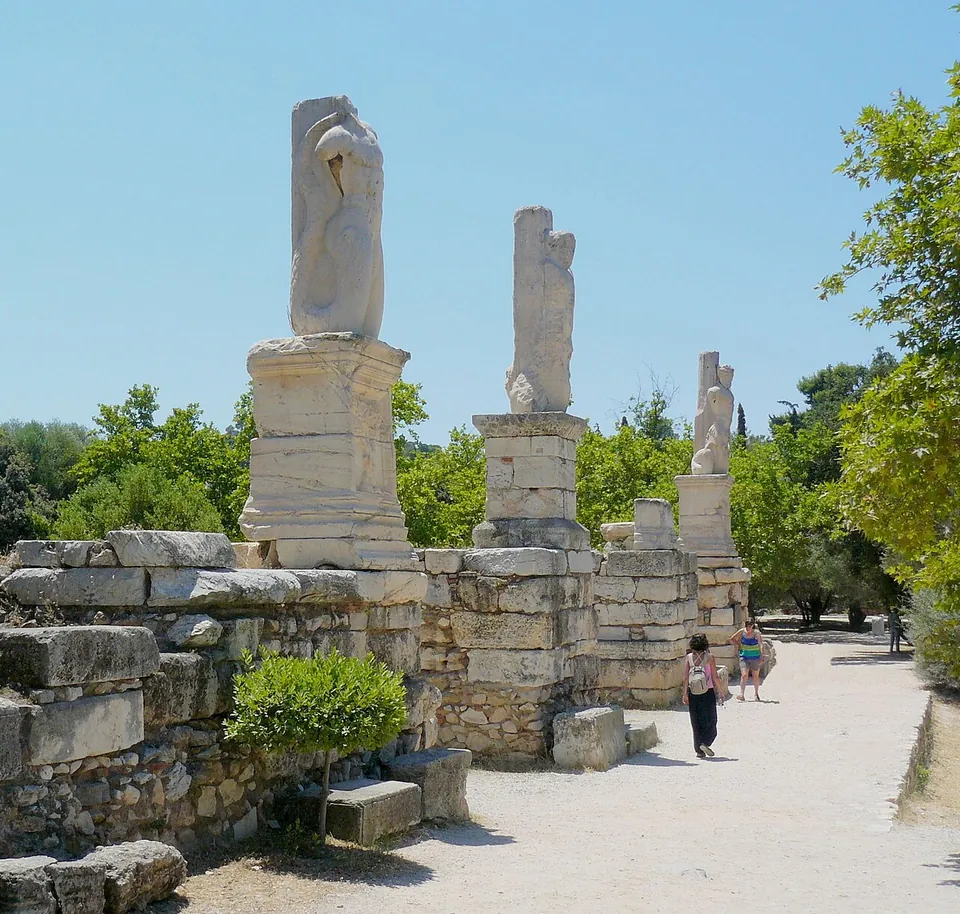
Photo: Janmad · CC BY-SA 4.0 · Commons
18 km · city · Central Athens
Ancient Agora of Athens
The Odeon of Agrippa was built about 15 BC in what had been open space in the middle of the Agora, a gift to the Athenians from Marcus Agrippa.
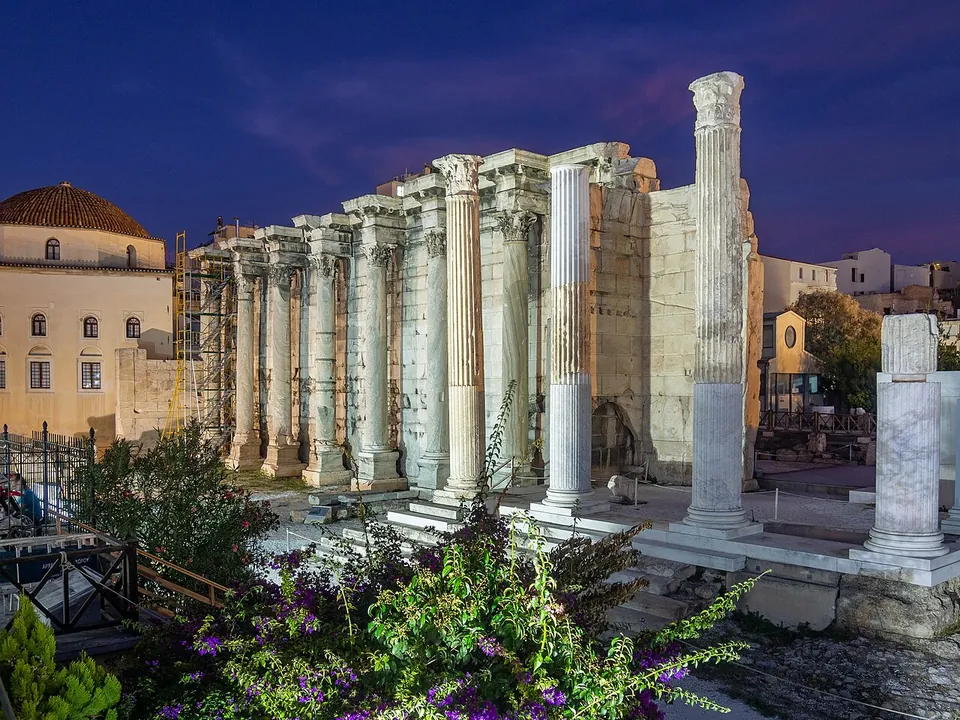
Photo: C messier · CC BY-SA 4.0 · Commons
18 km · site · Central Athens
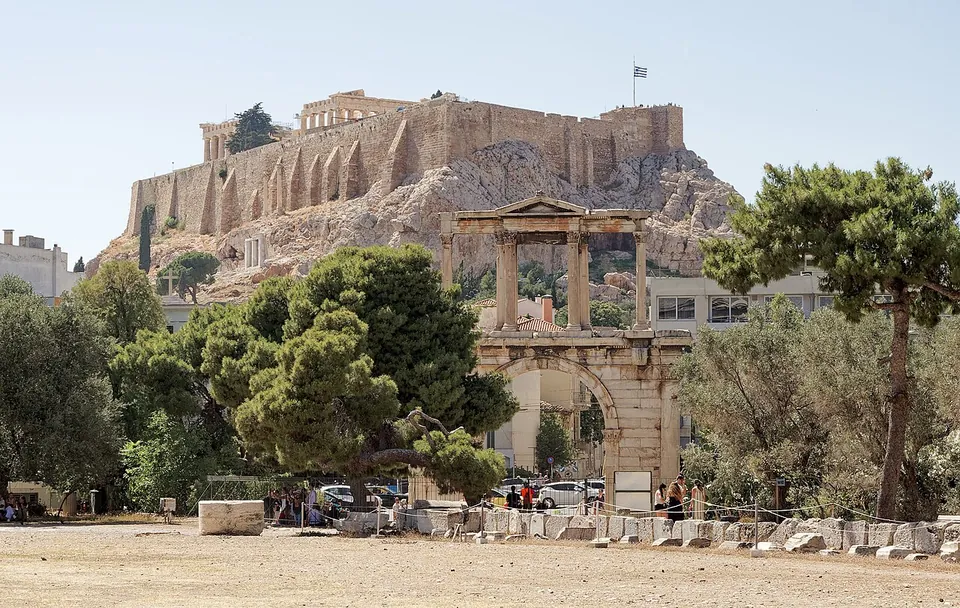
Hadrian's Library
Only the northern wing survives; the southern one has been destroyed completely (the operator).


Straight-line distances.
Sources
Every fact on this page comes from the records below, each used under the licence noted.
| Source | Licence |
|---|---|
| Pleiades 579920 | CC BY |
| Wikidata Q11918833 | CC0 |
| OpenStreetMap way/60095229 | ODbL |
| Hellenic Heritage (H.O.C.R.E.D., for the Ministry of Culture) — Eleusis, hours and tickets | licence not recorded |
| Wikipedia (en) — Elefsina | CC BY-SA 4.0 |
| Wikipedia (de) — Elefsina | CC BY-SA 4.0 |
| Wikipedia (en) — Achaia (Roman province) | CC BY-SA 4.0 |