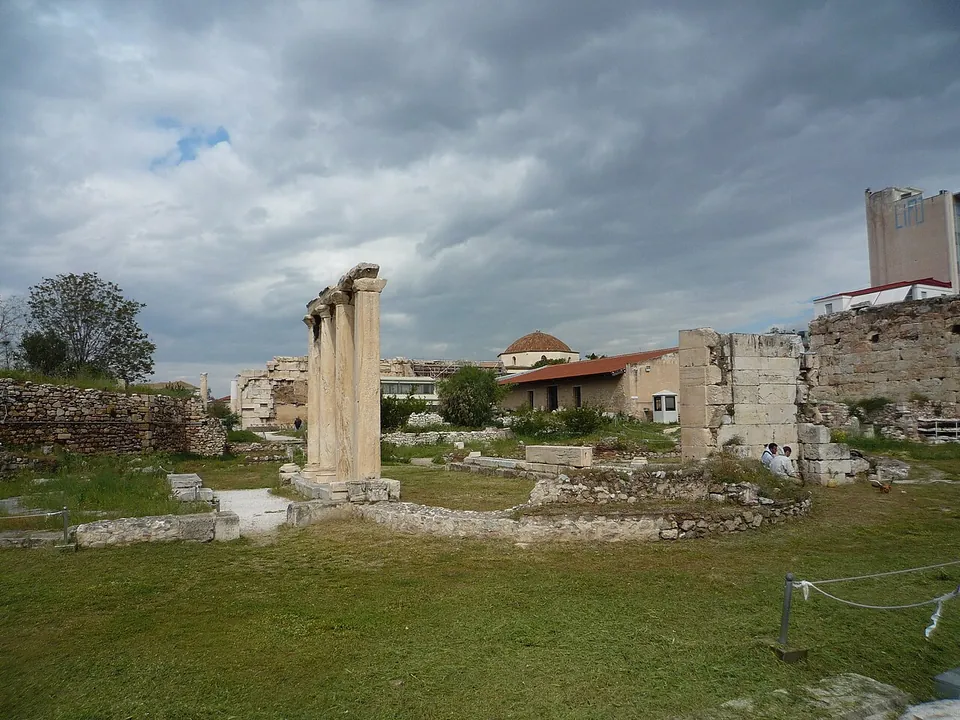
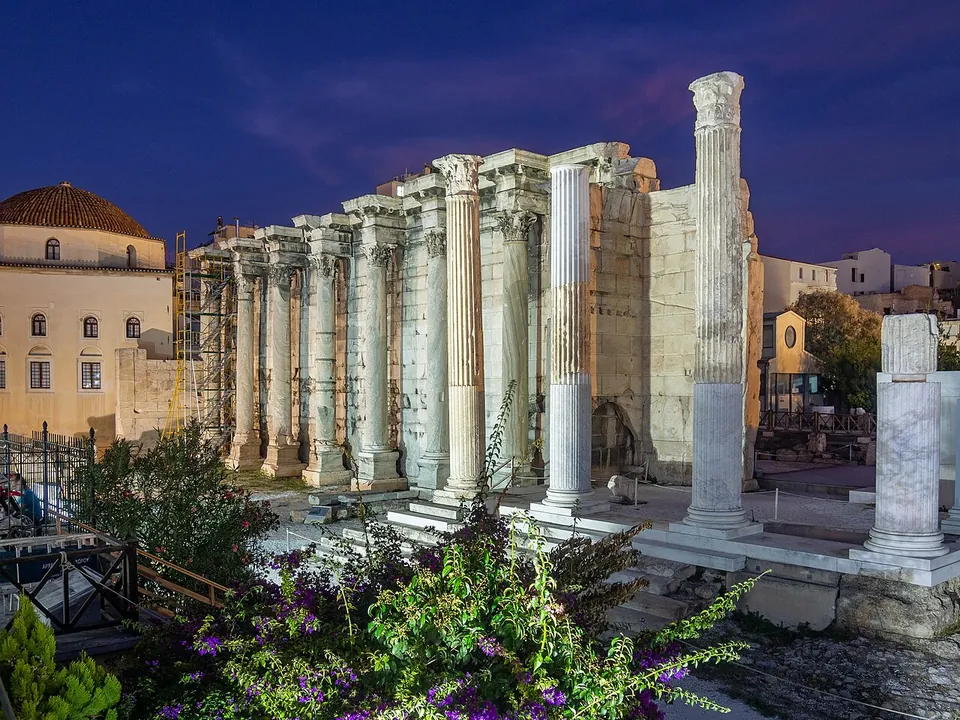
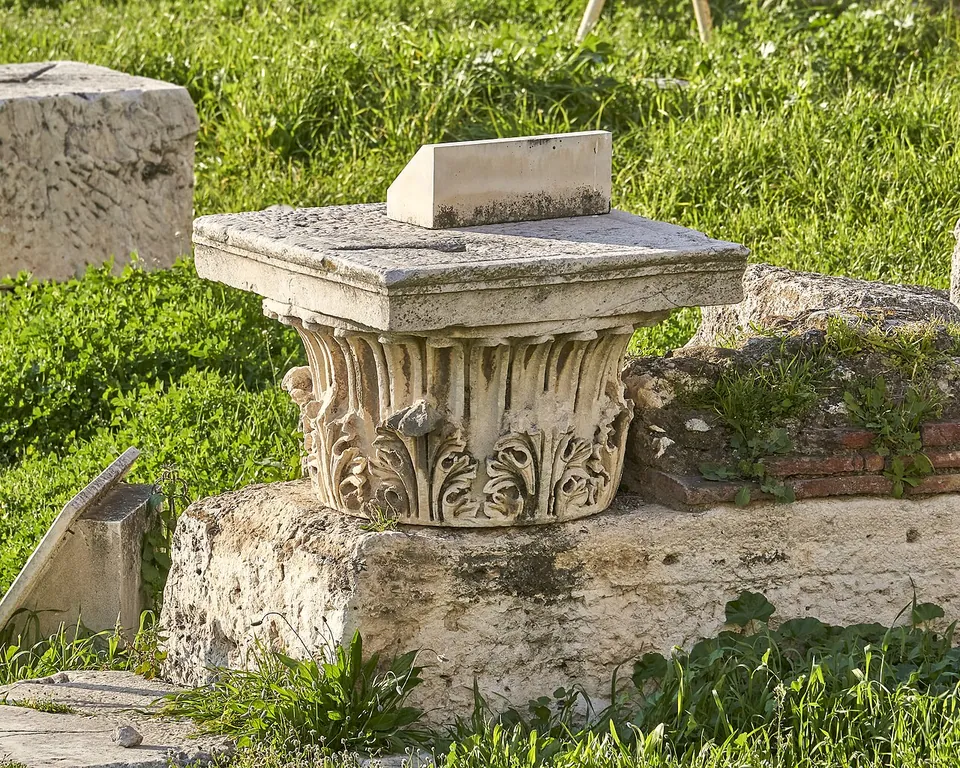


Hadrian’s Library is the ruin of the monumental building the emperor Hadrian put up in Athens around AD 132, beside the Roman Agora on the north side of the Acropolis. What stands is the northern part of its west front: a wall of marble with a row of Corinthian columns set against it.
What is there today
Only the northern wing survives; the southern one has been destroyed completely (the operator). At the front, the northern half of the west facade still stands, with Corinthian columns set against the wall (de.wikipedia). Behind it lay a courtyard of roughly 100 by 70 m, surrounded by a hundred columns of Phrygian marble (de.wikipedia; Pleiades), with an oblong pool in the middle; the library itself, with its shelves of papyrus rolls, reading rooms and lecture halls, was on the eastern side (en.wikipedia).
The site holds the remains of three later churches: a four-apsed church of the 5th century, a three-aisled basilica of the 7th, and a 12th-century church that was the first cathedral of the city (en.wikipedia). A larger-than-life marble statue of Nike, the goddess of victory, was dug up here in 1988 and is kept in a small exhibition room on the site, which is not open to the public at present (en.wikipedia). The former Tzisdarakis Mosque of 1759 stands right next to the library (de.wikipedia).
Is it worth the trip?
If you are at Monastiraki, yes - it is two minutes from the metro and 150 m from the Roman Agora, so the two make one short visit. Be clear about what it is: a single impressive facade and a broad precinct of foundations, more an idea of Hadrian’s Athens than a building you walk through. The ticket is €10.
Getting there
The entrance is at 3 Areos Street, two minutes on foot from Monastiraki metro station (lines 1 and 3); buses 025 and 026 stop at Monastiraki (the operator).
It opens daily from 08.00. From 1 April to 31 August it closes at 20.00; through September and October closing comes earlier in steps, to 18.00 in the second half of October; from 1 November to 31 March it closes at 15.00. Last entry is 20 minutes before closing, and the site is shut on 1 January, 25 March, 1 May, Easter Sunday and 25–26 December. A ticket is €10, reduced €5, and entry is free on 6 March, 18 April, 18 May, the last weekend of September, 28 October, and on the first and third Sunday of each month from November to March (hh.gr, read 9 October 2026 — check before travelling).
Visiting details
- Opening hours
- Daily 08.00–20.00 from 1 April to 31 August, then closing earlier through the autumn (19.30 in early September, 18.00 by late October); 08.00–15.00 from 1 November to 31 March. Last entry 20 minutes before closing. Closed 1 January, 25 March, 1 May, Easter Sunday and 25–26 December.
- Tickets
- €10; reduced €5. Free on 6 March, 18 April, 18 May, the last weekend of September and 28 October, and on the first and third Sunday of each month from November to March. Tickets online at tickets.hh.gr.
- Parking
- Street-side parking is mapped about 160 m away (OSM way/965230046); Monastiraki metro station is about 110 m from the point.
Hours and prices checked 9 October 2026 on the operator's own site. Confirm before travelling.
History
Hadrian built the complex around AD 132 (Pleiades; en.wikipedia), as part of the building programme he himself undertook in Athens (Pleiades). It was inaugurated around 132, when he visited the city for the third time; Pausanias described the building in detail without saying that it was a library (the operator). It served as a library and as a place where the city’s elite could meet and exchange ideas (Pleiades).
The Heruli badly damaged it in 267. The prefect Herculius repaired it in 407–412, and it was later built into the Roman city walls (en.wikipedia). The complex then became the site of the churches whose remains are still there (en.wikipedia; Pleiades).
More photographs
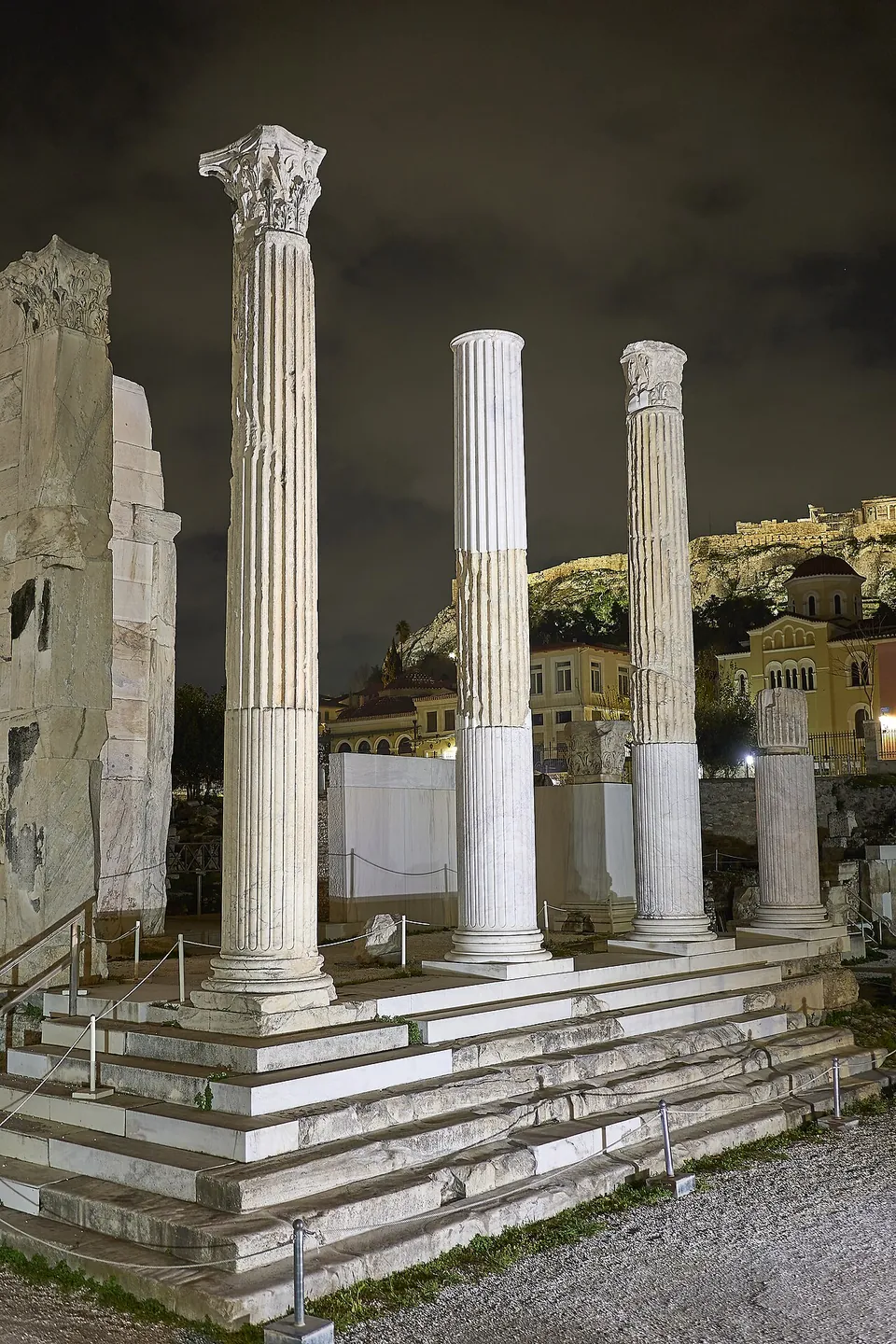

Nearby
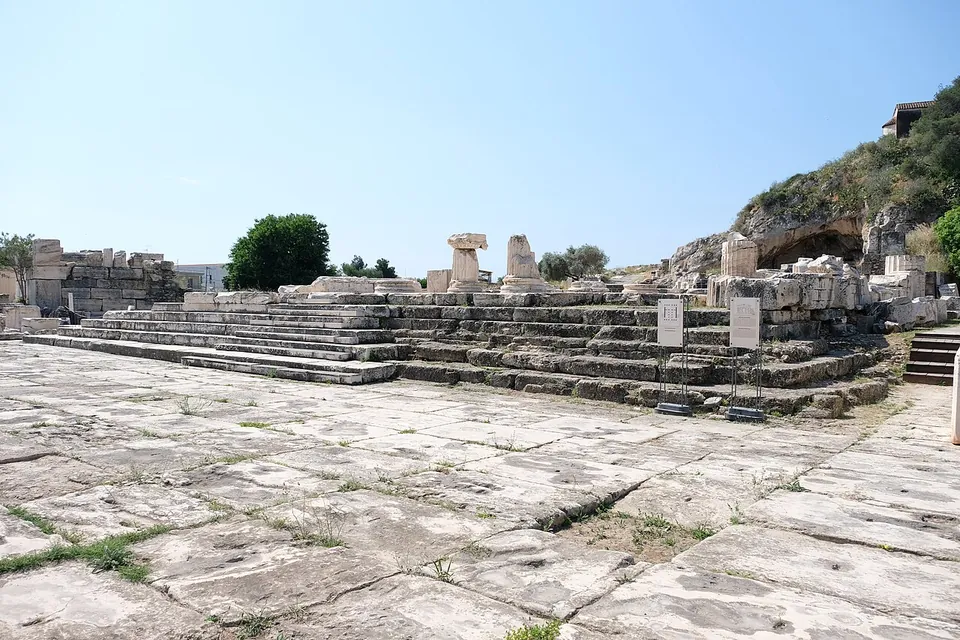
Photo: Davide Mauro · CC BY-SA 4.0 · Commons
18 km · site · West Attica
Eleusis
The visit follows the Processional Road, the end of the Sacred Way from Athens, through the Greater and the Lesser Propylaia to the Telesterion (the operator).

Straight-line distances.
Sources
Every fact on this page comes from the records below, each used under the licence noted.
| Source | Licence |
|---|---|
| Pleiades 728329644 | CC BY |
| Wikidata Q1455447 | CC0 |
| OpenStreetMap way/729674865 | ODbL |
| Wikipedia (en) — Hadrian's Library | CC BY-SA 4.0 |
| Wikipedia (de) — Hadriansbibliothek | CC BY-SA 4.0 |
| Wikipedia (en) — Victoria Romana (Hadrian's Library) | CC BY-SA 4.0 |
| Wikipedia (en) — Achaia (Roman province) | CC BY-SA 4.0 |
| Hellenic Heritage (H.O.C.R.E.D., for the Ministry of Culture) — Hadrian's Library, hours and tickets | licence not recorded |