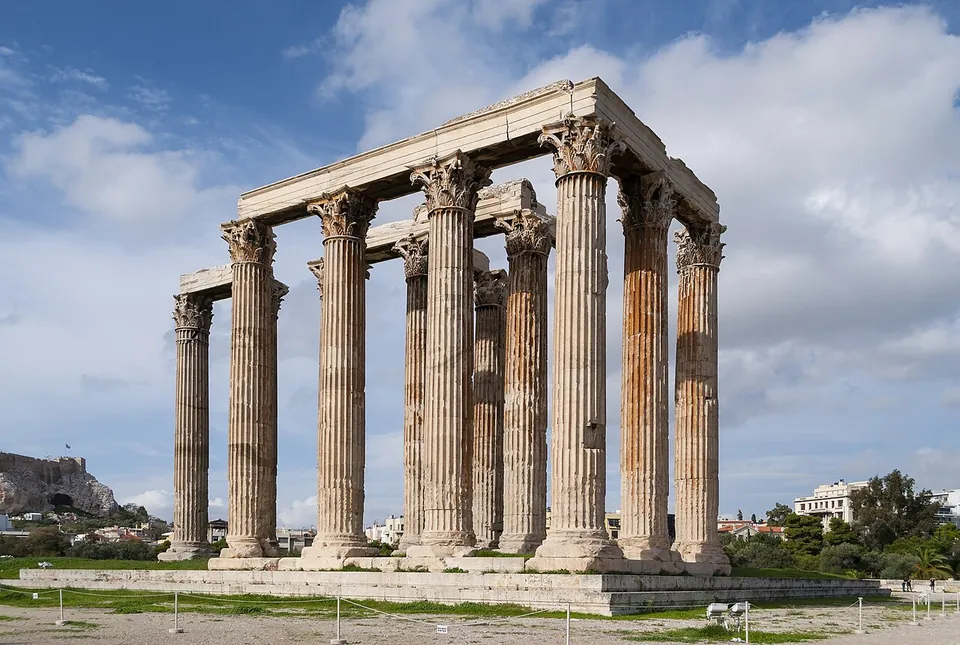


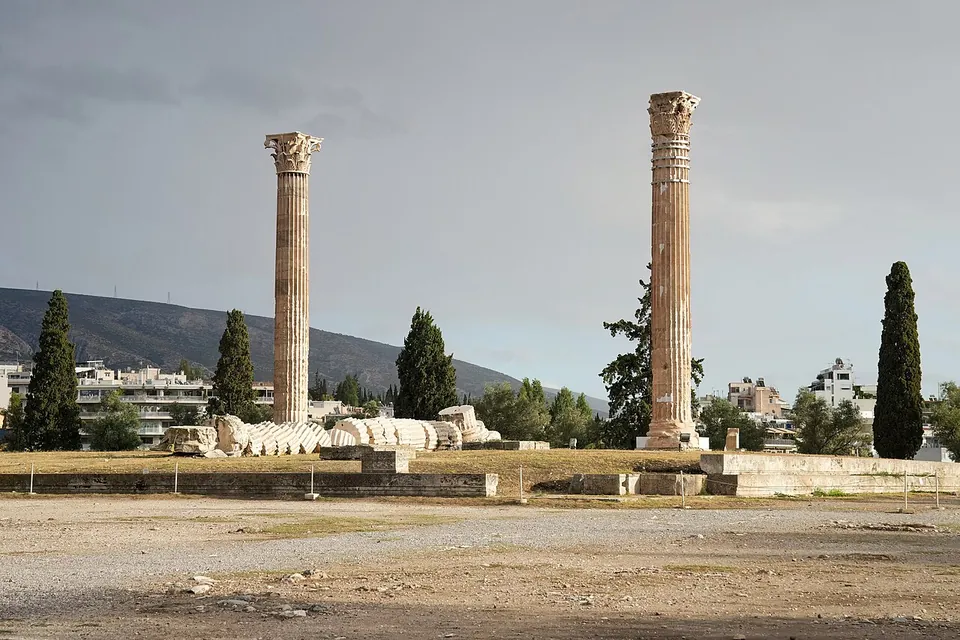
The Temple of Olympian Zeus was one of the largest temples of the ancient world. The tyrants of Athens began it in the 6th century BC, and it stood unfinished for more than six centuries, until the Roman emperor Hadrian completed it and dedicated it in 131–132 (the operator; en.wikipedia). Fifteen of its colossal Corinthian columns still stand, about 500 m south-east of the Acropolis, with Hadrian’s arch at the corner of the precinct (en.wikipedia).
What is there today
The temple, as Hadrian finished it, was of the Corinthian order and built of Pentelic marble, more than 100 m long and over 40 m wide, with 104 columns about 17 m high: two rows of twenty along each side and three rows of eight at each end (the operator; en.wikipedia; published measurements differ by a few metres). Sixteen columns survive: thirteen at the south-east corner and three near the south-west corner, of which the middle one fell in a storm in 1852 and lies where it fell. Nothing remains of the inner chamber or of the gold-and-ivory statue of Zeus it held (en.wikipedia; the operator).
Hadrian also enclosed the temple in a walled precinct paved with marble, filled with statues of the emperor dedicated by many cities, and the bases of some of them have been found at regular intervals round it (en.wikipedia).
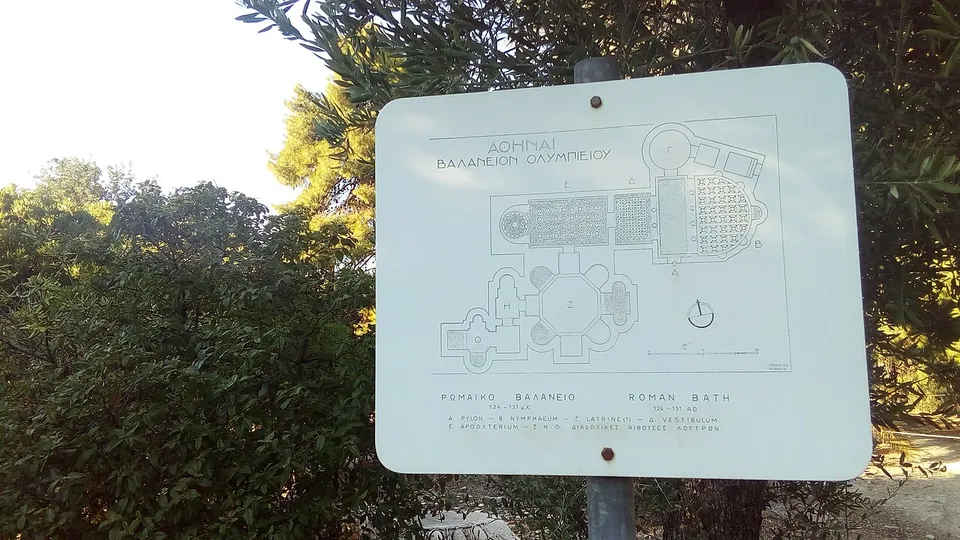
The Roman bath in the site dates from 124–131, the years of Hadrian’s building in Athens. The sign beside it shows a gateway, a fountain house, a probable latrine, an entrance hall, a changing room and a series of bathing halls (the sign at the bath).
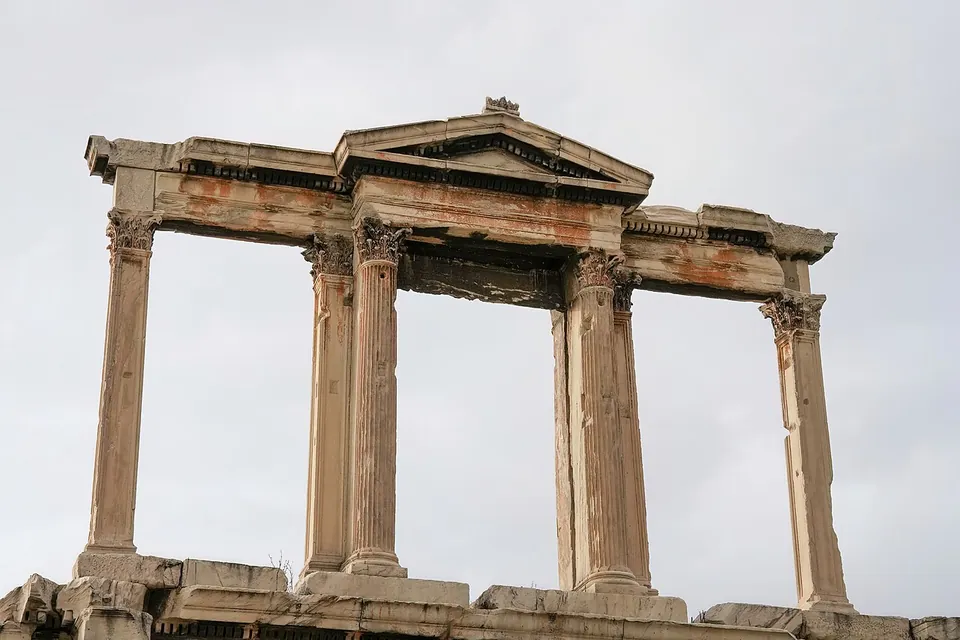
The Arch of Hadrian stands at the north-west corner of the precinct (en.wikipedia), on Amalias Avenue. It is a marble gateway 18 m high and 13.5 m wide, with a single arch below and an upper storey of Corinthian columns framing three bays (en.wikipedia, Arch of Hadrian). It was probably put up by the citizens of Athens in 131 or 132 to honour Hadrian, perhaps for the dedication of the temple; its two inscriptions, facing opposite ways, name Theseus and Hadrian as founders of Athens (en.wikipedia, Arch of Hadrian; Pleiades). Rome’s triumphal arches usually carried large statues on a massive upper storey; this one’s light upper storey has no room for them (en.wikipedia, Arch of Hadrian).
Is it worth the trip?
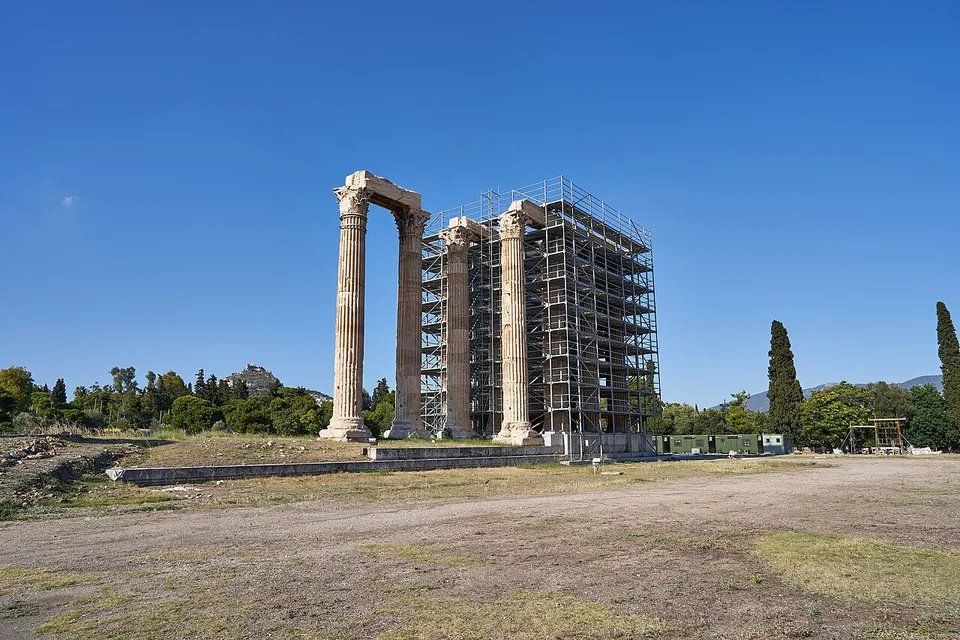
Yes. This is Hadrian’s Athens at full scale: in the Roman period the temple was renowned as the largest in Greece (en.wikipedia), and Hadrian’s completion of it was perhaps his most important gift to the city (the operator). A ticket is €20 (the operator); the Arch of Hadrian stands outside the fence on a public avenue. Photographs from 2021 and 2022 show scaffolding round the main group of columns, so part of it may be under restoration when you visit.
Getting there
The site’s address is Vasilissis Olgas Avenue, a 7-minute walk from the Akropoli metro station (line 2); the tram (line T6, Leoforos Vouliagmenis stop), buses 040, 230 and A2 and several trolleybuses also stop nearby (the operator). The Arch of Hadrian is outside the fence, on Amalias Avenue (en.wikipedia), and the Panathenaic Stadium is about 700 m to the east. Car parks are mapped about 200 m away (OpenStreetMap).
It opens daily, 08.00–20.00 from 1 April to 31 August, closing earlier through September and October (18.00 by the second half of October), and 08.00–15.00 from 1 November to 31 March. Last entry is 20 minutes before closing; it is shut on 1 January, 25 March, 1 May, Easter Sunday and 25–26 December. A ticket is €20, reduced €10, and entry is free on 6 March, 18 April, 18 May, the last weekend of September, 28 October, and on the first and third Sunday of each month from November to March (hh.gr, read 9 October 2026 — check before travelling).
Visiting details
- Opening hours
- Daily, 08.00–20.00 from 1 April to 31 August, then closing earlier through the autumn (19.30 in early September, 18.00 by late October); 08.00–15.00 from 1 November to 31 March. Last entry 20 minutes before closing. Closed 1 January, 25 March, 1 May, Easter Sunday and 25–26 December.
- Tickets
- €20; reduced €10. Free on 6 March, 18 April, 18 May, the last weekend of September and 28 October, and on the first and third Sunday of each month from November to March.
- Parking
- Car parks are mapped about 190 m and 250 m away (OSM way/233182027, node/3483488253); Akropoli metro station (line 2) is a 7-minute walk.
Hours and prices checked 9 October 2026 on the operator's own site. Confirm before travelling.
History
The site was an ancient open-air sanctuary of Zeus, where the tyrant Peisistratus built a first temple around 550 BC. It was demolished after his death, and his sons began a colossal limestone temple in the Doric style around 520 BC (515 BC by the operator’s date), and the work stopped when the tyranny fell in 510 BC; Aristotle cited it as a project to keep the people busy and poor (en.wikipedia; the operator). In 174 BC the Seleucid king Antiochus IV took it up again under the Roman architect Decimus Cossutius, who changed the design to Corinthian and the material to Pentelic marble; the work stopped again at the king’s death in 164 BC. In 86 BC the Roman general Sulla, sacking Athens, took some of the unfinished columns to Rome for the Temple of Jupiter on the Capitol (en.wikipedia).
Hadrian, who loved Greece, began a great building programme on his visit to Athens in 124–125. The temple was completed to Cossutius’s design with few changes and dedicated by Hadrian in 132, about 638 years after it was begun, with a gold-and-ivory statue of Zeus in its inner chamber and a colossal statue of Hadrian behind it, raised by the Athenians (en.wikipedia; the operator gives 131–132). The traveller Pausanias described it in the 2nd century (en.wikipedia).
The temple’s glory was short. It was badly damaged when the Heruli sacked Athens in 267, probably never repaired, and destroyed by an earthquake in the 5th century; its material went into a basilica built nearby in the 5th or 6th century, and later into the houses and churches of medieval Athens (en.wikipedia). In 1759 the Ottoman governor Tzistarakis had a column burned for lime to build his mosque in Monastiraki Square (en.wikipedia; the operator).
More photographs


Nearby
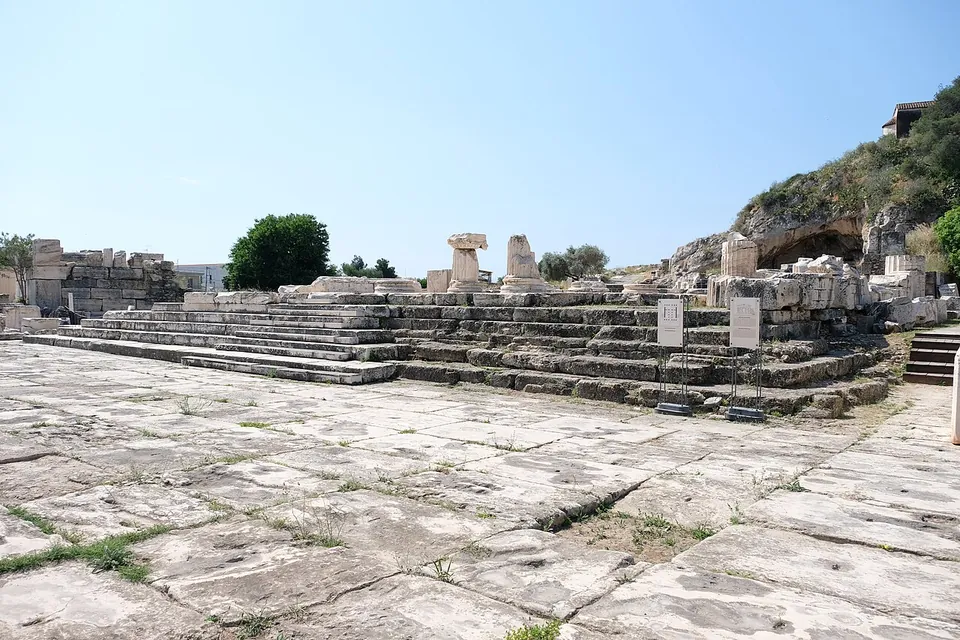
Photo: Davide Mauro · CC BY-SA 4.0 · Commons
19 km · site · West Attica
Eleusis
The visit follows the Processional Road, the end of the Sacred Way from Athens, through the Greater and the Lesser Propylaia to the Telesterion (the operator).

Straight-line distances.
Sources
Every fact on this page comes from the records below, each used under the licence noted.
| Source | Licence |
|---|---|
| Pleiades 659771158 | CC BY |
| Wikidata Q1123019 | CC0 |
| Vici.org 17742 | CC BY-SA (text), CC0 (metadata) |
| OpenStreetMap way/63765671 | ODbL |
| Hellenic Heritage (H.O.C.R.E.D., for the Ministry of Culture) — Olympieion, hours and tickets | licence not recorded |
| Wikipedia (en) — Temple of Olympian Zeus, Athens | CC BY-SA 4.0 |
| Wikipedia (en) — Arch of Hadrian (Athens) | CC BY-SA 4.0 |
| The sign at the Roman bath in the Olympieion site, photographed 2017 (Wikimedia Commons) | licence not recorded |
| Wikipedia (en) — Achaia (Roman province) | CC BY-SA 4.0 |