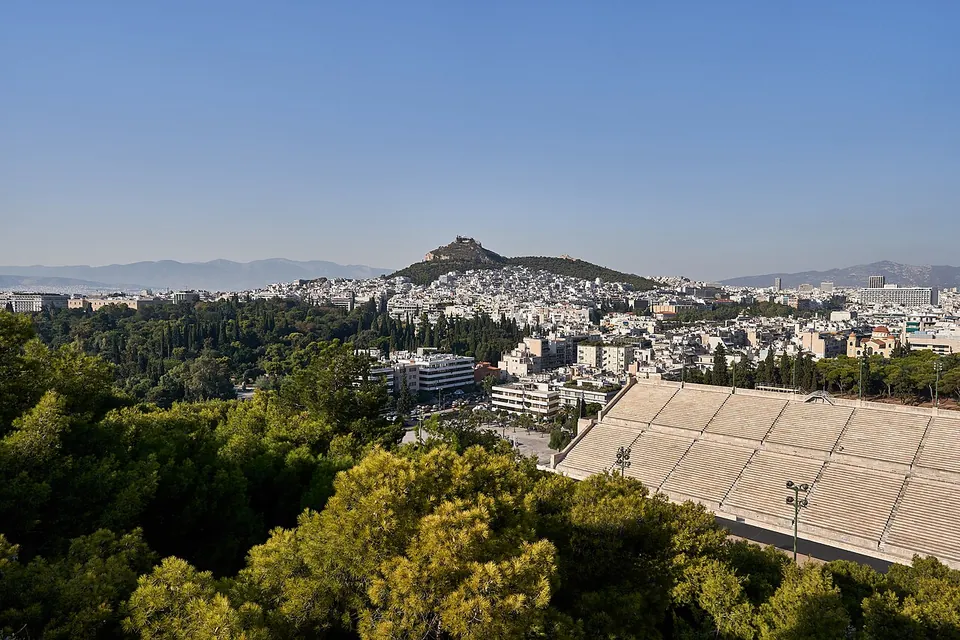
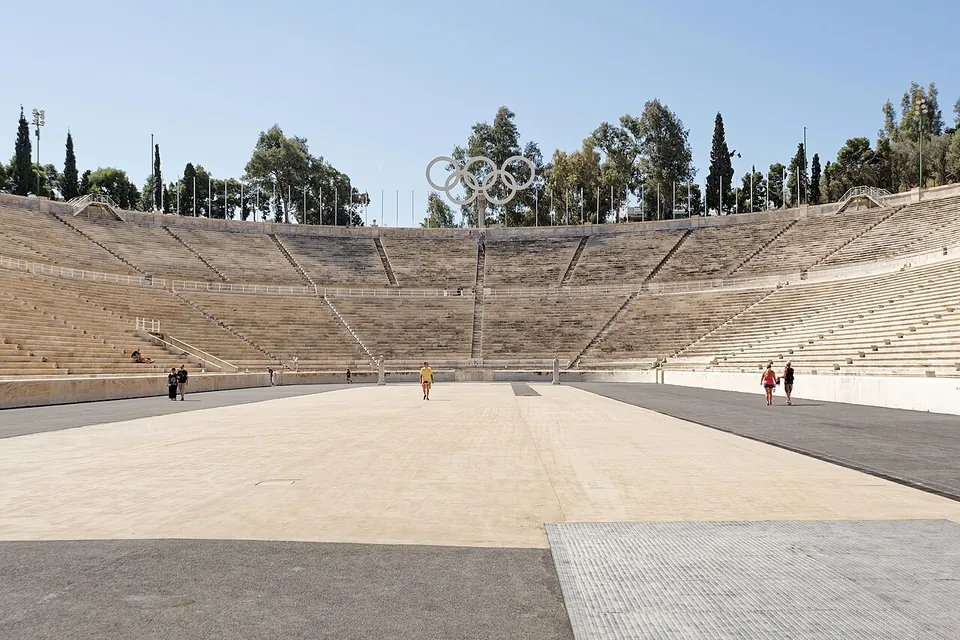
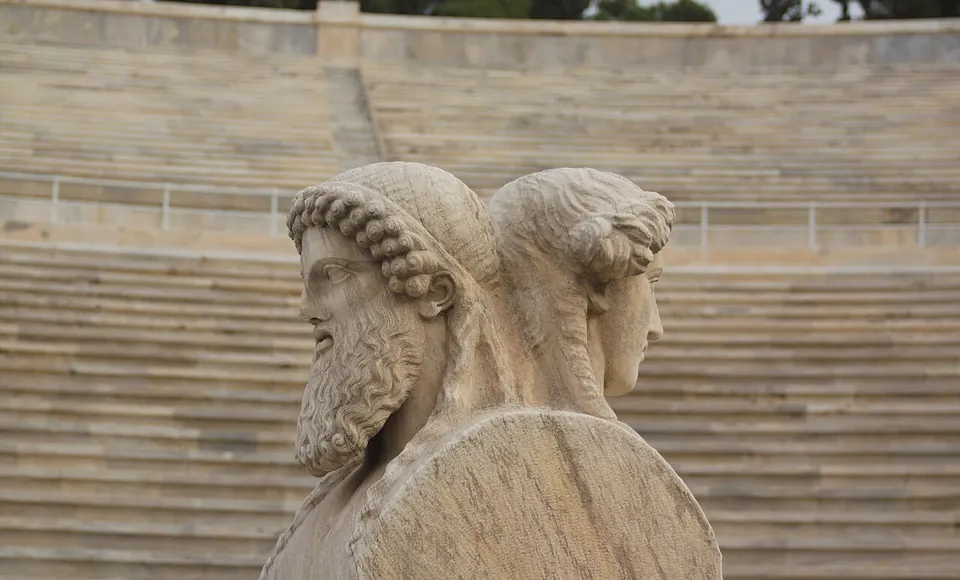


The Panathenaic Stadium is the marble stadium of ancient Athens, given its marble seats for 50,000 spectators by Herodes Atticus, an Athenian and a Roman senator, in the 2nd century AD (en.wikipedia; Pleiades). What you see today is its rebuilding for the first modern Olympic Games in 1896, a close copy of Herodes’ stadium (en.wikipedia).
What is there today
A long U-shaped stadium of white Pentelic marble, set in a natural ravine between two pine-covered hills, Ardettos and Agra, in the Pangrati district east of the National Garden (en.wikipedia). Its architect in the 1890s, Anastasios Metaxas, worked from what the excavations of 1869–70 had found and repeated the dimensions and design of the 2nd-century stadium, so the building closely follows Herodes’ (en.wikipedia).
With a ticket you can walk round the stadium and run on the track, go through the vaulted passage, and see an exhibition of Olympic posters and torches from 1896 onwards; the operator recommends the view from the upper tiers of section 21 over the Acropolis, the Zappeion and Lycabettus.
Is it worth the trip?
Yes, if you take it for what it is: a faithful rebuilding rather than a ruin, but one at the full size of Herodes’ stadium, built entirely of marble, which shows the scale Rome brought to a Greek building type (en.wikipedia). It is in central Athens, about 1 km from three metro stations, and a ticket is €12 (the operator).
Getting there
The entrance is on Vasileos Konstantinou Avenue, opposite the statue of the Discus Thrower. The stadium is about 1,000 m from the Akropoli, Syntagma and Evangelismos metro stations; buses and trolleys stop at “Stadium”, and the tram at Zappeio (the operator).
It opens daily, 08.00–19.00 from March to October and 08.00–17.00 from November to February, with last entry at closing time. A ticket is €12, reduced €6 for students, and includes a 30-minute audio guide and the museum; children up to 6, and disabled visitors with one companion, enter free (the operator, read 9 October 2026 — check before travelling). The track can be closed, and the hours changed, for events, which the operator announces on its site.
Visiting details
- Opening hours
- Daily, 08.00–19.00 from March to October and 08.00–17.00 from November to February; last entry at closing time. The track can be closed, and the hours changed, for events, which the operator announces on its site.
- Tickets
- €12; reduced €6 for students; free for children up to 6, disabled visitors and one companion. The ticket includes a 30-minute audio guide and the museum.
- Parking
- No car park of its own; the operator recommends the metro (Akropoli, Syntagma or Evangelismos, about 1,000 m away), buses and trolleys to the "Stadium" stop, or the tram to Zappeio. There is bicycle parking at the entrance.
Hours and prices checked 9 October 2026 on the operator's own site. Confirm before travelling.
History
A racecourse stood here from the 6th century BC for the Panathenaic Games, the festival of Athena, and spectators sat on the slopes of the ravine. Around 330 BC the statesman Lykourgos built a stadium of poros stone. Herodes Atticus rebuilt it entirely in Pentelic marble between 139/140 and 143/144 AD: a Greek building type, but, at 50,000 seats, “Roman in scale”, about the size of the Stadium of Domitian in Rome (en.wikipedia).
After the emperor Theodosius I banned the old festivals and spectacles in the late 4th century, the stadium was abandoned, its marble was taken for other buildings, and wheat grew on the site. The architect Ernst Ziller excavated it in 1869–70, and it was rebuilt in marble with money from George Averoff for the 1896 Olympics, whose opening and closing ceremonies it held (en.wikipedia).
Nearby
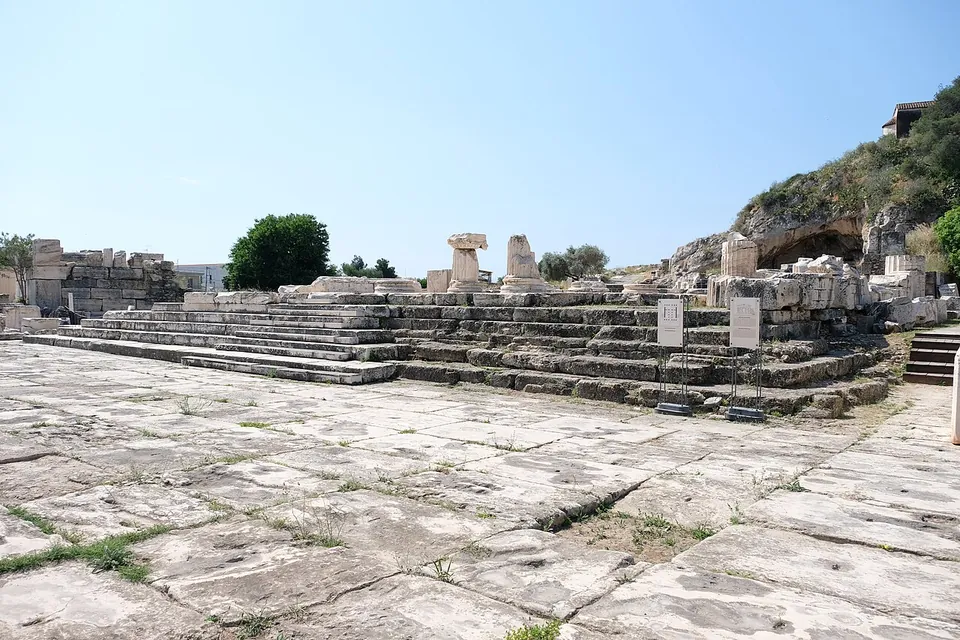
Photo: Davide Mauro · CC BY-SA 4.0 · Commons
20 km · site · West Attica
Eleusis
The visit follows the Processional Road, the end of the Sacred Way from Athens, through the Greater and the Lesser Propylaia to the Telesterion (the operator).

Straight-line distances.
Sources
Every fact on this page comes from the records below, each used under the licence noted.
| Source | Licence |
|---|---|
| Pleiades 433457819 | CC BY |
| Wikidata Q208811 | CC0 |
| OpenStreetMap relation/19023844 | ODbL |
| Panathenaic Stadium (the operator) — Visit, hours, tickets and getting here | licence not recorded |
| Wikipedia (en) — Panathenaic Stadium | CC BY-SA 4.0 |
| Wikipedia (en) — Achaia (Roman province) | CC BY-SA 4.0 |