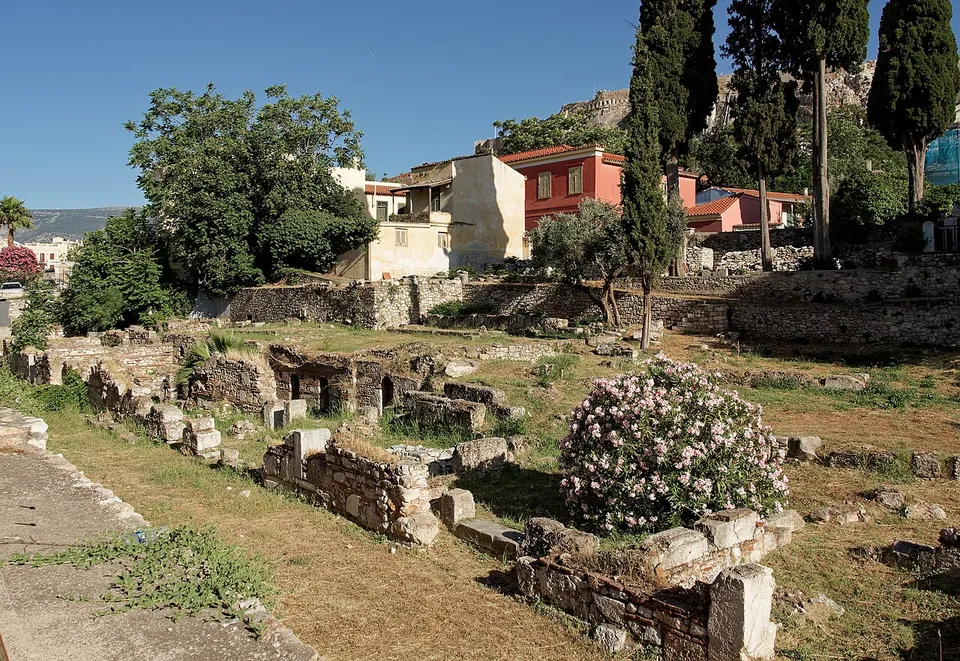


The Ancient Agora was the centre of public life in Classical Athens: its market, law courts, council house, temples and meeting place (the operator). Under Rome the old open square filled up with new buildings: a great concert hall given by the Roman statesman and general Agrippa, a library, fountains and colonnades, and in the 5th century a palace (en.wikipedia; Pleiades). Above it all stands the Temple of Hephaestus, the best-preserved temple of the 5th century BC (the operator).
What is there today
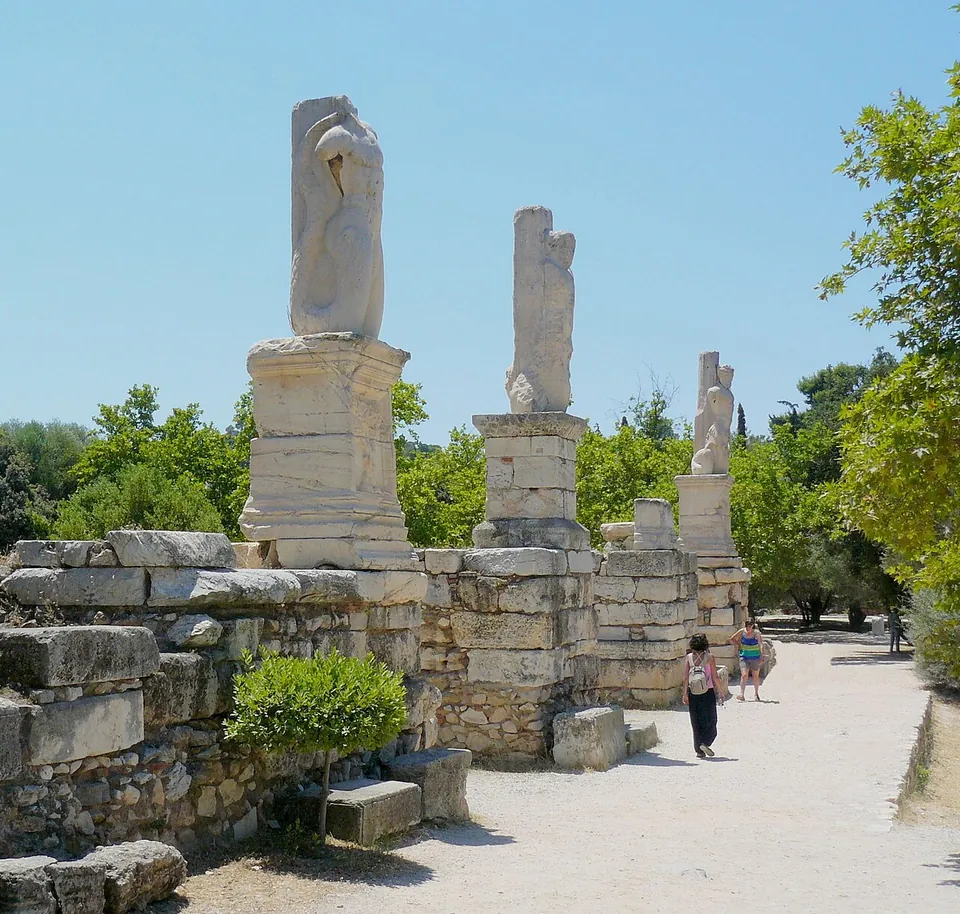
The Odeon of Agrippa was built about 15 BC in what had been open space in the middle of the Agora, a gift to the Athenians from Marcus Agrippa. Its two-storey hall seated about 1,000. Around 150 its roof, spanning 25 m, collapsed, and it was rebuilt as a smaller lecture hall for 500, with a grander north front whose pillars were carved as Giants and Tritons, figures with snake tails and fish tails. The Heruli destroyed it in 267, and in the early 5th century a large palace was built over the site, with those pillars reused for its monumental entrance (en.wikipedia, Odeon of Agrippa). They are the statues you see beside the path today. Pleiades describes a building put up with the palace, eleven rooms round a courtyard, as probably administrative.
The Library of Pantainos, in the south-east corner, was built by Flavius Pantainos about 97–102 and pulled down to make way for the late Roman wall after 267 (Pleiades). Beyond the books, its wings held rooms for other uses, and the official entrance to the Agora ran between it and the Stoa of Attalos (en.wikipedia). Nearby are a semicircular fountain house of the 140s and the Southeast Stoa of the mid 2nd century (Pleiades). On the east side stood a speakers’ platform put up by or for Roman generals in the late 2nd or early 1st century BC (Pleiades).
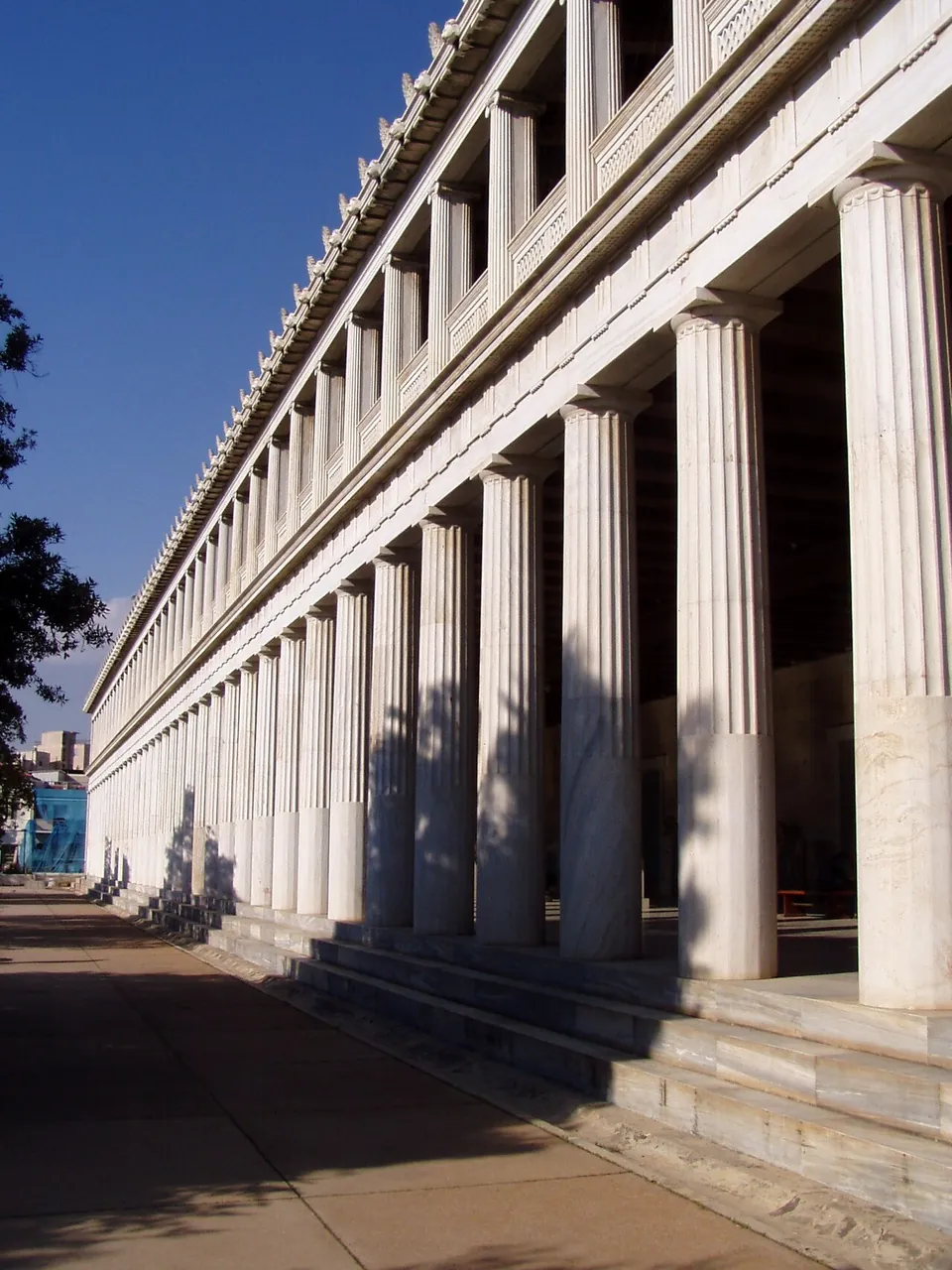
The Greek Agora is still the frame: the Temple of Hephaestus on the hill above, the council house and the Tholos at its foot (the operator), and the Stoa of Attalos of the 2nd century BC, rebuilt in the 1950s to house the site museum (en.wikipedia).
Is it worth the trip?
Yes. It is the heart of ancient Athens, a short walk from Monastiraki, and Rome’s buildings are a real part of it, above all the Odeon’s Giants. Combine it with the Roman Agora and Hadrian’s Library, both a few minutes’ walk away. A ticket is €20 (the operator).
Getting there
The entrance is at 24 Adrianou Street, 4 minutes on foot from Monastiraki Square and 14 from Syntagma; Monastiraki station is on metro lines 1 and 3, and Thiseio on line 1 (the operator).
It opens daily, 08.00–20.00 from 1 April to 31 August, closing earlier through September and October (18.00 by the second half of October), and 08.00–17.00 from 1 November to 31 March. Last entry is 20 minutes before closing; it is shut on 1 January, 25 March, 1 May, Easter Sunday and 25–26 December. A ticket is €20, reduced €10, and entry is free on 6 March, 18 April, 18 May, the last weekend of September, 28 October, and on the first and third Sunday of each month from November to March (hh.gr, read 9 October 2026 — check before travelling). There is a shop, toilets and a lift (the operator).
Visiting details
- Opening hours
- Daily, 08.00–20.00 from 1 April to 31 August, then closing earlier through the autumn (19.30 in early September, 18.00 by late October); 08.00–17.00 from 1 November to 31 March. Last entry 20 minutes before closing. Closed 1 January, 25 March, 1 May, Easter Sunday and 25–26 December.
- Tickets
- €20; reduced €10. Free on 6 March, 18 April, 18 May, the last weekend of September and 28 October, and on the first and third Sunday of each month from November to March.
- Parking
- No car park close by; Monastiraki metro station (lines 1 and 3) is a 4-minute walk, and Thiseio (line 1) is also near (the operator).
Hours and prices checked 9 October 2026 on the operator's own site. Confirm before travelling.
History
After the Roman general Sulla sacked Athens in 86 BC, marble workers set up in the ruins of the Agora’s south square (en.wikipedia). From the reign of Augustus the open square was built over: the Odeon in the middle, then under the emperors the library, fountains and colonnades (en.wikipedia; Pleiades). A statue of Hadrian found in 1932 is believed to be the one Pausanias saw in front of the Stoa of Zeus (en.wikipedia). The Herulian sack of 267 ended this phase: the Odeon was destroyed, and stone from the Library of Pantainos and the Southeast Stoa went into the new city wall (Pleiades). The American School of Classical Studies at Athens began excavating the Agora in 1931 (en.wikipedia).
Nearby
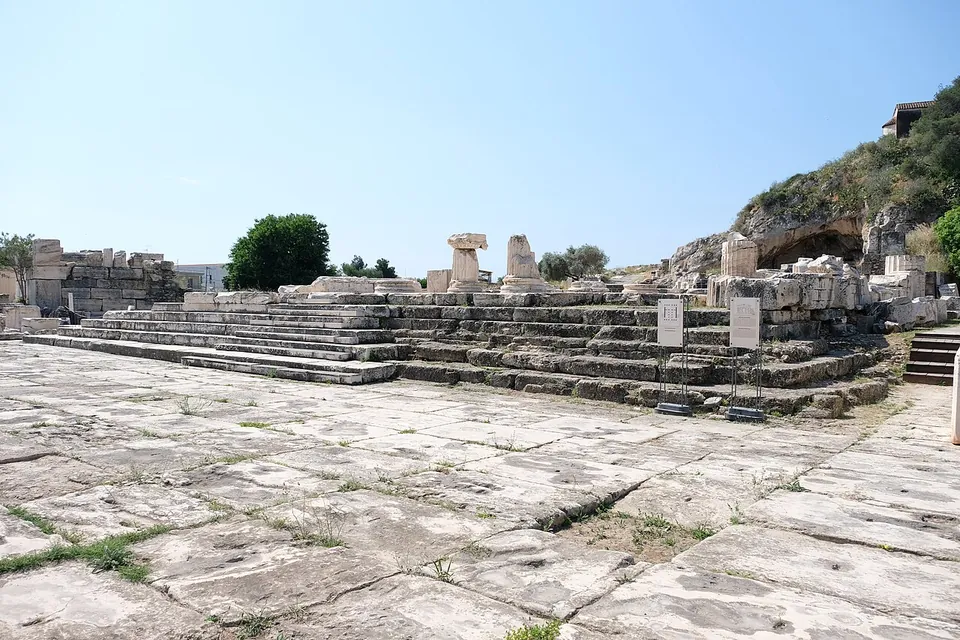
Photo: Davide Mauro · CC BY-SA 4.0 · Commons
18 km · site · West Attica
Eleusis
The visit follows the Processional Road, the end of the Sacred Way from Athens, through the Greater and the Lesser Propylaia to the Telesterion (the operator).

Straight-line distances.
Sources
Every fact on this page comes from the records below, each used under the licence noted.
| Source | Licence |
|---|---|
| Pleiades 807514119 | CC BY |
| Wikidata Q110976845 | CC0 |
| OpenStreetMap relation/13139942 | ODbL |
| Hellenic Heritage (H.O.C.R.E.D., for the Ministry of Culture) — Ancient Agora of Athens, hours and tickets | licence not recorded |
| Wikipedia (en) — Ancient Agora of Athens | CC BY-SA 4.0 |
| Wikipedia (en) — Odeon of Agrippa | CC BY-SA 4.0 |
| Wikipedia (en) — Achaia (Roman province) | CC BY-SA 4.0 |