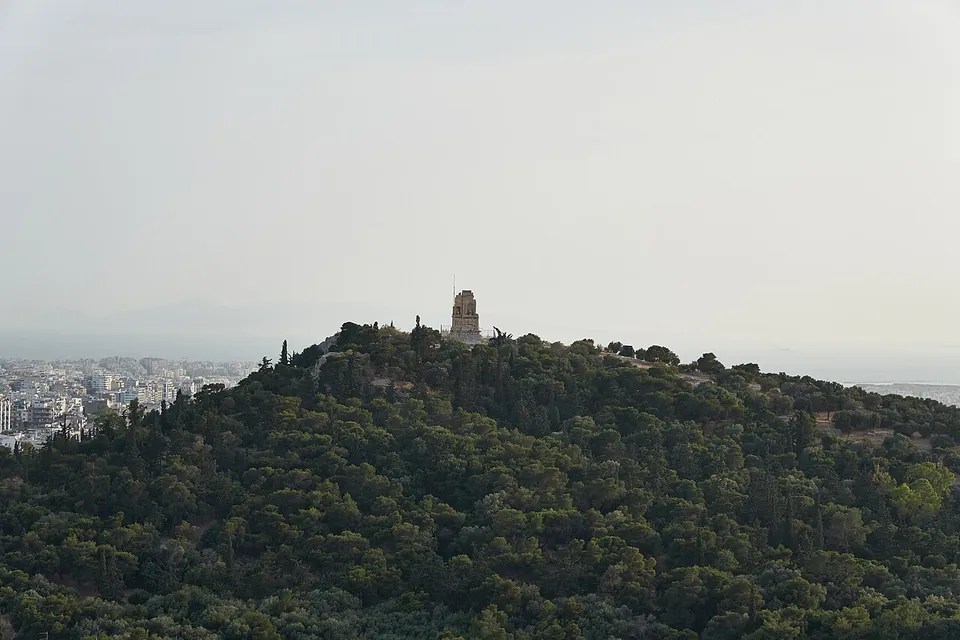
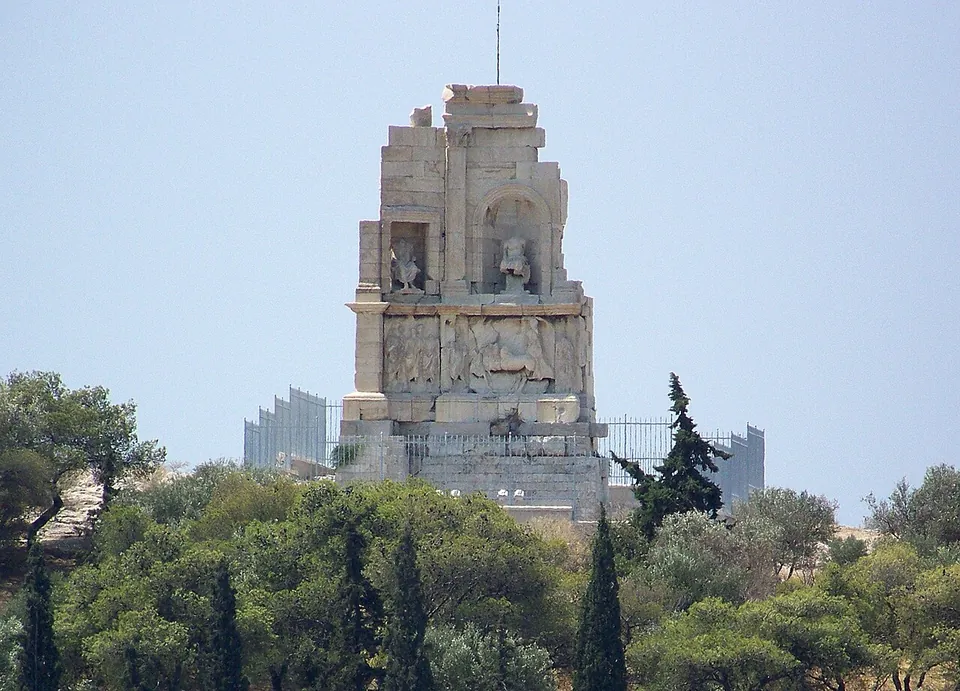


The Philopappos Monument is the marble tomb the Athenians built in the early 2nd century AD on the summit of Mouseion Hill, south-west of the Acropolis, for Philopappos, an exiled prince of Commagene and a benefactor of the city. Its front still stands, with two seated statues and a carved procession.
What is there today
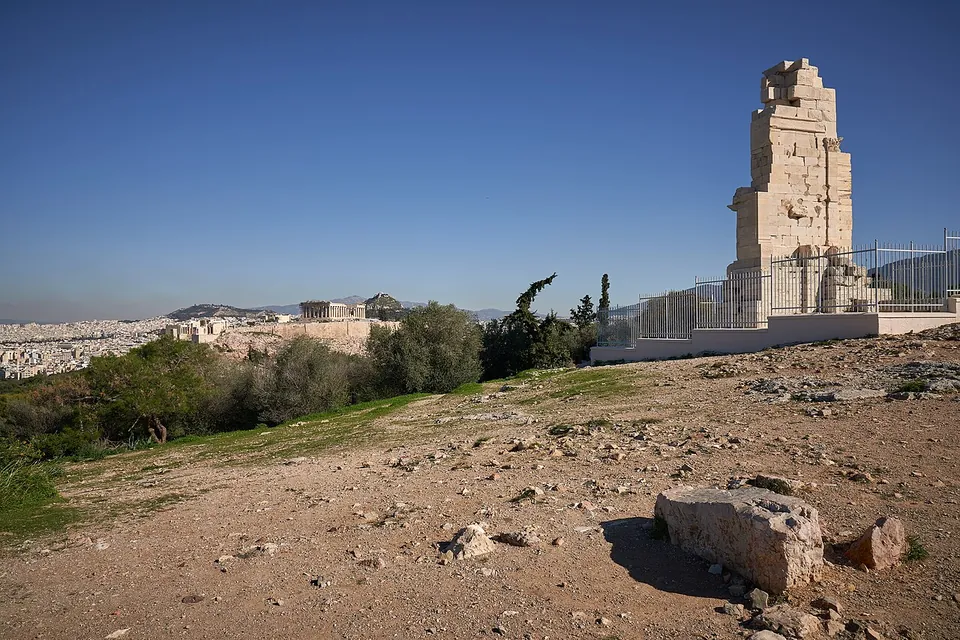
The tomb stands high on its hill and can be seen from far around. It was built of Pentelic marble on a footprint of about 9 by 9 m, and everything but its north facade has fallen. What survives shows the headless seated statues of Philopappos, in the middle, and of his ancestor Antiochus IV, to the left, with a relief of a triumphal procession below them (de.wikipedia). The monument is fenced (the photographs here show the railing), so you see it from the hilltop around it.
Is it worth the trip?
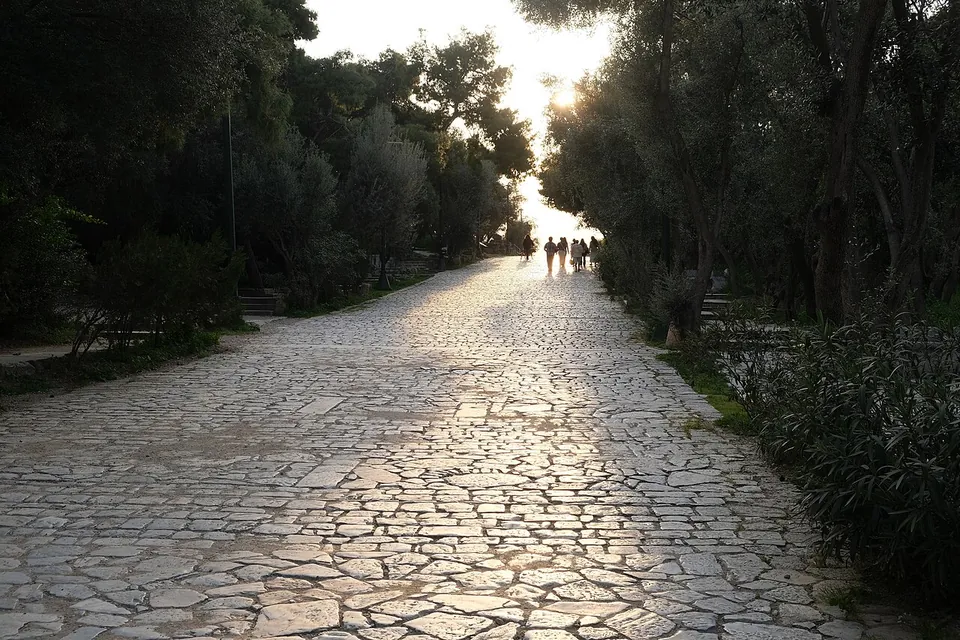
Yes, and the walk is part of the point. The monument is a Roman tomb in a commanding position, free to visit, and the hilltop looks across to the Acropolis, about 650 m away; the photograph at the top of this site’s Acropolis page was taken from this hill. It is a climb rather than a site visit: the path is rough stone, and not all of it is free of steps (This is Athens).
Getting there
Mouseion Hill rises opposite the Acropolis to the south-west (en.wikipedia, Philopappou). The nearest metro stations are Petralona on line 1 and Syngrou–Fix on line 2, and trolleybus 15 stops at Philopappou (en.wikipedia). A car and coach park is mapped about 290 m from the monument (OpenStreetMap).
Entry is free: the hill is open ground with no ticket (This is Athens, the City of Athens’ official guide, read 9 October 2026). It stays open because, when a 2002 plan proposed fencing the hill and charging admission, a residents’ movement fought it and won at the Council of State (STE) in 2015 (en.wikipedia).
Visiting details
- Tickets
- Free. The monument stands on open parkland on the hill, with no ticket.
- Parking
- A car and coach park is mapped about 290 m from the monument (OSM way/303308729, "Restaurant and Bus Parking").
Before you go
- The path up the hill is rough stone paving, and not all of it is step-free (This is Athens, the city's official guide).
Hours and prices checked 9 October 2026 on the operator's own site. Confirm before travelling.
History
Gaius Julius Antiochus Epiphanes Philopappos lived from about 65 to 116 and was a prince of the royal house of Commagene (en.wikipedia). He became a Roman citizen, a suffect consul in 109 and a citizen of Athens, of the deme of Besa (it.wikipedia). The monument was raised in his honour by the Athenians between 114 and 119 by de.wikipedia’s account, or between 114 and 116 by his sister, the poet Julia Balbilla, together with the citizens of Athens, by it.wikipedia’s.
It seems to have stood largely intact until at least the 15th century: Cyriacus of Ancona, who travelled in Greece between 1412 and 1445, recorded its inscriptions (de.wikipedia). The hill took its modern name from the monument (de.wikipedia, Philopappou).
More photographs

Nearby
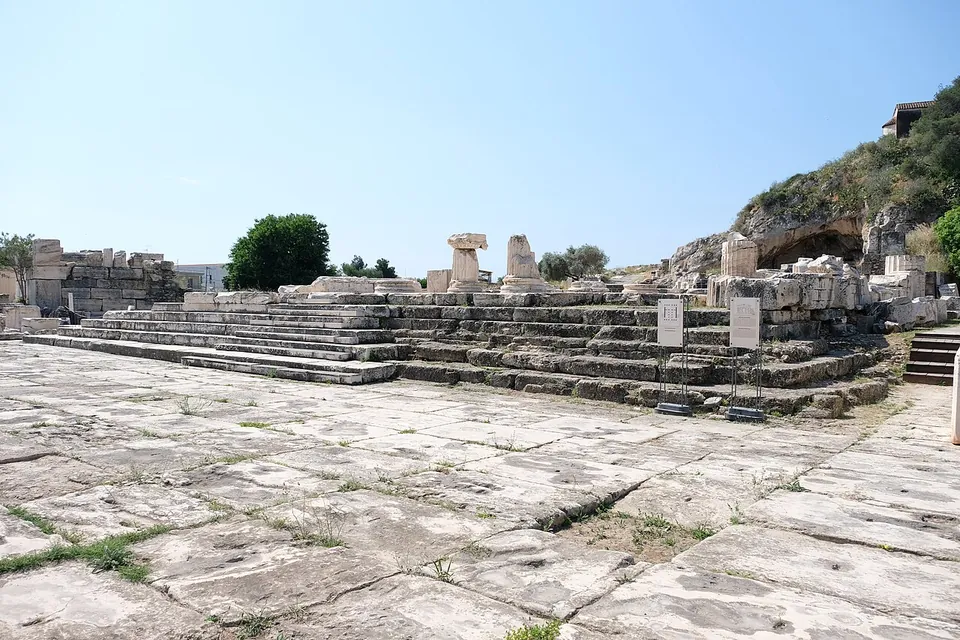
Photo: Davide Mauro · CC BY-SA 4.0 · Commons
18 km · site · West Attica
Eleusis
The visit follows the Processional Road, the end of the Sacred Way from Athens, through the Greater and the Lesser Propylaia to the Telesterion (the operator).

Straight-line distances.
Sources
Every fact on this page comes from the records below, each used under the licence noted.
| Source | Licence |
|---|---|
| Wikidata Q1760491 | CC0 |
| OpenStreetMap way/442128059 | ODbL |
| Wikipedia (en) — Philopappos Monument | CC BY-SA 4.0 |
| Wikipedia (de) — Philopapposmonument | CC BY-SA 4.0 |
| Wikipedia (it) — Monumento di Filopappo | CC BY-SA 4.0 |
| Wikipedia (en) — Philopappou (the hill and its neighbourhood) | CC BY-SA 4.0 |
| Wikipedia (en) — Achaia (Roman province) | CC BY-SA 4.0 |
| This is Athens (the City of Athens' official visitor guide) — Philopappou Hill, Pnyx, Hill of the Nymphs | licence not recorded |