

What is there today
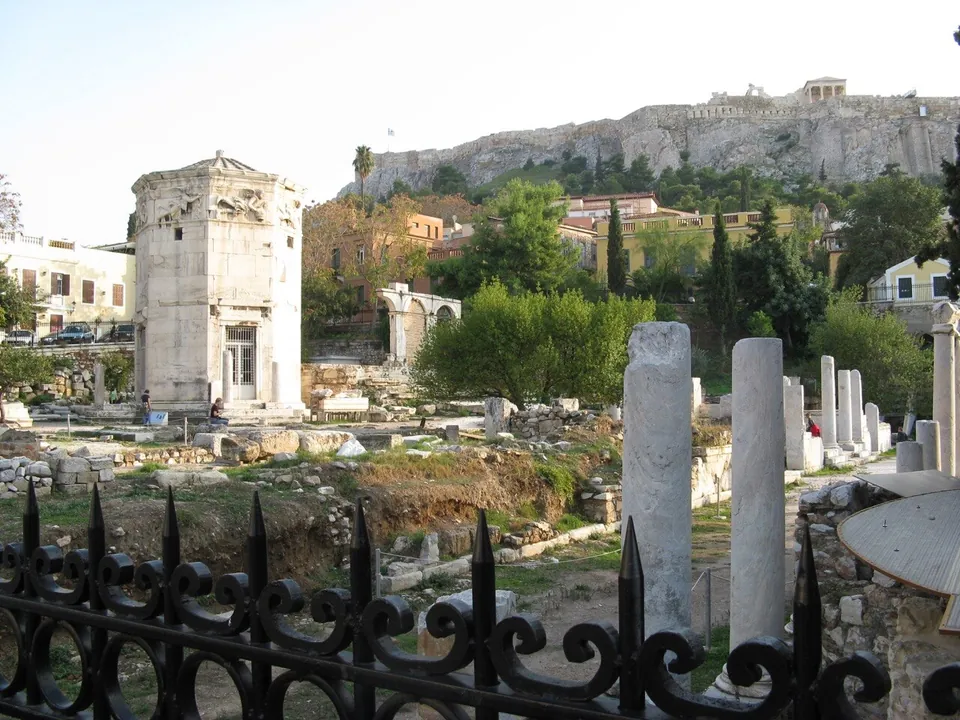
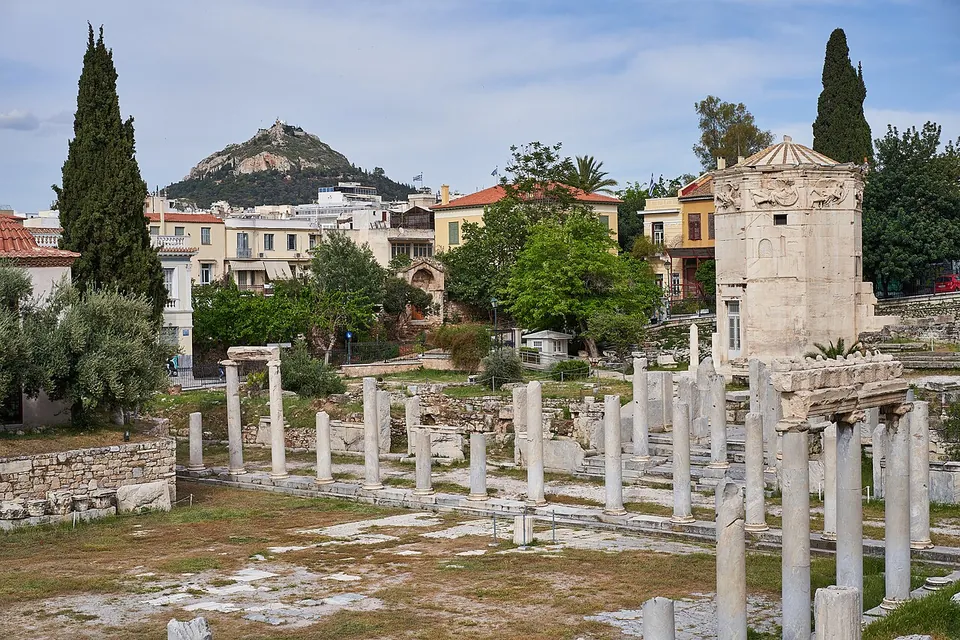
The Agora was a large rectangular courtyard surrounded by colonnades, shops and storerooms. Its paving of large marble slabs was laid in Hadrian’s reign, and some slabs carry texts of Marcus Aurelius, because they had been used for something else first. Only about half of it can be seen: the rest is still under the houses of the old town (the operator).
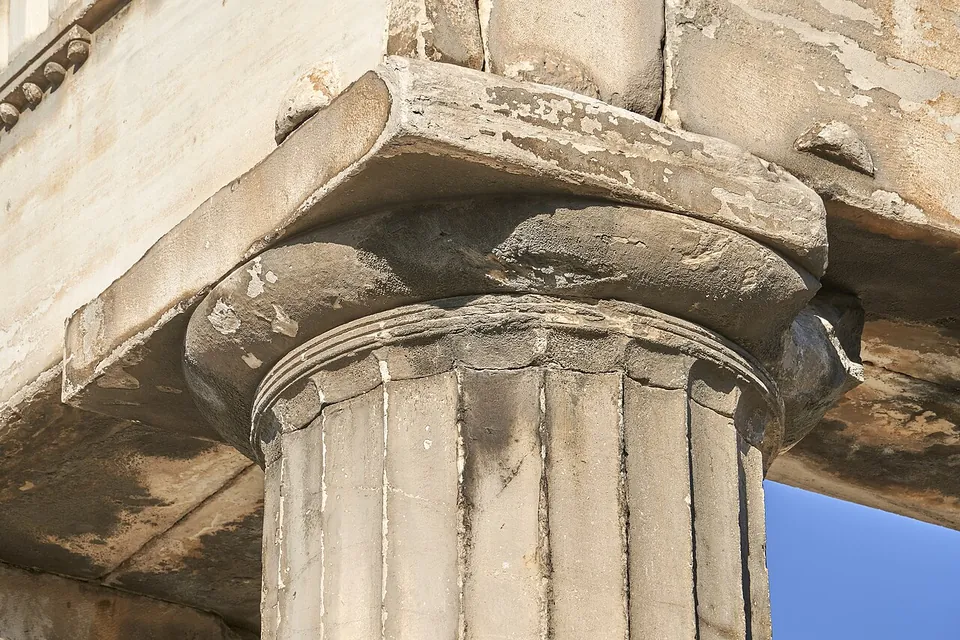
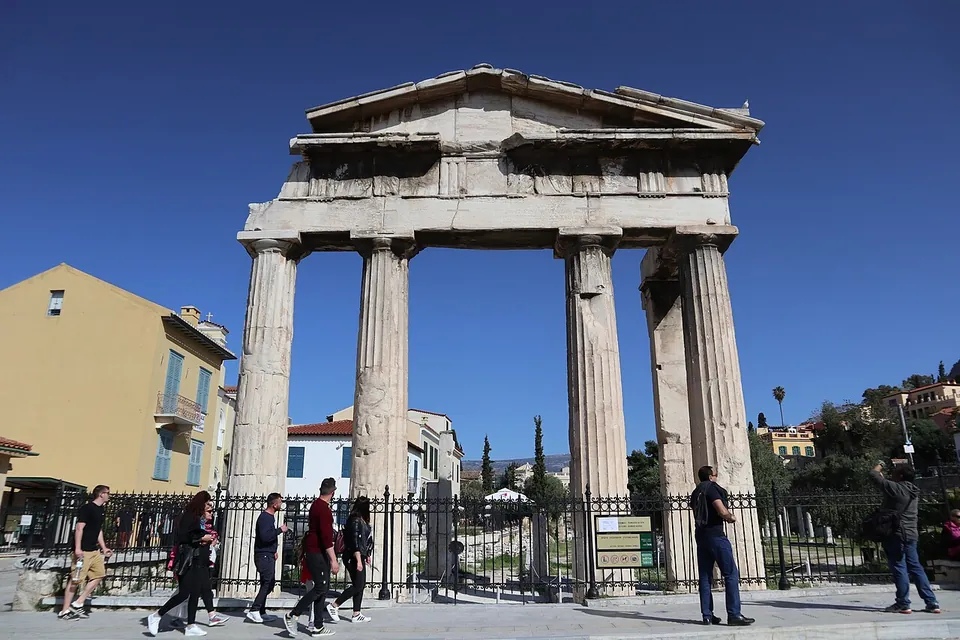
The Gate of Athena Archegetis, on the west side, still stands: four Doric columns and a pediment of Pentelic marble (the operator). It was built with gifts from Julius Caesar and Augustus and dedicated to Athena Archegetis in 11 BC (en.wikipedia; Pleiades gives 11/10 BC). A second gateway, to the east, is not in line with it and is built of a different material (the operator).
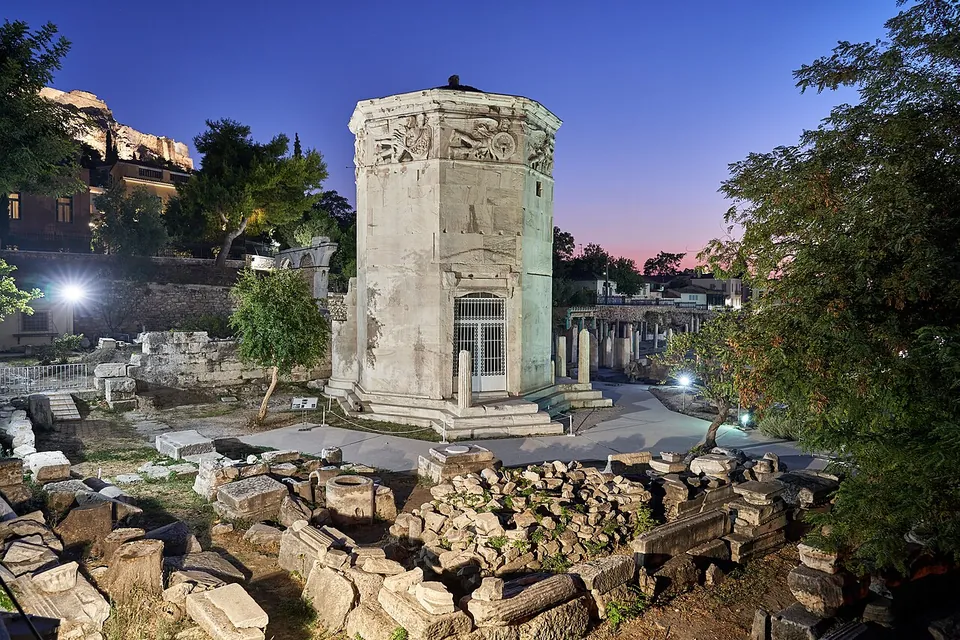
The Tower of the Winds is an octagonal tower of Pentelic marble, named after the eight reliefs of wind gods round its top. It was finished by about 50 BC at the latest, so it is older than the market around it. It once had a wind vane on top, a water clock inside and sundials on its faces: it is the only clock tower to survive from classical antiquity (en.wikipedia). It is 13 m high, and it is the best-preserved ancient building in Athens, because it never stopped being used - as the baptistery of an early Christian church and later as a prayer hall for the dervishes’ dance (de.wikipedia).
East of the Agora stand the arches of a building of the mid-1st century AD whose purpose is unknown; early 20th-century scholars wrongly took it for the office of the market inspectors (Pleiades). Wikidata also records ancient public latrines at the Roman Agora.
Is it worth the trip?
Yes, if you are in the old town anyway. It is small and quick to see, two minutes from Monastiraki metro and 150 m from Hadrian’s Library, so the two make one visit. The Tower of the Winds alone justifies the stop; the courtyard itself is a broad space of broken columns and paving rather than standing buildings. A ticket is €10.
Getting there
The site’s address is Dioskouron Street, two minutes on foot from Monastiraki metro station (lines 1 and 3); buses 025 and 026 stop at Monastiraki (the operator). There are toilets on site (the operator).
It opens daily from 08.00. From 1 April to 31 August it closes at 20.00; through September and October closing comes earlier in steps, to 18.00 in the second half of October; from 1 November to 31 March it closes at 15.00. Last entry is 20 minutes before closing, and the site is shut on 1 January, 25 March, 1 May, Easter Sunday and 25–26 December. A ticket is €10, reduced €5, and entry is free on 6 March, 18 April, 18 May, the last weekend of September, 28 October, and on the first and third Sunday of each month from November to March (hh.gr, read 9 October 2026 — check before travelling).
Visiting details
- Opening hours
- Daily 08.00–20.00 from 1 April to 31 August, then closing earlier through the autumn (19.30 in early September, 18.00 by late October); 08.00–15.00 from 1 November to 31 March. Last entry 20 minutes before closing. Closed 1 January, 25 March, 1 May, Easter Sunday and 25–26 December.
- Tickets
- €10; reduced €5. Free on 6 March, 18 April, 18 May, the last weekend of September and 28 October, and on the first and third Sunday of each month from November to March. Tickets online at tickets.hh.gr.
- Parking
- Paid parking is mapped about 130 m away (OSM way/294492617, fee=yes); Monastiraki metro station is two minutes on foot.
Hours and prices checked 9 October 2026 on the operator's own site. Confirm before travelling.
History
The Agora was built in the 1st century BC and may have taken over many of the commercial functions of the old Agora (Pleiades). The operator dates the project to 19–11 BC and says Augustus helped pay for it; an inscription on the gate records that the money came from Julius Caesar and Augustus (en.wikipedia; Pleiades: from the Julio-Claudians).
It then disappeared under the later town until only the gate showed. Many took the gate for a temple until the British architects Stuart and Revett read it correctly, from inscriptions about the taxes paid by oil merchants. Houses were demolished and a street cut off to dig the Agora out (the operator).
More photographs


Nearby
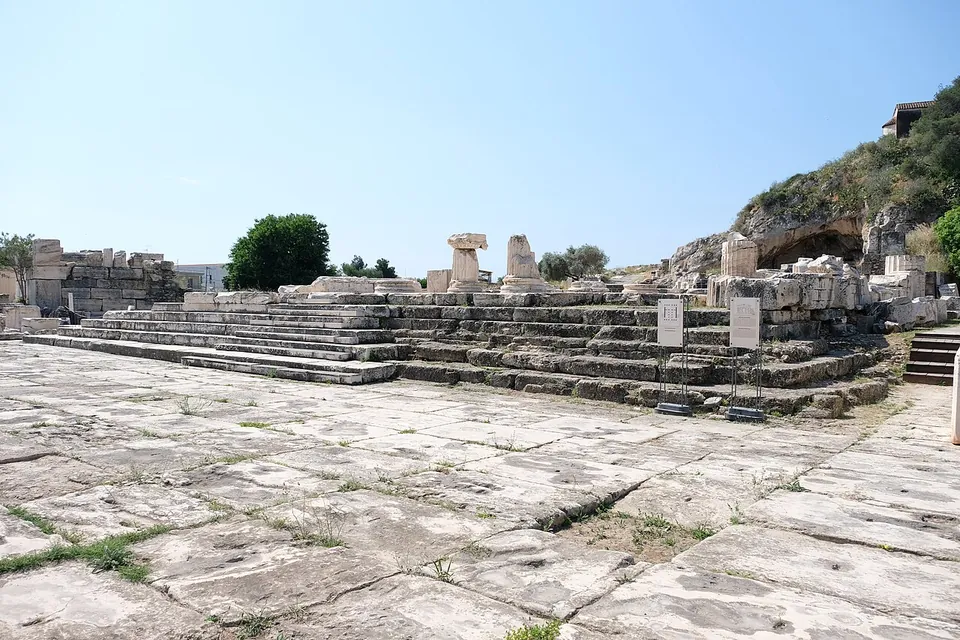
Photo: Davide Mauro · CC BY-SA 4.0 · Commons
18 km · site · West Attica
Eleusis
The visit follows the Processional Road, the end of the Sacred Way from Athens, through the Greater and the Lesser Propylaia to the Telesterion (the operator).

Straight-line distances.
Sources
Every fact on this page comes from the records below, each used under the licence noted.
| Source | Licence |
|---|---|
| Pleiades 773761100 | CC BY |
| Wikidata Q1435551 | CC0 |
| OpenStreetMap relation/11197557 | ODbL |
| Pleiades — Gate of Athena Archegetis | licence not recorded |
| Pleiades — Tower of the Winds | licence not recorded |
| Pleiades — Arcuated Building | licence not recorded |
| Wikidata — Vespasianae of Athens (Q24204307) | licence not recorded |
| Wikipedia (en) — Roman Agora | CC BY-SA 4.0 |
| Wikipedia (de) — Römische Agora | CC BY-SA 4.0 |
| Wikipedia (en) — Gate of Athena Archegetis | CC BY-SA 4.0 |
| Wikipedia (en) — Tower of the Winds | CC BY-SA 4.0 |
| Wikipedia (de) — Turm der Winde (Athen) | CC BY-SA 4.0 |
| Wikipedia (en) — Achaia (Roman province) | CC BY-SA 4.0 |
| Hellenic Heritage (H.O.C.R.E.D., for the Ministry of Culture) — Roman Agora of Athens, hours and tickets | licence not recorded |