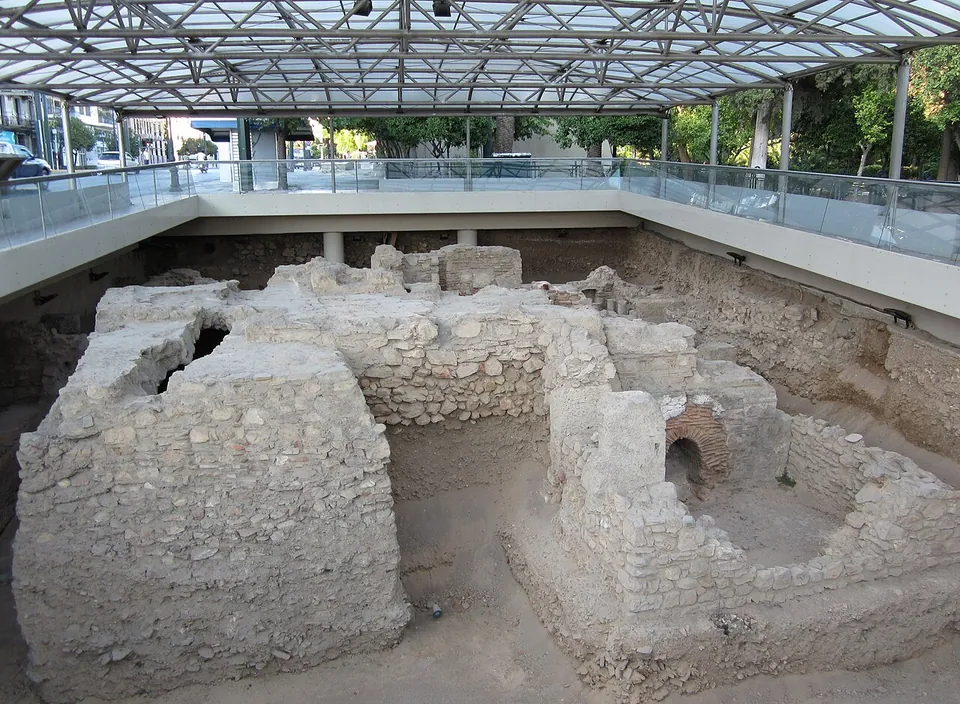


The Roman Baths at Zappeion are a late Roman bath house, built after the incursion of the Heruli at the end of the 3rd century AD and in use into the 6th, found during the building of the Athens metro and now shown under a glass roof beside Amalias Avenue, at the edge of the National Gardens (the Ministry). You can see them at any time from the pavement and from a path around them (the Ministry).
What is there today
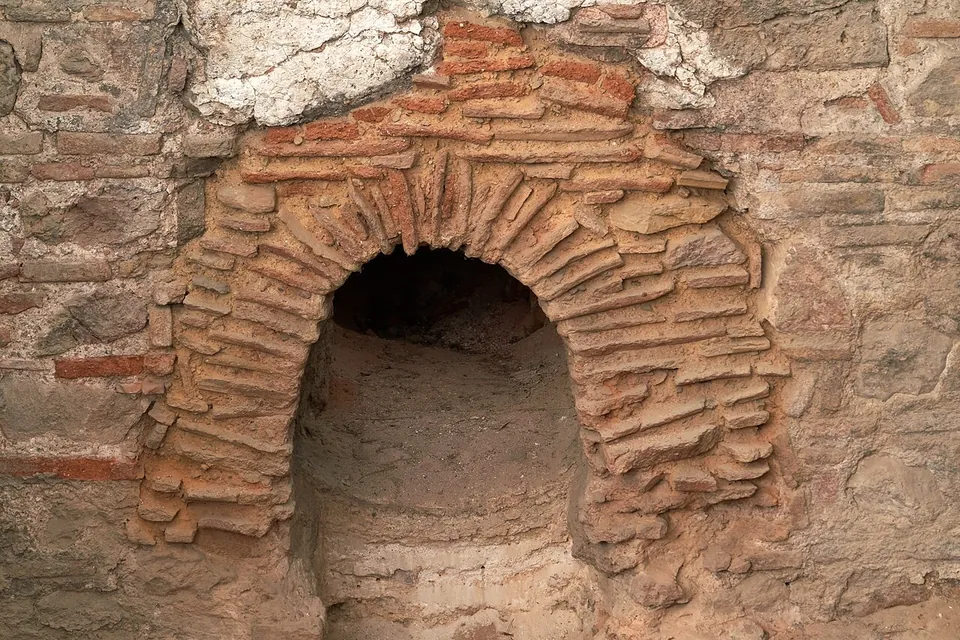
The bath house was so well preserved that the metro’s air shaft, which its discovery interrupted, was moved further south so that the remains could stay where they were found. It was conserved, roofed and opened to the public in 2003–2004 (the Ministry). What you see from the railings are the walls of the bath rooms in stone and brick, below street level under the modern roof (the photographs).
Is it worth the trip?
As a five-minute stop on the way between Syntagma Square and the Temple of Olympian Zeus, yes: it is seen from the street, at any hour (the Ministry; OpenStreetMap). It is not a destination in itself.
Getting there
The baths lie inside the National Gardens by the Zappeion, along Amalias Avenue (the Ministry). Buses and trolleys stop at “Zappeio” about 80 m away (OpenStreetMap). The site is always open, and the baths are seen from the avenue and from a path around them (the Ministry, read 9 October 2026).
Visiting details
- Opening hours
- Always accessible; the baths are seen from Amalias Avenue and from a path around them.
- Tickets
- Free
- Parking
- Inside the National Gardens by the Zappeion, along Amalias Avenue (the Ministry); bus and trolley stops "Zappeio" about 80 m away (OSM node/3162720298). A car park is mapped about 170 m away (node/3483488253), but in central Athens the metro or a walk is easier.
Hours and prices checked 9 October 2026 on the operator's own site. Confirm before travelling.
History
The area lay outside the city walls until Hadrian’s time and had been inhabited since prehistory and used for burials from the Geometric period. With its springs and thick vegetation it was a place of worship of many gods. When the city grew under Hadrian, with the completion of the Temple of Olympian Zeus and the building of Hadrian’s Gate, the area came inside the city, and new sanctuaries, houses, public buildings and baths were built. These baths followed the Herulian invasion of the late 3rd or early 4th century and were repaired and enlarged in the 5th and 6th centuries (the Ministry).
Nearby
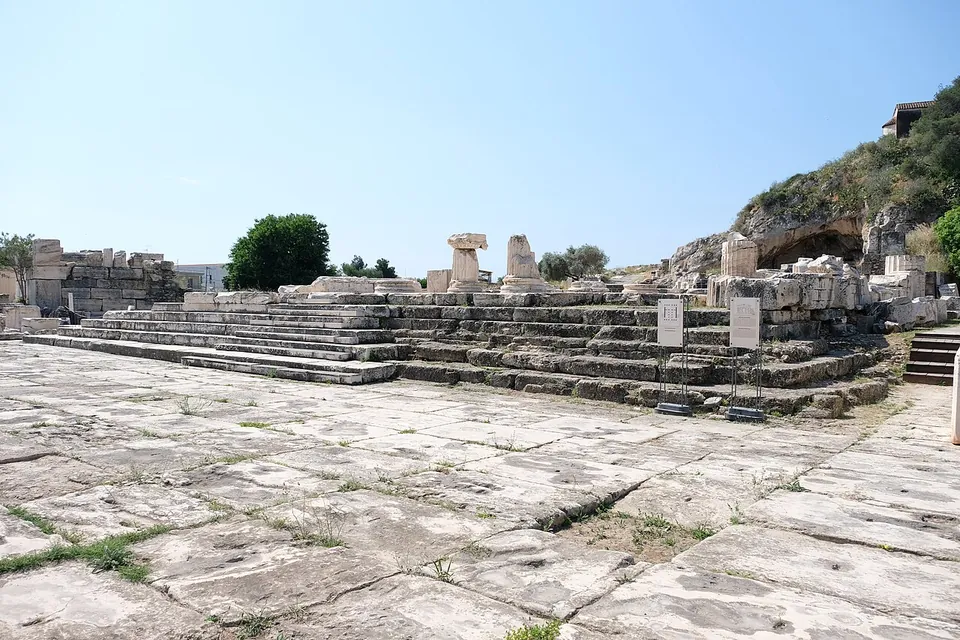
Photo: Davide Mauro · CC BY-SA 4.0 · Commons
19 km · site · West Attica
Eleusis
The visit follows the Processional Road, the end of the Sacred Way from Athens, through the Greater and the Lesser Propylaia to the Telesterion (the operator).

Straight-line distances.
Sources
Every fact on this page comes from the records below, each used under the licence noted.
| Source | Licence |
|---|---|
| Wikidata Q38279567 | CC0 |
| OpenStreetMap node/4267892358 | ODbL |
| Ministry of Culture and Sports (Odysseus) — Roman Baths at Zappeion | licence not recorded |
| Ministry of Culture and Sports (Odysseus) — Roman Baths at Zappeion, information | licence not recorded |
| Wikipedia (en) — Achaia (Roman province) | CC BY-SA 4.0 |