

What is there today
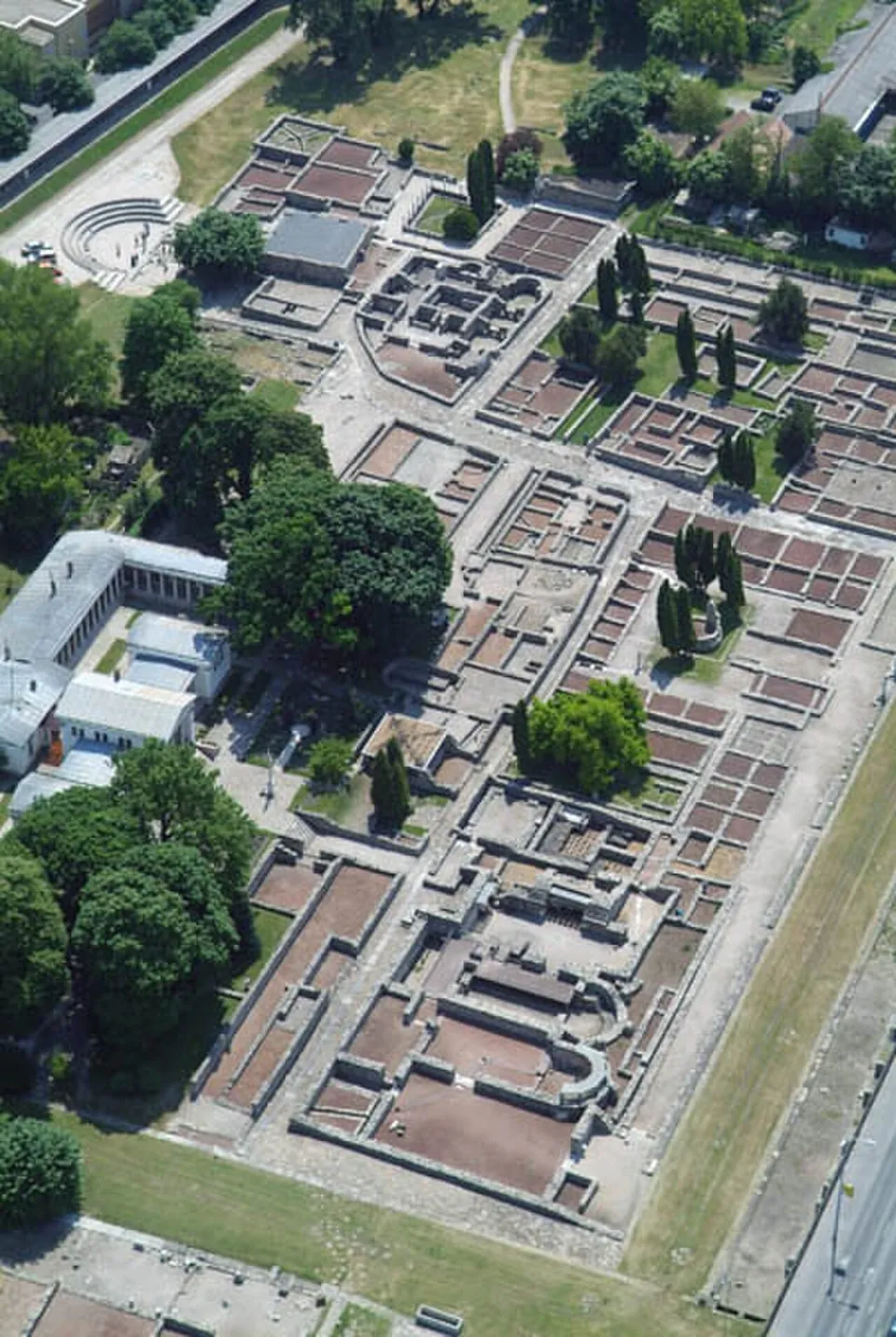
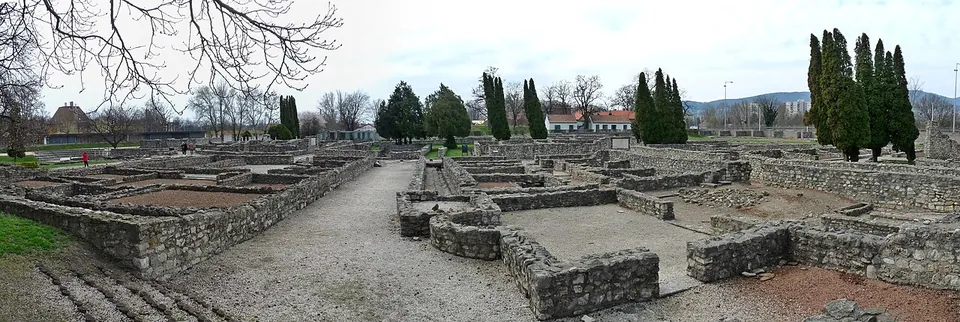
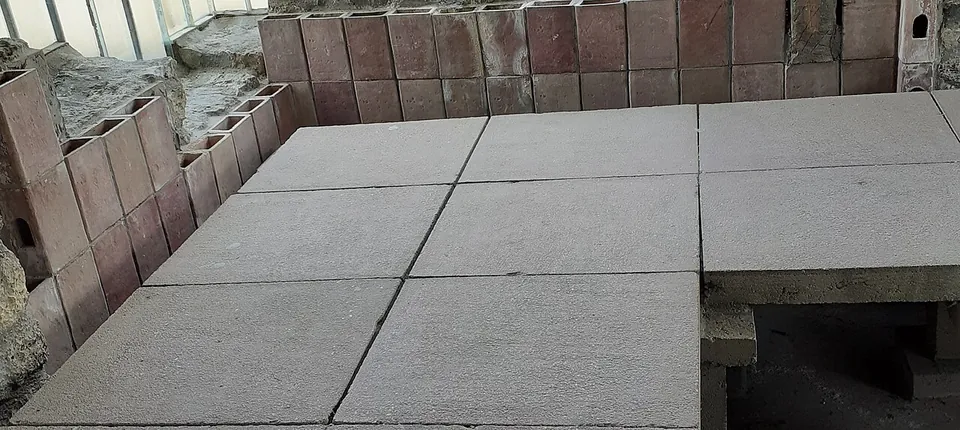
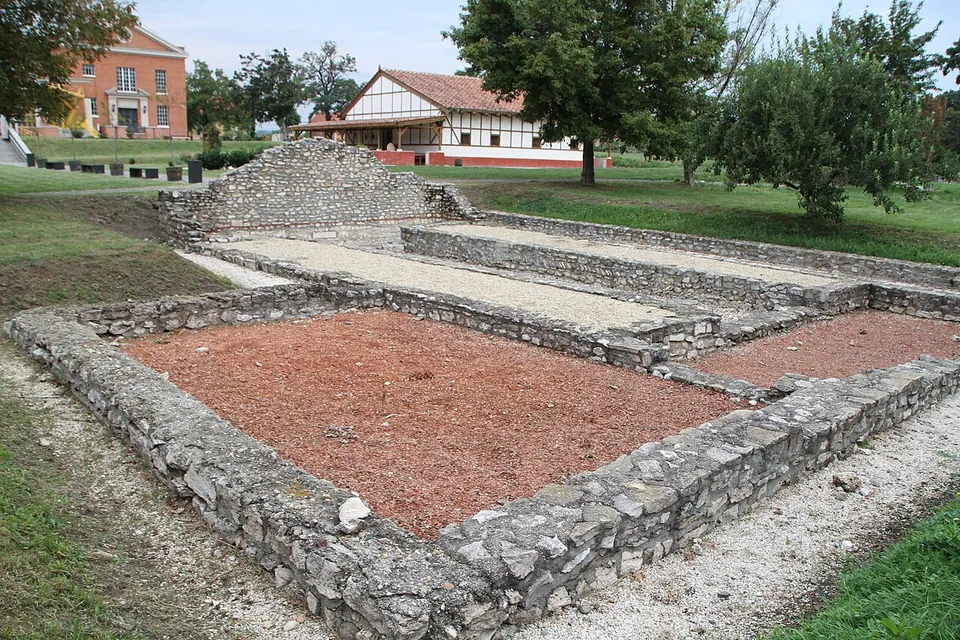
The park shows public buildings and private houses of the civil town from the 2nd and 3rd centuries AD, in a layout that follows the town’s plan (the operator). OpenStreetMap names, among others, the large public baths, the double baths, the meat market (macellum), the so-called houses of the butcher and of the merchant, and a group of craftsmen’s houses around a courtyard, and maps most of the walls at about a metre high. The museum building stands at the edge of the park, and stretches of the town’s aqueduct are mapped as ruins beside it.
About 400 m north of the park, at a road junction, stands the civil town’s amphitheatre (below).
Is it worth the trip?
Yes, if you are in Budapest. The operator calls it one of the largest Roman archaeological parks in Hungary, it is on a suburban railway line out of the city, and it is where you walk through the streets of a Roman town rather than past a single ruin. Know what kind of site it is before you go: a town plan in walls about a metre high, not standing buildings. From November to March the park opens only in dry weather, and the museum is closed every Monday.
Getting there
The museum is at Szentendrei út 135, in Budapest’s 3rd district. The H5 suburban railway (HÉV) stops at Aquincum and Kaszásdűlő, trains on lines S76 and Z72 stop at Aquincum station, and buses 34, 106 and 134 stop at Záhony utca. The museum’s car park is entered only from the gate on Záhony utca (the operator).
From 1 April to 31 October the archaeological park is open Tuesday to Sunday from 09.00 to 18.00 and the exhibitions from 10.00 to 18.00, with last entry at 17.30. From 1 November to 31 March both open Tuesday to Sunday from 10.00 to 16.00, the park only when the weather is dry, with last entry at 15.30. The museum is closed on Mondays. A ticket is 3,000 HUF, about €8.10; students, visitors aged 6 to 26 and pensioners aged 62 to 70 from the EEA pay 1,500 HUF, about €4.10, and children under 6 go free. A BHM+ pass at 5,500 HUF, about €14.90, covers every Budapest History Museum site for a month (aquincum.hu, read 4 October 2026; check before travelling, since prices move).
Visiting details
- Opening hours
- 1 April to 31 October, Tuesday to Sunday - archaeological park 09.00–18.00, exhibitions 10.00–18.00, last entry 17.30. 1 November to 31 March, Tuesday to Sunday 10.00–16.00, the park only in dry weather, last entry 15.30. Closed on Mondays all year.
- Tickets
- 3,000 HUF (about €8.10); 1,500 HUF (about €4.10) for students, visitors aged 6–26 and pensioners aged 62–70 from the EEA; free under 6. A BHM+ pass, 5,500 HUF (about €14.90), covers every Budapest History Museum site for a month.
- Parking
- The museum's car park is entered only through the gate on Záhony utca (the operator); OpenStreetMap maps further car parks about 170 m from the park.
Before you go
- Closed on Mondays all year.
- From November to March the archaeological park opens only in dry weather.
Hours and prices checked 4 October 2026 on the operator's own site. Confirm before travelling.
The civil amphitheatre
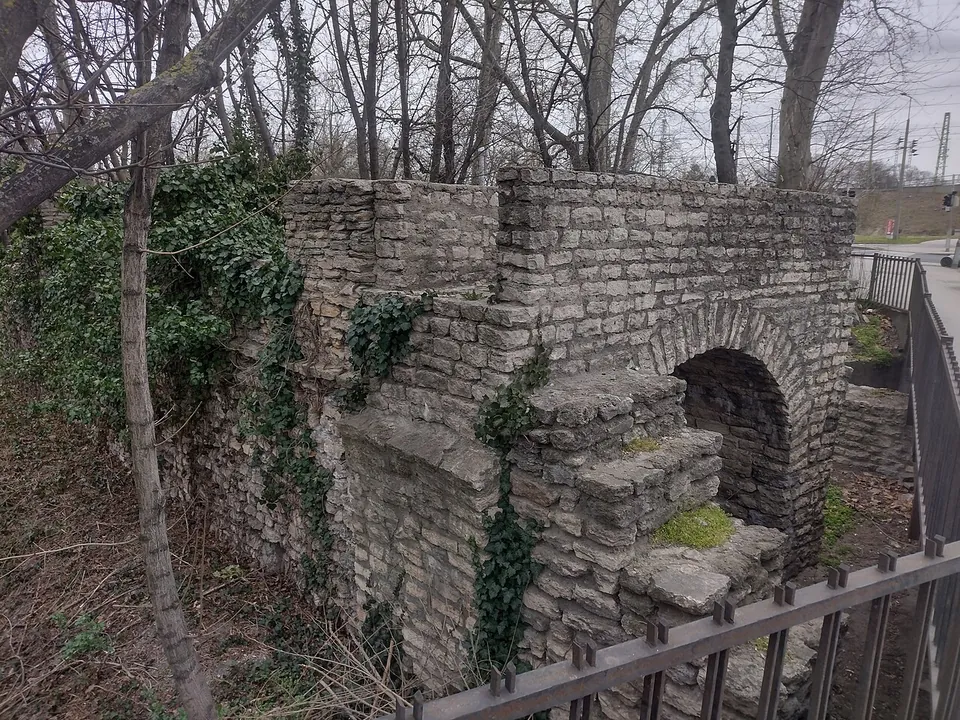
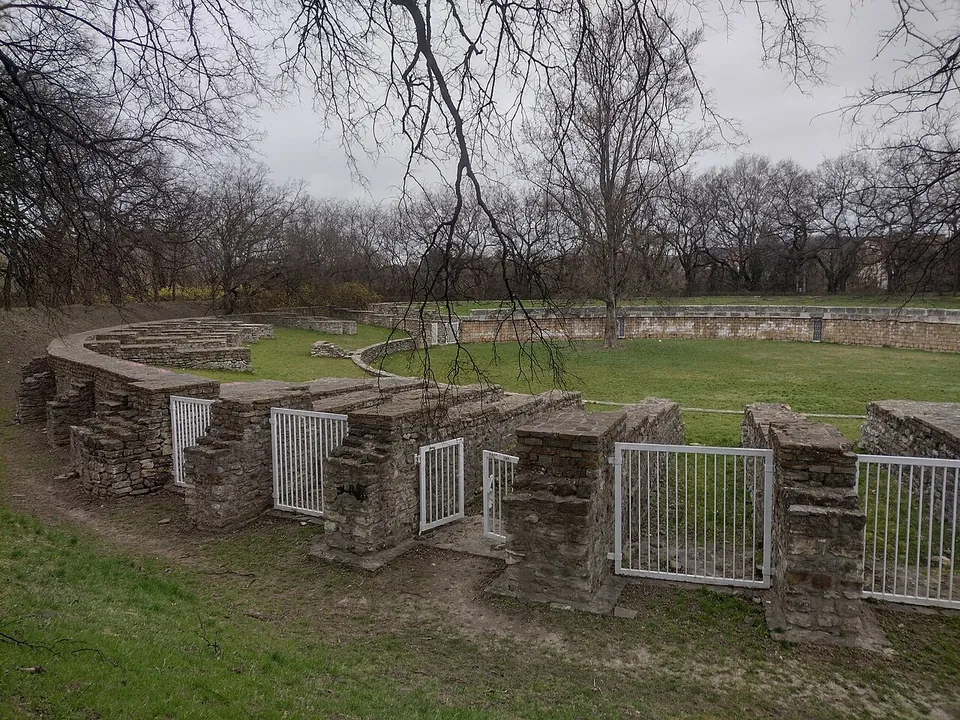
The smaller of Aquincum’s two amphitheatres stands outside the north wall of the civil town, at the junction of Szentendrei út and Zsófia utca (hu.wikipedia). It is nearly round, 86.5 by 75.5 m along its axes, and held about 6,000 to 7,000 spectators on stone benches set on rammed earth between two ring walls; some of the benches are carved with their owners’ names, and the stands were partly roofed (hu.wikipedia; de.wikipedia). Two gates on the east–west axis led into the arena, which was ringed by a 3 m wall, and beside the west gate stood a shrine to Nemesis, goddess of the games (hu.wikipedia). Published construction dates differ: the German and Hungarian articles put it in the 2nd century (the Hungarian before the middle of it), with several renovations in the 3rd, while the English article gives AD 250 to 300. Excavation began in 1880 under Károly Torma (hu.wikipedia). The larger military amphitheatre, 3.5 km south in Óbuda, has its own page.
The macellum
The market hall of the civil town is part of the archaeological park, its foundations conserved. It was built only in the mid-3rd century, a few decades before the civil town was abandoned, and it is one of Aquincum’s most unusual buildings, an example of a very rare type of Roman market hall (de.wikipedia).
The sanctuaries of Mithras
Aquincum had several sanctuaries of Mithras; published counts range from four (hu.wikipedia) to six (Wikidata). One, the Mithraeum of Victorinus, was built inside a townhouse (en.wikipedia), and Wikidata’s coordinates put it and a second sanctuary within 200 m of the museum.
History
Aquincum was the Roman forerunner of Budapest, on the Danube, which here formed the empire’s frontier (de.wikipedia). The site was first settled by the Eravisci (Pleiades), and the Roman garrison was founded around AD 89 on the right bank of the river, near a Celtic settlement (hu.wikipedia). From the late 1st century the place consisted of a legionary fortress and two separate towns, both called Aquincum: one grew up around the fortress, as often happened around Roman camps, while the other, further north, was legally independent of the army and received town rights early in the 2nd century, first as a municipium and later as a colonia (de.wikipedia). That northern town is the one in the park. For over two centuries Aquincum was the seat of the governor of Lower Pannonia, whose palace stood on an island in the Danube, and the roads that met here made it a hub of trade (de.wikipedia). Its heyday was the 2nd and 3rd centuries, and at the end of the 3rd it became part of the province of Pannonia Valeria (hu.wikipedia). The emperor Marcus Aurelius is believed to have written at least part of his Meditations at Aquincum (en.wikipedia).
The fortress lay around today’s Flórián tér, about 2.5 km south of the park, where OpenStreetMap maps its remains. Medieval chroniclers took the ruins for those of the legendary city of Sicambria. In 1778 a Swabian vine-grower in Óbuda came upon the remains of a Roman underfloor heating system while working, and István Schönvisner identified the find with Aquincum. Building work still turns up Roman remains, and the ancient settlement reached well beyond today’s ruin field, across the whole Buda side and into central Pest (hu.wikipedia).
More photographs



Nearby
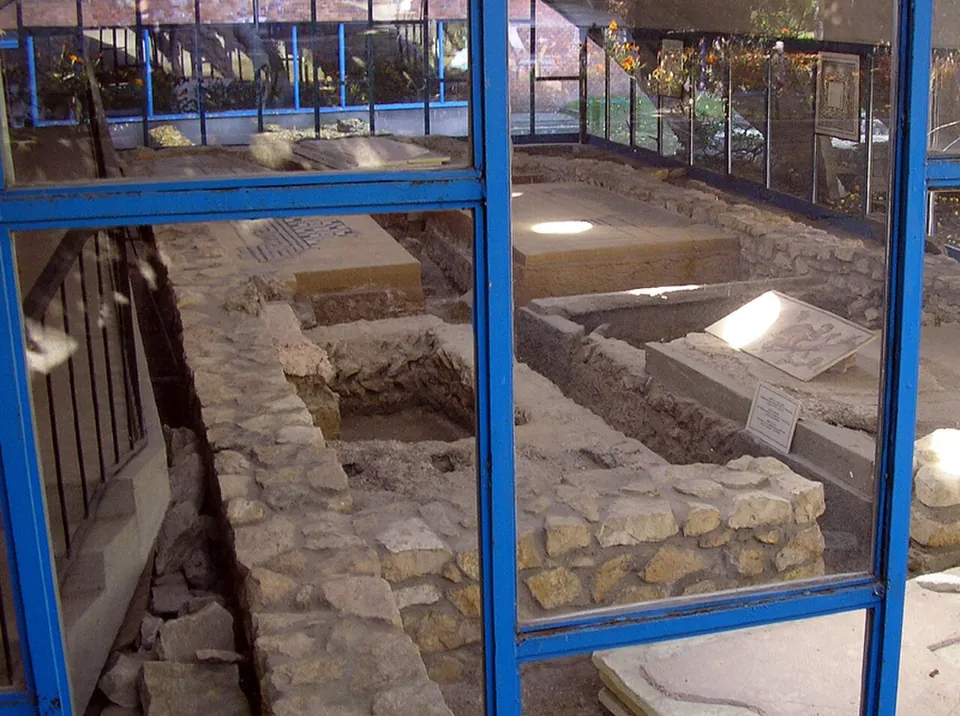
Photo: Vadaro · Public domain · Commons
2 km · villa · Budapest
Hercules villa
Three rooms with mosaic floors are displayed in a large protective building, some with geometric patterns and some with figures, and a separate building shows more mosaics; in the garden are late Roman stone coffin graves (the operator).
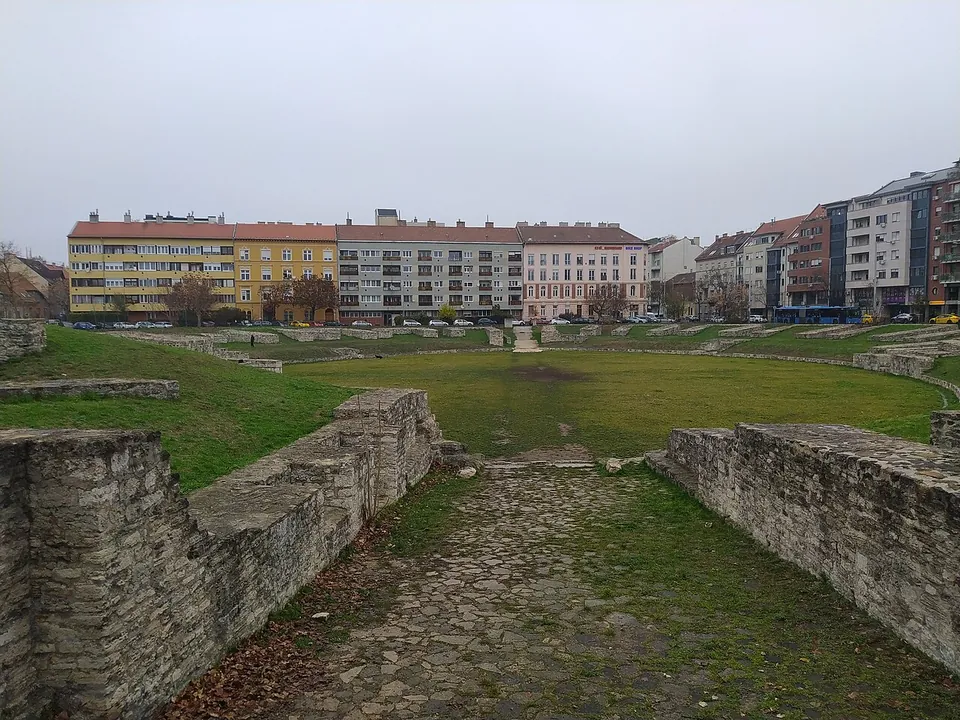
Photo: Envagyokabela · CC BY-SA 4.0 · Commons
4 km · amphitheatre · Budapest
Aquincum military amphitheatre
The building measures 131.9 by 108.4 m and is estimated to have held 12,000 to 13,000 spectators (de.wikipedia).
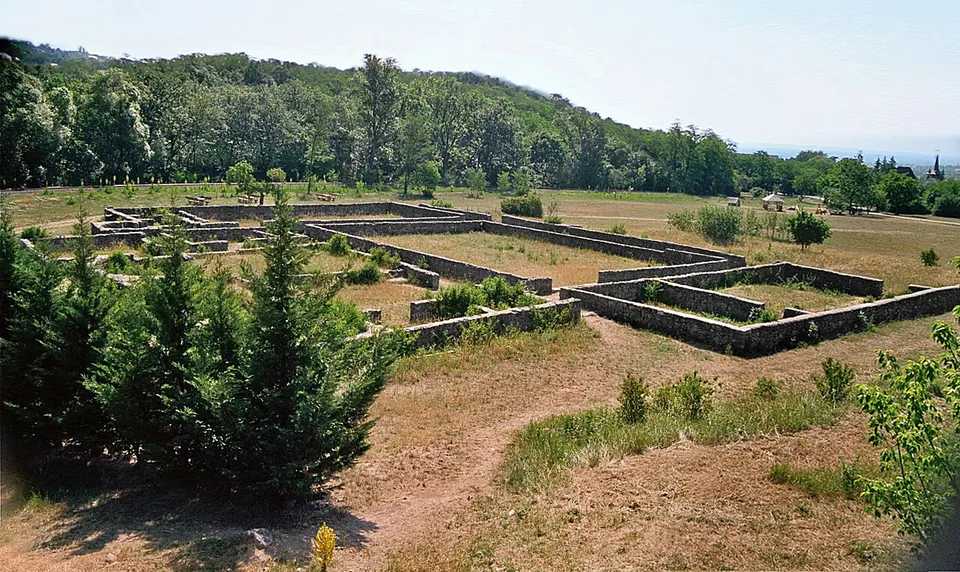
Photo: Mediatus · CC BY-SA 3.0 · Commons
14 km · villa · Pest County
Villa rustica of Szentendre-Skanzen
The foundations of the main building are almost completely exposed and open to visitors; they were conserved between 1981 and 1984 by an international building camp, after years of exposure to the weather (de.wikipedia).


Straight-line distances.
Sources
Every fact on this page comes from the records below, each used under the licence noted.
| Source | Licence |
|---|---|
| Pleiades 197130 | CC BY |
| Wikidata Q623345 | CC0 |
| OpenStreetMap way/369996830 | ODbL |
| Pleiades — Aquincum Castra (the legionary fortress) | licence not recorded |
| Wikipedia (de) — Aquincum | CC BY-SA 4.0 |
| Wikipedia (en) — Aquincum | CC BY-SA 4.0 |
| Wikipedia (hu) — Aquincum (történelmi település) | CC BY-SA 4.0 |
| Wikipedia (hu) — Aquincumi polgárvárosi amfiteátrum | CC BY-SA 4.0 |
| Wikipedia (de) — Amphitheater der Zivilstadt von Aquincum | CC BY-SA 4.0 |
| Wikipedia (en) — Aquincum Civil Amphitheatre | CC BY-SA 4.0 |
| Wikipedia (de) — Macellum (Aquincum) | CC BY-SA 4.0 |
| Wikipedia (en) — Aquincum Mithraeum (of Victorinus) | CC BY-SA 4.0 |
| Wikipedia (hu) — Mithrász-szentély (Fertőrákos) | CC BY-SA 4.0 |
| Aquincum Museum — opening hours (the operator, Budapest History Museum) | licence not recorded |
| Aquincum Museum — ticket prices | licence not recorded |
| Aquincum Museum — the archaeological park | licence not recorded |
| Aquincum Museum — getting there | licence not recorded |